This HFS Highlight is for CMOs, CAIOs, and CIOs evaluating Canva’s shift from design tool to AI platform and the enterprise stakes of recognizing it first.
A year ago, every CMO knew the pain points. Brand assets scattered across drives, content reviews stuck in email chains, marketing teams recreating the same collateral in fifteen variants. Canva walked into that pain and built a credible answer, and the CMOs who bet on it are seeing the payoff.
What most have not noticed is that Canva is no longer running the same platform. At Canva Create and Analyst Day, Canva announced that it has evolved from a design tool with AI features to an AI platform with design tools, with a 120-person research lab, proprietary foundation models, persistent memory, scheduled agents, and connectors to Slack, Gmail, Claude, and Drive. The CMOs who recognize the shift first run the conversation; everyone else inherits whatever it becomes without them. The bigger lesson: the next generation of enterprise AI platforms won’t all come from the incumbents you already buy from.
Last year, we noted that Canva was angling to become an enterprise content hub, not just a marketing-stack tool. The 2026 launch answered the question by changing the category: from app to platform, a hub for creativity, consistency, and brand. Among 40+ launches at Canva Create, the headline was Canva AI 2.0, an architectural rebuild:
These are not features bolted onto a pre-AI tool. They are the foundation of a platform built around how AI works, and that distinction explains a lot of what looks like a Copilot adoption problem. Microsoft and Google are using AI rollouts to retrofit purpose-built tools designed before AI existed: PowerPoint, Word, Teams, and Excel. AI on top makes the artifacts faster, but doesn’t change what the artifacts were designed to be in the first place.
Canva is doing the opposite, building AI solutions that are attuned to the audience that values creativity over constraint, where the campaign is the unit of work, not the file. A marketer briefs a product launch, and Canva ships the landing page, the deck, the social cuts, and the email, all from the same brand memory. PowerPoint with Copilot is not yet built to do this.
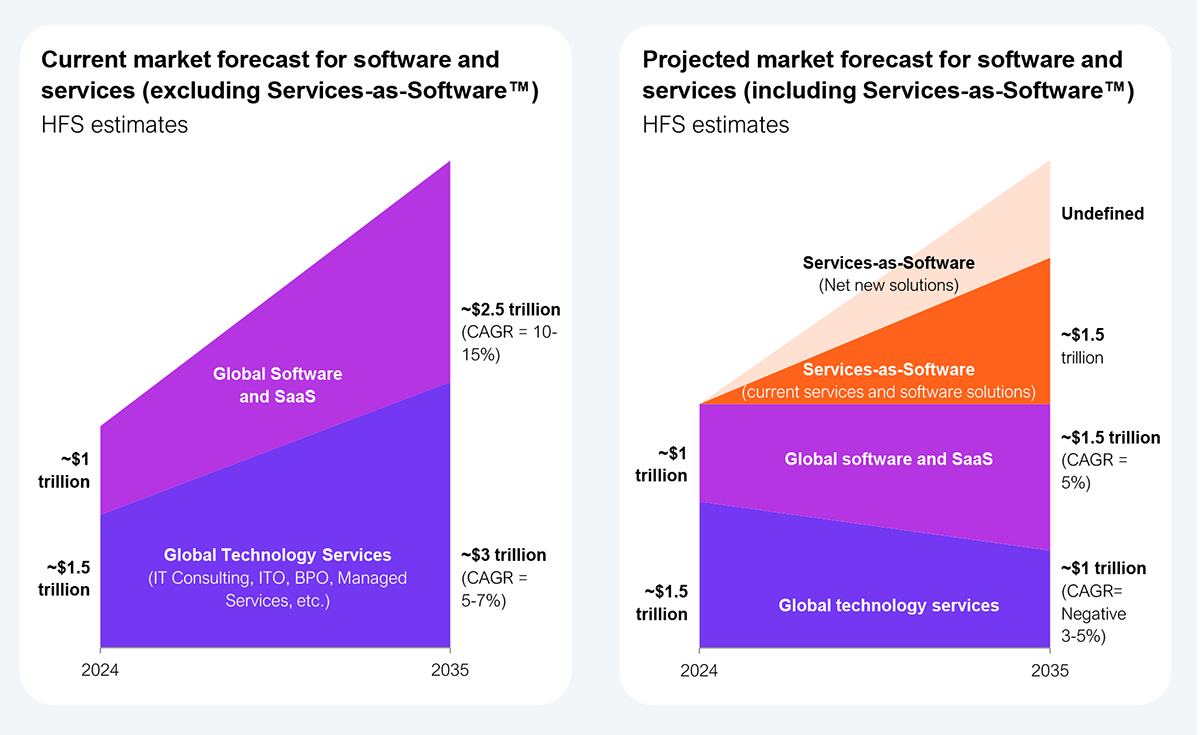
The Services-as-Software shift is the largest move we see in enterprise spend, and most productivity vendors are not built to capture it. AI-native platforms that deliver outcomes through consumption pricing are absorbing budget from both legacy software and services simultaneously, a shift that HFS estimates will reach roughly $1.5 trillion by 2035 (see Exhibit 1).
Adobe, Microsoft, and Figma all have credible claims on this category, and each has shipped real AI capability—but each is retrofitting AI onto a pre-AI franchise, and buyers who wait for them to finish will pay for the transition twice. Canva’s position rests on a different combination: a horizontal install base of hundreds of millions of non-designers already using the product monthly across marketing, sales ops, HR, and internal comms (Adobe and Figma are creative-team-bound, Microsoft sits in productivity); a web-native editor that the agent and connector layer fits onto naturally, without the desktop heritage Adobe is working around; and pooled consumption pricing that matches Services-as-Software economics rather than seats with metered add-ons. The agent stack is new, and the use cases are still emerging. But Canva can compete for them from inside the perimeter while other vendors are still selling their way in.
Source: HFS Research, 2026
Canva’s transformation is real on the technology side, but it’s still maturing on the go-to-market side. The platform is shipped, but the enterprise motion is still bottom-up: land through marketing, expand through creative teams, wait for the next generation of design-native employees to carry the platform up the org chart. That patient, generational approach has worked beautifully so far and built a remarkable enterprise footprint. The problem is timing. AI platform consolidation is moving faster than workforce turnover, and Microsoft, Google, and Salesforce are already pitching enterprise AI platform deals at the C-suite, with CIO and CAIO governance built into the conversation from day one.
Your next move is showing up where the platform decisions get made:
The platform capability is already there. Closing the gap between what Canva has built and how you buy turns a strong footprint into a defensible AI platform bet.
The Canva sitting inside enterprises in 2026 is closer to what comes next than to what most enterprises thought they were buying. CMOs who recognize the shift first run the conversation. The ones who keep classifying Canva as a design tool will spend the next eighteen months explaining to their CAIO why they kept buying incumbent AI while the platform that mattered was already inside their org.
Register now for immediate access of HFS' research, data and forward looking trends.
Get StartedIf you don't have an account, Register here |
With the exception of our Horizons reports, most of our research is available for free on our website. Sign up for a free account and start realizing the power of insights now.
Our premium subscription gives enterprise clients access to our complete library of proprietary research, direct access to our industry analysts, and other benefits.
Contact us at [email protected] for more information on premium access.