
The hard problem in enterprise AI is creating measurable business value across fragmented estates, constrained budgets, legacy environments, and siloed accountability. That problem lands hardest for CIOs, COOs, digital leaders, operations chiefs, and business transformation executives who are under pressure to modernize, cut cost, increase resilience, and show returns quickly, while their organizations still struggle to define where AI will create value.
At London’s “Hitachi Hour” (Hitachi Digital Services + Global Logic) analyst event, Hitachi executives were direct on two points. First, many large enterprises still do not know what they want to do with AI. Second, significant provider effort is still required to help clients identify use cases and quantify impact before scaling anything meaningful.
Such challenges provide the context for the GlobalLogic–Hitachi Digital Services combination into a yet to be named NewCo, with a new operating model and GTM for the AI age. The merged entity responds to the growing client frustration with fragmented delivery models where one provider builds, another modernizes, another runs operations, and no one fully owns the end-to-end outcome. It combines digital engineering, enterprise modernization, and run operations into a single “build, modernize, and scale,” model (see Exhibit 1), with AI embedded across all three. In line with HFS Services-as-Software™, this enables a shift from selling disconnected services towers toward a more software-like, integrated, continuously improving model that can be aligned to business outcomes versus labor inputs.
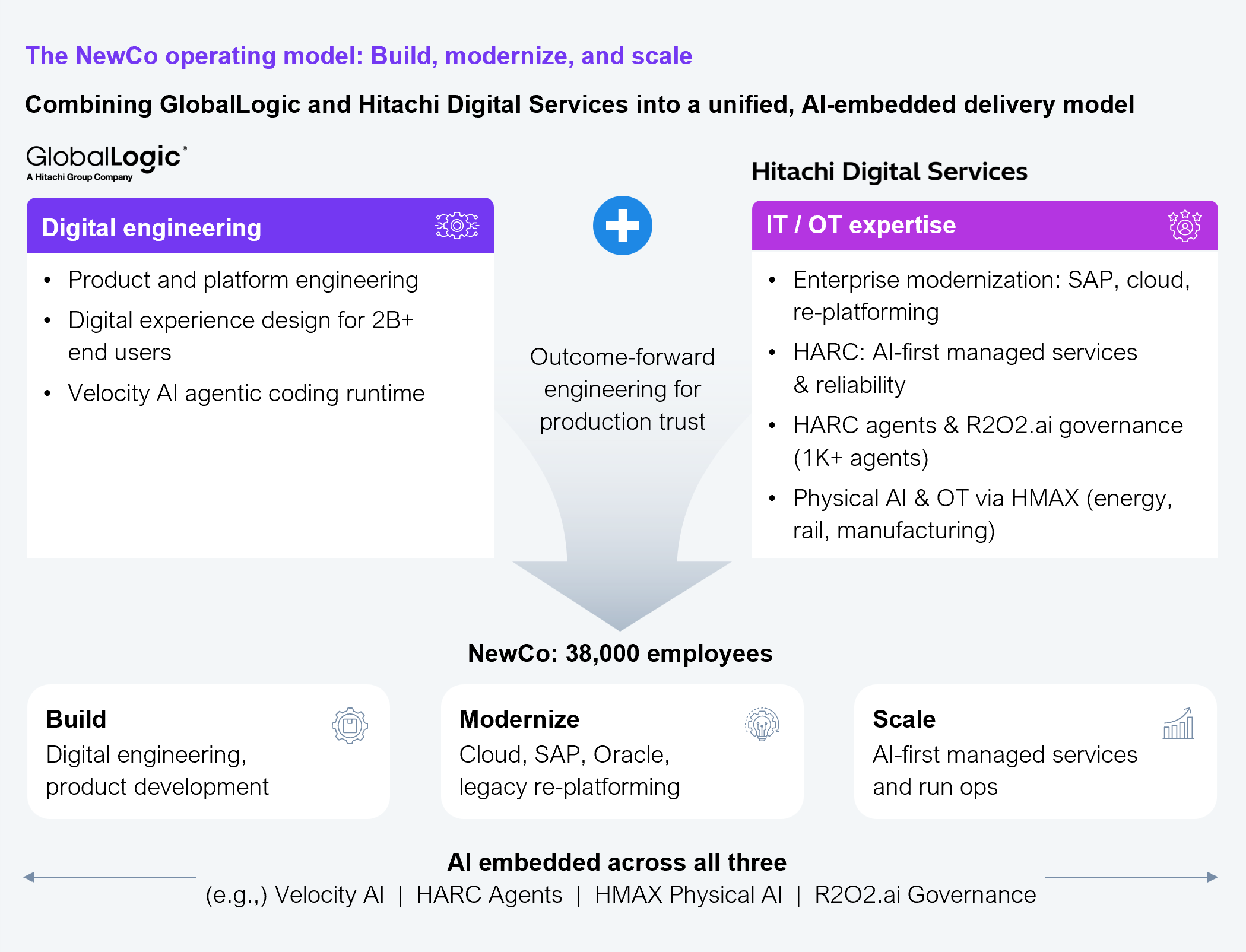
Source: HFS Research, 2026
The story becomes more convincing when it is attached to customer examples rather than architecture language. The following examples suggest that the combined firm is not just talking about AI enablement, but about embedding intelligence into operations, workflows, and industrial contexts where outcomes can at least begin to be measured.
The addition of what Prem Balasubramaniam, CTO and Head of AI at Hitachi Digital Services, calls outcome-forward engineering (OFE) is a twist on the hot topic of forward-deployed engineering (FDE). FDE is embedded with customers to adapt and operationalize technology in context. OFE is also engineering-first and embedded in a co-innovation model aimed at delivering measurable business and operational outcomes in mission-critical IT/OT/AI environments through outcome accountability and industrial domain depth. Where FDE scales delivery by placing people closer to the problem, OFE aims to scale outcomes by embedding intent, governance, and trust into systems built by AI.
Instead of just delivering code or integrations, the idea is to start with the desired outcome and engineer backward from that. Prem’s argument is that AI is changing software delivery so radically that coding itself is no longer the scarce capability. As models get better at generating code, the real differentiators become trust, fidelity, governance, validation, and production readiness.
The provider’s value thus shifts from supplying engineering hours to acting as a custodian of whether AI-generated systems are safe, scalable, resilient, and commercially useful in production, which are all essential for delivering repeatable outcomes at enterprise scale. This aligns with HFS’ Services as SoftwareTM direction, reframing delivery around governed orchestration, reusable intelligence, and operational assurance rather than effort-based software crafting.
The NewCo’s go-to-market shift will succeed or fail on whether it can make outcome-based commercial models in environments where customers still struggle to define and baseline value. This is the unresolved tension underneath an otherwise strong NewCo narrative. Providers want to price on outcomes. However, many enterprises are still buying discovery, de-risking, and capability building. Providers want to make themselves accountable, but that remains a challenge as customers still operate across legacy systems with fragmented ownership and uneven data foundations. Providers want to be paid on gains from AI. But customers remain cautious about how those gains are measured, governed, and therefore shared.
The Hitachi Digital Services-GlobalLogic NewCo is moving in the right direction and faster than many peers by aligning engineering, modernization, operations, and industrial domain depth into an outcome-led proposition. OFE sharpens it further by recognizing that in the AI era, trust is the product as much as the code. But customers must stay focused on the commercial realities.
The strategic story is now strong, and the customer examples show progress. But the NewCo must now demonstrate it can repeatedly translate this into scalable contracts where value is measurable, risk is shared, and outcome-based pricing is more than an aspiration.
Register now for immediate access of HFS' research, data and forward looking trends.
Get StartedIf you don't have an account, Register here |
With the exception of our Horizons reports, most of our research is available for free on our website. Sign up for a free account and start realizing the power of insights now.
Our premium subscription gives enterprise clients access to our complete library of proprietary research, direct access to our industry analysts, and other benefits.
Contact us at [email protected] for more information on premium access.


