
Rackspace used its Boston analyst event in April 2026 to launch a strategic pivot from infrastructure provider to the enterprise AI operator focused on real production. The shift involves connecting infrastructure, inference, data governance, and workflow execution in a single outcome-focused operational model.
This is much more than AI washing. The commercial traction is already visible: private cloud is expected to grow year over year for the first time in years, a meaningful inflection point that validates demand for governed AI infrastructure. But to build credibility at scale, Rackspace must now deliver outcomes.
The new positioning, supported by a curated ecosystem of partners (including the addition of Palantir and Uniphore), is aimed at fixing enterprise issues. Rackspace believes these issues stem from dislocated efforts to slap AI onto fragmented processes as well as from firms attempting to assemble point solutions from vendors focused more on selling than delivering the required enterprise outcome.
Rackspace is seeking to become your governed runtime for enterprise AI, focused on regulated and latency-sensitive sectors where private infrastructure, data gravity, resilience, and recovery matter most.
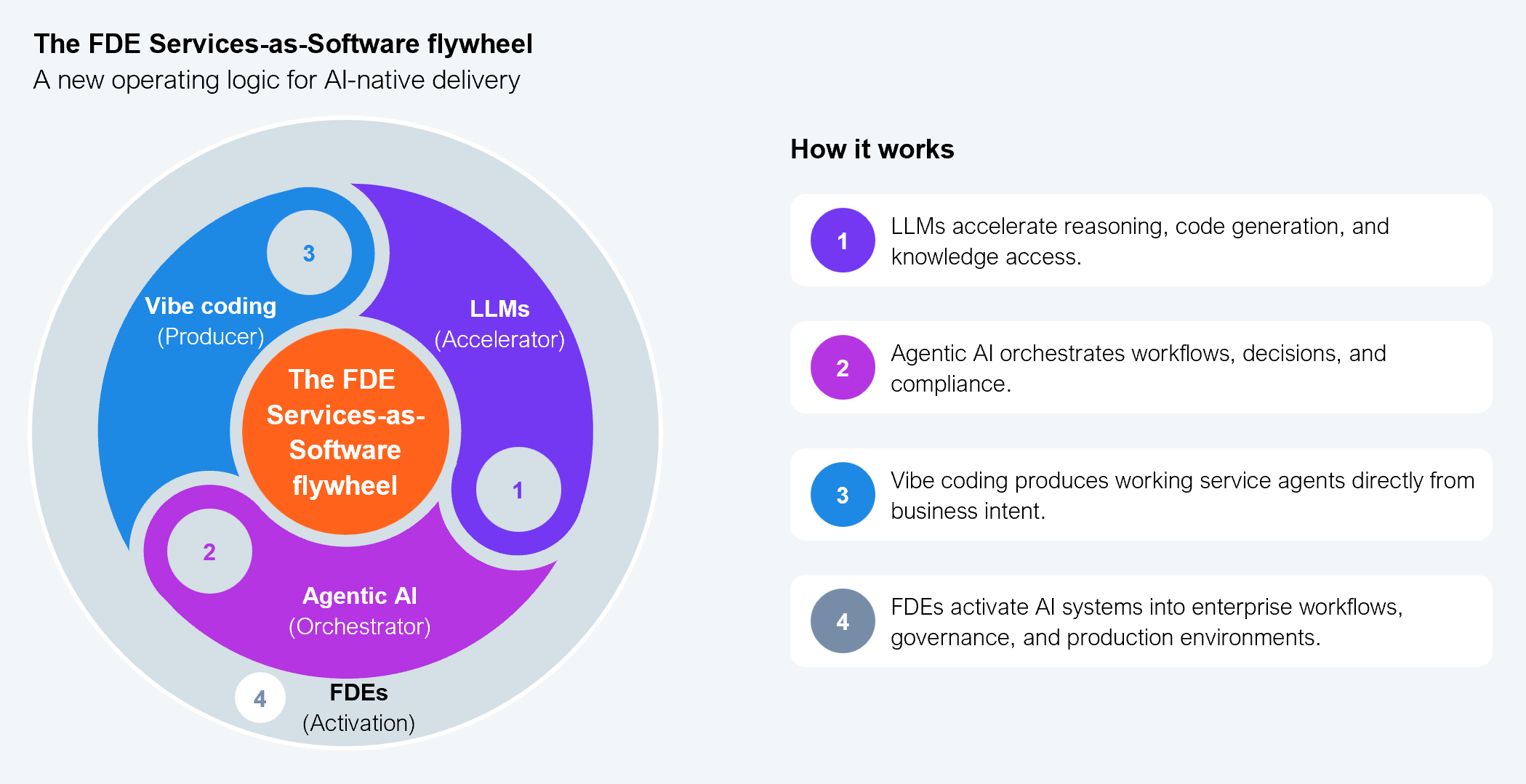
The partnership with Palantir, one of the five “commercial business partners” Palantir has committed to, delivers more than a brand halo of speed-to-outcome capability. It is at the core of Rackspace’s new operating model, emphasizing forward-deployed engineering (FDE; see Exhibit 1), the power and value of ontology in supporting AI that works in enterprise settings, proof-led selling to end the pilot purgatory trap, and rapid workflow redesign to get to outcomes fast.
The company has already trained more than 200 people on the Palantir platform, supported by capability-scaling AI agents to speed up delivery and contain costs. It isn’t reselling Palantir, but rather changing how it builds and delivers services as repeatable AI-led software.
Source: HFS Research, 2026
Where Palantir enables Rackspace to offer an ontology-heavy, workflow-centric transformation approach, Palo Alto-based Uniphore complements with an inference, orchestration, a small language model (SLM), and a data-preparation layer. Tied to Rackspace’s operational footprint (complete with core business applications, cloud platforms, core infrastructure, and edge-to-core-to-cloud capabilities), the offer becomes a coordinated curated stack for enterprise enablement.
Most global system integrators (GSIs) help define the transformation, map processes, and integrate tools. Fewer claim deep responsibility for the runtime itself, including the private cloud, proximity of compute to data, resilience model, operational monitoring, and governed run-state over time. Rackspace argues that for industries such as healthcare and financial services, these are important concerns.
Customer conversations at the event offered validation. In healthcare, resilience and recoverability remain table stakes before AI can scale. In banking, explainability, auditability, and cost control are just as important as model performance. Rackspace’s pitch is that its operational model aligns more closely with those enterprise realities than a typical advisory-led services model.
Much of the new Rackspace story is promissory. For now, outcome-based contracting remains more aspiration than commercial reality. And while early wins and a solid deals pipeline look positive, the company must show that the new operating model can scale beyond a handful of lighthouse engagements and partnership announcements. Treating itself as customer zero for its Palantir partnership will build credibility. Rackspace is targeting 70% of its back-office processes for AI transformation within 12 months.
Right now, some of the most distinctive elements in the story come from Palantir’s delivery model and Uniphore’s technology stack. Rackspace must make those operationally unique and commercially durable, all while shaking up its own culture with newly established leadership hires. It’s no small task and comes with ambitious self-imposed timelines to demonstrate impact.
To succeed, Rackspace must remain disciplined in its growth ambitions. It will benefit customers most when it stays focused on use cases where its combination of runtime, governance, and engineering density really matters.
Customers must pay close attention to progress in the next 9–12 months. More partnerships and more deals may demonstrate the pivot is gaining early traction. But to prove this makes AI work at scale in the enterprise, demand evidence of the outcomes delivered.
Register now for immediate access of HFS' research, data and forward looking trends.
Get StartedIf you don't have an account, Register here |
With the exception of our Horizons reports, most of our research is available for free on our website. Sign up for a free account and start realizing the power of insights now.
Our premium subscription gives enterprise clients access to our complete library of proprietary research, direct access to our industry analysts, and other benefits.
Contact us at [email protected] for more information on premium access.


