
This HFS Hot Tech report on Aokah is for GBS leaders, CIOs, and enterprise transformation executives evaluating AI-native platforms to set up and scale global capability centers.
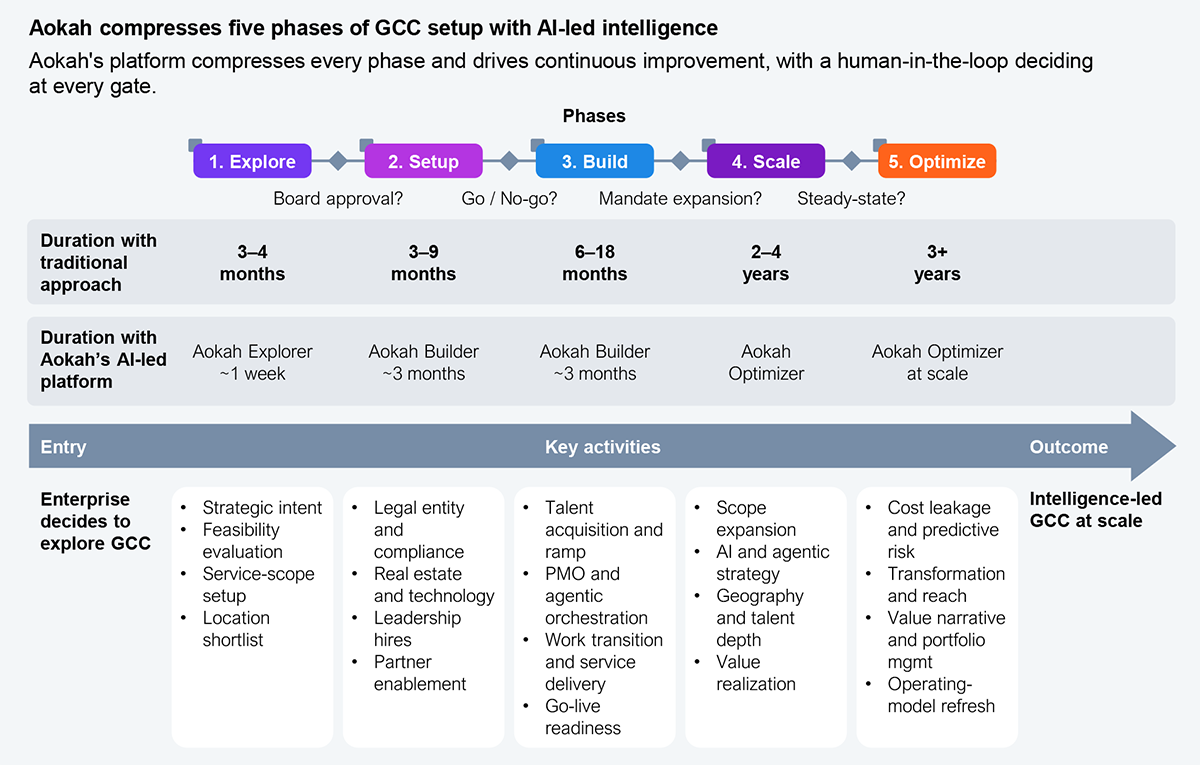
The global demand for global capability centers (GCCs) has grown rapidly, with more than 1,800 GCCs in India alone and additional growth in LATAM, Eastern Europe, and Southeast Asia. Yet GBS leaders still set up GCCs through bespoke, weeks-long consulting engagements, resulting in enterprise demand outrunning consulting capacity. More than 72% of new GCC builds experience material delays or cost overruns within their first 24 months. Aokah is one of the first vendors to address this bottleneck by leveraging generative AI (GenAI) and agentic AI to build a Services-as-Software™ model through a software-led servitization approach (see Exhibit 1).
Aokah’s model is built on proprietary data and proven methodology to deliver CXO-ready decisions. Aokah started its Services-as-Software journey with an AI-enabled recommendations engine and plans to expand into agentic workflows across the GCC lifecycle. This AI-native approach to GCC services makes Aokah worthy of the HFS Hot Tech vendor designation.
Location assessment has been a manual, context-driven process for consultants, taking 6–12 weeks to develop actionable recommendations. Aokah is disrupting this layer with its data-rich offering, providing instant, AI-enabled recommendations based on the parameters and weightings provided. Additionally, Aokah has launched its Explorer and Builder offerings and is developing the Optimizer element to address the entire value chain. It has mapped the user journey for setting up GCCs to its offerings, making it reusable whenever GBS leaders want to repeat the process to open new function lines or geographies.
Source: HFS Research, 2026
The platform is based on five knowledge foundations or “Wisdoms” (program, geo, talent, ecosystem, and delivery), providing a unified system of decision support, execution governance, and real-time risk management across the five phases of the GCC lifecycle, shown in Exhibit 1. The Explorer offering is anchored by Aokah’s location intelligence module (geo “wisdom”), which covers cost, talent depth, infrastructure, risk, ESG, and ecosystem signals across 500+ global cities. Users set their own parameter weights, such as for AI/ML talent density, operating cost, and geopolitical risk, and the platform returns a ranked shortlist with supporting evidence, replacing the slide decks consultants typically hand-build.
The Builder offering, now generally available as of April 2026, covers GCC setup playbooks for entity structuring, role architecture, hiring plans, and vendor selection, powered by agentic workflows that draft artifacts for a program manager to edit rather than authoring them from scratch. Builder serves as an independent orchestration and governance layer across every workstream, including legal entity formation, talent acquisition, vendor onboarding, facilities, IT, and compliance, regardless of whether the enterprise is building independently, through a build-operate-transfer partner, assisted build, or hybrid model. The Optimizer offering will launch soon to target running GCCs: productivity benchmarking, span-of-control analysis, and process-automation candidates surfaced from operational data.
At one Fortune 500 chemical manufacturer, the head of GBS used Aokah Explorer during site selection to stress-test locations and weightings in real time, clearing the CFO’s scrutiny on costs and choices. He compressed initial location shortlisting from 10 weeks of consultant output to less than a week using real-time information. This exercise helped him reconcile anecdotal consultant preferences (including known traps like high-attrition markets) with objective data. Such use cases have made the Aokah Explorer the most impactful offering in Aokah’s suite today.
In addition to this successful implementation, three global enterprises in consumer goods, diversified manufacturing, and logistics are already using Aokah Explorer and Aokah Builder in live programs, providing early validation across multiple verticals.
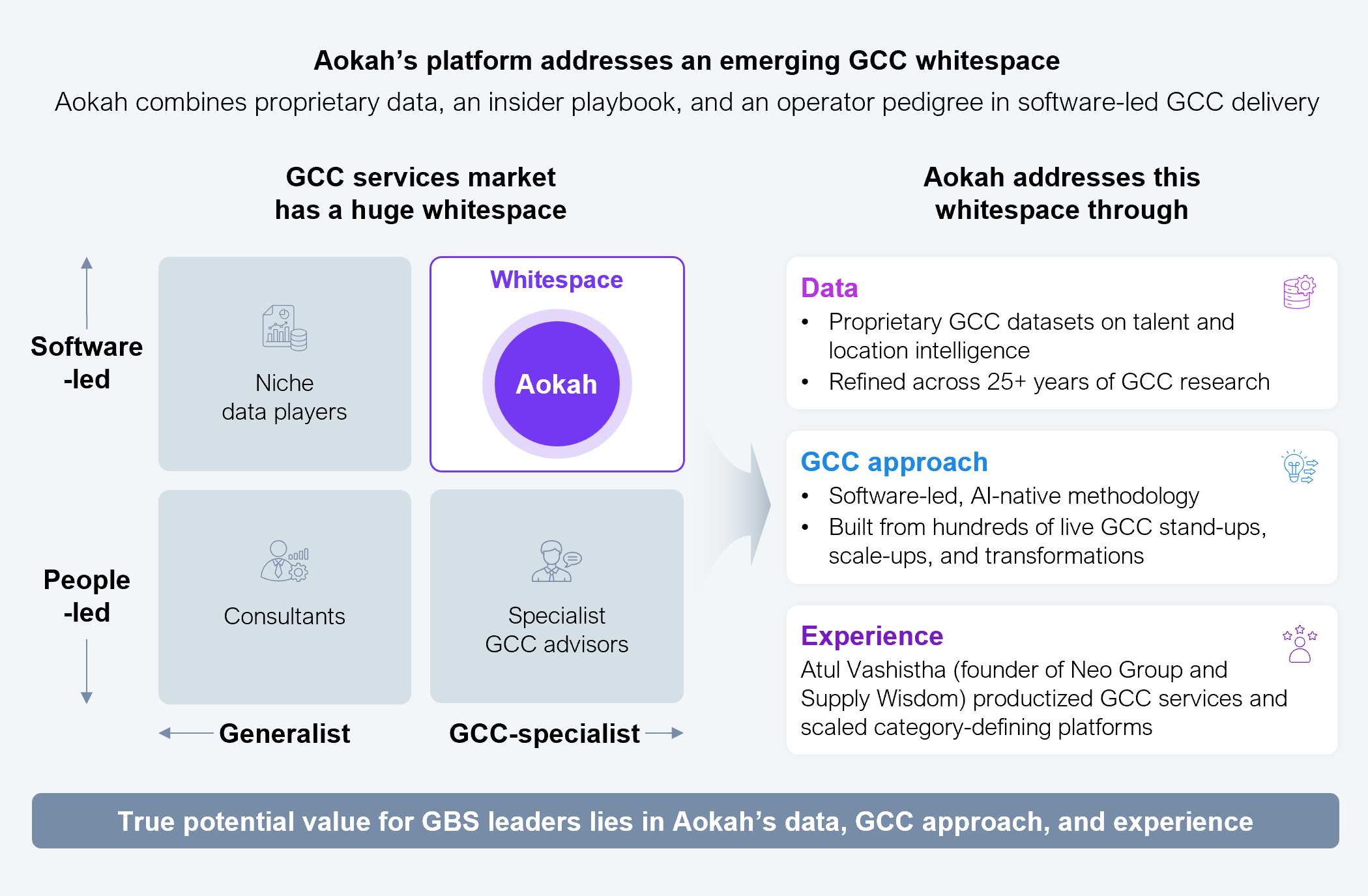
Aokah Founder Atul Vashistha has spent more than 25 years in the GCC services industry, building Neo Group and Supply Wisdom, and has received several leadership accolades as a result. That experience gives the team an early read on where AI-led services can compress the value chain and provides a deep well of data and codified methodology from 300+ enterprise GCC programs. Competitors may build similar tooling, but Aokah’s data, approach, and experience will be difficult to match.
Source: HFS Research, 2026
Adjacent data players overlap on inputs but don’t assemble a GCC-specific decision product. Aokah’s bet is that owning the GCC decision workflow end-to-end is more defensible than competing on any single data point.
While advisory incumbents and GCC specialists maintain the right relationships for CXO decision advisory, their delivery relies on a people-intensive approach. The ideal option for GBS leaders is an advisory incumbent that productizes its GCC data-rich assets or a horizontal AI consulting platform that extends into AI-native GCC use cases. Aokah is following this approach, but it needs to lock in proprietary data feedback loops and partner channel relationships to build a sustainable lead in this whitespace.
As data-heavy services are productized into software, enterprises should expect Aokah to sit in the middle ground between them. CXOs still require relationship-building and trust-led advisory after data-led evaluations to make monumental decisions.
Enterprises will see Aokah through a mix of service partnerships and direct engagements. Through consulting partners, client-specific data feeds into recommendations more quickly. Engaging directly, the platform lets the enterprise stress-test any hypothesis and gain reassurance when making final calls.
Aokah is also being white-labeled by consulting and research firms, meaning GBS leaders may be using the platform without realizing it is the underlying engine. If your consulting partner is delivering location intelligence or building playbooks under their own brand, it is worth asking which platform underlies it to evaluate the underlying data quality and avoid paying a markup for the same engine you could license directly.
Additionally, Aokah has also begun executing on geographic expansion. In January 2026, it launched UK operations to support EMEA enterprises designing new GCC strategies and scaling performance with governance and measurable outcomes.
The market for GCC setup advisory is shifting from a consulting-led, weeks-long decision cycle to a data- and AI-led, hours-long one. Aokah is the early leader in this shift. The Explorer offering has already compressed a 10-week consulting deliverable into less than a week for a Fortune 500 buyer, a rare proof point in a category where most vendors are still pitching roadmaps.
With Aokah Builder now live and the Optimizer offering’s agentic-first design on the roadmap, Aokah is evolving from a point solution into the agentic system of record for GCC decisions. Buyers who engage Aokah early will compress decision cycles, de-risk location and org-design choices with evidence, and free internal teams and consulting partners to move up the stack into advisory and change management.
The vendor that owns this transition will set the reference architecture for the next decade of capability centers.
HFS Hot Tech organizations display truly differentiated offerings and out-of-the-box thinking that can be inspiring and useful. This report profiles one of the HFS Hot Techs selected through our rigorous five-step assessment. The HFS Hot Tech designation remains in place for one calendar year. Every Hot Tech joining our program remains listed on our exclusive and searchable database.
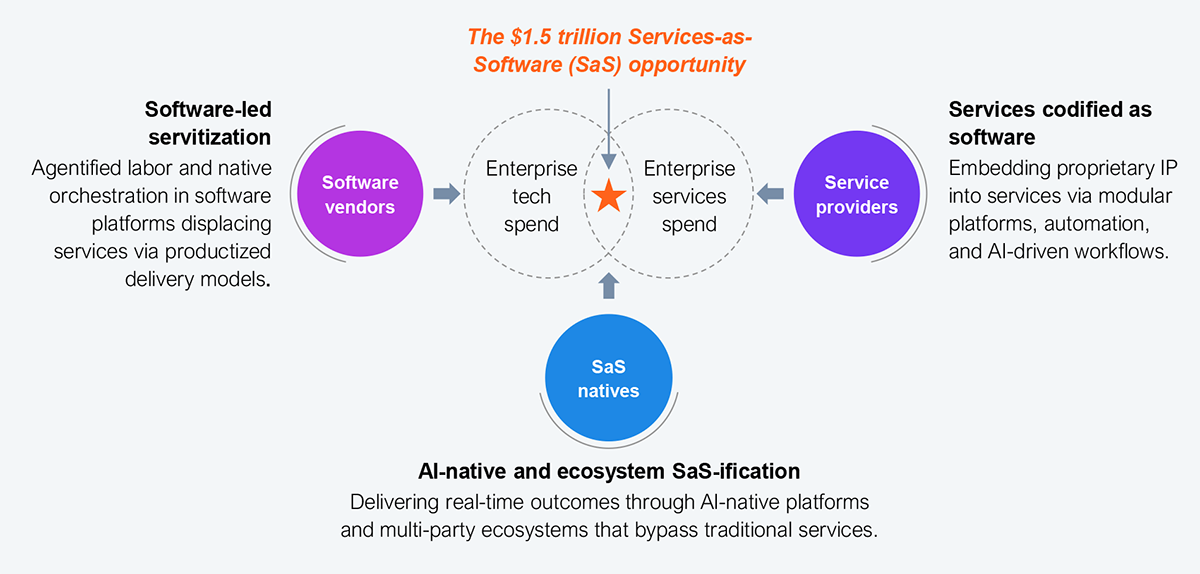
HFS Research coined “Services-as-Software” (Exhibit 3) to encapsulate a concept reshaping how the world will consume technology services and software. This emerging category will disrupt traditional services and software models, absorbing significant revenue from both, and create a new total addressable market worth $1.5 trillion.
Source: HFS Research, 2026
Enterprises consuming third-party services, service providers, and technology providers need a smart ecosystem to succeed and survive in the future. HFS Hot Techs are service and technology providers handpicked by our analysts to help you flesh out your ecosystem with offerings that solve today’s complex business problems and exploit market opportunities.
Register now for immediate access of HFS' research, data and forward looking trends.
Get Started


If you don't have an account, Register here |
With the exception of our Horizons reports, most of our research is available for free on our website. Sign up for a free account and start realizing the power of insights now.
Our premium subscription gives enterprise clients access to our complete library of proprietary research, direct access to our industry analysts, and other benefits.
Contact us at [email protected] for more information on premium access.

