This HFS Services-as-Software Hot Tech report is for CIOs, CISOs, and enterprise resilience and risk leaders who need to understand how agentic AI and low-code orchestration can convert business continuity and disaster recovery from manual coordination into repeatable, automated execution.
Many CIOs rely on business continuity plans that look effective on paper and work well in workshops, but they break down when real disruption strikes. Planning tools capture intent, but few CIOs have an execution engine that turns that intent into action when systems fail and the recovery clock starts.
This gap is more evident in hybrid environments, where applications have presence across multiple platforms with different dependencies and recovery paths. While traditional tools can support planning and tracking, they can’t automate recovery execution, leaving teams dependent on tribal knowledge, manual scripts, and a small number of specialists.
HFS sees Perpetuuiti as one of the few players focused directly on this execution problem. Its platform is purpose-built to help enterprises move beyond static plans and into predictable recovery by automating cross-platform recovery steps, validating readiness, and orchestrating real failover actions. For organizations trying to make resilience repeatable, Perpetuuiti can bring a practical model that complements existing continuity and IT service management systems rather than replacing them.
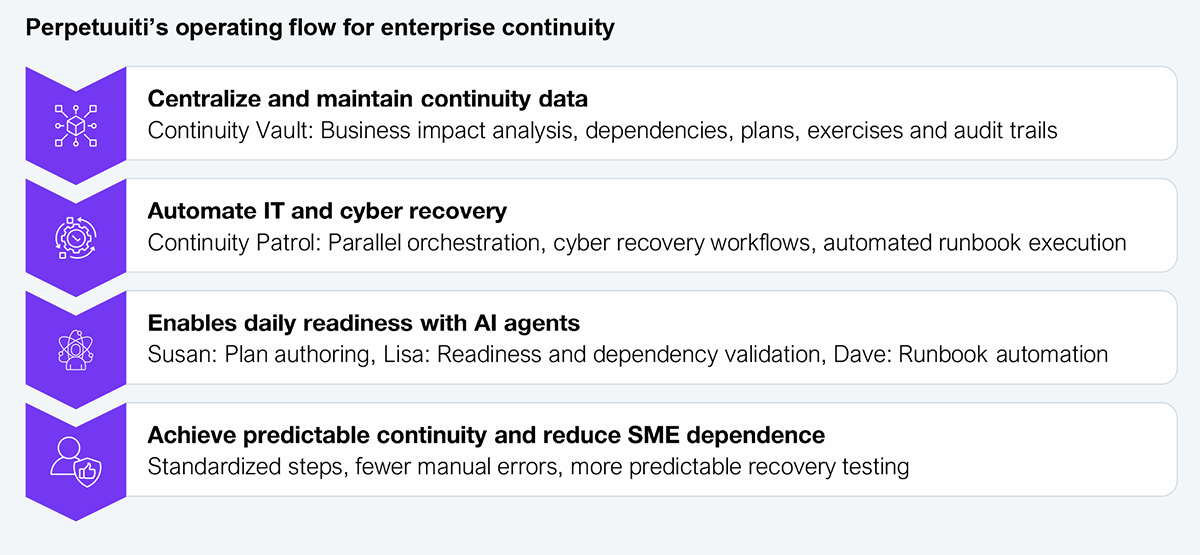
Most continuity programs break down not because plans are missing, but because execution still relies on people coordinating steps manually during disruption. Perpetuuiti structures its platform around three components designed to close that gap: a lifecycle engine that organizes plans, an automation layer that executes recovery steps, and AI agents that actively support planning, monitoring, and execution. Together, these help teams move from static, annually exercised plans to coordinated, repeatable execution.
Source: HFS Research, 2025
Continuity Vault enables teams to map their key processes, identify their dependencies, assess risks, develop plans, conduct drills, and store the results in a single system that aligns with ISO 22301 practices.
Recovery usually slows down because manual runbooks require teams to interpret steps, validate dependencies, and coordinate actions in real time during an incident. What differentiates Perpetuuiti in the market is its vendor- and technology-agnostic, patented recovery automation engine, which uses an AI-supported, low-code/no-code model to replace manual coordination with executable recovery workflows across environments.
Perpetuuiti’s AI agents operate fully offline, a requirement for highly regulated sectors where cloud-based AI is not allowed.
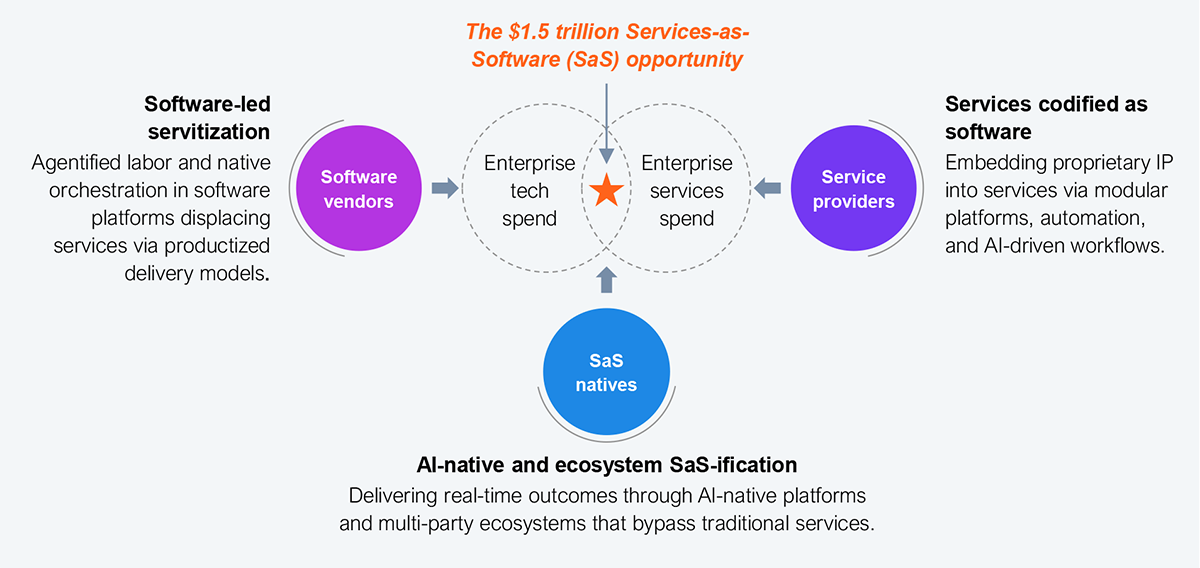
These building blocks reflect a broader shift where continuity and recovery work, which traditionally was dependent on scripts and SMEs, is now increasingly delivered through software-led, AI-supported execution. In this sense, Perpetuuiti’s model converts resilience services into repeatable software workflows, aligning with how enterprises want to operationalize resilience at scale.
Enterprises choose Perpetuuiti because it makes application continuity and cyber recovery easier to manage in real life, not just in documents.
A large healthcare organization using Perpetuuiti for disaster recovery and resilience shared that traditional DR tools and workflows couldn’t match the scale and complexity of its application environment.
It highlighted that Perpetuuiti’s broad integration library and low-code orchestration made it easier to automate recovery across diverse platforms. Following adoption, the customer reported a materially faster recovery during Tier-1 DR exercises, with failover completing in minutes rather than the extended period of manual coordination previously required.
The customer also valued the vendor-agnostic design, which gave them a single place to coordinate recovery across diverse infrastructure.
HFS sees Perpetuuiti addressing a gap that many enterprises still underestimate: resilience breaks during execution, not planning. In most organizations, recovery continues to depend on people coordinating steps under pressure. Perpetuuiti shifts this dynamic by automating recovery actions across hybrid environments, reducing dependence on individual expertise and giving the platform a more operational identity than workflow-centric continuity tools. From an HFS perspective, this places Perpetuuiti in the Services-as-Software category, converting resilience work traditionally delivered through manual services into repeatable, AI-led software execution.
The key question is how well this position scales. Customer feedback points to the need for Perpetuuiti’s AI agents to stay meaningfully ahead of what enterprises can increasingly build themselves. Differentiation will depend on the depth and resilience-specific expertise embedded in agents such as Dave.
Perpetuuiti enters this phase from a position of strength, shaped by execution experience across hundreds of enterprises and more than 100,000 automated recovery drills. This accumulated operational knowledge provides a credible foundation as resilience shifts from planning to execution.
HFS Hot Tech organizations display truly differentiated offerings and out-of-the-box thinking that can be inspiring and useful. This report profiles one of the HFS Hot Techs selected through our rigorous five-step assessment. The HFS Hot Tech designation remains in place for one calendar year. Every Hot Tech joining our program remains listed on our exclusive and searchable database.
HFS Research coined “Services-as-Software” to encapsulate a concept reshaping how the world will consume technology services and software. This emerging category will disrupt traditional services and software models, absorbing significant revenue from both, and create a new total addressable market worth $1.5 trillion.
Source: HFS Research, 2025
Enterprises consuming third-party services, service providers, and technology providers need a smart ecosystem to succeed and survive in the future. HFS Hot Techs are service and technology providers handpicked by our analysts to help you flesh out your ecosystem with offerings that solve today’s complex business problems and exploit market opportunities.
Register now for immediate access of HFS' research, data and forward looking trends.
Get StartedIf you don't have an account, Register here |
With the exception of our Horizons reports, most of our research is available for free on our website. Sign up for a free account and start realizing the power of insights now.
Our premium subscription gives enterprise clients access to our complete library of proprietary research, direct access to our industry analysts, and other benefits.
Contact us at [email protected] for more information on premium access.