
This HFS Research Highlight is for CIOs, chief AI officers, sourcing leaders, and enterprise transformation executives evaluating LTM’s Services-as-Software™ strategy and BlueVerse Credits commercial model as a benchmark for AI-era service partnerships.
At the rebranded LTM’s first Analyst and Advisor Day in Dallas, CEO Venu Lambu laid out a strategy that addressed the structural decline of the traditional ops-and-transformation business as a catalyst for future growth. LTM estimated half a trillion dollars of legacy services spend compressing and $900 billion of new addressable spend opening up in business AI and platform-led modernization. The firm’s response is to simultaneously rewrite five foundational building blocks of services, including how a single unit of work is measured, the talent model, the pricing construct, buyer profiling, and competition scoping. While the intellectual frame is one of the sharpest among Indian-heritage providers today, it has execution gaps, particularly in Services-as-Software (SaS). LTM’s ability to bridge them will depend on it driving internal restructuring at the same pace as the external market is rewiring its expectations over the next 12 months.
LTM’s reimagination of services is a potential opportunity for enterprises seeking to embrace SaS. HFS Research recognizes that the SaS market will be a $1.5 trillion (see Exhibit 1), directionally paralleling LTM’s projections; however, translating that into enterprise purchases will depend on the business priority, the cost of addressing it, and the associated change management. It is unlikely enterprises lean into SaS via consulting; it will be an outcome of context, cost, and change, an approach LTM plans to leverage to rebuild the services business.
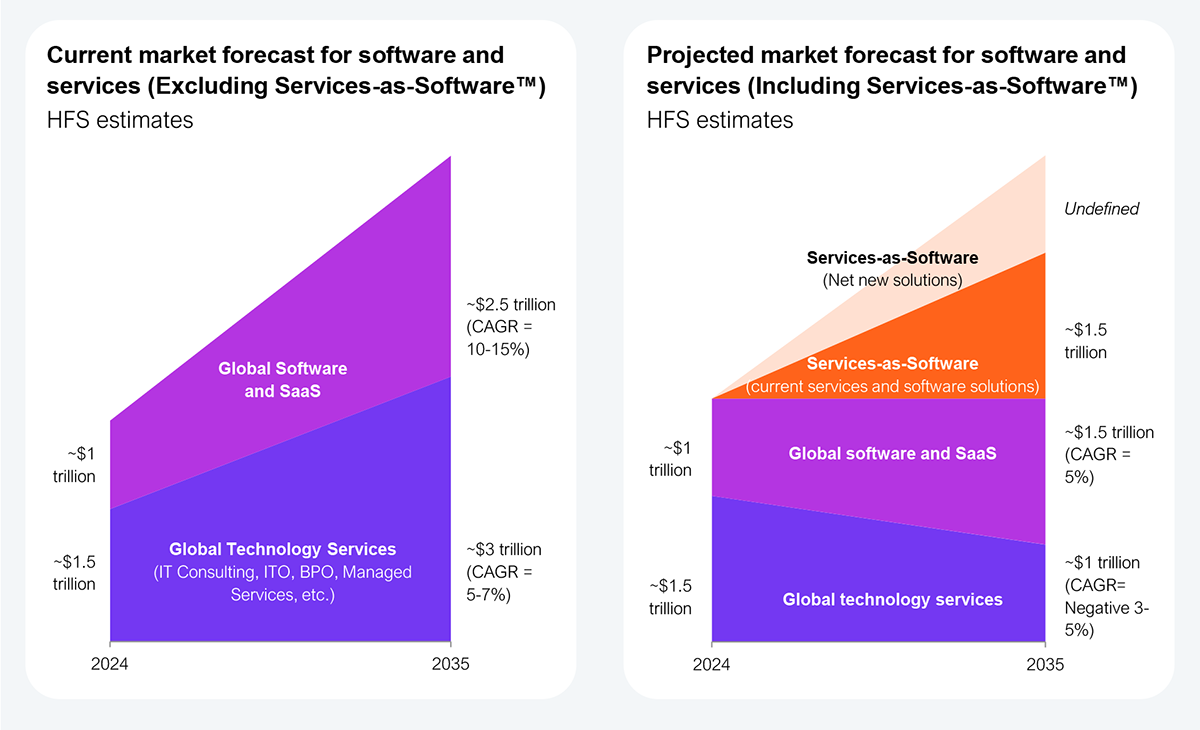
Source: HFS Research, 2026
Reorganizing AI-enabled solutions and investments and reframing the measure of value are critical to AI’s potential. The clearest evidence of the LTM rewire is BlueVerse (LTM’s SaS solution), which replaces headcount-based pricing with a unified credit currency spanning people, agents, platforms, and tokens. This is the HFS SaS thesis taking commercial shape not just in narrative but in action, as 14 service lines were consolidated into three lines of business: iRun, iTransform, and Business AI. To deliver, the talent stack moves from pyramid to diamond, becoming both skill- and role-based, creating a new career track for forward-deployed engineers.
The competition is being redrawn, too. LTM is taking equity stakes in pre-IPO AI players, such as Voicing AI for contact center transformation, and signing partnerships such as Trusys AI for AI governance and an exclusive partnership with Uniphore for small language models across its four business AI functions. Enterprises must keep tabs on providers as investors, not just partners, as a strategic imperative.
LTM Craft Studio runs personalized campaigns for some of the world’s largest CPG and financial services brands and works with filmmakers and production studios managing streaming platforms. This is a few hundred billion dollars of brand, experience, content, and storytelling spend, and LTM is betting that agency is converging with the core enterprise services agenda. The qualifier is that this territory is not unowned, given other credible and established players, including Accenture Song, Wipro Designit, and Publicis Sapient. LTM’s distinctive claim is platform discipline plus global delivery scale. Still, work is needed to defend that position through the Dallas AI studio and to sharpen the “out-create” verb to land with C-suite buyers who have heard creative-meets-tech narratives in the past three years.
The work LTM is doing with its clients across industries is nascent and uneven as enterprises operate with different levels of AI maturity. A leading life sciences company’s CAR-T therapy program (using a cancer patient’s white blood cells, genetically modifying them, and infusing them back into the patient to fight the disease in a time-bound manner) is a remarkable clinical story in which 3,000 lives were saved in 18 months. Still, the work is traditional application management for a time-critical workflow, while a global hospitality brand’s contactless-experience story is more digital. Voicing AI’s live demo on stage showed potential in design and is heading toward scale as LTM handles roughly 8% of annual call volume.
Enterprises must force their service partners, like LTM, to get beyond the buzzy AI narrative in strategy slides and roadmap commitments, and into actual delivery that impacts their strategic priorities.
LTM is positioning itself around outcome-led work without a heavy advisory front end. Most enterprises are not asking providers to own full end-to-end revenue outcomes and are unlikely to. Many commercial models remain anchored in output-based engagements rather than true gain-share or outcome-based constructs. Both enterprises and service providers, and LTM in this case, must have an honest discussion about pricing constructs, or else stop talking about it, because outcome-based pricing is a narrative without teeth.
That said, LTM’s direction is strategically important. Its BlueVerse Credits model points to a narrower but more credible path for enterprises: targeted, outcome-oriented engagements where providers are rewarded for measurable impact, with risk and upside capped at levels that remain practical for both parties. The implication for enterprise leaders is that outcome-based models are becoming more of a reality. Still, they are likely to mature first in specific use cases and value pools rather than across entire transformation programs.
Enterprises looking to advance their AI initiatives and evaluating LTM as a partner should expect clear evidence of its net-new commercial, talent, and operating models designed to manage both risk and scale. On that test, BlueVerse Credits is one of the more credible commercial designs in the market.
Register now for immediate access of HFS' research, data and forward looking trends.
Get Started

If you don't have an account, Register here |
With the exception of our Horizons reports, most of our research is available for free on our website. Sign up for a free account and start realizing the power of insights now.
Our premium subscription gives enterprise clients access to our complete library of proprietary research, direct access to our industry analysts, and other benefits.
Contact us at [email protected] for more information on premium access.

