This HFS Point of View is for CIOs, CDOs, and CFOs who still measure agentic AI through labor-productivity KPIs while competitors build intelligence-driven operating models that learn, adapt, and execute faster.
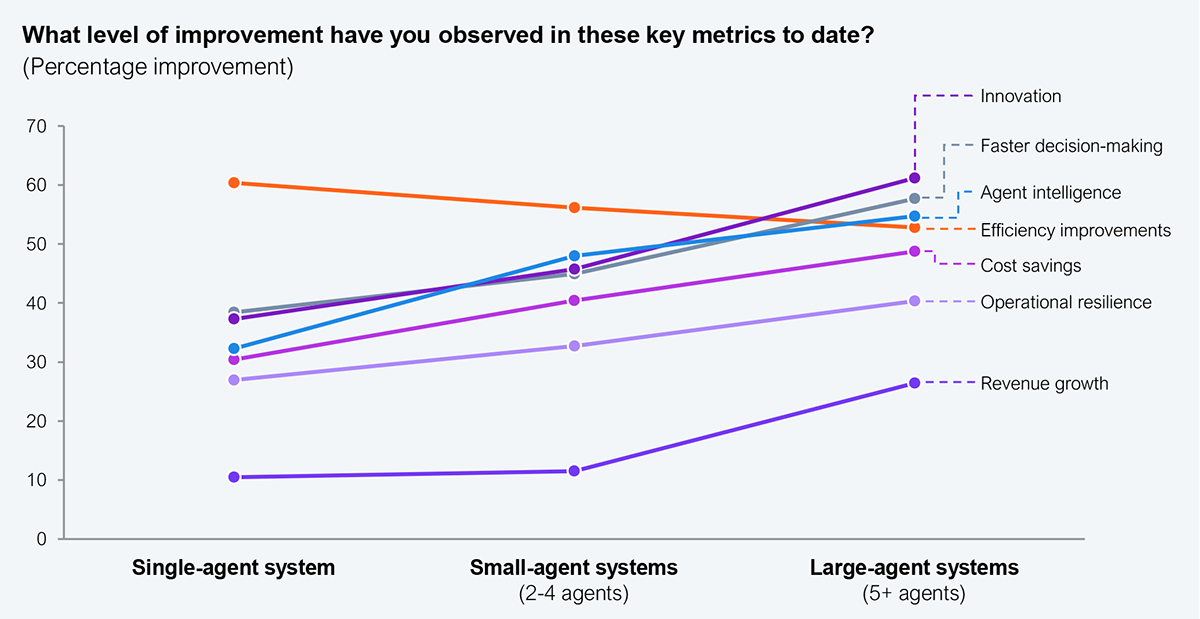
Enterprises that continue measuring agentic AI primarily through labor productivity KPIs risk optimizing themselves into irrelevance while competitors build intelligence-driven operating models that learn, adapt, and execute faster. Most enterprises running agentic AI are still measuring it through efficiency KPIs built for the automation era. The enterprise data captured in the HFS Market Impact Report, Design your agent OS to win the AI future, based on an HFS-Cognizant study of 202 Global 2000 enterprises with agentic AI in production, shows the cost of that bet. Reported efficiency improvements averaged 60% in single-agent deployments, 58% in small multi-agent systems (2–4 agents), and 52% in large multi-agent systems (5+ agents). There is an 8-percentage-point decline across the maturity curve (see Exhibit 1).
Meanwhile, the outcomes that compound with maturity are faster decision-making, agent intelligence, and innovation, and these are not the ones most enterprises bought agentic AI for. CIOs, CDOs, and CFOs need to reset both the value model and the KPI stack before the new value gets buried under the legacy scorecard of their existing KPI stack.
Sample: 202 survey participants
Source: HFS Research, 2026
Exhibit 1 reveals that improvements in three metrics in large multi-agent systems surpass efficiency’s 52% gain: innovation (61%), faster decision-making (58%), and agent intelligence (55%). The metric most enterprises bought agentic AI for, efficiency, becomes the least impressive as systems deepen. Revenue growth shows the steepest acceleration (10% to 27%), but only at the large multi-agent threshold, suggesting that revenue impact requires orchestration depth, not just agent count. The trajectory across the three systems is consistent: cost savings and efficiency are the first dividend of agentic AI, not the last. The intelligence-led dividend grows as systems mature.
Most enterprises still approach agentic AI as an automation tool, the same mental model that justified RPA and BPM investment. That mindset works until the system matures. Single-agent deployments do what enterprises bought them for: automate repetitive work, lower cost per transaction, and reduce manual effort. They are productivity tools. Multi-agent deployments unlock a different value. Cross-agent orchestration can produce decision quality alongside throughput, and mature multi-agent ecosystems can behave more like operating systems for decisions, capable of collaborative reasoning and dynamic execution.
As enterprises cross the multi-agent threshold, competitive advantage can shift away from process efficiency and toward sensing change faster, deciding better, and executing dynamically across interconnected workflows. However, this shift is a possibility, not an automatic feature of agent count. Enterprises that don’t measure for it or don’t orchestrate for it will stay stuck on the automation curve, even with many agents in production.
Sample: 202 survey participants
Source: HFS Research, 2026
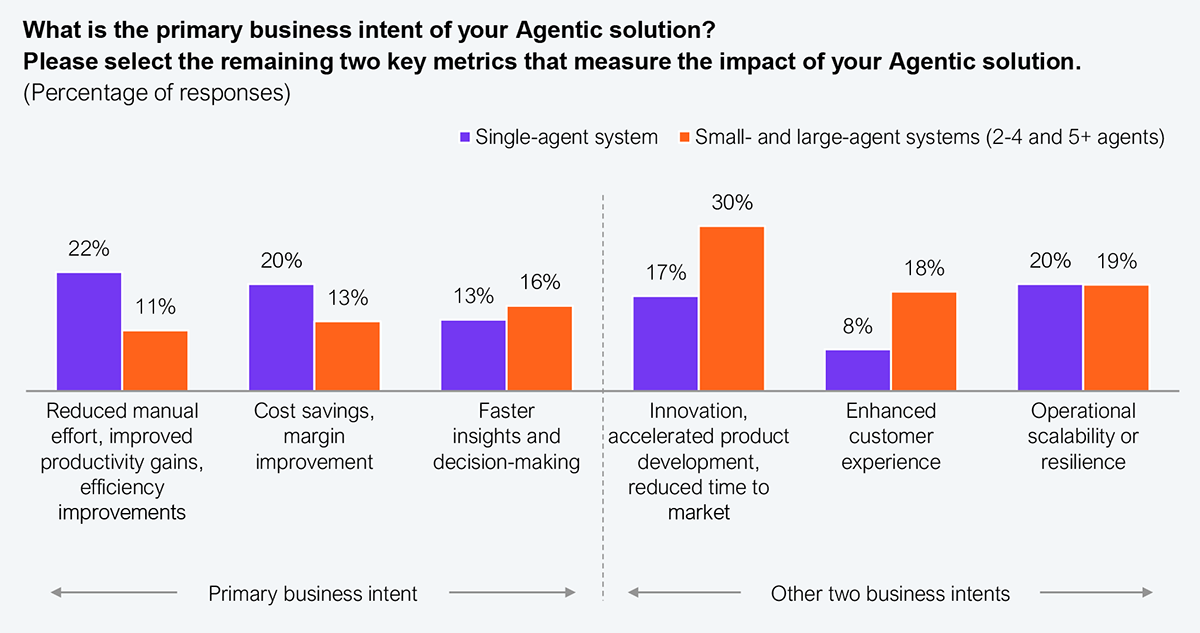
Exhibit 2 makes the intent shift visible. Among multi-agent enterprises, innovation (30%), customer experience (18%), and faster insights (16%) overtake efficiency and cost savings as the most-cited primary intent (vs. single-agent systems). Operational scalability holds steady at around 20% in both groups. The buying logic itself changes with maturity; the KPI stack should follow. Agentic AI maturity must progress from internal optimization to external transformation.
The measurement consequence is direct. Most enterprises still track agentic AI through traditional productivity KPIs (cost reduction, utilization gains, time savings) designed for an era when each automated task had a known cost and a known outcome. Multi-agent systems break those assumptions: the work is probabilistic, the path is multi-step, and decisions happen inside the workflow rather than around it. As organizations cross the multi-agent threshold, the real enterprise impact shifts toward decision velocity, operational scalability, innovation acceleration, governance maturity, and organizational adaptability.
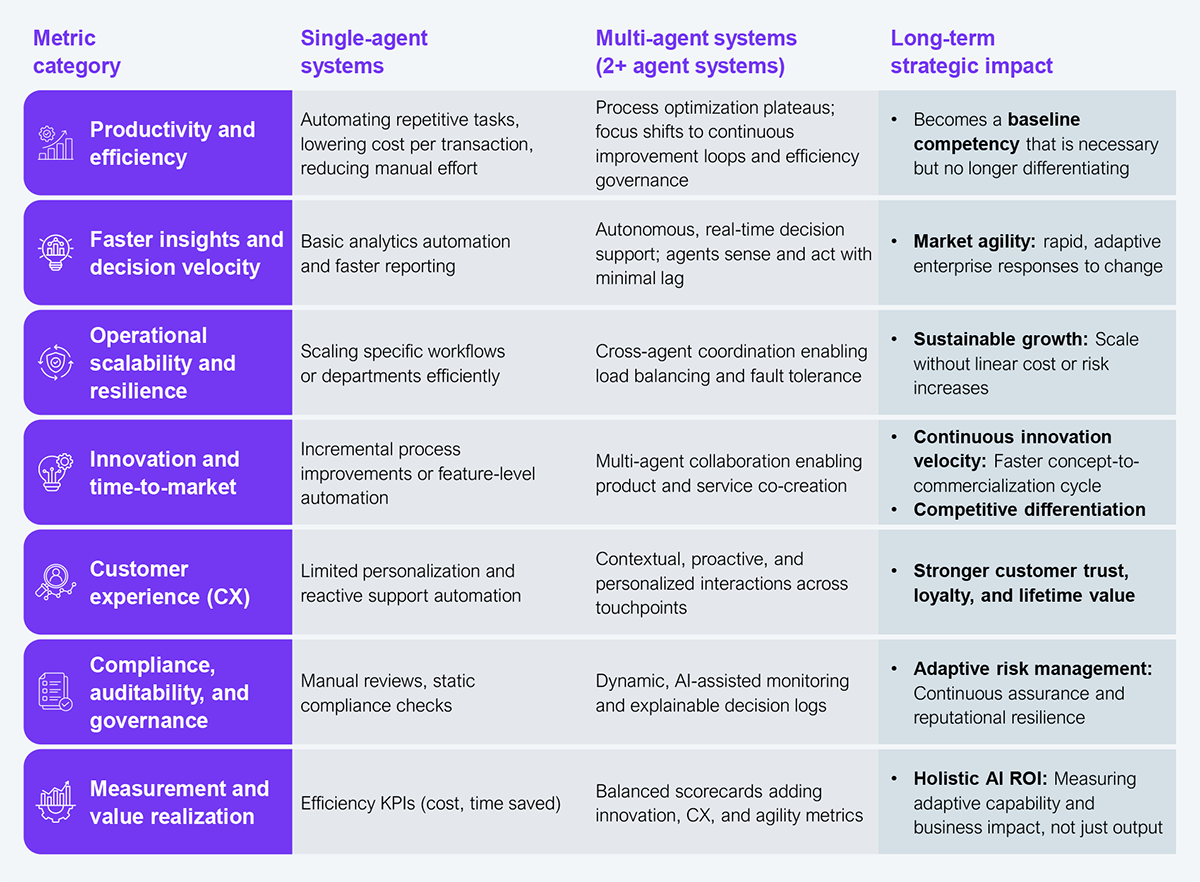
Exhibit 3 maps how the KPI stack should evolve. Efficiency may justify the initial investment in agentic AI, but long-term competitive advantage will depend on whether enterprises can measure the intelligence-led outcomes, including innovation, customer experience, and faster decision-making, that Exhibit 2 just made visible before their compounding value gets buried under an efficiency-first KPI stack.
Sample: Table reflects survey findings and HFS’s strategic interpretation of enterprise maturity patterns.
Source: HFS Research, 2026
Enterprises that keep measuring through labor-productivity KPIs will only see the part of agentic AI that fits those KPIs, the efficiency half. Innovation, customer experience, and faster decision-making don’t appear on scorecards or dashboards built for cost takeout, so the program looks defensible on paper and stalled in practice.
The upside doesn’t disappear. It compounds on the balance sheet of the competitor that measured it first.
The value is real. It will hide in plain sight until you build the scorecards that can see it.
Register now for immediate access of HFS' research, data and forward looking trends.
Get StartedIf you don't have an account, Register here |
With the exception of our Horizons reports, most of our research is available for free on our website. Sign up for a free account and start realizing the power of insights now.
Our premium subscription gives enterprise clients access to our complete library of proprietary research, direct access to our industry analysts, and other benefits.
Contact us at [email protected] for more information on premium access.