Data Viewpoint

Skills aren’t blocking agentic AI adoption; operating conditions are 

This HFS Data Viewpoint is for service provider leaders and enterprise transformation executives diagnosing why agentic AI delivery stalls despite a trained and capable workforce.
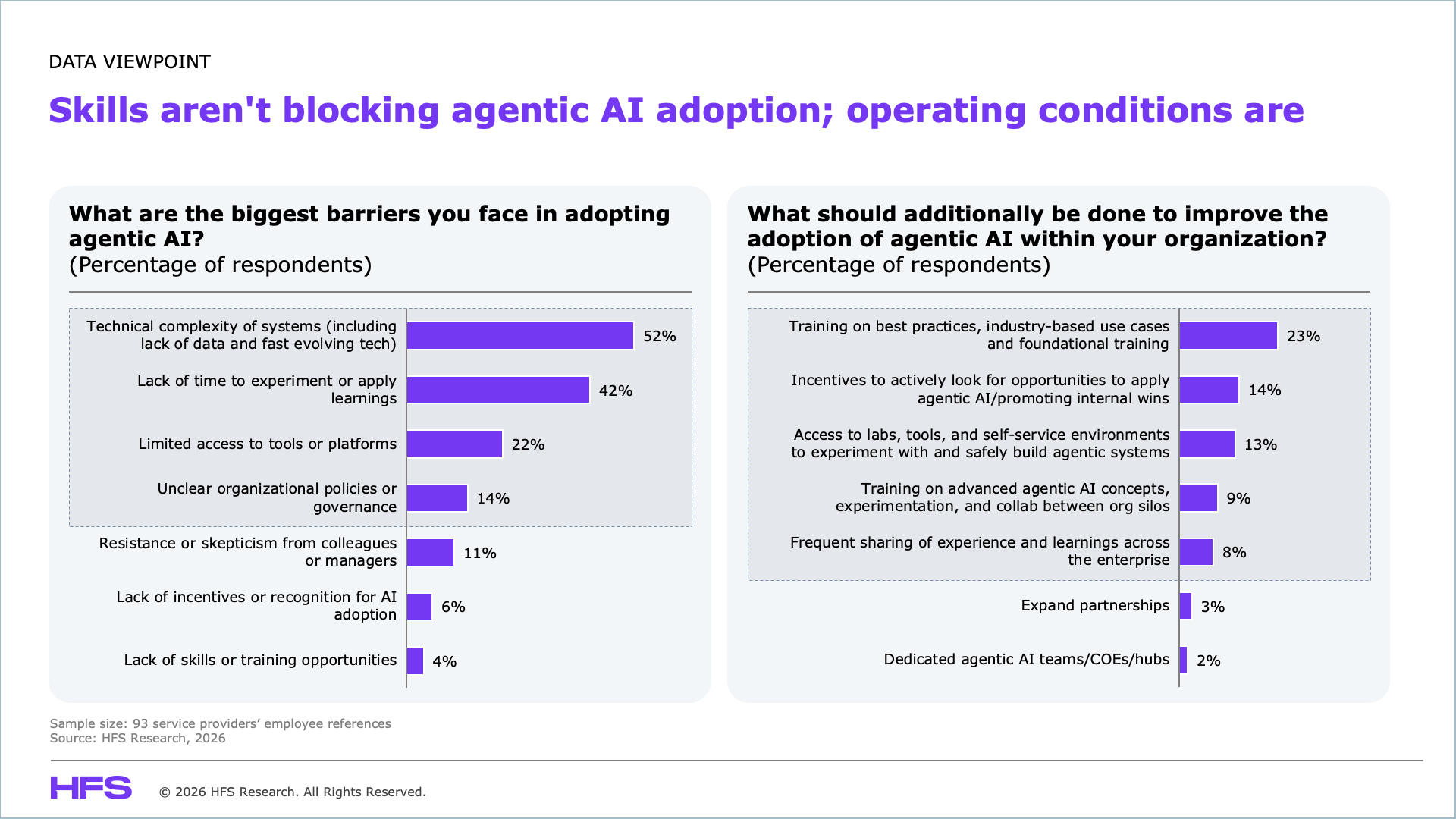
Exhibit 1: What are the biggest barriers you face in adopting agentic AI? Horizontal bar chart showing the percentage of respondents citing each barrier to adopting agentic AI, ordered from largest to smallest. Technical complexity of systems, including lack of data and fast-evolving technology, leads at 52%, followed by lack of time to experiment or apply learnings at 42%, limited access to tools or platforms at 22%, unclear organizational policies or governance at 14%, resistance or skepticism from colleagues or managers at 11%, lack of incentives or recognition for AI adoption at 6%, and lack of skills or training opportunities at 4%. Sample size: 93 service providers' employee references. Source: HFS Research, 2026.
Exhibit 2: What should additionally be done to improve the adoption of agentic AI within your organization? Horizontal bar chart showing the percentage of respondents selecting each recommended action to improve agentic AI adoption, ordered from largest to smallest. Training on best practices, industry-based use cases, and foundational training leads at 23%, followed by incentives to actively look for opportunities to apply agentic AI and promote internal wins at 14%, access to labs, tools, and self-service environments to experiment with and safely build agentic systems at 13%, training on advanced agentic AI concepts, experimentation, and collaboration between organizational silos at 9%, frequent sharing of experience and learnings across the enterprise at 8%, expanded partnerships at 3%, and dedicated agentic AI teams, CoEs, or hubs at 2%. Sample size: 93 service providers' employee references. Source: HFS Research, 2026.

HFS Research surveyed 93 employees of service providers that enterprises rely on for agentic AI delivery. The reality is uncomfortable: their capabilities are largely in place, but the operating conditions required to turn a trained workforce into a productive one are missing. These include protected experimentation time, production-grade tools and platforms, governance clarity, and visible recognition for agent builders.

All 93 respondents are senior service provider practitioners (86% have more than 10 years of work experience) interviewed in the Agentic Services Horizon, 2026 report. They are spread across three role bands: strategy and governance leaders (30%), project leads who deliver agentic AI services (34%), and builders who design and configure agentic systems (28%). All respondents answered both questions, so the chart reflects a layered view from leaders, delivery leads and practitioners, not two separate audiences.

Around 92% of employees say they received formal agentic AI training in the last 12 months, yet 90% say they would benefit from additional training. Capability is not the limiting factor. The delay in value delivered comes from capacity, complexity, and tooling, the same constraints that show up in enterprise teams running their own agentic programs. Enterprises that continue to overinvest in training rather than operational enablement risk slowing ROI from AI by attacking a bottleneck that is no longer the primary constraint.

Here are the top six takeaways from the above two charts:

  • Talent capacity, not capability, is the bigger bottleneck. Across all three role bands of employees, technical complexity (52%) and lack of time (42%) are the top two barriers in agentic AI adoption. Skill gaps rank lowest at just 4%. For enterprises and service providers alike, the emerging constraint is delivery bandwidth, not access to talent.
  • Limited tool access blocks the work itself. Twenty-two percent of practitioners cite limited access to tools and platforms as the third-largest barrier. Project leads (the role responsible for delivery) flag limited tool access roughly four times more often than strategy leaders or builders. Access to production systems decides whether agentic AI work scales or stalls.
  • Governance ambiguity is a quiet throttle. Fourteen percent of practitioners cite unclear organizational policies and governance as an adoption barrier, ahead of peer resistance (11%). Without clear rules on what’s allowed and how decisions get audited, delivery teams hedge.
  • Continuous and advanced training is the most-prescribed fix. Twenty-three percent of practitioners want their organization to invest in training on best practices, industry use cases, and foundational agentic AI as the top adoption lever. Employees want sharper and more applied training, but training alone will not remove the operational bottlenecks slowing adoption.
  • Workforce motivation is emerging alongside technology as an adoption lever. Fourteen percent of practitioners want their organization to invest in incentives, recognition, and promoting internal wins. And another 8% want their organizations to frequently share experiences and learnings across the enterprise.
  • Centralized AI structures get the least support. Only 2% of practitioners want a dedicated CoE or hub, and 3% want expanded partnerships. These are the two lowest-ranked items in the data. Practitioners indicate appetite for distributed enablement rather than additional centralized AI infrastructure.
The Bottom Line: Enterprises that fund the operating conditions (i.e., time, tools, governance clarity, and recognition) will be able to convert agentic AI capability into competitive advantage. Those that keep funding more training instead of operational enablement will continue delaying AI returns despite having trained workforces already in place.

Sign in to view or download this research.

Login

Register

Insight. Inspiration. Impact.

Register now for immediate access of HFS' research, data and forward looking trends.

Get Started

Download Research

    Sign In

    Sign up for a free
    research account

    With the exception of our Horizons reports, most of our research is available for free on our website. Sign up for a free account and start realizing the power of insights now.

    Digests/Newsletters: Overviews of the latest news, insight, and research by HFS.

    HFS Events: Exclusive invitations to HFS webinars, roundtables, and summits, bringing together key industry stakeholders focused on major innovations impacting business operations.

    By registering you agree to our privacy policy.

    I hereby consent that HFS Research can process my personal data.

    Premium Access

    Our premium subscription gives enterprise clients access to our complete library of proprietary research, direct access to our industry analysts, and other benefits.

    Contact us at [email protected] for more information on premium access.

    Help

    If you are looking for help getting in touch with someone from HFS, please click the chat button to the bottom right of your screen to start a conversation with a member of our team.

    [email protected]

      Contact Ask HFS AI Support