
The HFS Horizons: Agentic Technology, 2026 report is for CIOs, chief AI officers, and enterprise transformation leaders evaluating technology partners to move agentic AI from pilot into scaled production across hyperscaler, SaaS/ERP, and AI-native environments.
HFS Horizons: Agentic Technology, 2026 assesses 12 technology firms powering enterprise agentic transformation, spanning hyperscalers, enterprise SaaS/ERP providers, and agentic AI-native firms. The report evaluates how effectively each firm advances the shift toward Services-as-Software™, an HFS Research paradigm in which services are delivered primarily through software rather than human effort, with outcome-based pricing and near-full machine-led execution. Data collection spanned September 2025 to January 2026 and included 24 reference checks for AI-native participants.
The chart below plots all 12 technology firms across the three HFS Horizons, showing which firms have reached the Market Leader status and which are maturing as Enterprise Innovators. 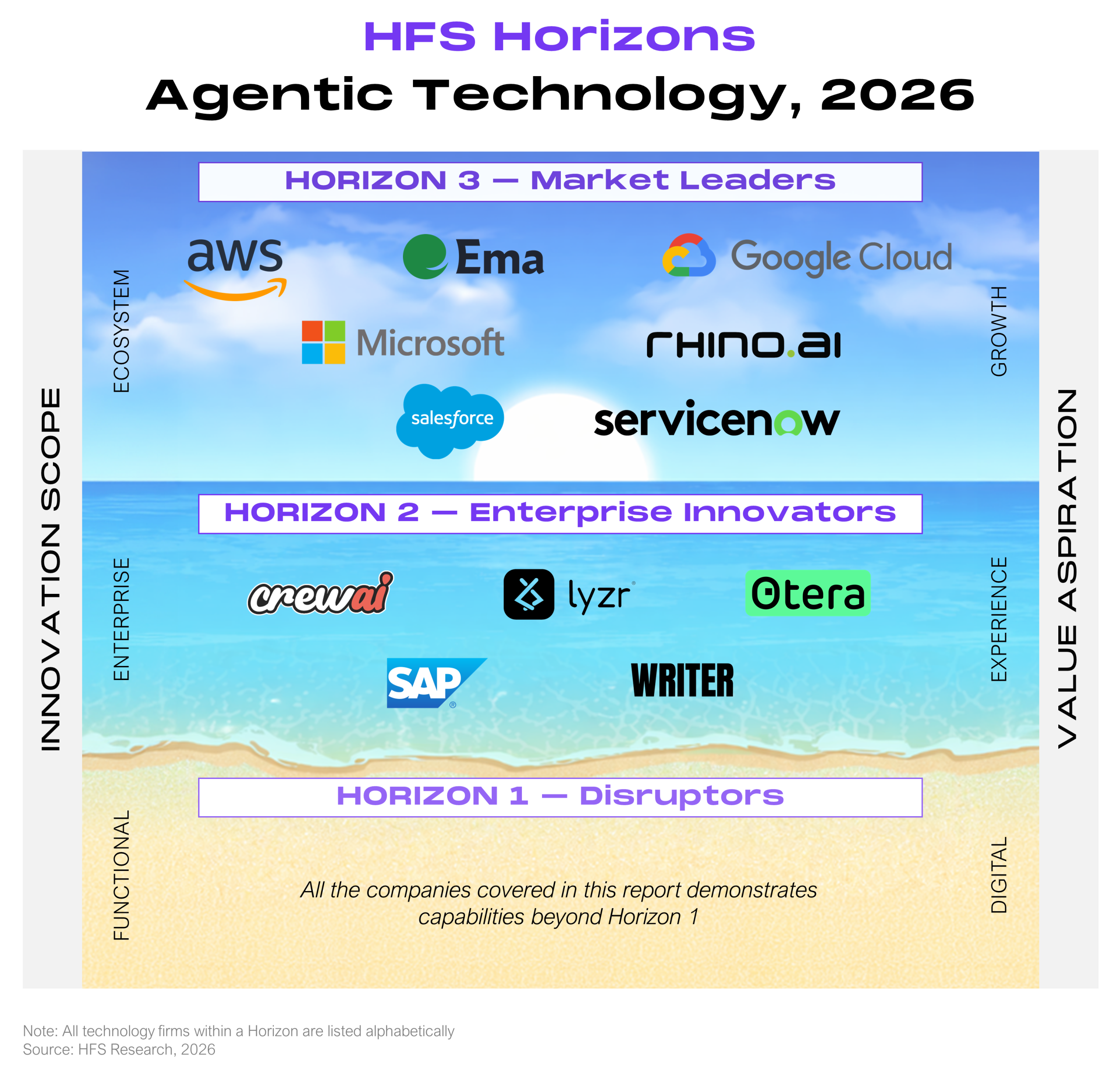
HFS finds that every firm in this cohort has production-grade agentic capabilities available today, yet true Services-as-Software remains emergent across most of the cohort. HFS assesses that the bottleneck is no longer the technology but enterprise operating models, data readiness, and governance maturity.
Vendor briefings with AI leadership and other public information such as websites and publication across 12 technology firms augmented by 24 client, partner, and employee reference checks for AI-native participants, conducted globally between September 2025 and January 2026.
To read the rest of the research, click the download button below.
Register now for immediate access of HFS' research, data and forward looking trends.
Get Started



If you don't have an account, Register here |
With the exception of our Horizons reports, most of our research is available for free on our website. Sign up for a free account and start realizing the power of insights now.
Our premium subscription gives enterprise clients access to our complete library of proprietary research, direct access to our industry analysts, and other benefits.
Contact us at [email protected] for more information on premium access.

