This HFS Point of View is for CIOs, CTOs, and business transformation leaders rethinking India’s GCCs as AI talent hubs rather than cost-savings centers.
CIOs, CTOs, and business transformation leaders: Pursue India’s talent instead of its cost savings. You cannot staff your AI, engineering, and data ambitions at scale anywhere else, and enterprises worldwide are already acting on this. India accounted for 76% of all new GCCs (Global Capability Centers) globally over the last five years, and that expansion continued even as tariffs, inflation, and weak growth tested the model in 2025.
Why do companies set up and expand their GCCs in India? Initially, the GCC idea rested on cost savings, which, of course, still matter. However, HFS’s analysis shows that access to specialized tech talent at scale (see Exhibit 1) is now the top reason. Talent influences nearly every other major driver, including the creation of centers of excellence for new technologies, India becoming a leading hub for data centers and AI innovation, and tapping into the startup ecosystem. Add all that, and we see that nearly 40% of the motivation for coming to India is directly tied to talent.
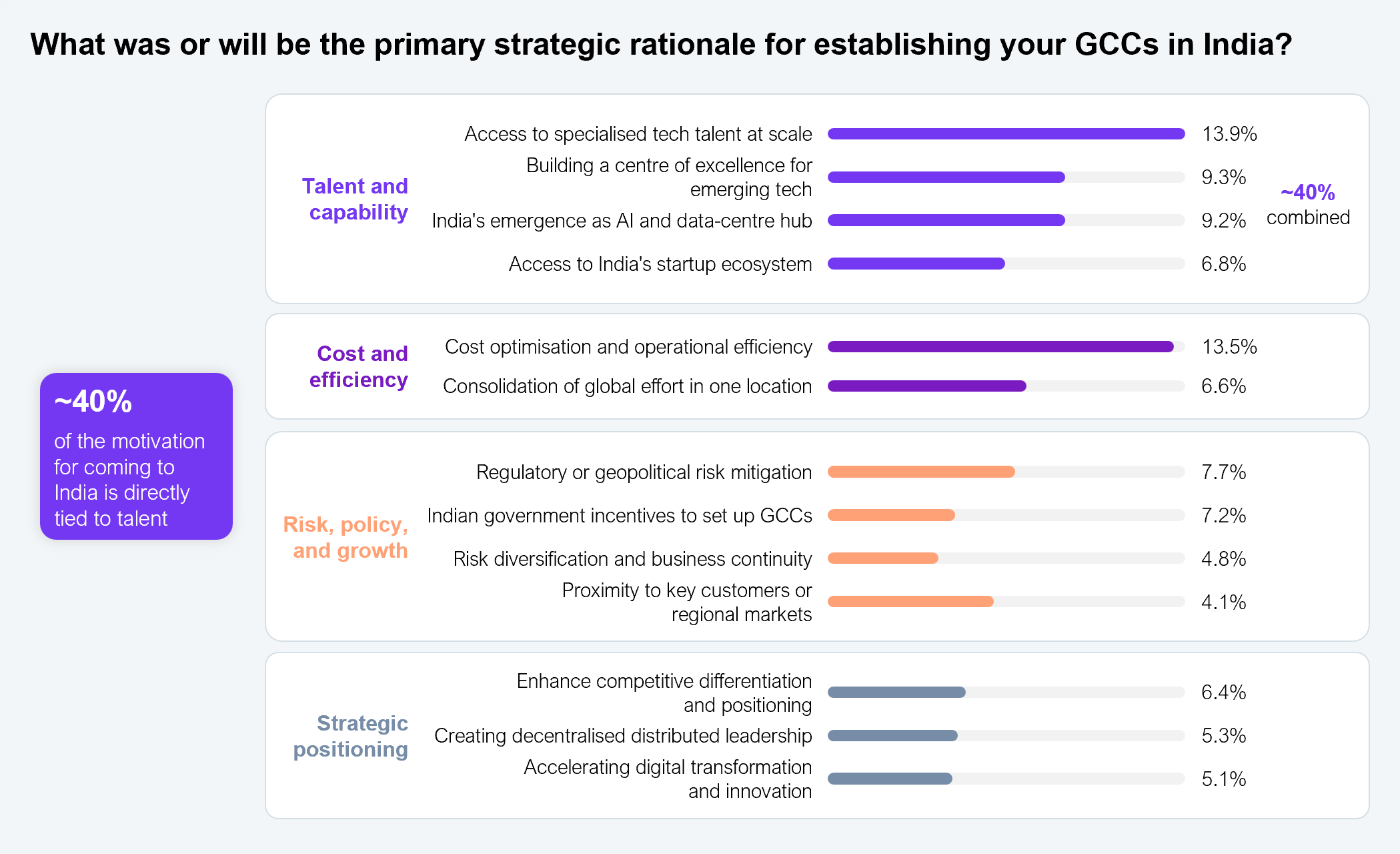
Source: HFS Research, 2026
Enterprises in developed markets are finding it harder to fill their AI, data, cyber, and engineering talent gaps locally. Visa rules have become more stringent, local talent pools have shrunk, and rising wages have reduced the benefits of relocating employees. Work follows talent, and India remains the only country with these skills widely available. NASSCOM estimates that more than 250,000 AI and machine learning professionals work in Indian GCCs. India is the second-largest employer of AI talent for enterprises.
Most large and mid-market enterprises are coming to India to fill talent gaps, leverage talent, support their innovation journey, and meet enterprise mandates. Enterprises have realized they can’t control macroeconomic factors; however, they can control their business operations, workflows, costs, and AI journey. They will not be in the race if they can’t leverage the AI capabilities.
According to NASSCOM, the number of GCCs in India grew 32% between FY21 and FY26E with the addition of 500 GCCs and around 600,000 new direct employees (see Exhibit 2). Additionally, HFS Research found that India accounted for 76% of all new GCCs worldwide.
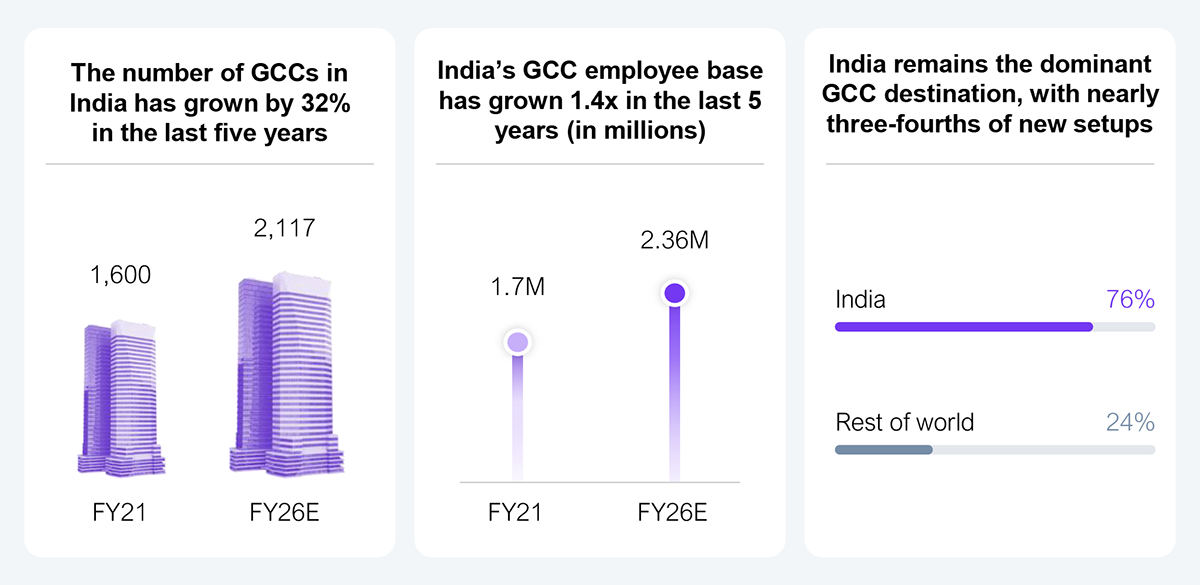
Source: NASSCOM; HFS Research, 2026
If global economic conditions were going to disrupt India’s GCC growth, 2025 would have shown it in the data. Global GDP growth hit its lowest level in years, the US imposed new tariffs on Indian exports, central banks raised interest rates while inflation persisted, and revenue growth at India’s largest IT services firms slowed. However, in India, we saw the opposite: new buyers, larger in size and from more countries, are entering various locations across the Indian market. The resilience to global economic pressures is due to strong governance, rapid policymaking, the availability of diverse R&D talent, and, most importantly, the ease of doing business for foreign enterprises. Though India’s inflation, attrition, and labor costs are rising, the attraction of domain-specific talent at scale is nullifying them.
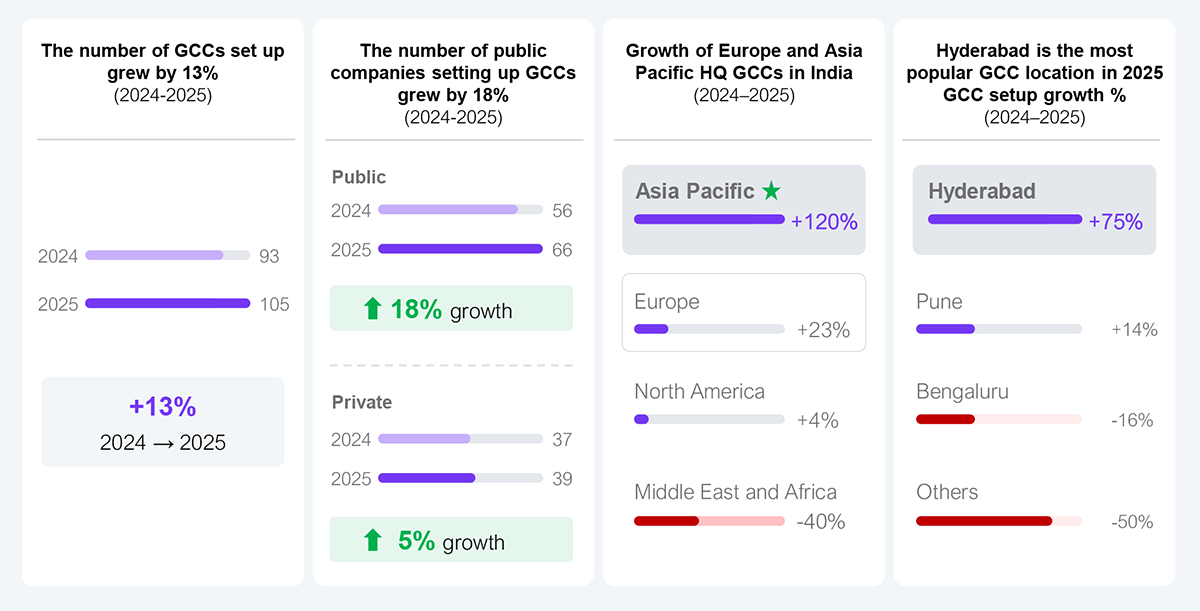
According to the HFS GCC Intel 360 data suite, the number of new GCC setups (see Exhibit 3), including both public- and private-sector GCCs and other firms outside North America, increased in 2025 compared to 2024.
Sample: Based on 198 new GCCs set up in 2024 and 2025; large enterprise revenue is >$10 billion; mid-market is between $500 million and $5 billion; small is <$500 million
Source: HFS Research, 2026
New GCCs grew by 13% in India
In 2025, overall, the net new GCCs grew by 13%, driven by large and mid-market enterprises. The mid-market GCCs have increased from 28 in 2024 to 49 in 2025. These centers require AI talent and skilled engineering and data professionals, and India is the only market able to meet this demand. Additionally, large companies are moving AI and platform operations in-house. Notable mid-market companies, including Citizens Financial Group, Entain, and LANXESS, established their GCCs in 2025.
Both publicly listed and private companies are setting up GCCs
The share of public and private sector GCCs in India grew 18% and 5%, respectively, between 2024 and 2025. Public companies have longer decision-making processes and many internal complexities, but they are prioritizing talent and rushing to establish operations in India. Companies such as Johnson & Johnson, Marriott International, and Goodyear have set up their GCCs in India.
Non-American firms now drive the majority of India’s new GCCs
American firms no longer have the majority share of the Indian GCC market. European companies’ share rose from 45% to 55%, with a 23% growth in 2025. Asian firms, mainly Japanese, saw a 120% increase in GCCs compared to 2024. Firms like Carlsberg and Lonza (both European) and Daikin (Japanese) are engaged in AI, data, cybersecurity, and engineering projects, highlighting the global talent shortage and the rising interest in opportunities in India.
The landscape in India is changing
Hyderabad has surpassed Bengaluru as the top GCC location in both growth and volume, and Pune’s presence improved in 2025 compared to 2024. Delhi-NCR, Chennai, and select tier-two cities are now key locations for enterprises. This shift is driven by increased competition for talent.
The implications converge on a single point, where talent now supersedes all other variables in your operating model, regardless of the macro environment.
Measure India against its capacity to provide the talent you need to execute AI, not its labor arbitrage value
The board cases winning approval today frame India as an AI capability investment, and the real question is whether your enterprise can deliver its AI roadmap without anchoring it in Indian talent.
Own the AI talent for long-term value creation
The fastest-moving large companies are bringing AI, data, and platform management into their own GCCs in India, where the talent is. Long-term control over capability and intellectual property cannot be maintained under a contractor model.
Diversify locations to tap domain-specific talent
Hyderabad, Pune, Bengaluru, Delhi-NCR, and Chennai offer different talent pools and industry specializations. For example, Hyderabad is known for life science and pharma talent. Treating these locations as a coordinated group of capability hubs is essential for any serious GCC strategy.
Enterprise CIOs are moving quickly and planting their flags because the cost of waiting will be measured in the AI capabilities your competitors will own, and you will spend the next decade trying to rebuild.
Register now for immediate access of HFS' research, data and forward looking trends.
Get StartedIf you don't have an account, Register here |
With the exception of our Horizons reports, most of our research is available for free on our website. Sign up for a free account and start realizing the power of insights now.
Our premium subscription gives enterprise clients access to our complete library of proprietary research, direct access to our industry analysts, and other benefits.
Contact us at [email protected] for more information on premium access.