This HFS Highlight is for CIOs, chief AI officers, and data and AI leaders evaluating how to act on Databricks’ context, cost, and control thesis without overcommitting to a single vendor.
Fix the three Cs of context, cost, and control, and you unlock enterprise AI. That’s the thesis emerging from Databricks’ Data + AI Summit in San Francisco, held on June 15–18. CEO Ali Ghodsi told the room what many enterprise leaders have already concluded: “AI does not have an intelligence problem, it has a context problem.”
The diagnosis is right, and data and AI leaders should act on it. But they must do so with caution. The same vendor that champions “no lock-in” is assembling one of the most complete agentic stacks in the market. Few enterprises should be willing to hand their entire data and AI estate to a single supplier. Our advice: pilot, but carefully govern the dependencies you may create.
Databricks frames enterprise AI around context, cost, and control. This mirrors what HFS sees as stalling enterprise programs: the fragility of agentic workflows when operating without an understanding of the enterprise’s internal language and ways of working, runaway token costs, and governance issues.
Recognizing these barriers should reset your priorities. Stop chasing the latest model, and invest instead in the context and governance layers that actually determine production quality and cost.
On context, Genie Ontology and its OntoRank index (see Exhibit 1) pre-compute a knowledge graph across enterprise data assets, effectively auto-generating your context to spare agents the costly “random walks” of discovery at query time. The logic is sound and worth piloting, but it challenges the quality claims. This context is built on data and is unlikely to surface the tribal knowledge and tacit understanding of how work gets done. Treat this as unproven until you test it against your own data.
On control and cost, Unity AI Gateway (see Exhibit 1) is a one-plane capture of budgets, observability, identity, and guardrails across every agent, model, and MCP server. It answers concerns about runaway spend and oversight gaps. This must become table stakes for any agent program, whether procured from Databricks or not. As an open source, it could stand as a reference architecture for those assembling their own.
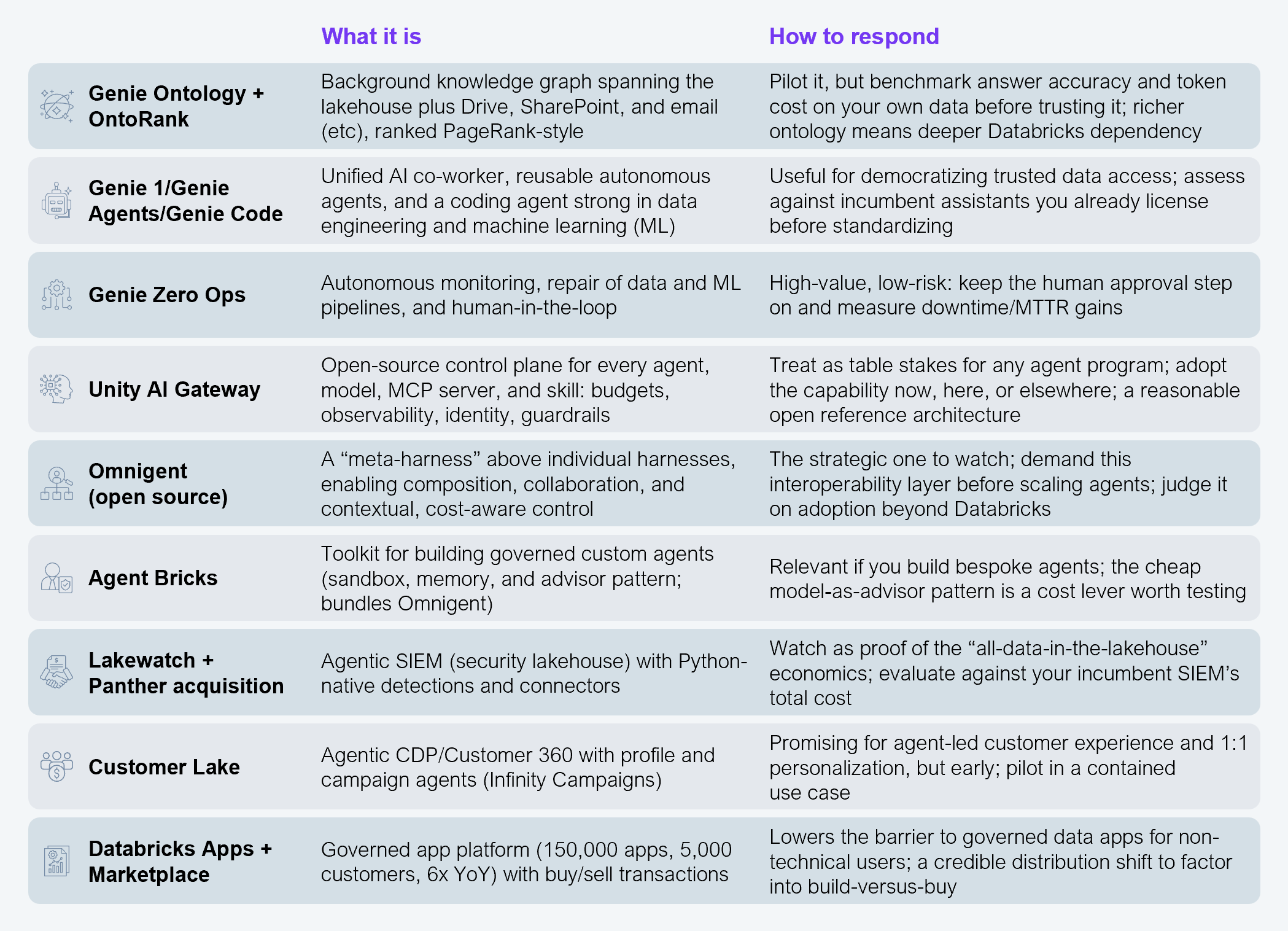
Source: HFS Research, 2026; based on Databricks Data + AI Summit keynotes and sessions
“Harness” is going to be one of the words of the year. Databricks announced Omnigent, an open-sourced meta-harness it hopes the world will adopt and a signal to AI and data leaders that interoperability is essential before multi-agent, cross-ecosystem agentic systems are deployed.
A harness is the software layer that sits around an LLM and turns it into something useful. It connects a model to files, tools, permissions, interfaces, workflows, and the outside world. Claude Code has one. Codex has one. Every custom agent effectively has one. We are accumulating harnesses almost as quickly as we’re accumulating models, and that creates three growing enterprise headaches:
Omnigent wraps different agents and presents them through a shared interface to ease composition, real-time collaboration, and contextual, cost-aware control. The intent is to support orchestration, governance, and collaboration across a sprawl of otherwise incompatible agents.
As a leader, use Omnigent as an opportunity to insist on a layer that lets you compose, switch, and govern underneath. Treat it as a candidate standard, but judge it on adoption beyond Databricks, especially as it does not require Databricks tooling.
Omnigent’s value depends on it becoming a widely used open ecosystem. Databricks’ decision to open source it rather than monetize it is a good sign. But you would be wise not to architect around it until the ecosystem materializes.
Act on the Databricks thesis and start paying down your context and governance debts today. Make agent cost control mandatory and built in as part of your AI tooling.
Where Databricks offers open, interoperable pieces (Unity AI, Gateway, Omnigent), be prepared to adopt aggressively. But on proprietary offerings such as Genie Ontology, Customer Lake, and Lakewatch, pilot with an eye on quality and cost gains.
Databricks may come to you with an all-in-one ambition, but the sheer breadth of this stack should heighten scrutiny rather than earn blanket commitment.
Register now for immediate access of HFS' research, data and forward looking trends.
Get StartedIf you don't have an account, Register here |
With the exception of our Horizons reports, most of our research is available for free on our website. Sign up for a free account and start realizing the power of insights now.
Our premium subscription gives enterprise clients access to our complete library of proprietary research, direct access to our industry analysts, and other benefits.
Contact us at [email protected] for more information on premium access.
If you are looking for help getting in touch with someone from HFS, please click the chat button to the bottom right of your screen to start a conversation with a member of our team.