This HFS Highlight on Lenovo and the FIFA World Cup 2026 is for CIOs and enterprise transformation leaders looking to operationalize AI in production at scale.
The FIFA World Cup 2026 is underway, drawing an audience of more than five billion people by the time a champion is crowned at the biggest event in sports history. But only a few will realize they are witnessing something far more demanding than a broadcast: the most punishing technology test in sport, with AI running flawlessly and in real time in front of the largest audience ever assembled.
The demands of that test are the same as those a CIO faces every day: managing vast volumes of data and building platforms sophisticated enough to turn that data into real-time intelligence, all while keeping applications, access, and security resilient under peak demand. FIFA is trusting Lenovo, its official technology partner, to deliver exactly that as a single partner co-innovating the entire stack. For any leader running a global enterprise, this is not a sponsorship to admire. It is a blueprint to study.
The World Cup is the most complex operating environment in sports, and the 2026 tournament will be the largest ever staged, with 48 teams playing 104 matches in 39 days across three countries. For a CIO, that complexity is familiar. Forty-eight teams behave like forty-eight business units, each with its own data, demands, and definition of success, all running on one platform at the same time. And for the first time in its history, FIFA has put all of it under a single technology partner accountable for fans, broadcast, stadiums, teams, and players alike.
What separates this from a logo on a banner is that the Lenovo technology is tangible. Every fan, player, coach, and official will feel it directly, and that is the line between renting visibility and reinventing the experience. It is the same line a CIO walks between deploying technology and delivering outcomes people can feel, and it is not crossed by buying products. Scale and experience at this level are earned by co-innovating a platform, data, and an AI strategy with a partner that has done it before. That is the partnership FIFA has built with Lenovo.
Lenovo is running the whole tournament as one connected system, from the pocket to the cloud. For CIOs, the lesson is that the integration delivers outcomes no single tool can achieve:
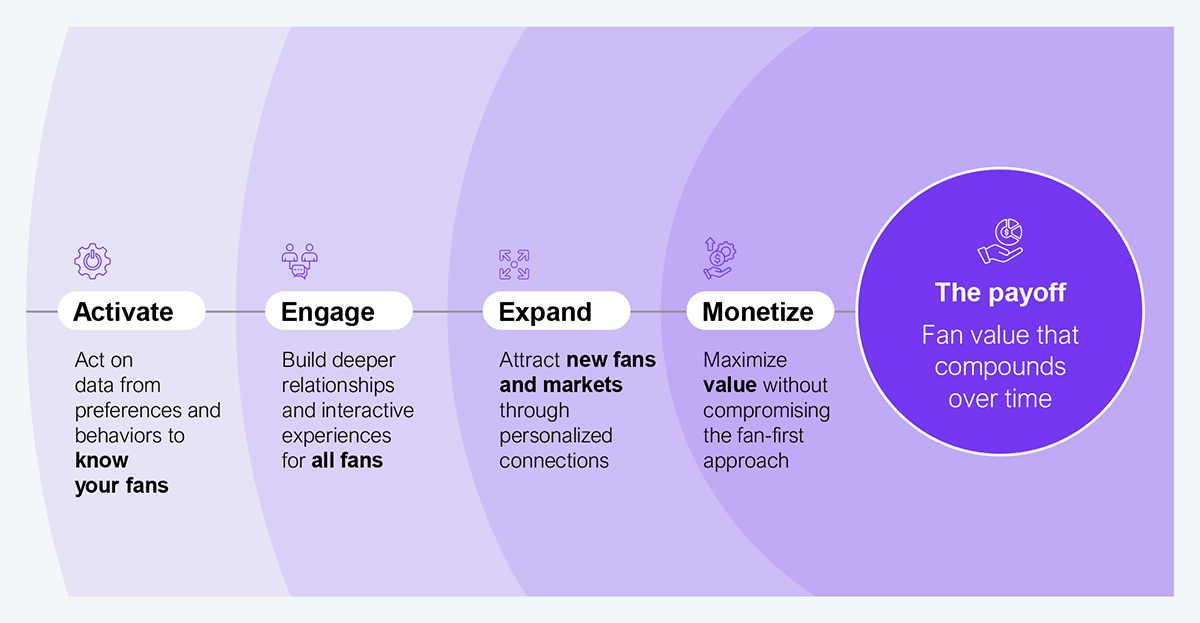
These capabilities deliver against the four pillars HFS uses to define a best-in-class fan experience: activate, engage, expand, and monetize (see Exhibit 1). Lenovo activates by turning the data its connected systems capture into a real-time read on who its audience is, engages through wayfinding and immersive experiences, expands by carrying a North American tournament to fans on every continent, and monetizes through fan fests and activations that turn engagement into demand, then into sales worldwide.
Source: HFS Research, 2026
HFS documented this same unified data, co-innovation playbook at enterprise scale with Tepper Sports & Entertainment and Innova Solutions. The World Cup is that playbook on a planetary scale.
Strip away the spectacle, and the World Cup answers the question most enterprises are still stuck on: whether they can get AI into production and keep it running. An HFS study found that 83% of enterprises remain in the early stages of AI adoption and only 17% have embedded it across their operations. Most are caught in pilot purgatory, where AI stalls at proof of concept and never scales.
The lesson the tournament makes obvious is that none of this works without a foundation. The Intelligent Command Center delivers because the data beneath it is connected. For a CIO, the first move is to unify fragmented data into one backbone before chasing AI features, because AI in production is impossible on top of fragmented systems.
But foundation alone is not enough. Closing the gap between AI ambition and production is not one an enterprise can buy its way across. It requires co-innovation with a partner that brings engineering depth, codified domain knowledge, and accountability for the outcome, not just a vendor optimizing against today’s KPIs. FIFA and Lenovo built shared IP that neither could create alone. As people-run services give way to Services-as-Software™ across the Global 2000, the arbitrage that defined IT for thirty years no longer differentiates. The partnership model does.
The FIFA World Cup 2026 is the most public test of whether AI can run in production at an enterprise scale, and Lenovo and FIFA are staking it in front of more than five billion people. What they show is how it is done with one platform, one connected data foundation, and one partner accountable for the outcome rather than a roster of vendors. Treat this tournament as a working blueprint and ask whether your own AI could survive the same test, with the whole world watching.
Those who treat the World Cup as a spectacle will be entertained. The CIOs who treat it as a playbook will lead the next generation of their enterprise.
Register now for immediate access of HFS' research, data and forward looking trends.
Get StartedIf you don't have an account, Register here |
With the exception of our Horizons reports, most of our research is available for free on our website. Sign up for a free account and start realizing the power of insights now.
Our premium subscription gives enterprise clients access to our complete library of proprietary research, direct access to our industry analysts, and other benefits.
Contact us at [email protected] for more information on premium access.