Take 5 Report

CMT CX leaders, move past your cost and fix your debt to unlock customer value

This HFS Take 5 report is for CMT customer experience, IT, and operations leaders scaling agentic AI from pilots to journey-wide customer value.

Executive summary

Communications, media, and telecom (CMT) enterprises have been heavily investing in AI for customer experience (CX), yet the outcomes have plateaued. Generic models cannot reason over the customer, contract, or workflow specifics, so value stalls on the growth side even as cost-to-serve improves. The bottleneck is operational, with integration complexity and data fragmentation as key constraints. The demand for implementing agentic AI in CX is real, but the application and data layer needs work before agents can act seamlessly across silos.

To realize the full value of AI for CX, enterprises must address the integration and data debt blocking journey-wide AI and shift the business case from cost to customer value. That means connecting fragmented systems and customer data so agents can act across the journey, grounding the work in governance and CX domain depth.

HFS Research, in partnership with Cognizant and Google Cloud, surveyed 51 CMT enterprise leaders across North America ($1 billion+ in revenue) to understand where agentic CX stands today and what it takes to move from pilots to scaled value.

The survey uncovered five key takeaways:
    • Seventy-six percent plan to scale agentic CX in two years
      This represents more than double today. The Level 3-to-Level 4 jump, from copilots to agents that take action, is where value compounds.

    • Most enterprises are stuck in pilots instead of scaling AI
      Only 20% have scaled enterprise-wide. Most agentic CX runs in pilots or siloed production today, and the gap widens where CX has to work across functions rather than within a workflow.

    • Generic AI cannot reason over a customer
      Enterprises are investing heavily, but less than 40% are satisfied with outcomes across any domain. Dissatisfaction peaks where industry and customer context are most important.

    • Integration and data are key blockers
      Integration complexity, data fragmentation, and governance are the biggest barriers. Without fixing debts, CMT enterprises will struggle to scale effectively.

    • Winning CX starts with working with what’s already in place
      Scaled value comes from native integration, governance maturity, and CX domain depth applied to existing systems, not from replacing them. The underplayed prize is customer lifetime value, not contact center economics.

The Bottom Line: Agentic CX represents CMT executives with a credible path to closing CMT’s growth-side CX gap. Capturing value requires partners with proven capabilities in integration, governance, and CX domain expertise. This also means that enterprises should shift their lens from cost to customer value.

      • Seventy-six percent plan to scale agentic CX in the next two years

This is more than double the share of those who already scaled. Most are looking to make the leap from GenAI-augmented AI to agentic AI or fully autonomous systems.
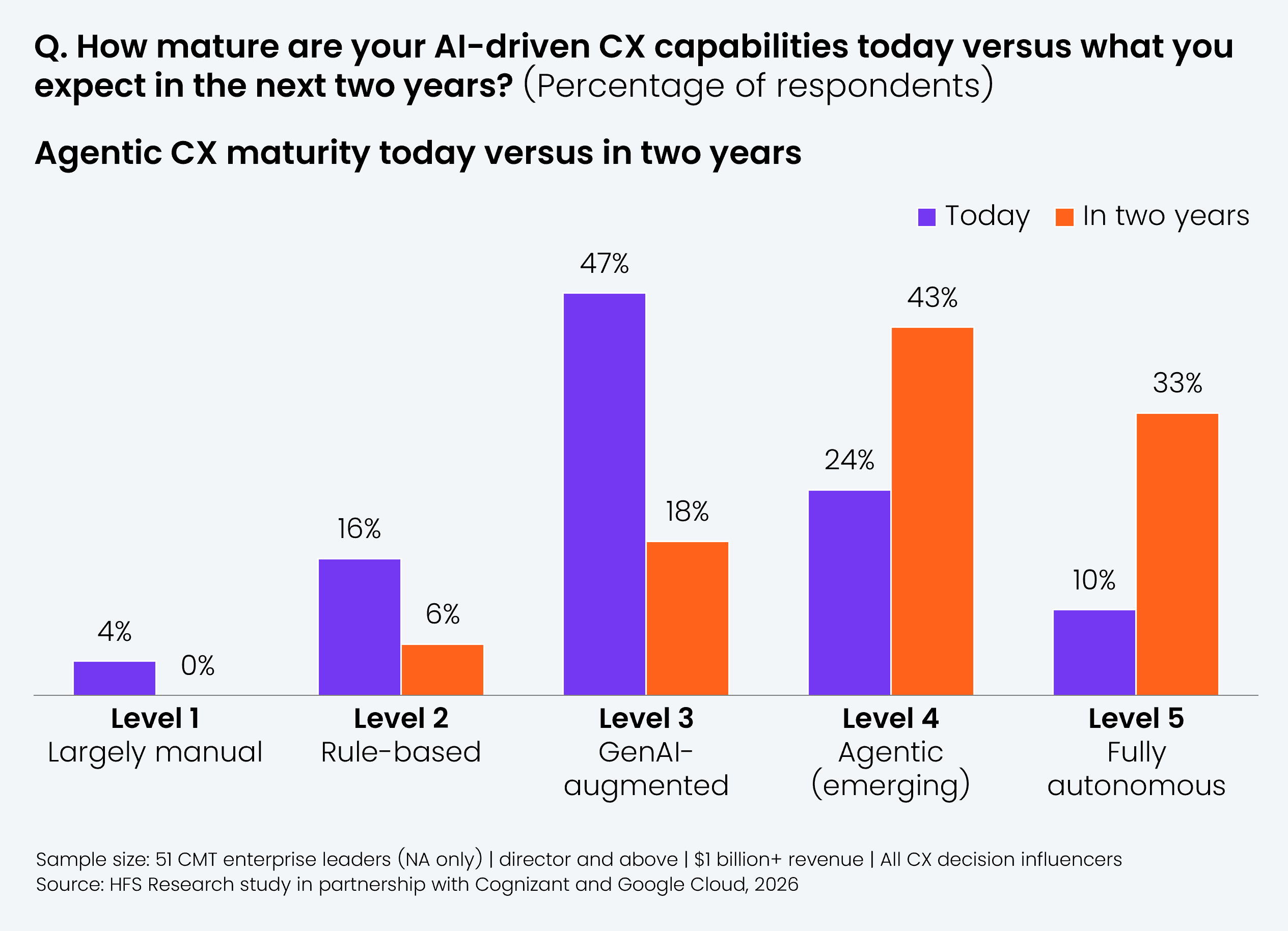
Grouped vertical bar chart comparing the share of respondents at each AI maturity level today against their expectations in two years, across five maturity levels. Level 1 (largely manual): today 4%, in two years 0%. Level 2 (rule-based): today 16%, in two years 6%. Level 3 (GenAI-augmented): today 47%, in two years 18%. Level 4 (agentic, emerging): today 24%, in two years 43%. Level 5 (fully autonomous): today 10%, in two years 33%. Sample: 51 CMT enterprise leaders, North America only, director and above, $1 billion+ revenue. Source: Cognizant, Google Cloud, and HFS Research, 2026.

  • Most CMT executives expect to jump two maturity tiers in 24 months. This requires a step-change in the operating model, not business as usual.
  • The Level 3-to-Level 4 leap is where value compounds. Moving from copilots that suggest the next action to agents is where CX economics change. It is also where integration and data debts should be addressed.
  • CMT leaders are planning a bigger maturity leap than most have made to date. The winners will be those who fix integration and data now.
  • Agentic CX delivers a Level 4 agent that handles a billing dispute end to end, including pulling the contract, issuing the credit, and updating the customer. Getting there is an integration project, not a single-system deployment.
    • Most enterprises are stuck in pilots instead of scaling AI

Most CX use cases sit at 20% scaled or below. Cross-system workflows such as billing (14%) and authentication (15%) lag the most.
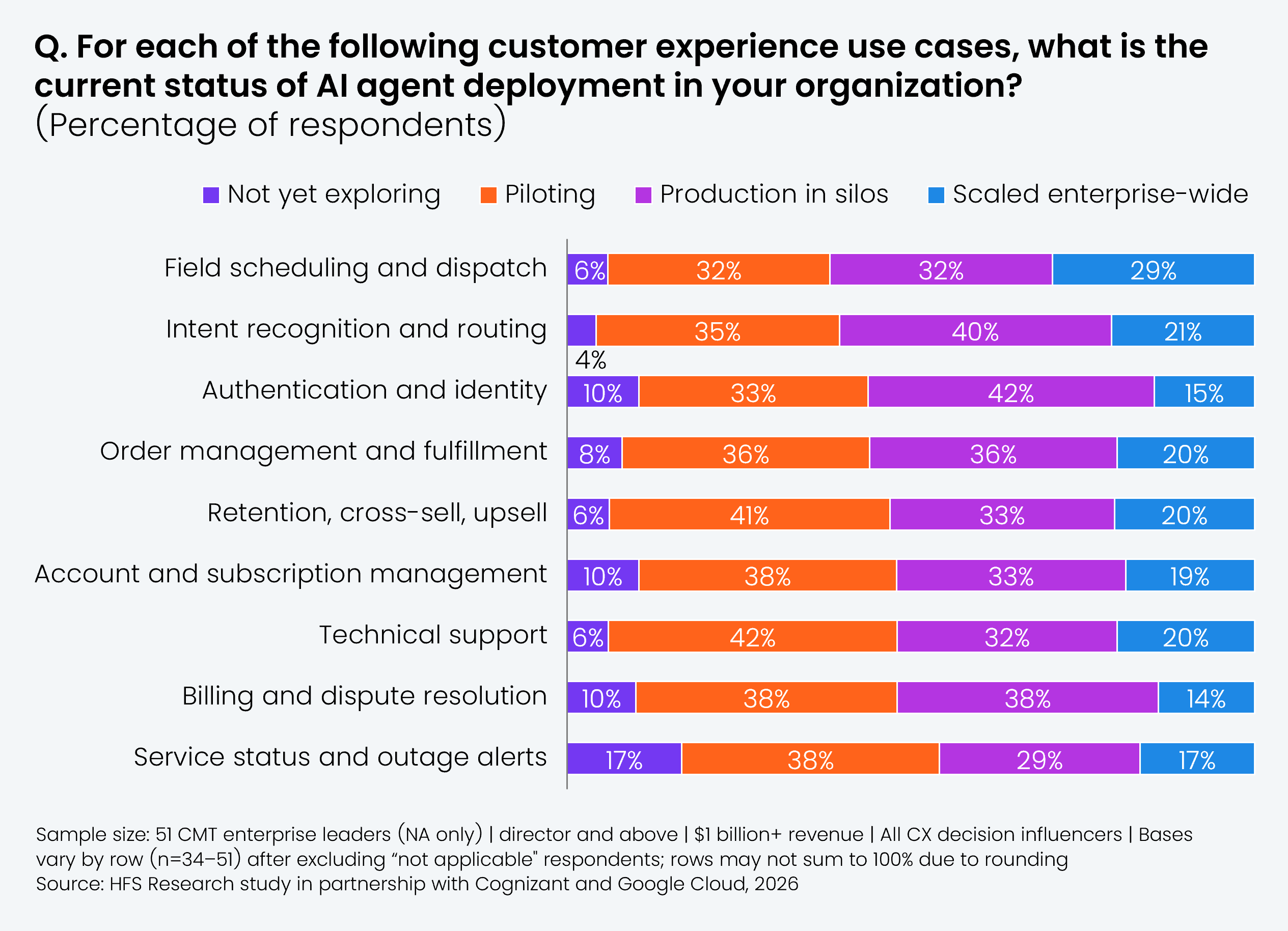
Stacked horizontal bar chart showing AI agent deployment status across nine CX use cases, with each bar split into four stages: not yet exploring, piloting, production in silos, and scaled enterprise-wide ("not applicable" responses are excluded from each bar). Values per use case (not yet exploring / piloting / production in silos / scaled enterprise-wide): field scheduling and dispatch 6%, 32%, 32%, 29%; intent recognition and routing 4%, 35%, 40%, 21%; authentication and identity 10%, 33%, 42%, 15%; order management and fulfillment 8%, 36%, 36%, 20%; retention, cross-sell, and upsell 6%, 41%, 33%, 20%; account and subscription management 10%, 38%, 33%, 19%; technical support 6%, 42%, 32%, 20%; billing and dispute resolution 10%, 38%, 38%, 14%; service status and outage alerts 17%, 38%, 29%, 17%. Sample: 51 CMT enterprise leaders, North America only, director and above, $1 billion+ revenue; bases vary by row (n=34 to 51) after excluding "not applicable" respondents, and rows may not sum to 100% due to rounding. Source: Cognizant, Google Cloud, and HFS Research, 2026.

  • Across every use case, most deployments sit in piloting or siloed production. Under 20% have scaled enterprise-wide across most use cases, well short of the 76% that plan to reach agentic CX in two years.
  • Single-domain use cases will scale first; cross-function ones are harder to crack. For example, a retention agent that knows the customer is in a billing dispute during a service outage is the kind of cross-silo move that protects retention. Today, that is the exception, not the default.
    • Generic AI cannot reason over a customer

Less than 40% of CMT leaders are satisfied with AI outcomes in any CX domain, as horizontal copilots and bolt-on tools fail to encode the workflows, rules, and customer data that decision-grade CX requires.
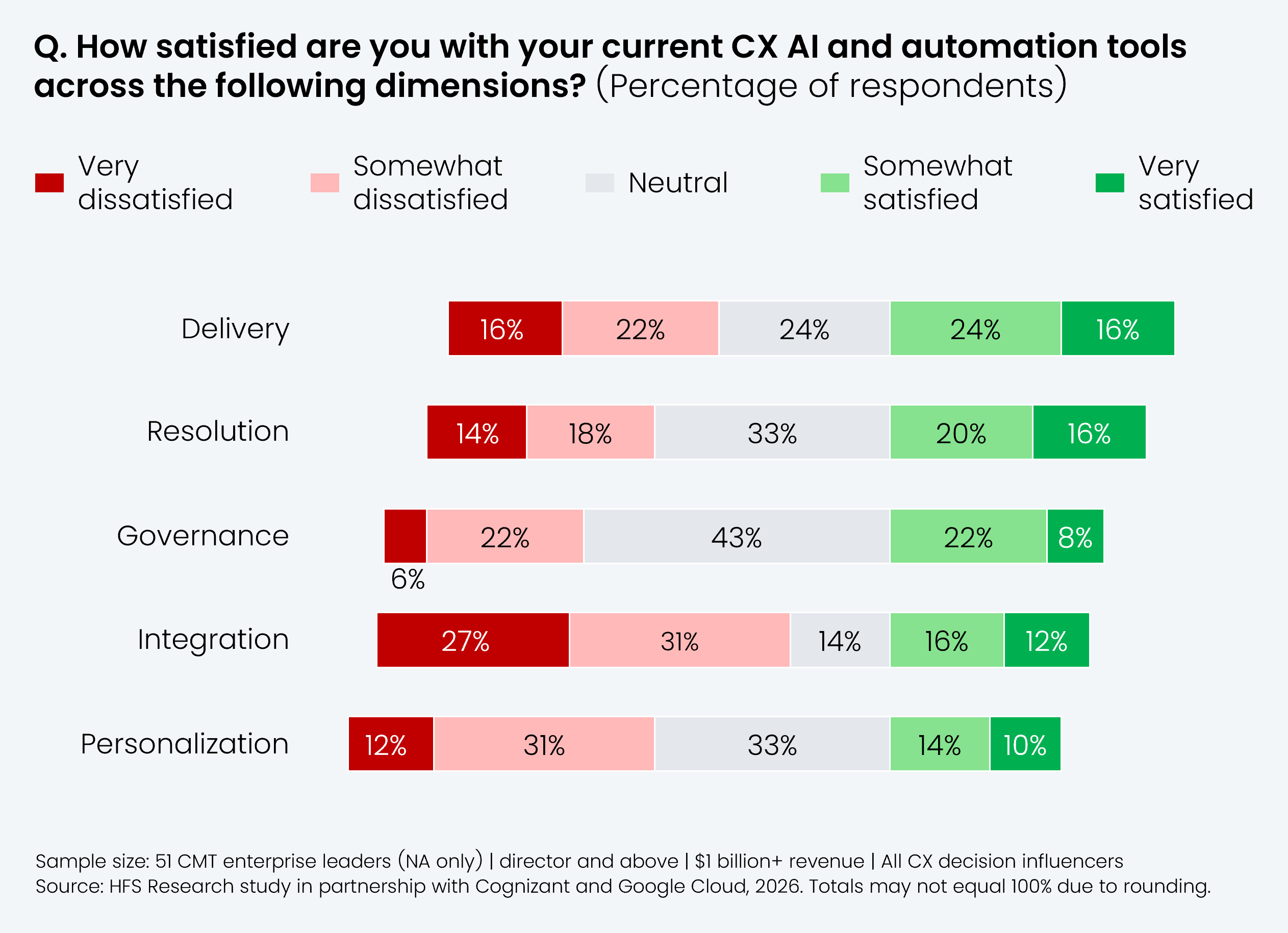
Diverging stacked horizontal bar chart showing satisfaction with current CX AI and automation tools across five dimensions, with each bar split into very dissatisfied, somewhat dissatisfied, neutral, somewhat satisfied, and very satisfied. Values per dimension (very dissatisfied / somewhat dissatisfied / neutral / somewhat satisfied / very satisfied): delivery 16%, 22%, 24%, 24%, 16%; resolution 14%, 18%, 33%, 20%, 16%; governance 6%, 22%, 43%, 22%, 8%; integration 27%, 31%, 14%, 16%, 12%; personalization 12%, 31%, 33%, 14%, 10%. Sample: 51 CMT enterprise leaders, North America only, director and above, $1 billion+ revenue; totals may not equal 100% due to rounding. Source: Cognizant, Google Cloud, and HFS Research, 2026.

  • CMT leaders are pouring investments into AI for CX. However, satisfaction with outcomes is capped well below ambition because generic models cannot reason over the specifics of a customer, a contract, or a workflow.
  • The gap is widest where context matters most. Personalization and cross-channel integration depend on customer signals, history, and downstream system state, precisely what horizontal tools cannot see.
  • Large neutral blocks indicate that pilots are running while outcomes are not yet good enough to defend a scale-up budget. It is a quiet form of failure that delays the harder conversation about the underlying systems.
  • A copilot that summarizes a support ticket without knowing the customer’s contract tier, prior escalations, or open invoices cannot drive resolution. Closing the gap requires CX-specific workflows, expert rules, and integrated customer data.
    • Integration and data are key blockers

Nearly half of the CMT leaders surveyed cite integration complexity (45%), data fragmentation (41%), and governance (41%) as the top blockers.
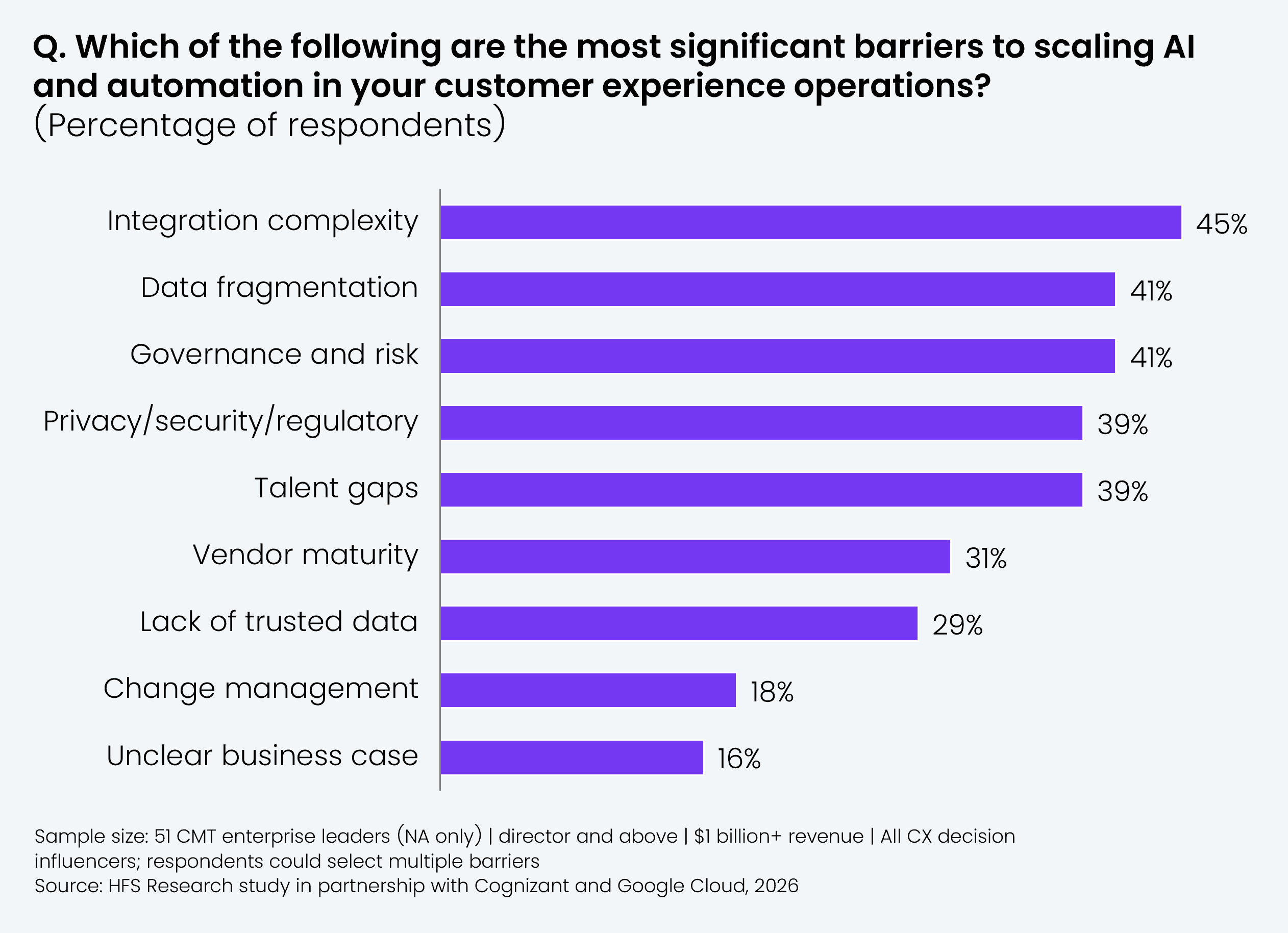
Horizontal bar chart ranking the most significant barriers to scaling AI and automation in CX operations by share of respondents selecting each barrier. Integration complexity 45%, data fragmentation 41%, governance and risk 41%, privacy/security/regulatory 39%, talent gaps 39%, vendor maturity 31%, lack of trusted data 29%, change management 18%, unclear business case 16%. Sample: 51 CMT enterprise leaders, North America only, director and above, $1 billion+ revenue; respondents could select multiple barriers. Source: Cognizant, Google Cloud, and HFS Research, 2026.

  • Integration and data are key blockers. The leading barriers are all plumbing problems: connecting systems, unifying data, and encoding rules.
  • Governance is now table stakes, not a brake. Blanket policies create more friction than they remove. Scaling requires governance controls built into the workflow itself.
  • Demand is not the problem. Business case and change management sit at the bottom of the list. Leaders know what they want agentic AI to do, but they cannot get the underlying systems to deliver it.
  • An AI agent that recommends a retention offer without seeing the customer’s billing disputes, tenure, or product entitlements is solving the wrong problem. Unblocking value requires CX-grade integration, trusted data, and built-in controls, not another model.
    • Winning CX starts with what’s already in place

Buyers rank integration, governance, and domain expertise above agentic AI-platform flexibility and pre-built agents.
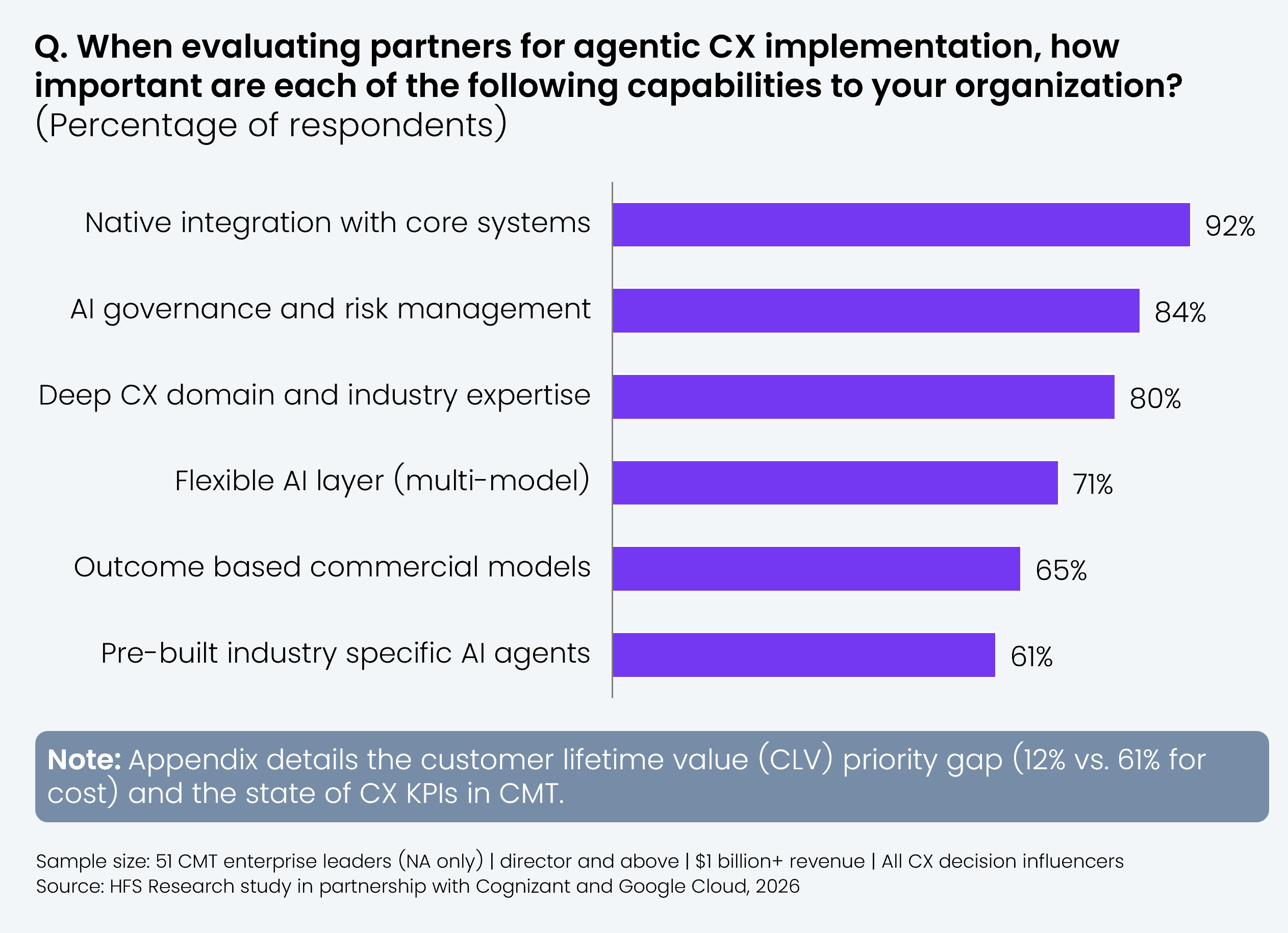
Horizontal bar chart ranking how important each partner capability is when evaluating partners for agentic CX implementation, by share of respondents rating it important. Native integration with core systems 92%, AI governance and risk management 84%, deep CX domain and industry expertise 80%, flexible AI layer (multi-model) 71%, outcome-based commercial models 65%, pre-built industry-specific AI agents 61%. Sample: 51 CMT enterprise leaders, North America only, director and above, $1 billion+ revenue. Source: Cognizant, Google Cloud, and HFS Research, 2026.

  • Enterprises prefer partners whose agentic CX work is defined by disciplined delivery and assurance, not by who has the best model.
  • Governance is now a procurement criterion. Buyers want guardrails built into agentic platforms, not bolted on after deployment.
  • Pre-built agents come last. Sector-specific workflows differ enough that customization beats configuration.
  • Deep partnerships matter. Vendors will need to align their frameworks and partnerships with what their customers have installed to be successful.
  • A partner that integrates the agent into the customer data and existing systems, demonstrates the governance trail and proves that the workflow in the buyer’s sub-segment will outsell one with a richer model menu.
The Bottom Line: Agentic CX represents CMT executives with a credible path to closing CMT’s growth-side CX gap. Capturing value requires partners with proven capabilities in integration, governance, and CX domain expertise. This also means that enterprises should shift their lens from cost to customer value.

CMT CX, IT, and operations leaders must take ownership of operationalizing agentic CX as a journey-wide capability, not a contact-center upgrade. The 18-month window for differentiated capability is open now.

Five moves CMT leaders must take to convert ambition into scaled value:

  1. Fix integration and data foundations: Fragmented data and disconnected systems are the binding constraint; no model compensates.
  2. Stop piloting and start scaling: Use the next 12 months to scale what already works.
  3. Treat journey-wide use cases as integration projects, not AI projects: Connect customer data and workflows before deploying the agent.
  4. Reframe the business case around CLV, not contact-center economics: Cost-out and CSAT are necessary but no longer differentiating.
  5. Select partners that work with the systems you already have: Integration, governance, and CX and industry domain expertise matter more than model choice.
    • Technology partners must
      Bring native integration accelerators into core operational systems, agent orchestration frameworks, AI governance for autonomous decisions, and a flexible AI layer that supports multiple foundation models and rapid deployment.

    • Service orchestrators must
      Bring deep CX domain expertise and sector-grade integration accelerators across the full customer journey, from onboarding through retention; scale agent + human operating models that turn agentic CX from a contact center upgrade to a customer value engine, with measurable gains in containment, first-contact resolution, and customer satisfaction.

The largest unrealized value in CMT agentic CX is the re-orientation from cost-first to CLV-led investment thesis.
Appendix
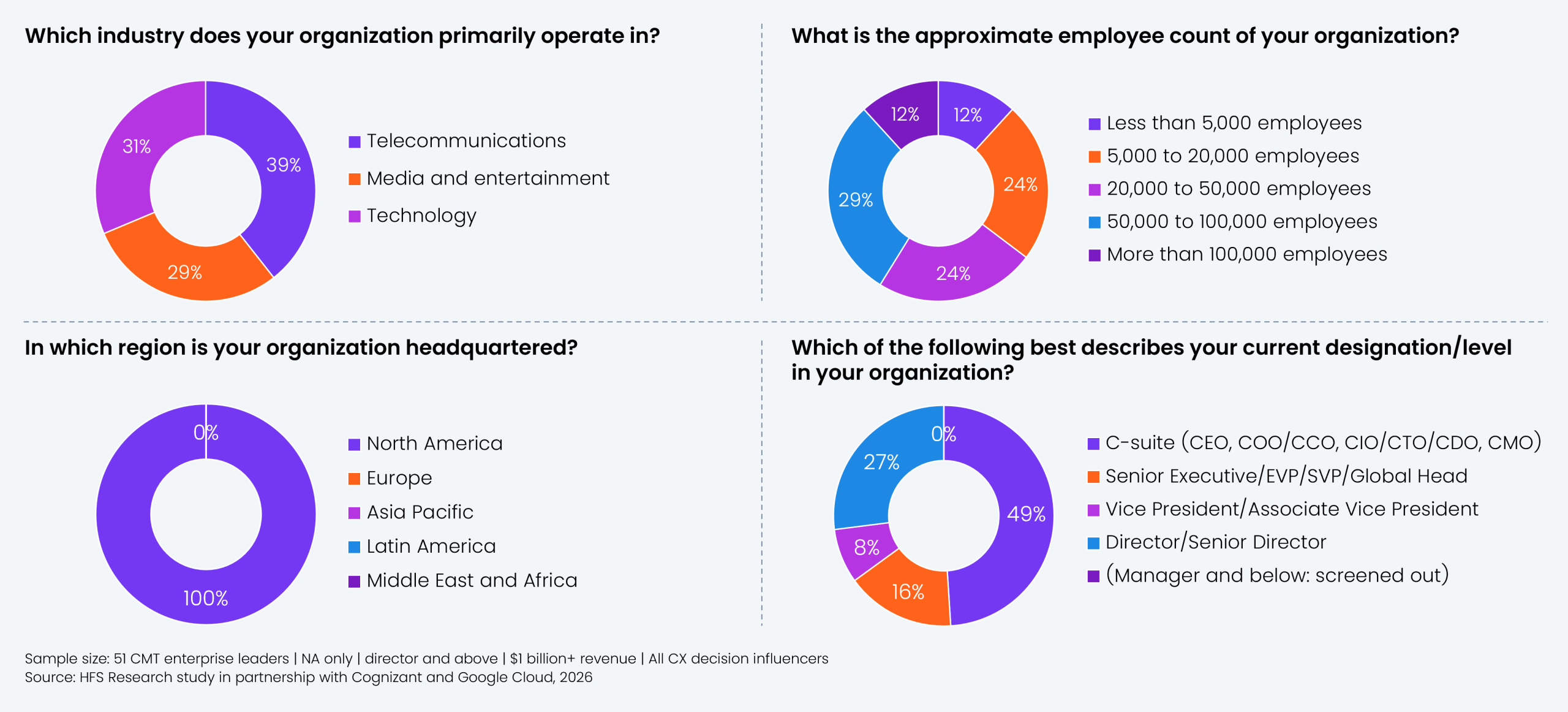
Survey demographics

Four donut charts showing the survey sample profile. Industry: telecommunications 39%, technology 31%, media and entertainment 29%. Approximate employee count: 50,000 to 100,000 employees 29%, 5,000 to 20,000 employees 24%, 20,000 to 50,000 employees 24%, less than 5,000 employees 12%, more than 100,000 employees 12%. Headquarters region: North America 100%. Designation/level: C-suite (CEO, COO/CCO, CIO/CTO/CDO, CMO) 49%, director/senior director 27%, senior executive/EVP/SVP/global head 16%, vice president/associate vice president 8%, with manager and below screened out. Sample: 51 CMT enterprise leaders, North America only, director and above, $1 billion+ revenue. Source: Cognizant, Google Cloud, and HFS Research, 2026.

AI has delivered efficiency, the next frontier is lifetime value

AI in CX programs at CMT companies are incomplete: efficiency is done, but growth and experience haven’t caught up. The next dollar pays off in retention, cross-sell, and customer perception, not further productivity gains.
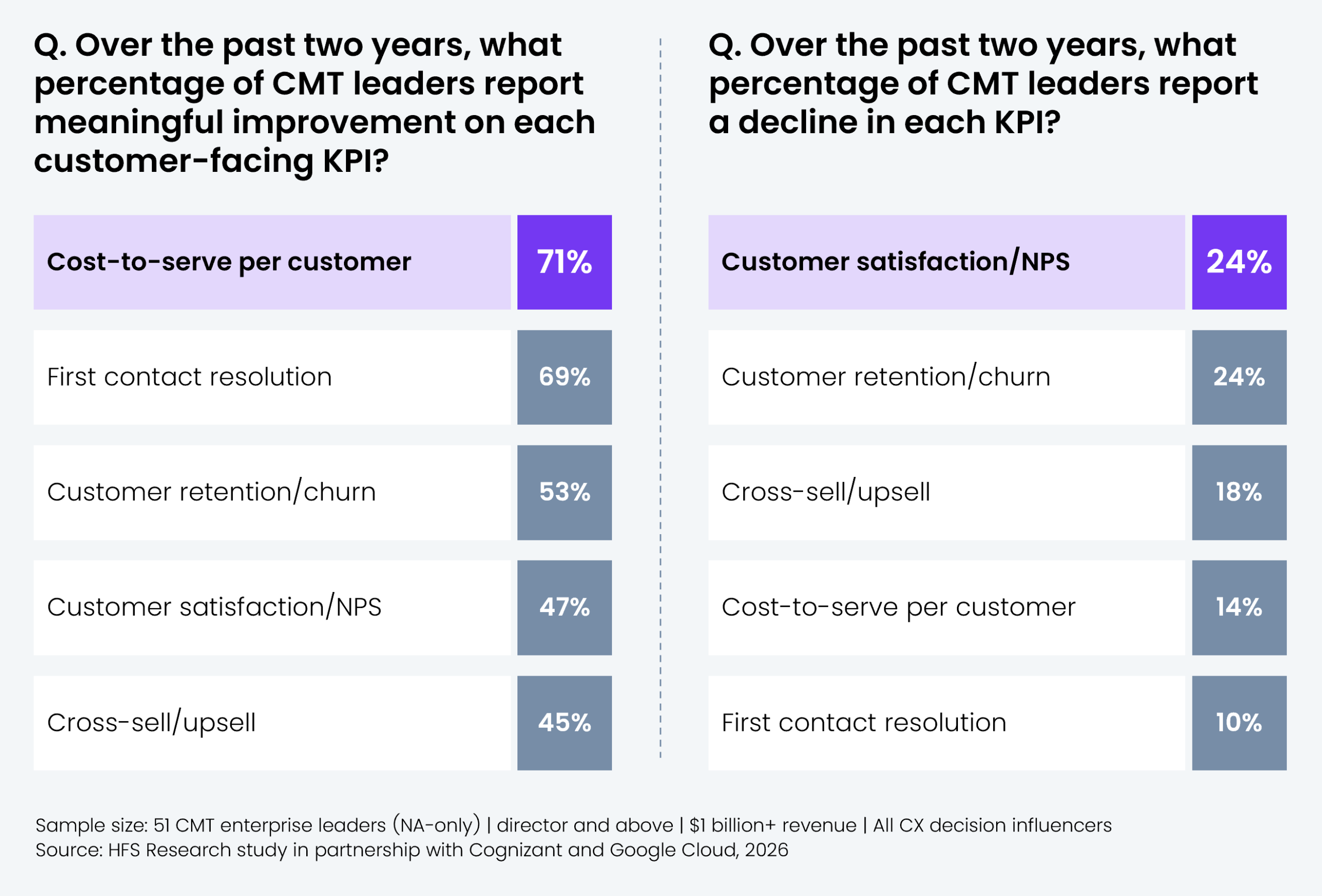
Two ranked comparison tables. The first lists the share of CMT leaders reporting meaningful improvement on each customer-facing KPI over the past two years: cost-to-serve per customer 71%, first contact resolution 69%, customer retention/churn 53%, customer satisfaction/NPS 47%, cross-sell/upsell 45%. The second lists the share reporting a decline in each KPI: customer satisfaction/NPS 24%, customer retention/churn 24%, cross-sell/upsell 18%, cost-to-serve per customer 14%, first contact resolution 10%. Sample: 51 CMT enterprise leaders, North America only, director and above, $1 billion+ revenue. Source: Cognizant, Google Cloud, and HFS Research, 2026.

  • AI in CX has matured along the path of least resistance, with a focus on productivity and stalled elsewhere.
  • Cost-to-serve and first-contact resolution are shaped by volume, routing, and containment, which are exactly what large language models, classification, and retrieval do well.
  • AI falls short on the KPIs that depend on context it does not yet hold:
    • Experience requires reading tone, history, and intent across a relationship, not a single ticket.
    • Retention plays out in the moments before churn, which sit outside the contact center.
    • Cross-sell needs an agent built to expand the relationship. Most agents are built to close the ticket.
    • The result is an incomplete program with AI industrializing the cost side of CX, while growth and experience wait for a capability that understands the customer, not just the CX silo.
CLV is the undervalued prize; enterprises are still funding agentic CX on cost-out

Cost reduction sits at the top of the priority list. However, executives need to be wary of a singular focus on cost as it may inadvertently impact growth side metrics.
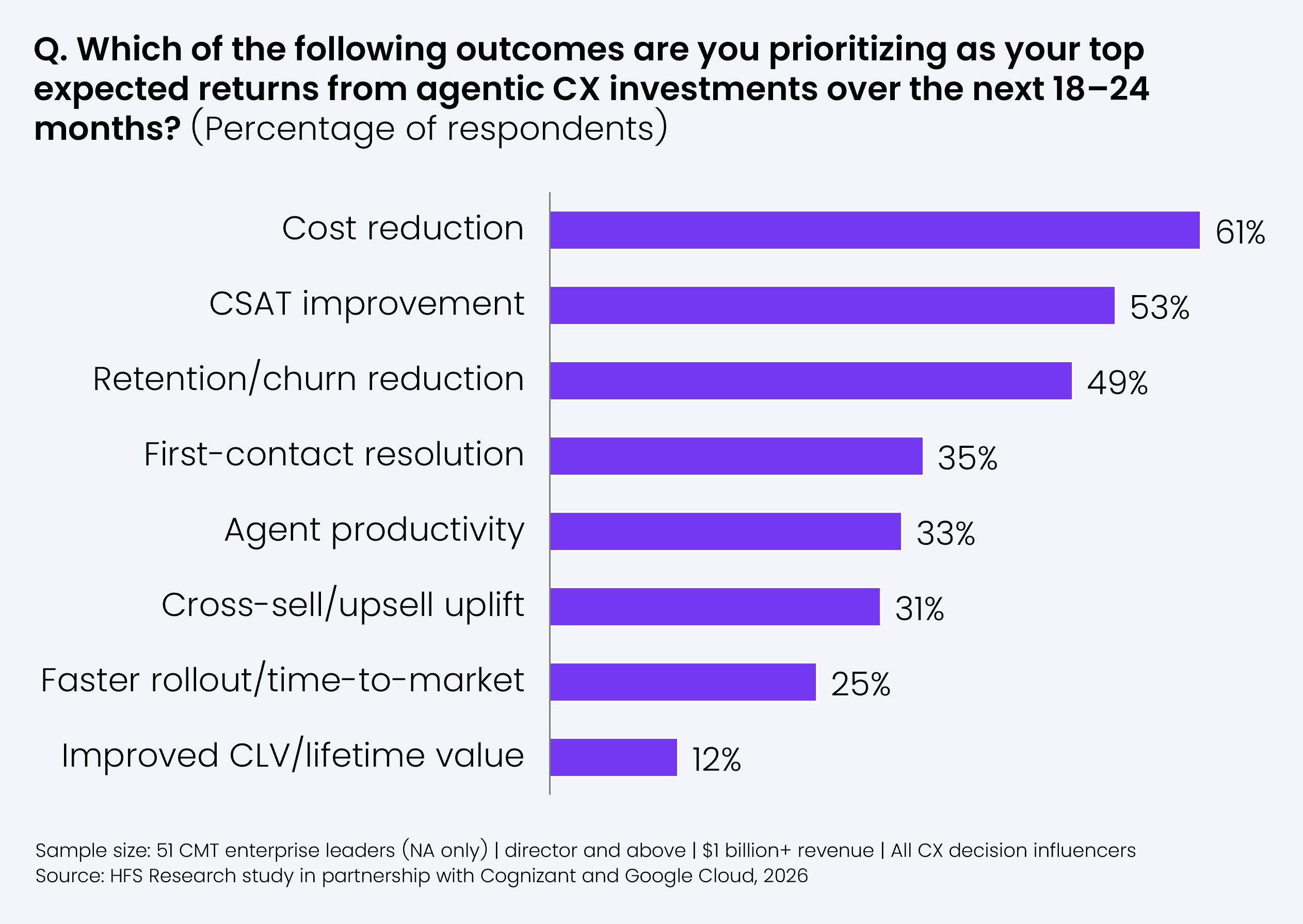
Horizontal bar chart ranking the top expected returns CMT leaders prioritize from agentic CX investments over the next 18 to 24 months, by share of respondents. Cost reduction 61%, CSAT improvement 53%, retention/churn reduction 49%, first-contact resolution 35%, agent productivity 33%, cross-sell/upsell uplift 31%, faster rollout/time-to-market 25%, improved CLV/lifetime value 12%. Sample: 51 CMT enterprise leaders, North America only, director and above, $1 billion+ revenue. Source: Cognizant, Google Cloud, and HFS Research, 2026.

  • The priority list is a wake-up call. CMT leaders want better retention, higher CSAT, and growth-side outcomes. However, they are funding agentic CX primarily through a cost-reduction lens. You cannot buy your way to CLV with a cost-out budget.
  • CLV uplift is the underplayed frontier. The one outcome that signals genuine lifetime-value thinking sits at the bottom of the list, while every other outcome (cost, satisfaction, productivity, retention) clusters in the same band.
  • An agent that resolves a billing issue prevents a churn moment and surfaces a relevant upsell in one interaction as the CLV unit of value. Today, that outcome lives in three priority buckets and three different teams.

Sign in to view or download this research.

Login

Register

Insight. Inspiration. Impact.

Register now for immediate access of HFS' research, data and forward looking trends.

Get Started


Download Research

    Sign In

    Sign up for a free
    research account

    With the exception of our Horizons reports, most of our research is available for free on our website. Sign up for a free account and start realizing the power of insights now.

    By registering you agree to our privacy policy.

    I hereby consent that HFS Research can process my personal data.

    Digests/Newsletters: Overviews of the latest news, insight, and research by HFS.

    HFS Events: Exclusive invitations to HFS webinars, roundtables, and summits, bringing together key industry stakeholders focused on major innovations impacting business operations.

    Premium Access

    Our premium subscription gives enterprise clients access to our complete library of proprietary research, direct access to our industry analysts, and other benefits.

    Contact us at [email protected] for more information on premium access.

      Contact Ask HFS AI Support