The HFS Generative GCC Index, 2026 is for GCC leaders, headquarters executives, and enterprise transformation leaders benchmarking how far India’s global capability centers have moved from shared services toward generative enterprises.
This report is for leaders looking to transform their GCCs from shared services centers to generative enterprises by improving the current maturity score through AI and other emerging technologies while continuing to share responsibilities, product innovation, and talent transformation activities.
India hosts approximately 2,117 GCCs operating across more than 3,700 units, generating roughly $98 billion in revenue, and employing around 2.36 million people as of March 2026, according to Nasscom. The key growth drivers are access to AI talent with a cost advantage, domain expertise, and ability to rapidly bring ideas to life, and, more importantly, a strong ecosystem of partnerships and innovation support.
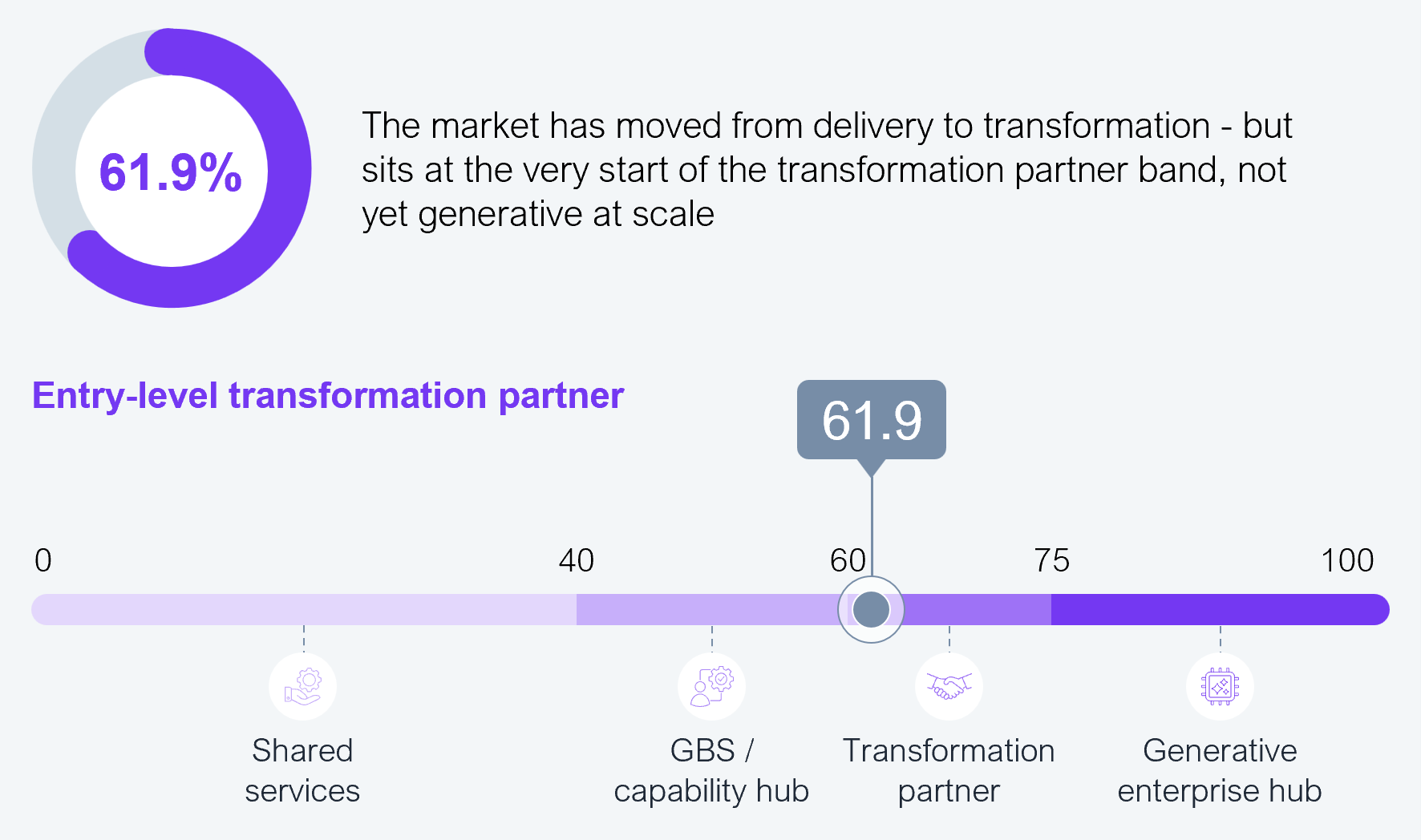
These centers spent more than two decades proving their capability. However, while 83% of the enterprises that own them consider mission-critical, only 17% have control over decisions and budgets. The inaugural 2026 HFS Generative GCC Index captures this disconnect. The score of 61.9 indicates a market that earned strategic importance at a much faster rate than the authority that accompanied it. The index converts the survey responses from India’s top GCC leaders into a maturity score spanning role, work, ownership, AI, talent, and ecosystem. It positions each center on HFS’ four-stage GCC maturity framework that charts the evolution from shared services to generative enterprises.
This study, executed in collaboration with ANSR, reveals a market in transition. GCCs are outgrowing their identity as capability delivery units and are becoming enterprise transformation engines, driving innovation and shaping how global businesses compete and grow. Most stand at the entry point of the transformation partner band, while a few are becoming generative at scale. The study represents seven broad industries headquartered in North America, Europe, the UK, and Asia.
Key insights from the 2026 HFS Generative GCC Index study


GCCs in India have decisively moved beyond shared services, but the next jump in maturity depends on AI at scale, platform engineering, and closing the empowerment gap. The score should be viewed as both an achievement and a warning. Without changes to partner-led operating models, talent anchored in process expertise, and ownership withheld by headquarters, the 2027 reading is likely to look similar to what it does today.
The next step for leaders is to use the index findings to present three questions at the next leadership meeting:

Transformation, engineering, and AI now define the center of gravity
GCCs no longer see themselves as shared service organizations, moving themselves away from operational efficiency and service delivery to enterprise transformation, digital innovation, and strategic ownership. Over the next 12–18 months, the differentiator will be whether they can lead transformation, as participation alone has become the baseline expectation.
When asked to describe the primary role of their GCCs today, only 17% of the leaders identify them as shared services centers, while 21% see them as integrated global business services (GBS) organizations (see Exhibit 1). They are increasingly viewed as digital transformation and engineering hubs (38%) and AI, data, and automation CoEs (34%), followed by product/platform ownership centers (23%).
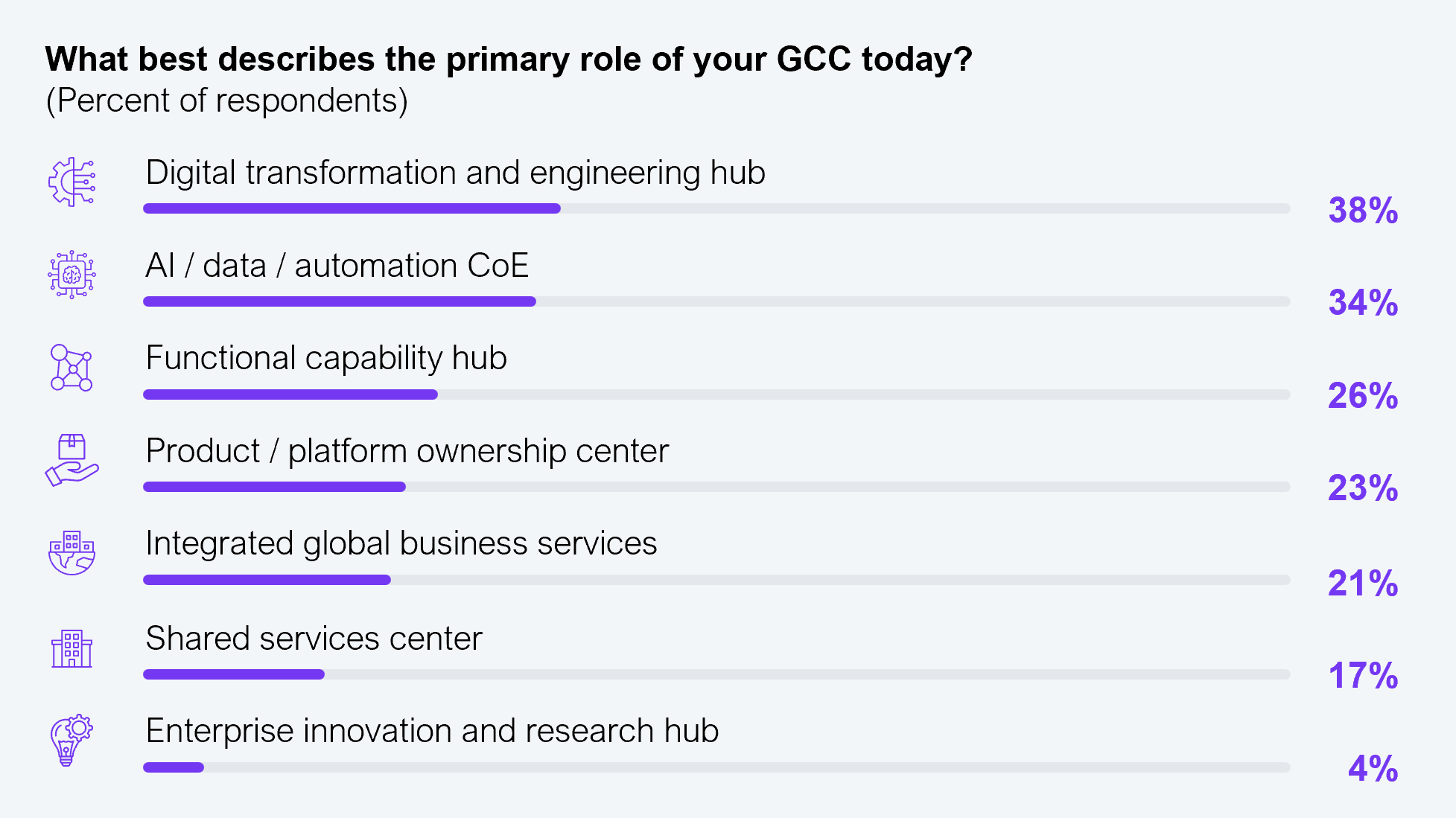
Sample size: 47 GCC leaders; respondents could choose multiple options, hence the total does not sum up to 100%
Source: HFS and ANSR Pulse survey, May and June 2026
Moreover, cost has stopped being the most important measure of contribution. Today’s GCC is defined by what it transforms, engineers, and intellectually owns. If the board presentation for your GCC still opens with headcount and cost per FTE, you are measuring a version of the center that ceased to exist several years ago. According to the HFS GCC Intel 360, about 45% of the 105 GCCs opened in 2025 have digital transformation, engineering, research, and development components in scope. This shows that engineering-based innovation is on the rise and product development and engineering maintenance are being in-sourced from vendors. Companies such as Boeing, Celanese, Rolls-Royce, and Lonza have already set up their engineering functions in India and are expected to further expand their engineering operations in the next 18 months.
Modern day GCCs have evolved into transformation engines for their enterprises, driving innovation, building differentiated capabilities, and enabling continuous evolution through the right integration of people, processes, and technology. To create a winning enterprise value proposition, we must translate lessons from the past and insights from the future into decisive action today.
Successful GCCs will attract the right talent while building durable, future-ready capabilities. AI is no longer experimental. It sits at the heart of the GCC strategy, with digital transformation as the top enterprise priority. When it comes to retail, the industry is being reshaped by digital transformation, powered by AI, omnichannel integration, and automation. Costco is actively leveraging these technologies to optimize its business operations and maximize the value of its membership model while continuing to scale its physical footprint. In this era of profound reinvention, digital capabilities are no longer optional; they are a necessity.
— Rajeev Mall, CEO, Costco Wholesale India
Data, engineering, and AI form the heart of modern GCC work
The 2026 HFS Generative GCC Index reveals that the focus has shifted from IT delivery to data engineering and intelligent decision making (see Exhibit 2). GCCs not only build or maintain applications but also make enterprise data fluent. AI/machine learning (ML) is the only capability where recent expansion is ahead of current delivery. Fifty-five percent of the GCC leaders reported expansion in the past 18 months against 51% delivering it today. The second-largest area of recent growth is data engineering and analytics, followed by product engineering/R&D, reinforcing the focus on faster decision making and innovation.
The concentration of investment in AI, data, and engineering signals where global enterprises expect future value creation to originate. AI blueprinting is no longer a purely technological exercise. Through GCCs, enterprises are operationalizing AI and agentic capabilities across every business and corporate function, positioning these centers as strategic capability hubs that enable enterprise-wide digital transformation.
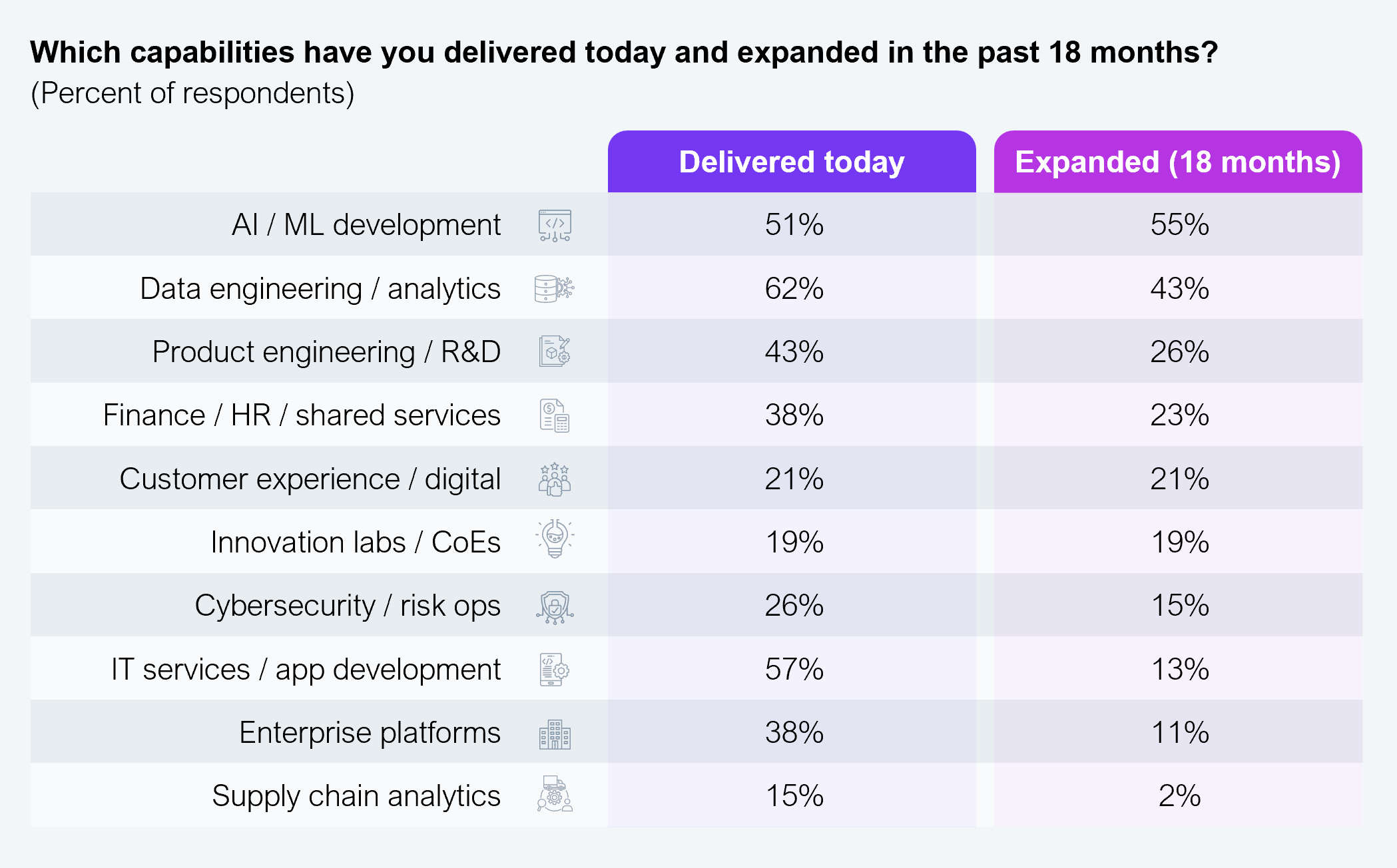
Sample size: 47 GCC leaders; respondents could choose multiple options, hence the total does not sum up to 100%
Source: HFS and ANSR Pulse survey, May and June 2026
The flip side is that the GCCs are de-prioritizing growth in IT services. IT services and app development are widely delivered but are no longer growth drivers. The index data shows that GCC capabilities have expanded meaningfully in product engineering, shared services, customer services, and innovation labs, which continue to be the most important strategic hubs for many GCCs.
Also, the biggest concerns are cybersecurity and supply chain analytics, which are critical to operations and currently facing pressure from AI risks but are overlooked in expansion plans. This data serves as a warning: while GCCs are scaling efforts that drive AI-led growth, they are not investing adequately in protective measures. To truly transform, leaders must integrate cybersecurity, supply chain analytics, and platform-engineering modernization into their conversations about AI/ML expansion.
India-based GCCs hold a distinct advantage by seamlessly integrating engineering, analytics, and product development within a single ecosystem. This setup facilitates quicker decision making, deeper insights, and the adaptability needed to meet evolving consumer expectations. The forthcoming phase will involve transitioning from pilot projects to scaled deployments that significantly enhance both operational efficiency and customer experiences.
At lululemon, we recognize a promising opportunity to further leverage AI responsibly and technology to advance our product innovation, increase our agility and speed to market, and deliver more personalized and engaging guest experiences. With India’s rich talent pool and technological prowess, GCCs are well-positioned to drive the next wave of global retail innovation.
— Praveen Mysore, Vice President – Product Technology and Head of India Tech Hub, lululemon
Enterprises are starting to measure GCCs on value, productivity, AI, and outcomes
GCC KPIs are shifting from cost-efficiency and headcount toward outcome-led metrics such as revenue influence, innovation velocity, and time-to-value. As enterprises globally redefine success around business impact rather than activity, GCCs are evolving from delivery centers into value engines that drive AI-led transformation, and shape strategic agendas from the core. The mandate now extends from savings to growth, measured by the enterprise outcomes these centers enable, the capabilities they build, and the markets they help unlock.
To connect value creation to impact measurement, GCC leaders must align strategic initiatives with key performance indicators (KPIs). According to the 2026 HFS Generative GCC Index, 45% of the leaders recognize the role of AI, data, and automation in creating value, followed by operational delivery, scale, cost, and specialized capabilities (see Exhibit 3). With productivity now taking precedence over cost efficiency, the focus should be on metrics such as output per employee and resource utilization to evaluate how these technologies enhance operational effectiveness. Such a shift indicates that the value derived from operational improvements goes beyond mere cost-cutting, emphasizing the importance of gauging overall performance and productivity.
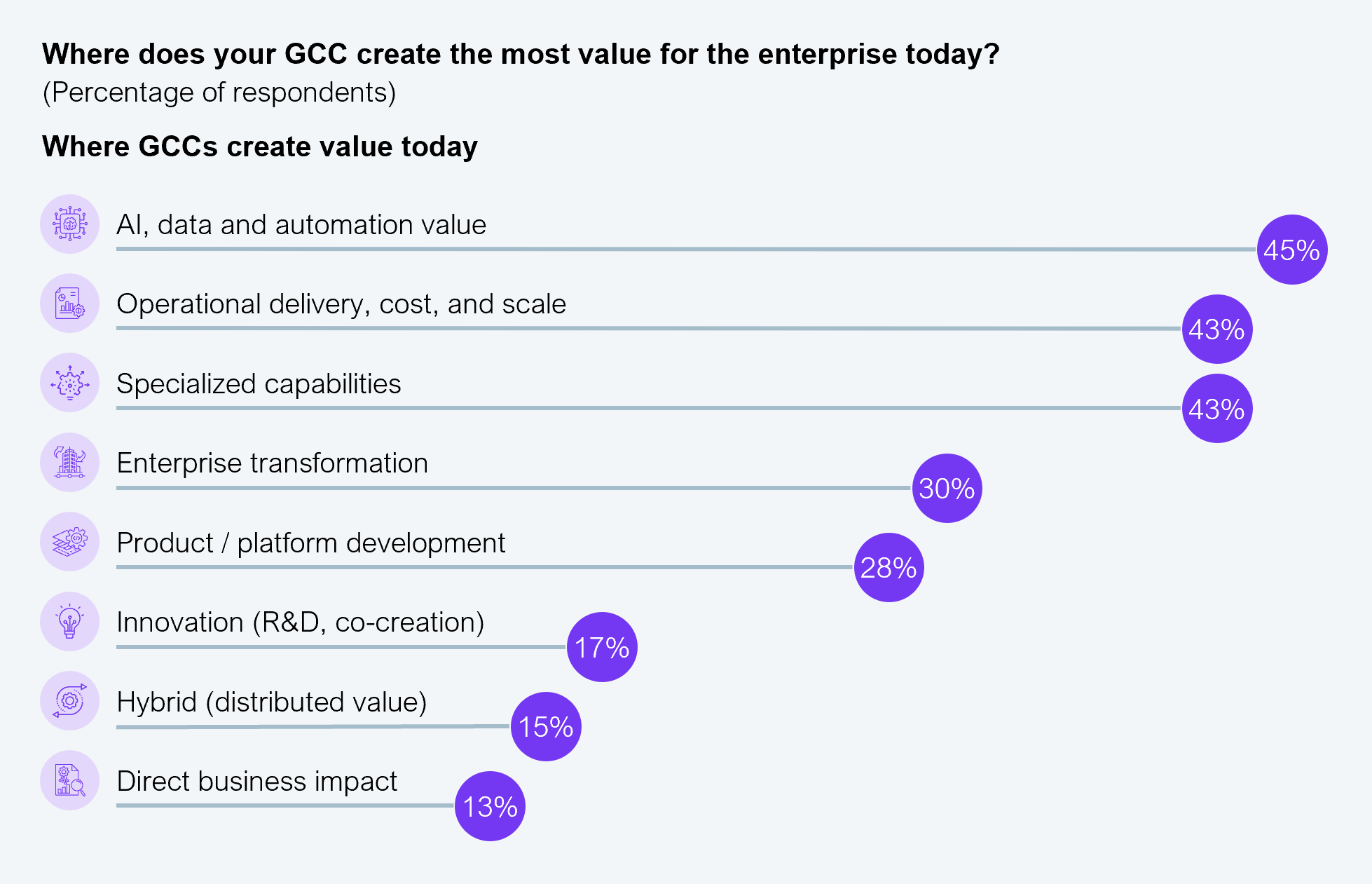
Sample size: 47 GCC leaders; respondents could choose multiple options, hence the total does not sum up to 100%
Source: HFS and ANSR Pulse survey, May and June 2026
AI and automation value delivered (51%) and productivity improvements (49%) now lead how enterprises measure GCC impact, ahead of cost efficiency (43%). Survey data also shows that about 23% of GCC leaders point to revenue impact and customer experience and 21% find time-to-market as key metrics for measuring impact. Tracking customer satisfaction scores and net promoter scores can provide insights into the effectiveness of initiatives aimed at improving customer experience (see Exhibit 4). By establishing metrics that reflect both operational efficiency and customer-focused outcomes, GCCs can better understand the tangible impact of their value-generation efforts through AI and automation.
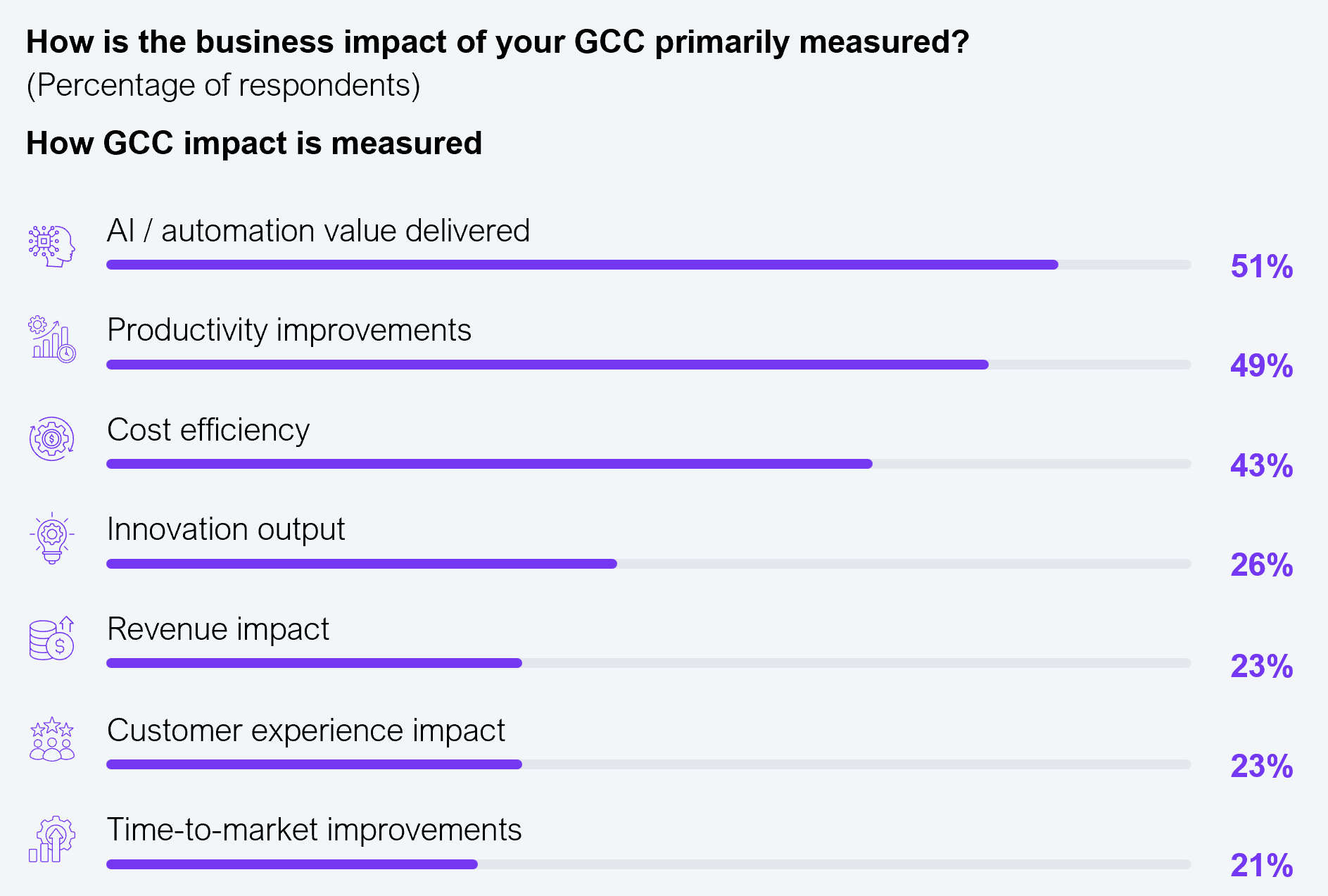
Sample size: 47 GCC leaders; respondents could choose multiple options, hence the total does not sum up to 100%
Source: HFS and ANSR Pulse survey, May and June 2026
At the same time, GCCs often struggle to identify the right KPIs for reporting and publishing outcomes, and the consequences are already visible: when the numbers do not meet expectations, the work goes to third-party service providers. A European automotive company, for instance, moved some of its innovation work from its GCC to an Indian systems integrator to accelerate the launch of a specialized advanced driver assistance systems (ADAS) and connectivity modules in newly launched vehicles. Enterprises are now asking their GCCs how quickly the product will be in the market compared to their competitors while maintaining the highest quality and a scalable model.
GCCs have rapidly evolved from cost-focused hubs to strategic engines of innovation. Their growth is powered by the ability to harness AI, data, and digital platforms to deliver enterprise-wide transformation.
Beyond traditional support roles, GCCs are shaping business models, driving operational agility, and fostering resilience in an increasingly complex market. By connecting cross-functional strategies and leveraging advanced technologies such as agentic AI and machine learning, GCCs are uniquely positioned to unlock new efficiencies, outcomes, and accelerate enterprise transformation.
This integration not only enhances productivity but also positions GCCs as indispensable partners for global businesses empowering them to thrive in a dynamic, technology-driven future.
— Sunil Gopinath, CEO, Albertsons Companies India
GCCs are embedding AI, but the Services-as-Software™ story needs its own deep dive
GCCs are democratizing AI for all, embedding intelligence into every role, workflow, and decision across the enterprise. The market has moved beyond proving AI’s potential to confronting the deeper challenge of redesigning the enterprise around it, moving the conversation from adoption to architecture. Enterprises and GCCs that master this transition will define the next generation of leadership as AI becomes the operating logic they run on.
But while GenAI technology is ready for deployment, our discussions revealed that most enterprises lack the structured, comprehensive, and contextualized data needed. Their data is largely fragmented, sourced from multiple parties acquired through M&As or from various internal and external entities. Additionally, the ERP, CRM, and supply chain systems are highly tailored to various use cases, complicating AI deployment.
According to the index data, 45% of GCC leaders said they embedded AI across delivery workflows, another 28% were running pilots, and 23% are in early experimentation stages. Only 4% have not started any AI initiatives and lack an AI-native operating model. The overall market has moved past pilots but not yet rewired the operating model around the tech (see Exhibit 5).
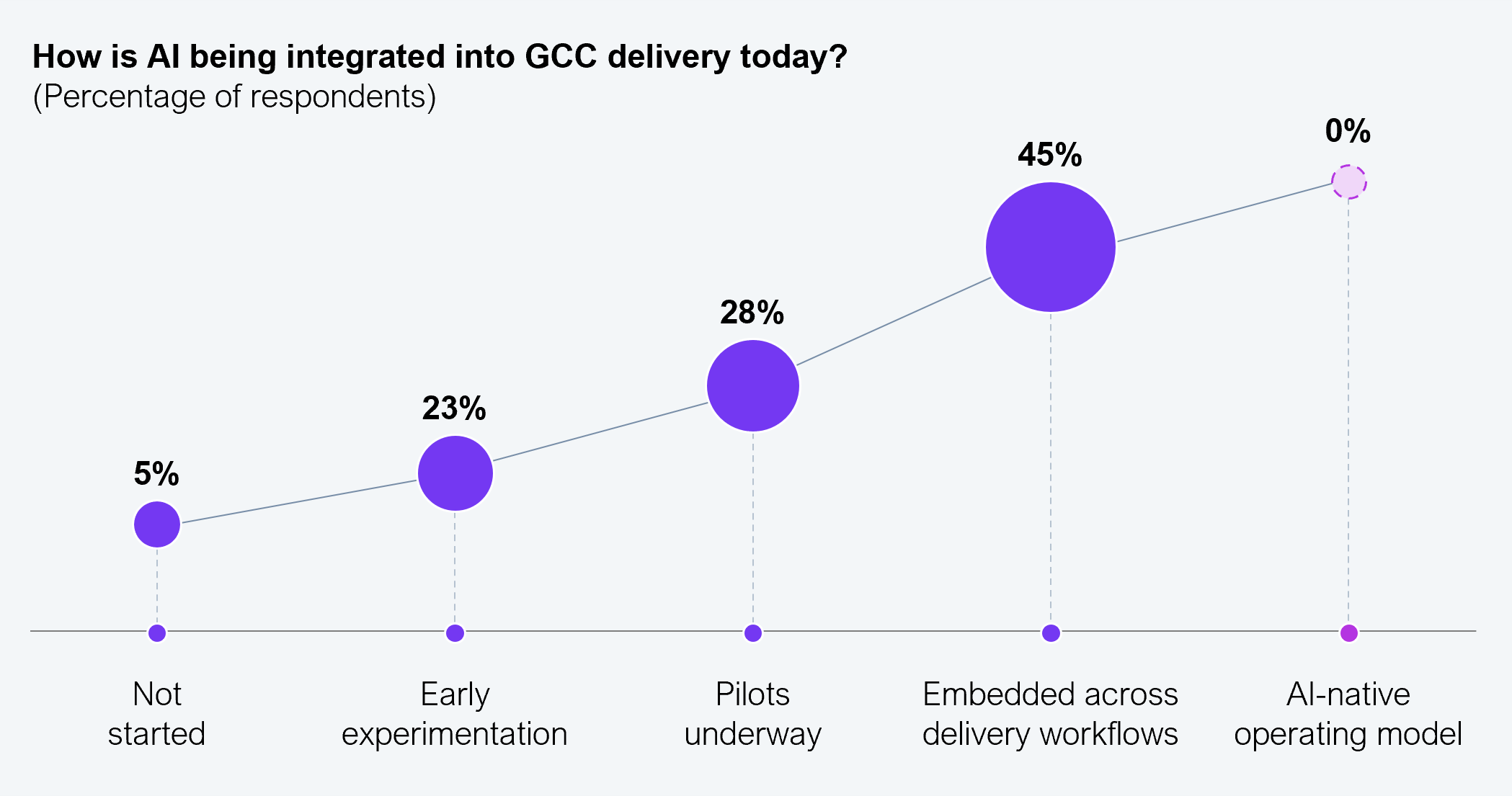
Sample size: 47 GCC leaders; respondents could choose multiple options, hence the total does not sum up to 100%
Source: HFS and ANSR Pulse survey, May and June 2026
In terms of where leaders see the greatest value today, 43% see GenAI driving automation in process-driven workflows (accounts payable, sourcing and procurement, supply chain, and software development life cycle), followed by decision intelligence and analytics
(see Exhibit 6). Many GCCs reported a significant 20%–40% productivity gain. However, some GCCs are more cautious, as code generation has accelerated automation, while validation, evaluation, and testing of the code are taking longer than usual. Traceability, trust factors, and ownership are key areas in calculating the value driven by the AI-based productivity.
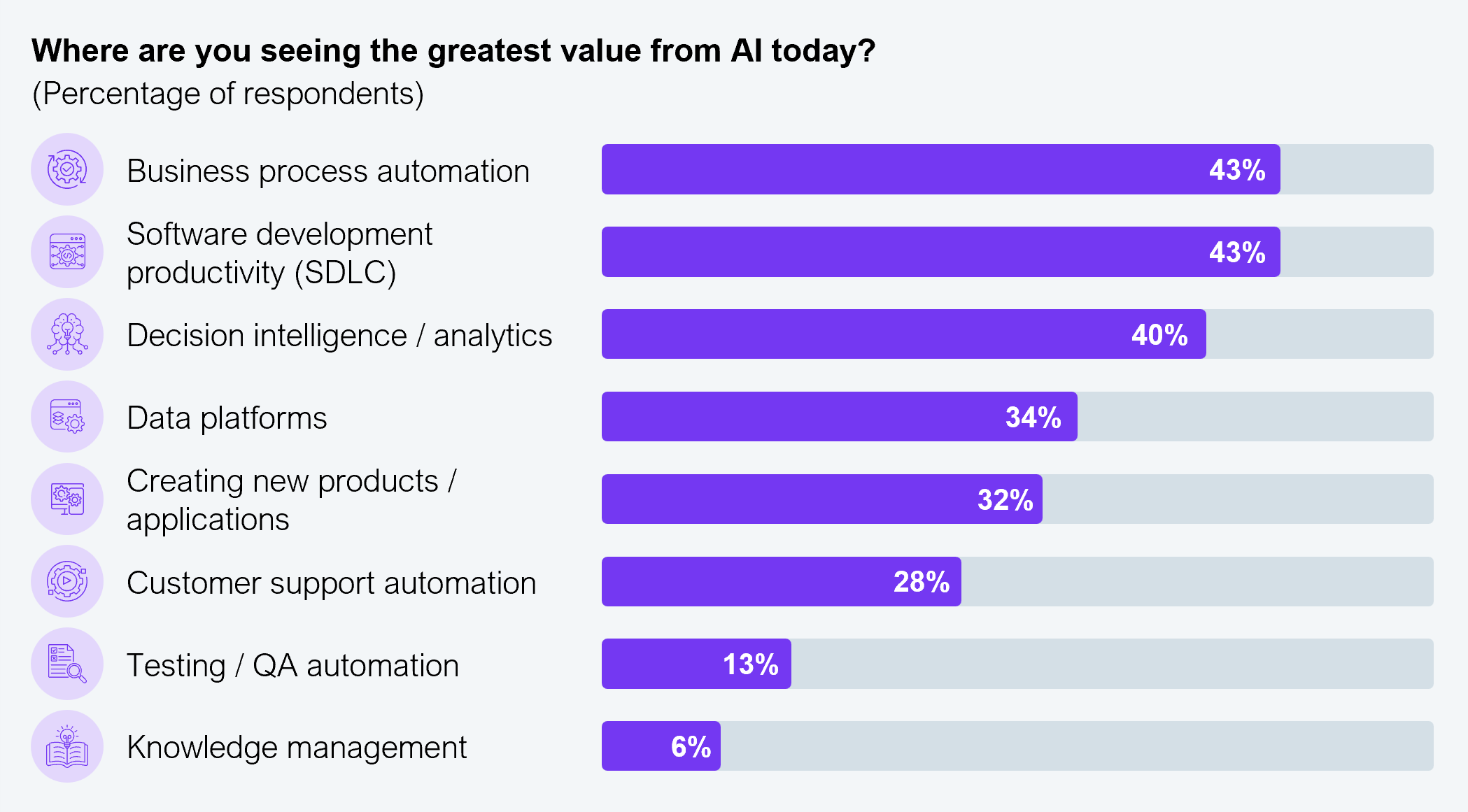
Sample size: 47 GCC leaders; respondents could choose multiple options, hence the total does not sum up to 100%
Source: HFS and ANSR Pulse survey, May and June 2026
The competitive edge will no longer come from adding more tools, but from how deeply intelligence is embedded into decision making. Data will evolve from a reporting asset into a real-time operating layer, enabling brands to anticipate desire rather than simply respond to demand. Talent models will shift as humans move away from execution toward judgment, creativity, and exception handling, while machines deliver scale and speed.
In this context, GCCs will play a pivotal role, acting as engines for AI and agentic automation, building, deploying, and continuously refining intelligent systems that drive enterprise-wide value at scale.
— Madhu Natesan, VP and MD at Under Armour India
The strongest GCCs will be measured by what they own, and not by how many people they employ
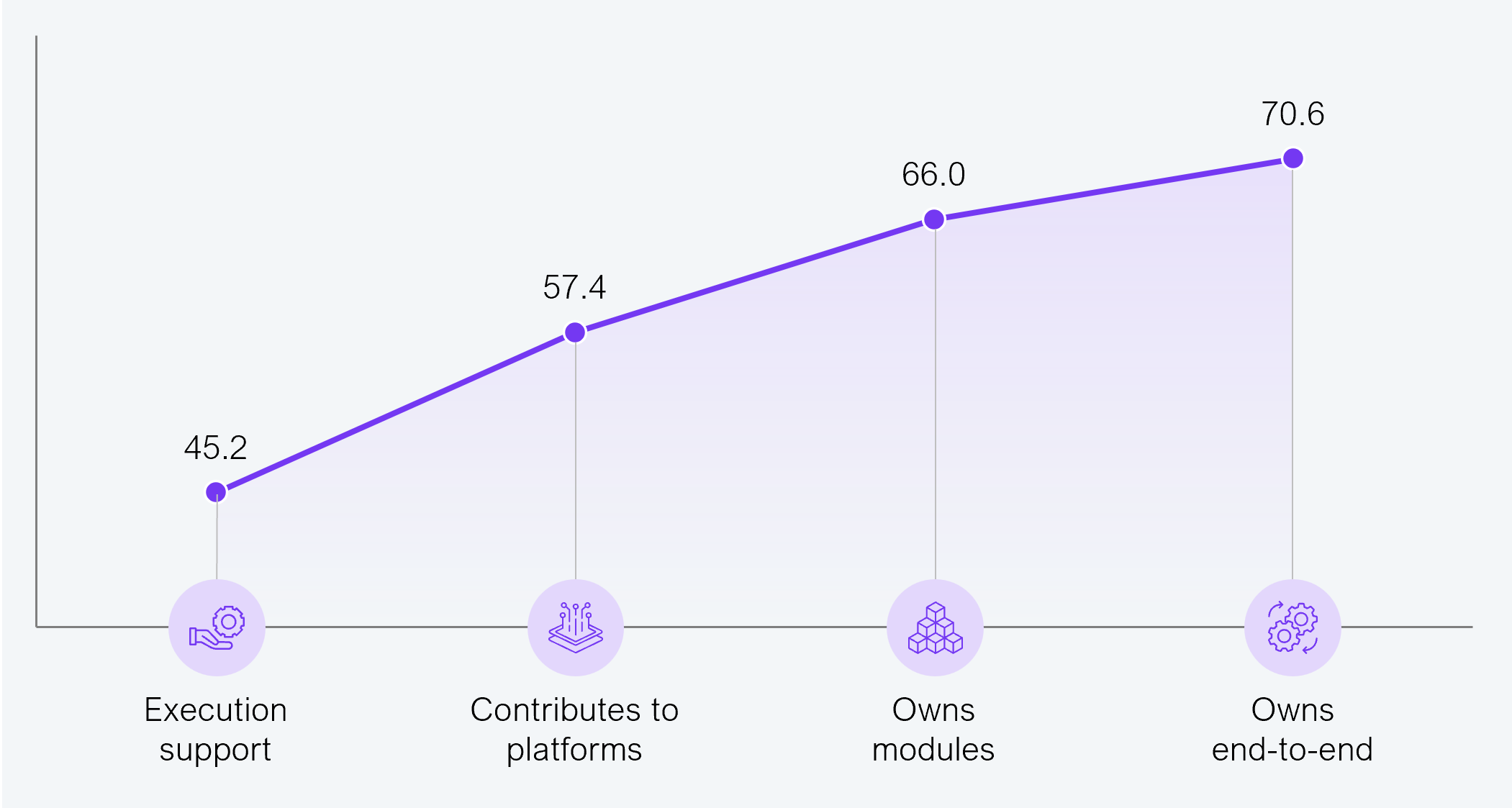
The relationship between GCCs and headquarters is evolving from the traditional view of GCCs as execution partners focused only on non-critical tasks to one based on an integrated and collaborative model centered on shared responsibility and ownership. This shift highlights the need for GCCs to contribute to enterprise initiatives while also taking ownership of products and influencing strategic decisions, thus redefining their role as vital engines of innovation and growth within the organization. The index validates this trend: the maturity score rises by 56%, from 45.2 for execution-only centers to 70.6 for GCCs that own products end-to-end (see Exhibit 17).
Current trends indicate that 15% of GCCs already own end-to-end products, 37% of GCCs own various modules or components, and 41% of GCCs are contributing to enterprise platforms as they increasingly integrate AI and ML into their operations (see Exhibit 7). Most GCCs are also expecting to enhance predictive intelligence across functions such as supply chain, sourcing and procurement, and finance. For headquarters, embracing this evolution means recognizing GCCs as crucial partners in driving strategic initiatives, allowing for co-leadership and transformative growth in the digital landscape.
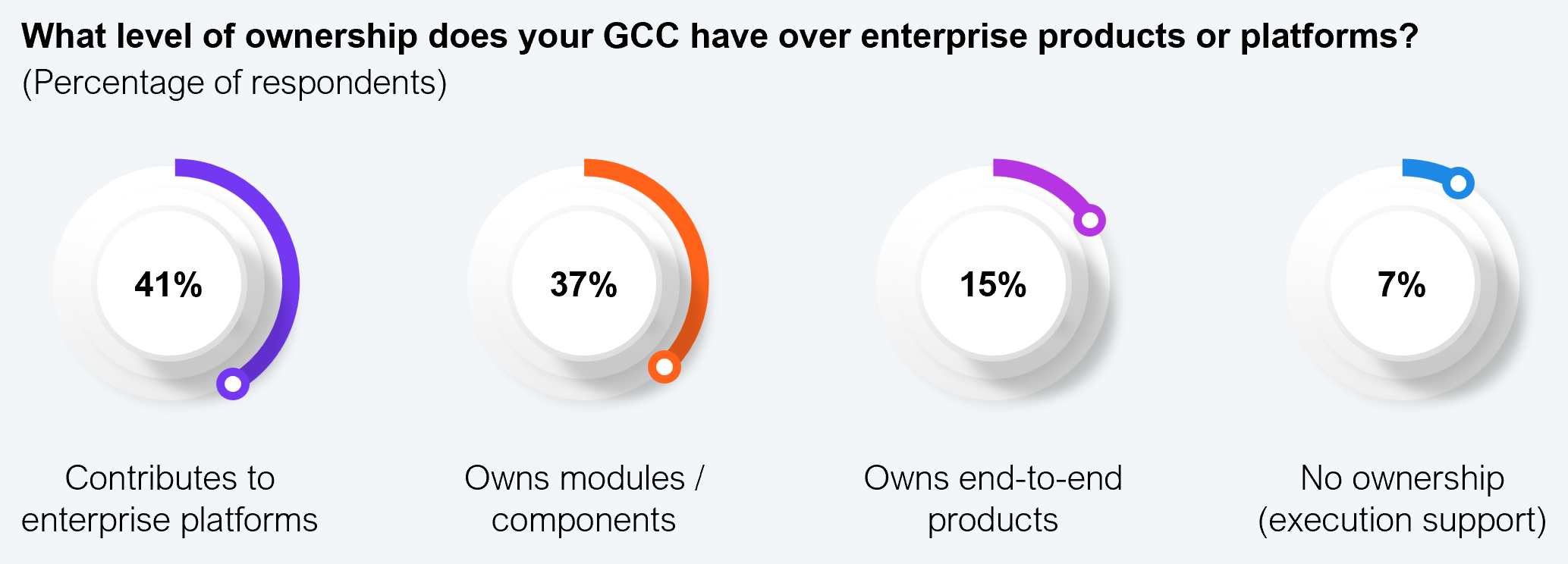
Sample size: 47 GCC leaders; respondents could choose multiple options
Source: HFS and ANSR Pulse survey, May and June 2026
Investing in leadership development, mindset change, and talent upskilling is crucial for both parties to navigate this transition and achieve operational excellence at scale. As organizations evolve, the benchmark for maturity is shifting from headcount to fostering ownership. Leaders of the next decade will be those that own products, shape strategy, create intellectual property, and directly impact enterprise growth.
The survey suggests that organizations are making progress here, but gaps remain. While 64% of the GCC leaders reported developing new product features or platforms and 55% created AI or digital prototypes in the past year, 15% reported no significant innovations. Only 11% are securing patents or IP filings, and just 9% are engaging in startup or ecosystem collaborations (see Exhibit 8). This indicates that while GCCs are innovating internally, they are yet to translate that work into protected, monetizable IP or collaborative networks.
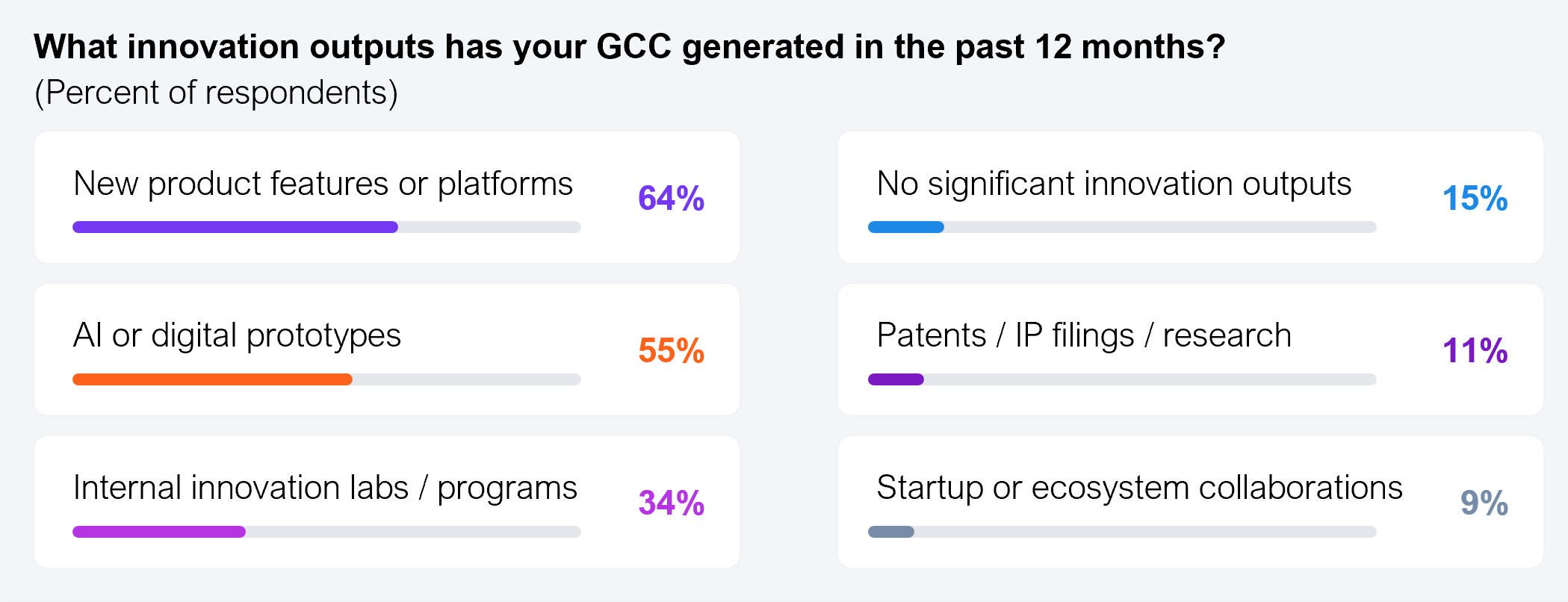
Sample size: 47 GCC leaders; respondents could choose multiple options, hence the total does not sum up to 100%
Source: HFS and ANSR Pulse survey, May and June 2026
GCCs in India will evolve into AI-native growth engines and true innovation orchestrators, enabling end-to-end digital ecosystems rather than managing isolated technologies. This shift is already taking shape with AI and machine learning becoming fundamental to business operations. GCCs will increasingly deliver predictive intelligence across supply chain, merchandising, finance, and customer experience, enabling global businesses to anticipate demand, respond to disruptions in real time, and drive operational excellence at scale.
Leadership development, talent upskilling, and employee well-being will be central to sustaining this momentum. GCCs that invest here will unlock opportunities for strategic co-leadership, shaping organization-wide innovation, strengthening global supply chain resilience, and driving inclusive, digital-first transformation worldwide. From India, GCCs will not just enable growth; they will design the future blueprint for innovation.
— Ankur Mittal, CTO and MD, Lowe’s India

GCCs are mission-critical before they are fully empowered
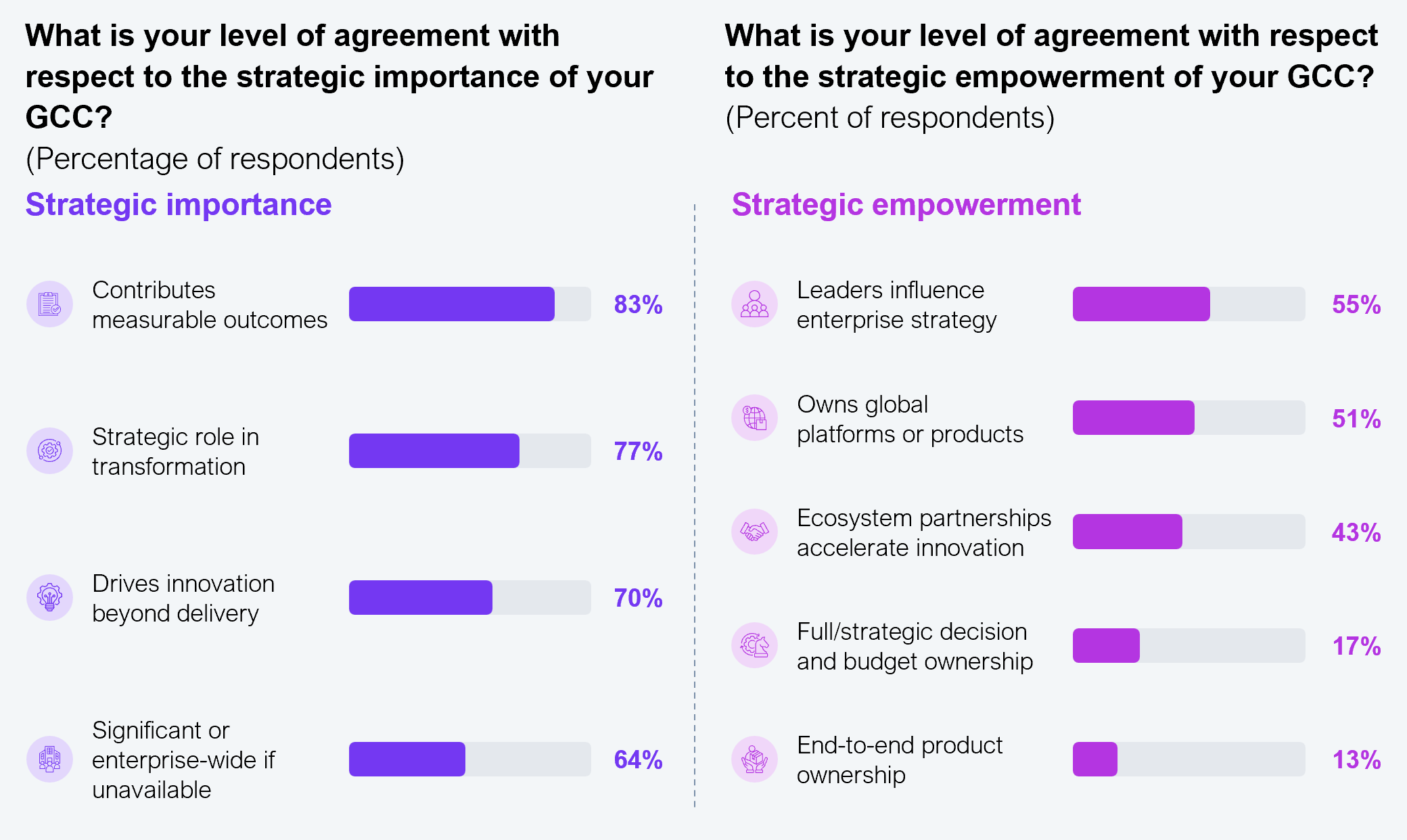
The gap between strategic importance (64%–83%) and strategic empowerment (13%–55%) suggests that enterprises increasingly rely on GCCs to drive business outcomes, yet many still stop short of giving them end-to-end ownership, decision rights, or P&L accountability
(see Exhibit 9). Call it accountability without authority, and recognize that every point of that gap is paid for in slower decisions, in leaders who leave for roles with more authority, and in innovation work that goes back to vendors.
This empowerment gap is now the single biggest blocker on the journey toward the generative enterprise. For the next generation of GCCs, the challenge has shifted from proving capability to securing the mandate to act on it. As GCCs move to the center of enterprise innovation, transformation, and AI adoption, decision rights and ownership must scale along with their expanding remit, because capability without authority stalls. And the organizations that close this gap by moving their GCCs from execution to ownership will be those that become truly generative enterprises.
Sample size: 47 GCC leaders; respondents could choose multiple options, hence the total does not sum up to 100%
Source: HFS and ANSR Pulse survey, May and June 2026
The strategic importance of GCCs is underscored by their ability to deliver measurable outcomes that drive innovation. Some companies have already made significant advancements through their India-based centers: Lowe’s developed a self-checkout engine now used in over 1,700 stores, Hyundai Mobis has developed software-defined vehicles from India, and AstraZeneca’s India center has become the global hub for innovation in drug development. Such examples highlight that GCCs are not just operational entities; they are catalysts for innovation that go beyond mere delivery.
While GCCs may develop key modules or platforms, the crucial aspects of product profitability, roadmap sign-offs, and budget decisions largely rest with headquarters. This is reflected in the fact that only 13% of GCCs report true end-to-end ownership. Without the financial authority to fully steer their initiatives, these centers often struggle with multiple challenges from headquarters, as well as talent availability in their domestic operations.
The most successful GCC leadership models are shifting from a focus on scale and efficiency to one centered on enterprise-wide accountability. GCC-grown leaders of today are stepping into global ownership roles and leading global centers of excellence. This transformation has been driven by outcome-based role design and intentionally aligned goals across locations. Leadership credibility is now defined by end-to-end ownership of results, rather than by activity reporting or output management.
— Richa Jain, Managing Director, Northern Tool + Equipment, India
Legacy technology, limited autonomy, and long-term alignment are key roadblocks
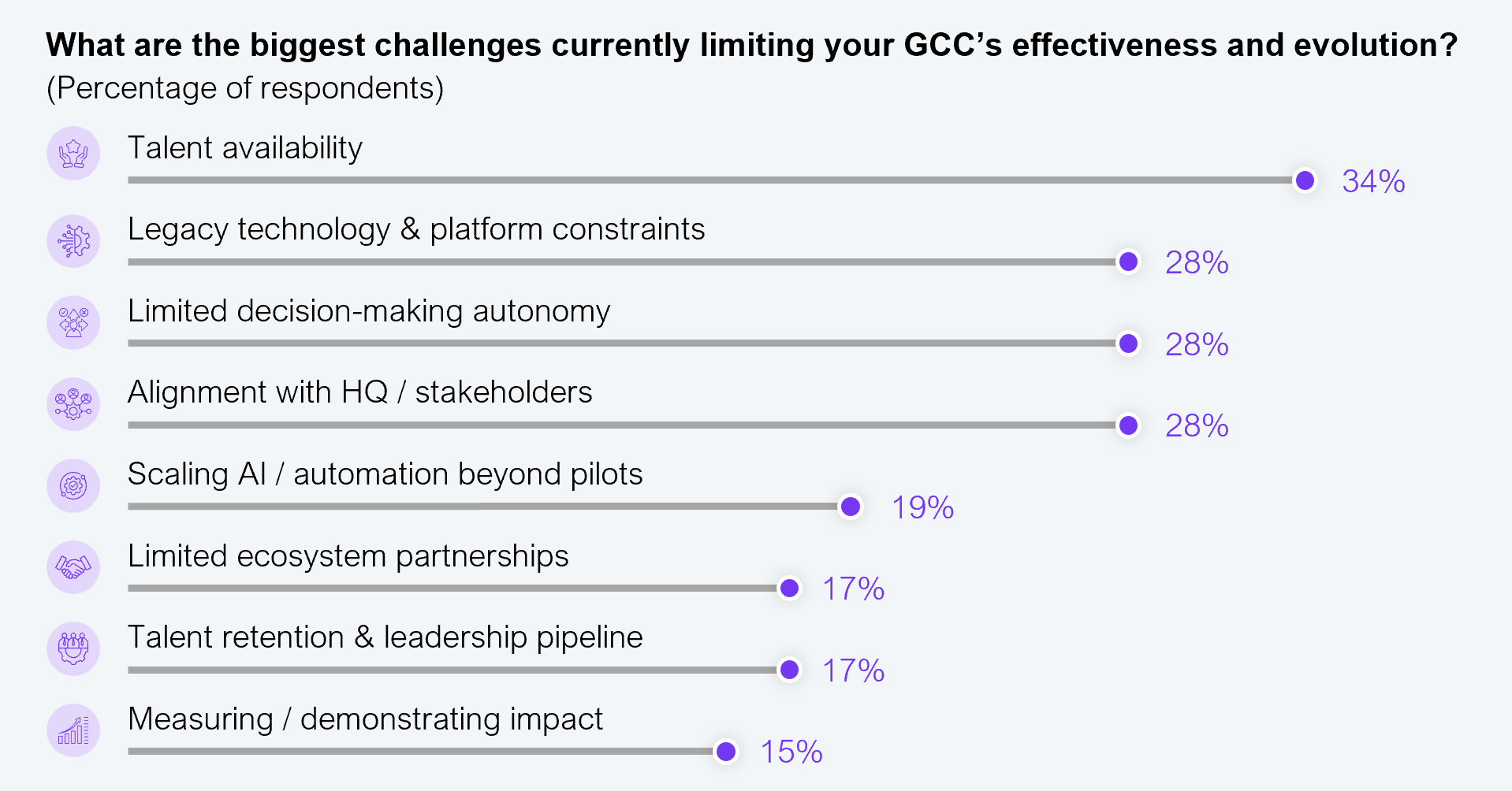
Talent availability remains the top barrier (34%), but legacy technology (28%), limited decision-making autonomy (28%), and headquarter alignment (28%) are now equal structural blockers (see Exhibit 10). Simply adding more talent will not close the maturity gap; operating model, autonomy, and alignment must be addressed in parallel. The next wave of GCC value creation will depend less on adding talent and more on removing the organizational barriers that prevent talent from operating at its full potential.
GCCs, in collaboration with service providers (HFS categorizes them as GCC builders, Accelerators, and Orchestrators), organize hackathons to identify talent with AI skills, work with universities to identify domain-specific resources, and partner with third-party training institutes to develop readily deployable talent for their innovation programs.
Sample size: 47 GCC leaders; respondents could choose multiple options, hence the total does not sum up to 100%
Source: HFS and ANSR Pulse survey, May and June 2026
Most brownfield GCCs run on decades-old legacy applications integrated with multiple decision-making systems; moving them requires a predefined workflow that does not disrupt existing operations. Many enterprise leaders still see GCCs as a support function for influencing intelligent decision making, given their domain expertise and ability to consolidate multiple data sources. To tackle these tech challenges, GCC leaders often lack the autonomy to implement solutions due to inconsistent alignment with headquarters.
However, some GCCs need to collaborate with the parent and ecosystem partners simultaneously, working autonomously to create niche, reusable assets with commercialization strategies that benefit the parent, competitors, and ecosystem partners. For example, Qualcomm, which filed the highest number of patents last year, monetized its innovative assets by selling to mobility and telecom clients. Similarly, Bosch Global Software Technologies Private Limited, an India-based center that provides engineering, IT, and business solutions to Bosch business units and external third-party clients across Europe, became a revenue-generating entity while continuing to serve the parent.
Internal readiness is ahead of external orchestration
GCCs have largely mastered enterprise integration. The next frontier is ecosystem orchestration. As innovation becomes increasingly networked, the most successful GCCs will be those that extend beyond the enterprise to become conveners of talent, technology, academia, startups, and strategic partners.
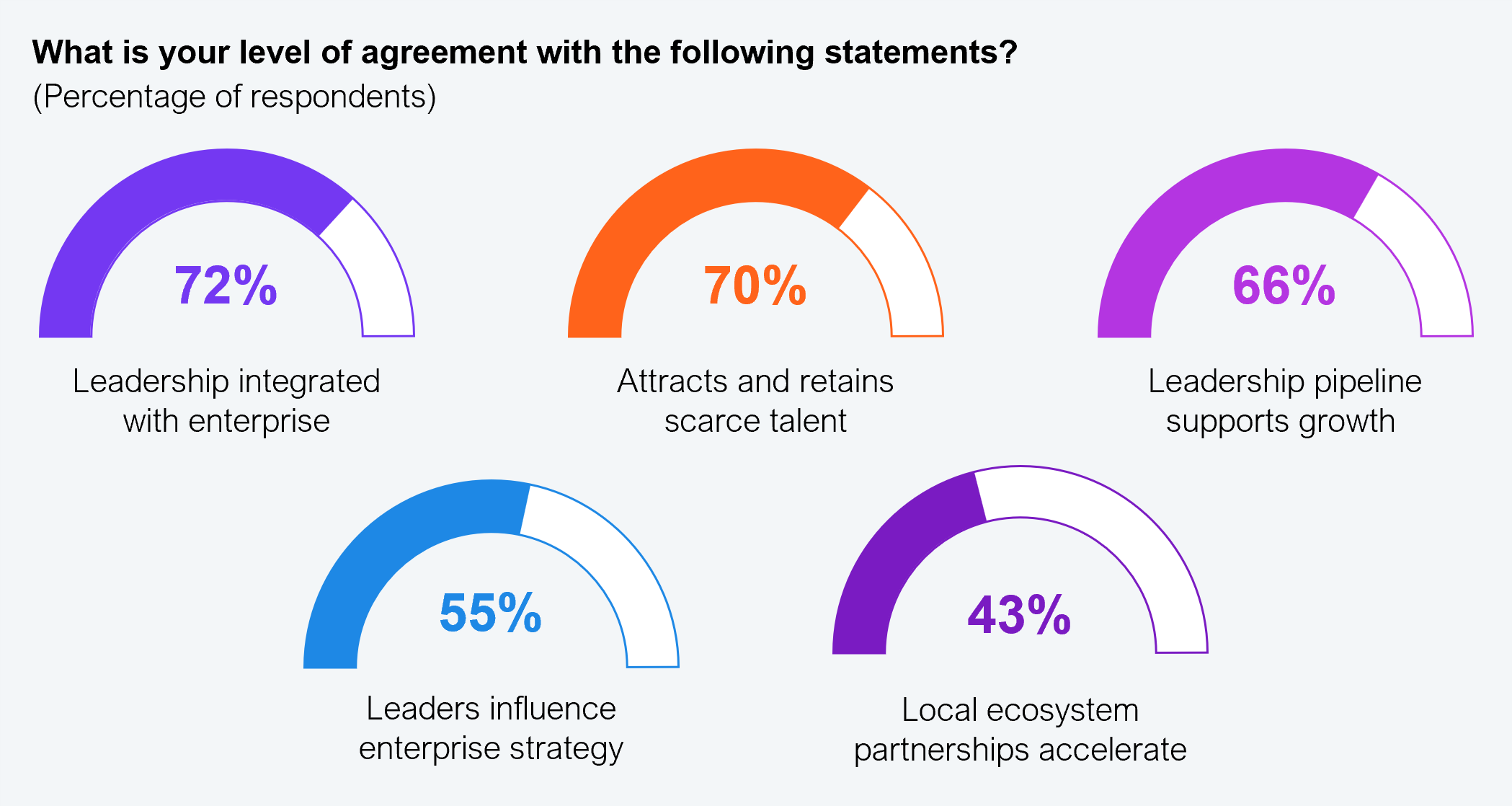
The 2026 HFS Generative GCC Index revealed a GCC leadership and ecosystem gap (see Exhibits 11 and 12). About 72% of the leaders reported that leadership is integrated with enterprise leadership; 70% said their GCCs attract and retain scarce talent; and 66% reported a leadership pipeline that supports growth. Leaders have largely succeeded in integrating with their parent company. Their global leadership pipelines are maturing, they are increasingly influencing enterprise strategy, and they are part of enterprise AI councils. However, this internal maturity has not translated into leadership in external innovation.
Sample size: 47 GCC leaders; respondents could choose multiple options, hence the total does not sum up to 100%
Source: HFS and ANSR Pulse survey, May and June 2026
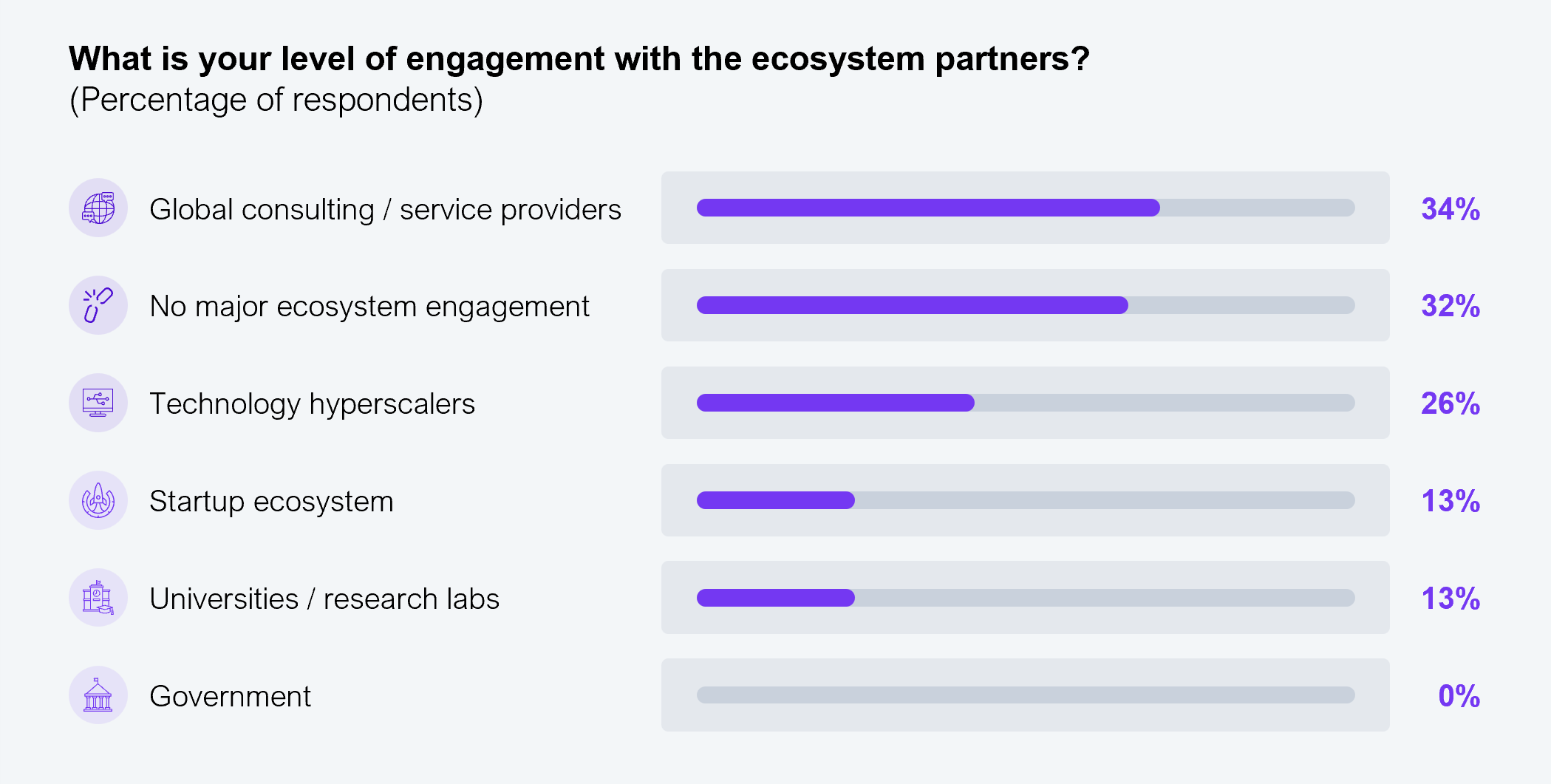
The existing GCC partnerships are skewed toward commercial suppliers, including the Big 4, large system integrators, and IT service providers (34%) and technology hyperscalers (26%). On the other hand, the disruptive-innovation sources barely register: startups (13%), universities/research labs (13%), and government (0%). The most striking challenge is that about 32% report no major ecosystem engagement at all. This is a clear whitespace, because these partners are unusually accessible in India right now (see Exhibit 12).
Sample size: 47 GCC leaders; respondents could choose multiple options, hence the total does not sum up to 100%
Source: HFS and ANSR Pulse survey, May and June 2026
Hyperscalers are investing billions to build capacity that GCCs can leverage. Microsoft is investing $17.5 billion in AI infrastructure in India over the next three years. Google announced $15 billion in investments over the next four years. AWS is pouring about $12.7 billion through 2030. And NVIDIA is boosting its AI-factory buildouts with Yotta, a large-scale sovereign AI infrastructure for India. Moreover, the startup ecosystem is vibrant with more than 140 GenAI startups raising $2.4 billion since 2022. The government-backed India AI Mission is deploying $1.2 billion into compute, sovereign models, and research, yet GCCs draw essentially nothing from the academic or public sector.
A few mature GCCs, including JP Morgan Chase, Eastman Chemical, Goldman Sachs, Stellantis, Qualcomm, and BOSCH, actively engage with academia, startups, and other ecosystem partners in India. They organize ER&D forum conferences and domain-specific roundtables with the right ecosystem partners to generate ideas and implement them at their enterprise. However, there is scope to enhance interactions to drive innovation.
The next evolution of GCCs will not be driven by scale alone, but by the strength of the ecosystem they help create. As enterprises deepen their presence, success will increasingly depend on connecting talent, academia, startups, industry, and government to foster collaboration, accelerate innovation, and build capabilities that extend beyond the enterprise.
— Smitha Hemmigae, Chief Market Officer, ANSR
The index converts the HFS evolution framework into a recurring benchmark
The 2026 HFS Generative GCC Index is a composite maturity benchmark. It scores maturity using core survey inputs across role, work, data, technology, talent, operating model, value, ownership, innovation, ecosystem, and enterprise dependence. Respondents, at no point, are asked to declare their own maturity. The index is conservative by design: it does not over-credit ambition without end-to-end ownership, AI-native operating models, and ecosystem orchestration.
The index is designed as a tracker. Future waves can compare the overall score, dimension scores, maturity distribution, ownership multiplier, and empowerment gap. The first edition uses conservative scoring to avoid over-crediting ambition or capability depth without end-to-end ownership, AI-native operating models, and ecosystem orchestration.
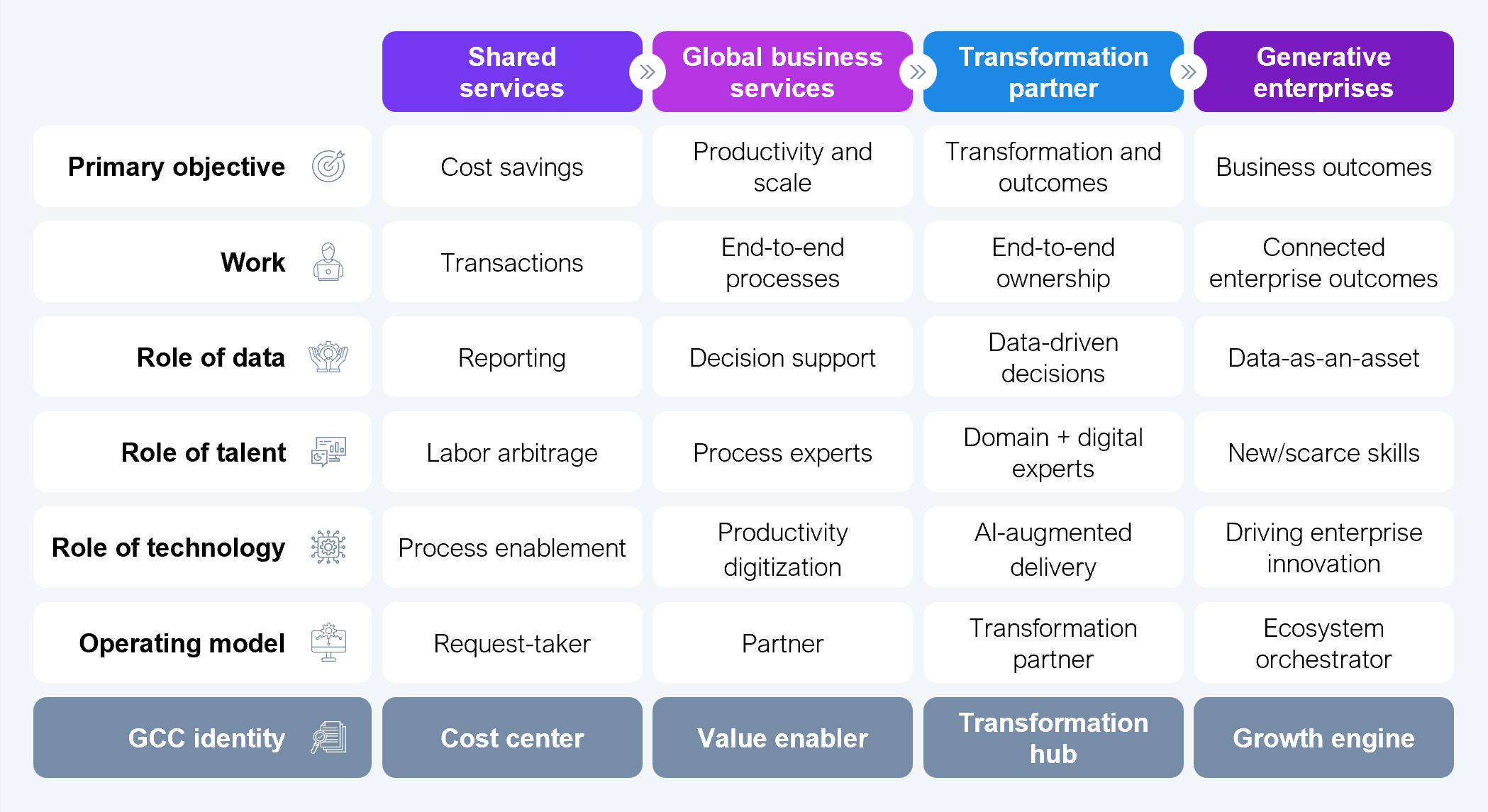
Source: HFS Generative GCC framework, 2026
Core questions feed each framework dimension. Profile questions are used for segmentation, while challenges and priorities explain momentum and constraints. The score measures current maturity, not future aspirations. The first wave places GCCs at the entry point of the Transformation Partner stage (see Exhibit 14).
Source: HFS and ANSR Pulse survey, May and June 2026
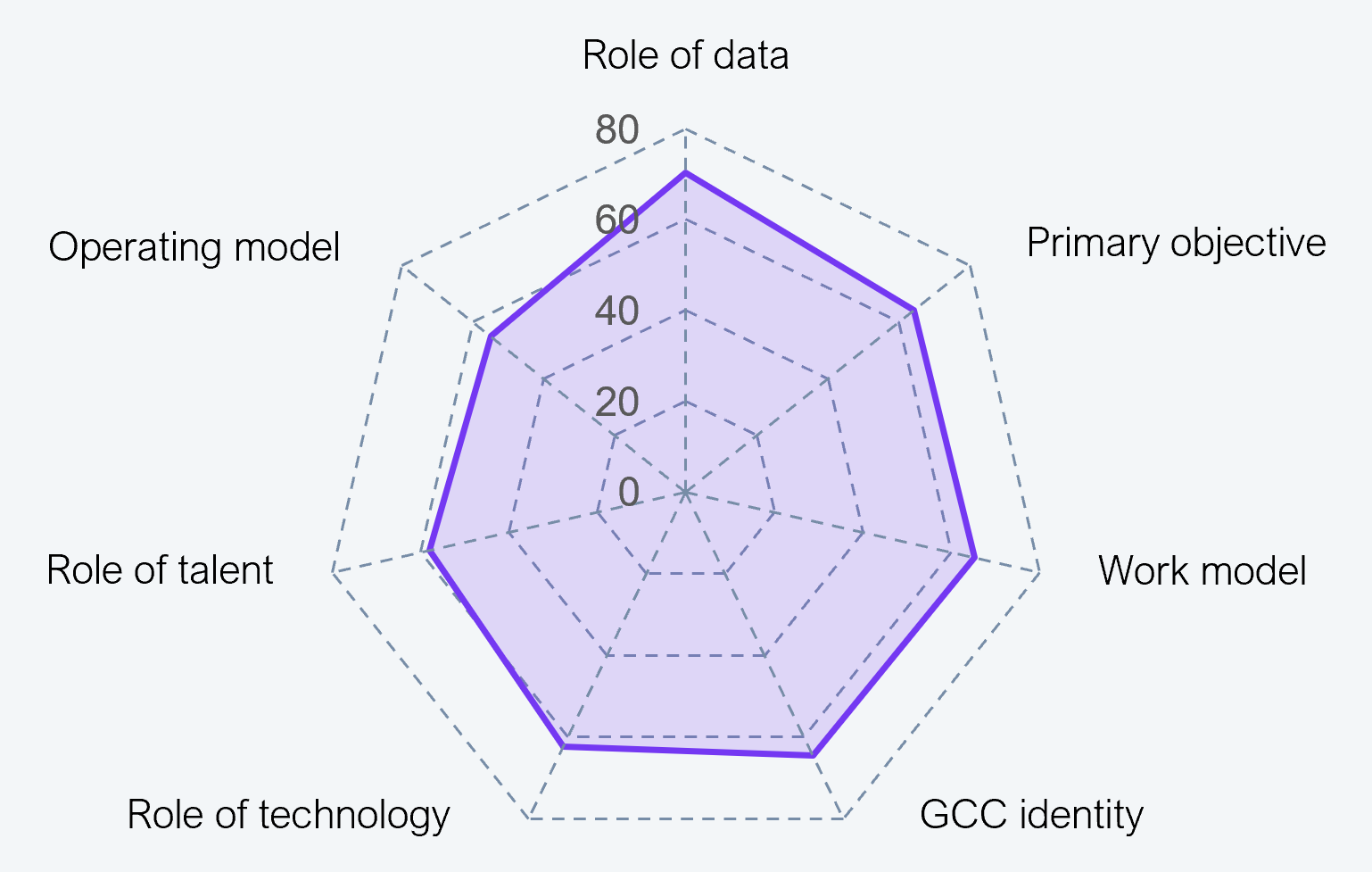
Of the seven dimensions, the role of data scores the highest. GCCs have credibly moved data from reporting to decision support and are treating data as an asset (see Exhibit 15). The primary objective, work model, GCC identity, and the role of the technology cluster are all average. The two drag dimensions are the role of talent (still anchored in process expertise) and the operating model (still partner-led rather than ecosystem-orchestrated). Future index gains will come less from continued AI adoption and more from rewiring the operating model itself.
Source: HFS and ANSR Pulse survey, May and June 2026
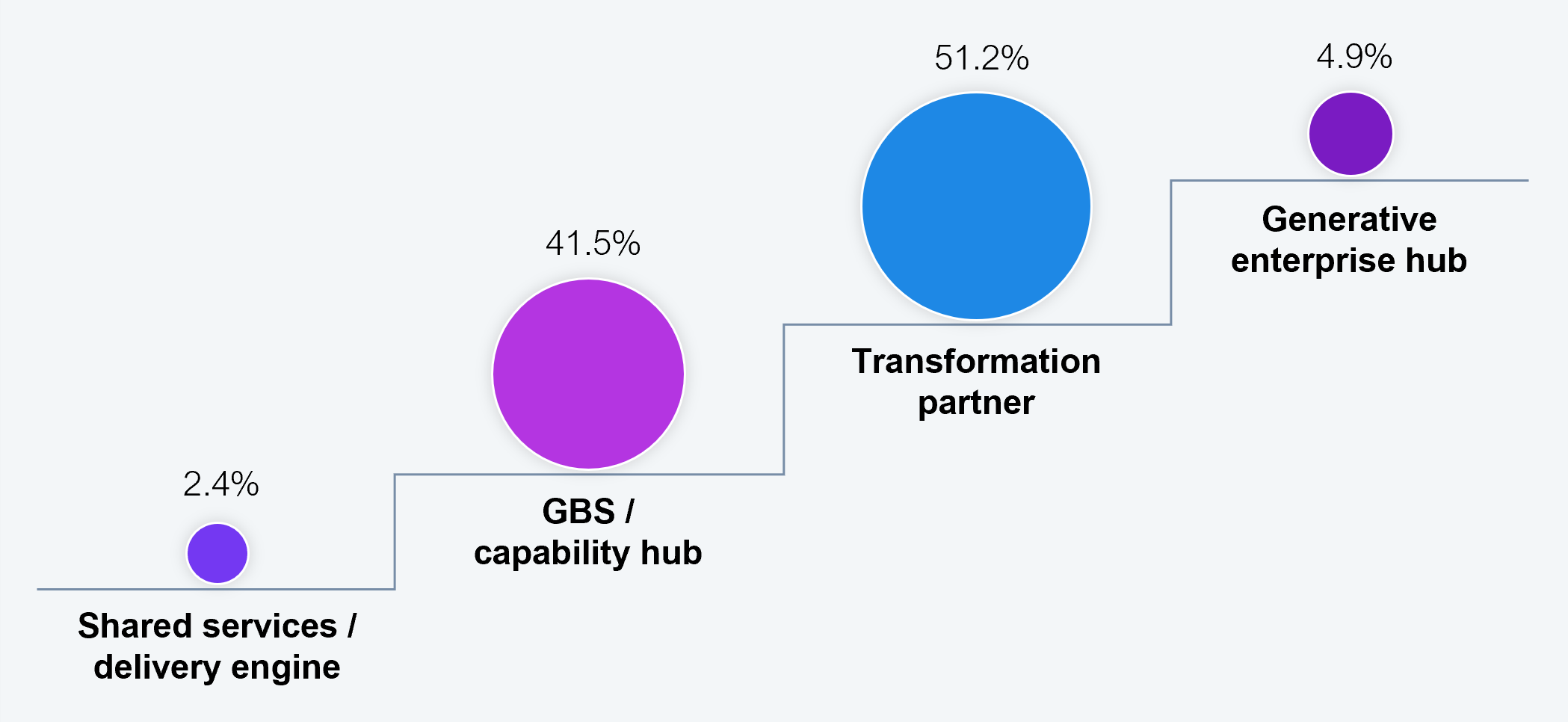
Most GCCs have moved beyond shared services (2.4%) and global capability hub (41.5%), as indicated by the GCC leaders in the pulse survey (see Exhibit 16). However, the true generative enterprise hubs remain rare. Any GCC that treats its data as an asset improves AI fluency, orchestrates internal applications and the external ecosystem, builds reusable assets, converts repeatable services into software (Services-as-Software), and drives top- and bottom-line growth through innovation. Based on the current pulse study, reaching the generative enterprise hub is achievable when we address the challenges, change the mindset, and participate in the ecosystem.
Source: HFS and ANSR Pulse survey, May and June 2026
When GCCs are segmented by ownership posture, the index score rises steadily from 45.2 for execution-support focused GCCs to 57.4 for contributors to enterprise platforms, 66.0 for module owners, and 70.6 for end-to-end product owners (see Exhibit 17). End-to-end ownership lifts index score by 56%, the single biggest lever in the dataset, which makes ownership both a maturity outcome and the multiplier on every other dimension the index measures.
Source: HFS and ANSR Pulse survey, May and June 2026
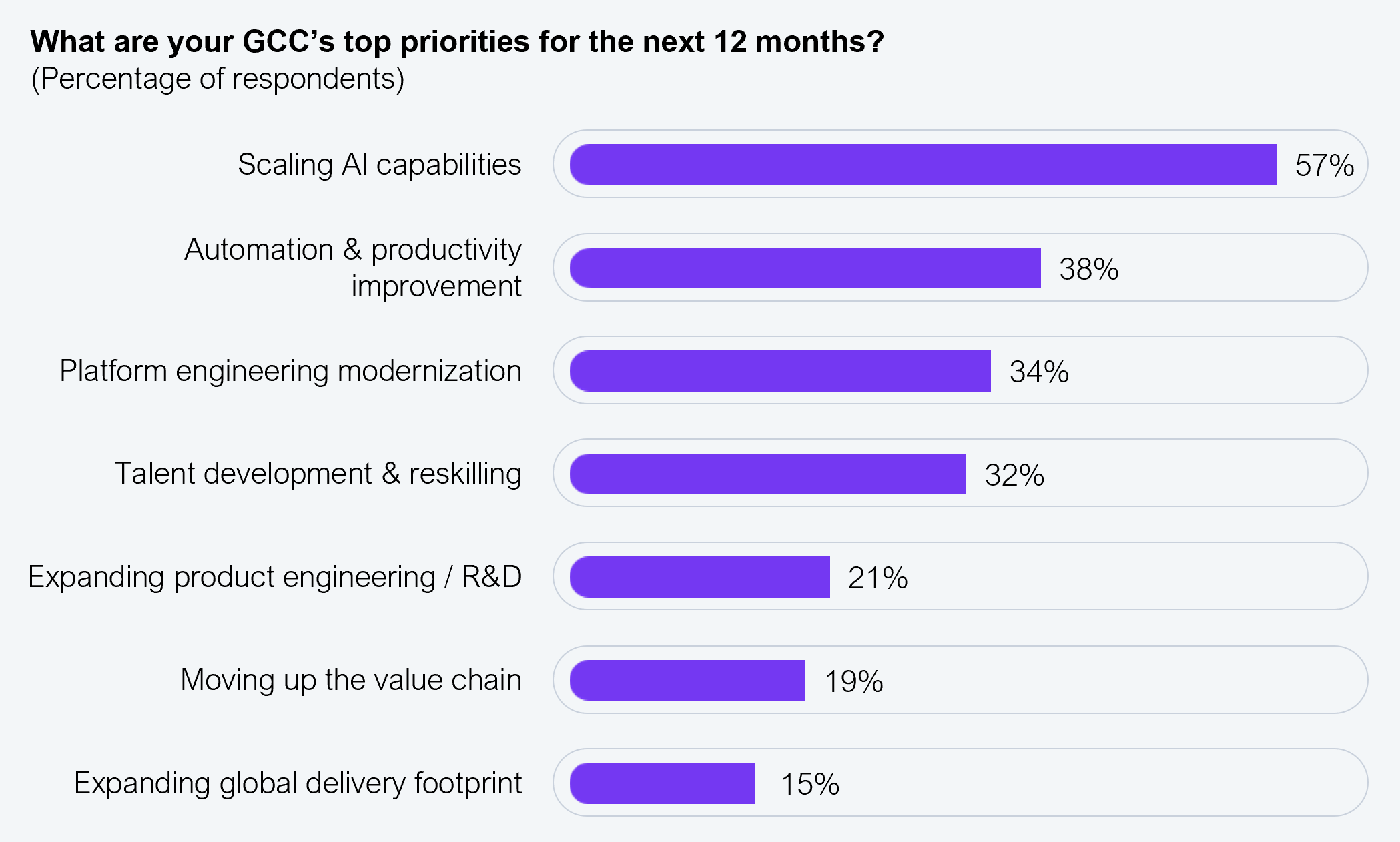
GCC leaders point overwhelmingly to four levers for the next 12 months (see Exhibit 18): scaling AI capabilities (57%), automation and productivity improvement (38%), platform engineering modernization (34%), and talent development and reskilling (32%). The market’s own priority list confirms the index conclusion, as the next maturity jump will be earned by GCCs that combine AI scale, platform engineering depth, senior AI-native talent, and a deliberate move into product ownership.
Sample size: 47 GCC leaders; respondents could choose multiple options, hence the total does not sum up to 100%
Source: HFS and ANSR Pulse survey, May and June 2026
Close the empowerment gap before AI ambition stalls
India’s GCCs are at an inflection point. The 2026 HFS Generative GCC Index reading places the market at the entry point of the transformation partner band, a real achievement on a journey that began over two decades ago in cost arbitrage. The road from transformation partner to generative enterprise hub is steeper than the road from shared services to capability hub and is paved with ownership, empowerment, and AI-native operating models, with headcount and locations counting for less at every stage of the climb.

Write ownership into the charter. Enterprise leaders must have a vision of chartering the GCC with empowered leadership. Rewrite GCC charters to transfer P&L authority, decision rights, and platform ownership, not just headcount.

Close the empowerment gap explicitly. The study indicates that 83% of GCCs are mission-critical, but only 17% have full decision and budget ownership. Make leadership empowerment a board-level KPI tied to AI outcomes. A useful test is whether the GCC head can approve a million-dollar AI investment without a call to headquarters. If the answer is no, the gap is not closed, regardless of what the GCC charter says.

Rewire the operating model for AI productivity. While AI-native operating models remain largely untapped across GCCs, those that redesign talent structures around high-value expertise can unlock disproportionate gains in productivity, innovation, and business impact. Create a cross-functional enterprise AI council with GCC leaders as core members to rewire the operating model. The measure of progress should be the number of decisions made inside the GCC each quarter rather than the number of FTEs it employs.

Move from internal integration to ecosystem orchestration. GCC leaders are tightly integrated with enterprise leaders and collaborate with commercial partners, including global system integrators and hyperscalers. There is a scope for ecosystem engagement, as more than 30% of GCC leaders have not engaged with ecosystem partners. The generative enterprise hub is an ecosystem orchestrator. A reasonable ask for the coming year is one university, one startup, and one hyperscaler program, which is a modest bar given that 34% of peers are already there.

Treat talent scarcity as a structural risk. About 34% of GCC leaders highlighted that talent availability is a major challenge, compounded by wage inflation and concentration. They must plan for tier-2 cities, nearshore footprint, and AI-augmented productivity in parallel.
Register now for immediate access of HFS' research, data and forward looking trends.
Get StartedIf you don't have an account, Register here |
With the exception of our Horizons reports, most of our research is available for free on our website. Sign up for a free account and start realizing the power of insights now.
Our premium subscription gives enterprise clients access to our complete library of proprietary research, direct access to our industry analysts, and other benefits.
Contact us at [email protected] for more information on premium access.