This HFS Highlight is for CIOs, heads of infrastructure, and enterprise AI leaders evaluating Cognizant AI Factory as the operating layer for production AI.
CIOs are finding that scaling AI changes the operating model, even when the underlying build is the same. As workloads spread across clouds, private infrastructure, and neo-clouds, cost becomes hard to predict, governance fragments, and reliability turns into an operating problem. Programs stall in the gap between a working demo and a production system, and that gap is not a hardware problem.
That shifts the buying question from who can supply the GPUs to who can keep AI secure, governed, and affordable in production. Cognizant’s AI Factory is built to address that gap, pairing the infrastructure with the governance and operations needed to run it. That is worth taking seriously and not something to take on trust.
For an enterprise buyer, GPU access, reference architectures, and agent libraries are becoming less useful differentiators among major providers. Cognizant makes the same point: the hard part is not buying the infrastructure but running it once AI is in production.
Its answer sits in the layer above the factory. Neuro Trust embeds identity, policy enforcement, and audit into AI workflows, working as a gate rather than a dashboard. It aims to stop a non-compliant action before it happens rather than report it afterward, keeping governance from fragmenting at scale. Neuro IT Ops handles observability, cost attribution, workload routing, and automated remediation across environments, keeping runaway cost and reliability under control. HFS calls this shift as Services-as-Software™, where value moves from standing up a factory to taking responsibility for running it in production.
Cognizant uses private AI to describe dedicated or privately operated deployments. Sovereignty is one reason enterprises may choose that approach, alongside cost, regulation, data control, and operational requirements. Cost often forces the decision once AI scales; token spend stays hidden in a small pilot and rises fast as users and agents are added.
The firm claims that purpose-specific small models can run about three times cheaper than frontier models on some tasks and puts the crossover between cloud APIs and private deployment anywhere from two million to 200 million tokens a month, depending on the workload. That range is too broad to be a rule. The lesson is narrower: model the cost at the workload level before you scale, or the infrastructure team inherits the bill after the business has committed to the use case.
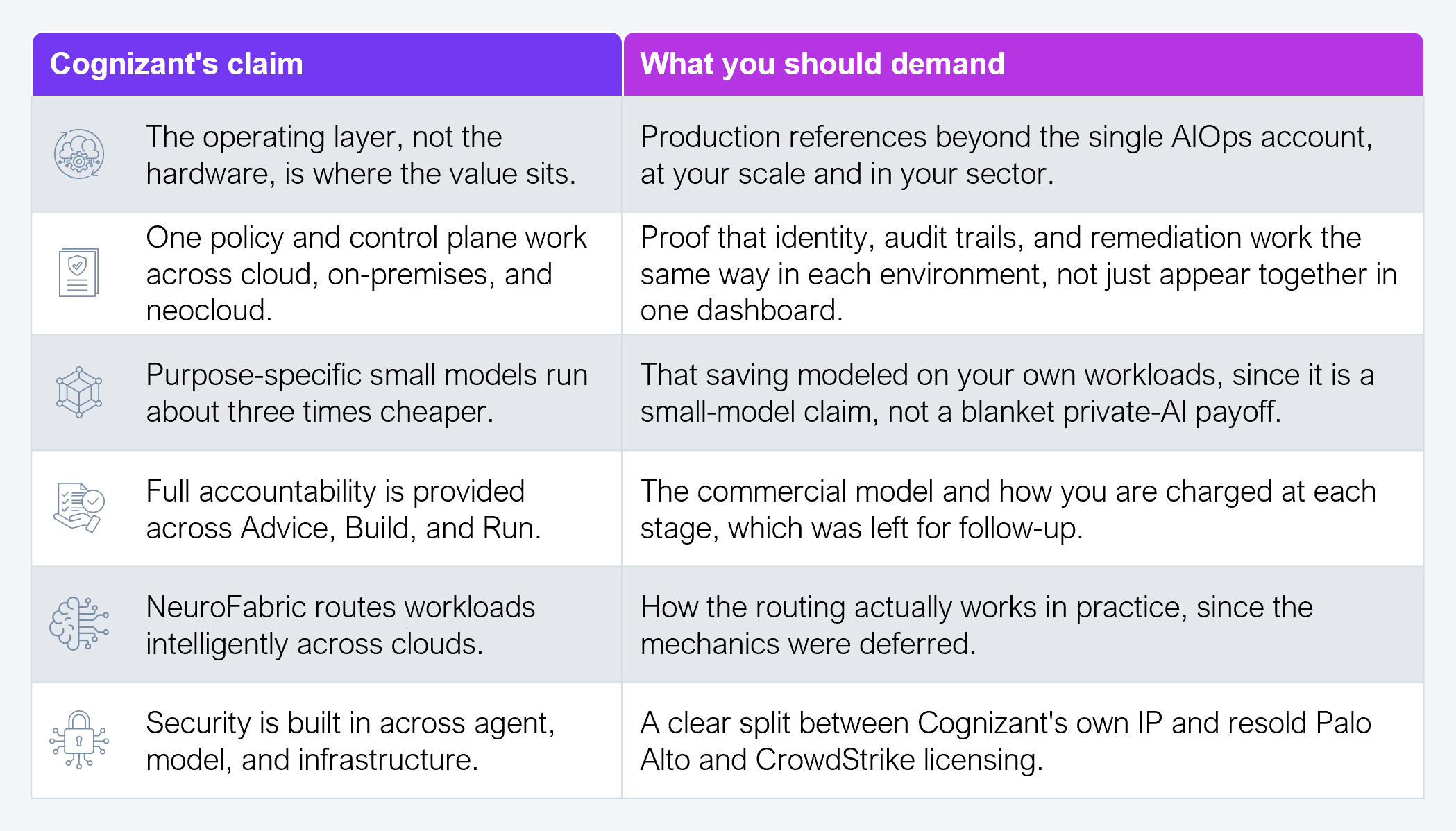
Large enterprises can run AI across hyperscalers, private infrastructure, and neoclouds, and each environment brings its own controls, leaving identity, policy, and audit fragmented across the estate. Cognizant claims that Neuro Trust can apply one governance framework across all of them, allowing an agent to meet the same permissions and policy checks wherever it runs. That is an important claim, because enterprises need consistent controls even when workloads span providers, which a single-cloud provider is not positioned to enable.
It is also the claim to test hardest (see Exhibit 1). Ask whether one policy, with its identities, audit trails, and remediation, genuinely holds across every environment, or only looks unified on a shared dashboard.
Source: HFS Research, 2026
Cognizant’s direction is credible, but much of the evidence is still early. It points to four client AI labs, with several examples still in pilot or proof of concept. The exception is its hyperscaler AIOps work, which it says handles 1.6 million tickets a year at a claimed 24% efficiency gain. That is real production proof, not slideware, but still a single case rather than a broad track record.
Two gaps matter most. Cognizant deferred how clients are charged across Advise, Build, and Run and how NeuroFabric’s cross-cloud routing actually works. Ask for both and test the cost savings on your own workloads before you commit.
Cognizant has read the production problem correctly. Its hyperscaler AIOps work shows operating experience at scale, but the wider AI Factory proposition still needs production proof.
So treat the operating layer as something worth buying and the proof worth demanding. Make Cognizant show that it runs in production, not only in pilots.
Register now for immediate access of HFS' research, data and forward looking trends.
Get StartedIf you don't have an account, Register here |
With the exception of our Horizons reports, most of our research is available for free on our website. Sign up for a free account and start realizing the power of insights now.
Our premium subscription gives enterprise clients access to our complete library of proprietary research, direct access to our industry analysts, and other benefits.
Contact us at [email protected] for more information on premium access.