Ten critical success factors to drive F&A services of the future
Enterprises have always wanted far more for far less from their F&A function. But the old days of finding cheaper labor and some better packaged software have pretty much been exhausted. The new thinking is to change how finance is delivered, where the routine F&A work becomes invisible to focus completely on the strategic value finance brings to the organization.
You need a holistic finance OneOffice, not just an efficient back office
The role of the smart CFO is evolving from being the bottom-line and compliance enforcer to a trusted business partner driving profitable growth. Finance is emerging as a critical business partner to power organizational business imperatives, including driving growth, entering new markets, launching new products, and improving customer experience.
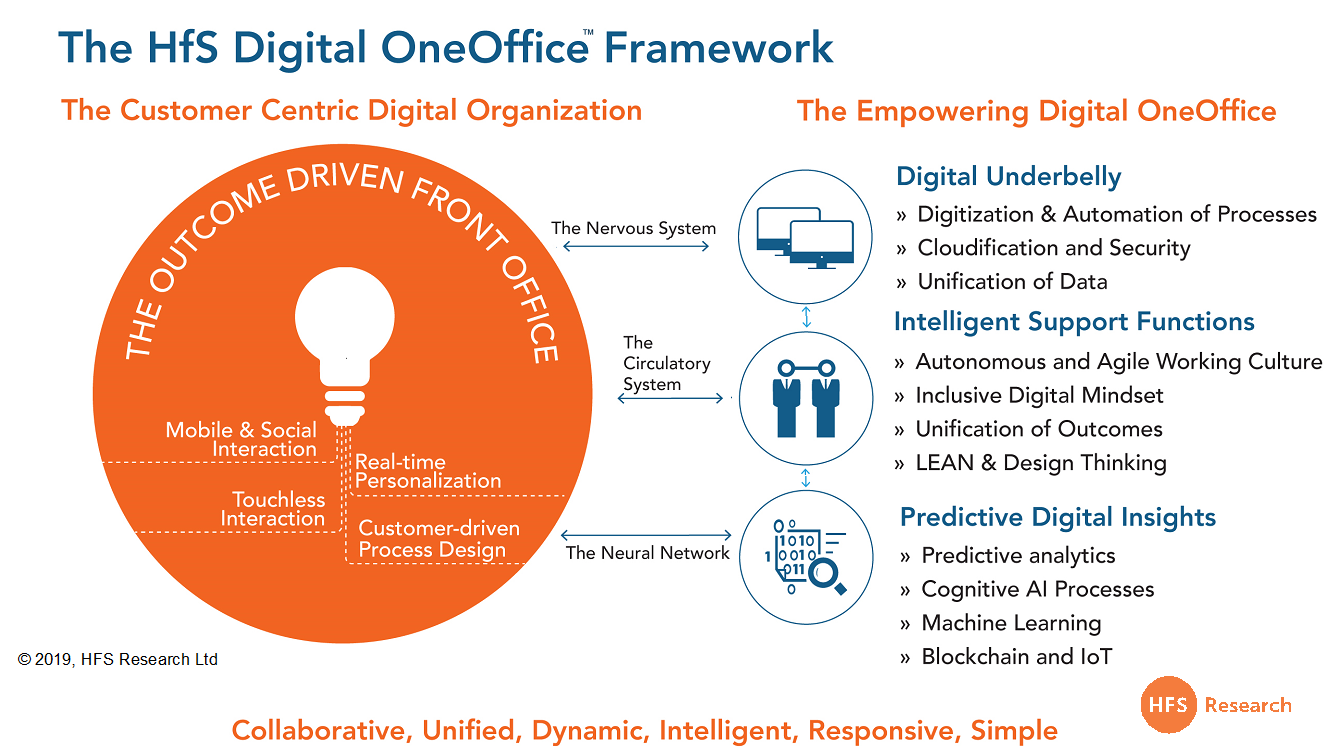
Ambitious organizations must have an operating framework that maps out how they have to operate in the future where critical functions like F&A are firmly integrated into the broader commercial (front office) goals of the organization. The Digital OneOffice is where teams function autonomously across front and back office functions to promote broader processes with real-time data flows that support rapid decision making. It’s where front, middle and back offices will cease to exist, as they will be, simply, OneOffice.
Exhibit 1: Finance must form part of the OneOffice, not the back office
Source: HFS Research 2019
Hence, the finance function must become the arbiter of real-time data to support key decisions around the competitive strategy of the firm, where divisions between departments cease to exist and finance staff are measured on the same metrics – usually improved customer experience, improved profitability and quality of data.
To achieve the OneOffice, F&A needs investments in a dynamic, new operating model that is resilient, responsive, and predictive and enables organizations to cruise through today’s uncertain times. But your big unanswered question is, “How do we achieve this feat successfully?”
What you need is an “invisible” F&A!
HFS defines “Invisible F&A” as the state of an F&A function where accounting transactions run like water and finance professionals focus on driving strategic objectives. Invisible finance will result in continuous accounting requiring no waiting to close books, effortless payables and receivables with near-zero cycles, and real-time analytics capabilities enabling proactive decisions.
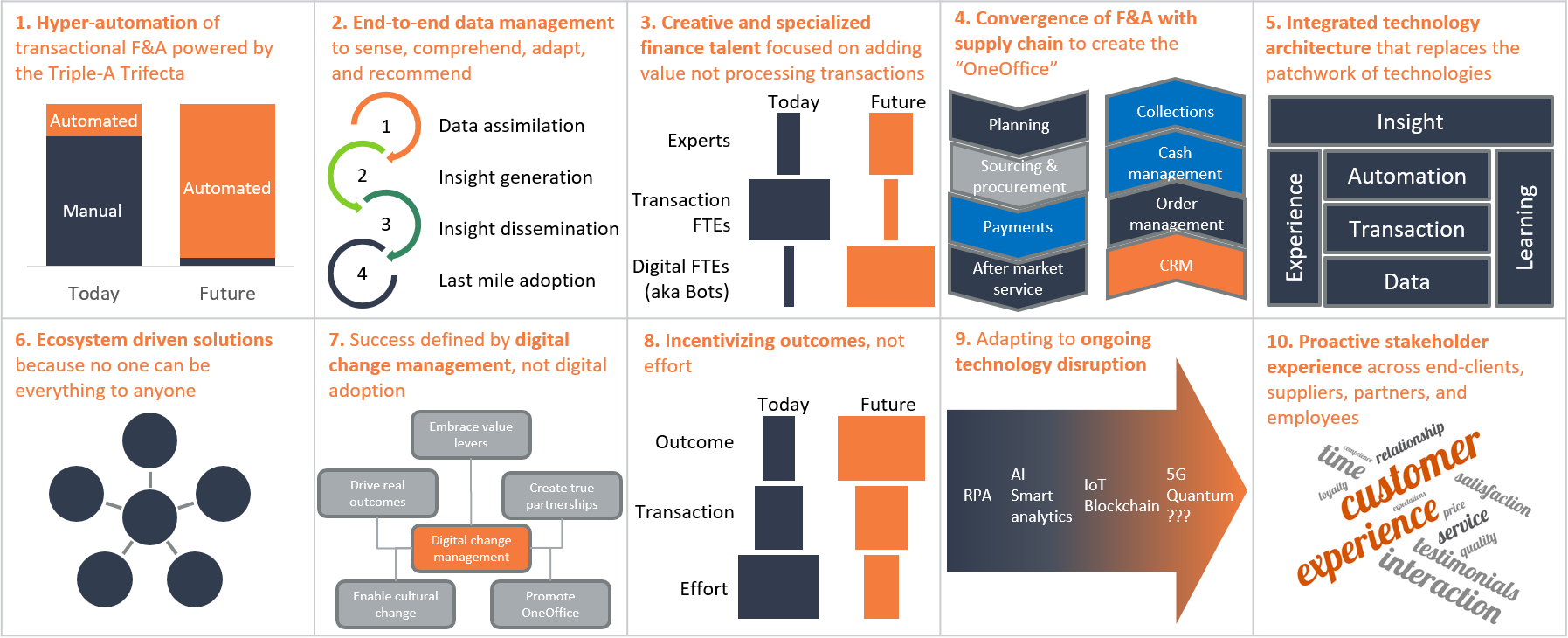
HFS has identified 10 critical success factors in Exhibit 1 that will help drive the invisible F&A function.
Exhibit 2: 10 Critical Success Factors of “Invisible F&A”
Source: HFS Research, 2019
#1. Hyper-automation of transactional F&A powered by the Triple-A Trifecta (automation, AI, and analytics)
Advancements in robotic process automation (RPA), artificial intelligence (AI) technologies including machine learning (ML) and natural language processing (NLP), and smart analytics (SA) are pushing the boundaries of value creation in F&A transactional processes, such as purchase order processing and general ledger transactions. RPA can automate the manual, rules-based tasks, and ML can handle pattern-based exceptions. Cognitive assistants are replacing legacy helpdesk functions. The 17 service providers assessed in the recent HFS Top 10 F&A Services report have deployed 9,000+ bots in F&A engagements. This number will likely nearly double annually for the next few years.
#2. End-to-end data management to sense, comprehend, adapt, and recommend
Smart analytics augments human decision making when machines that can learn and improve give humans actionable recommendations for decision making. Our latest research on smart analytics reveals a direct correlation between financial performance and maturity across the smart analytics lifecycle. Fifty percent of enterprises we identified as analytics adoption leaders plan to significantly increase investments at the last stage of the lifecycle — last mile adoption. Only 9% of companies we identified as laggards plan to do this. Most laggards (91% to 93%) do not plan to significantly increase investments across any stage of the analytics lifecycle.
#3. Creative and specialized finance talent focused on adding value, not processing transactions
Left-brained talent typifies the F&A function, which is full of operational experts that enable fast operations by following rules. Technology advancements, however, can automate most of these repetitive, rules-based tasks. Digital FTEs (or bots) already account for 5% to 7% of the total workforce in third-party F&A operations, and HFS expects this share rise exponentially; as a result, emerging F&A functions will require right-brained talent. “Invisible F&A” needs two main skillsets: experts who can deal with high-end F&A activities such as risk, treasury, and decision-making; and creative thinkers who can reach across the business ecosystem to define and design new business solutions. F&A needs to embrace, not resist, change. The talent profile you need is the inverse of what you have now.
#4. The convergence of F&A with supply chain to create the “OneOffice”
F&A’s operational transformation journey started nearly two decades ago with the rise of shared services and outsourcing around payables, receivables, and general ledger management. These mostly siloed tasks evolved into end-to-end processes as payables became procure-to-pay (P2P), receivables evolved to order-to-cash (O2C), and general ledger expanded into record-to-report (R2R). Finance was already expanding into procurement and sales organizations; however, it was still mostly back-office focused. The future calls for a boundary-free organization where silos around the front, middle, and back offices collapse to create a “OneOffice” — the office that caters to the customer. To create this Finance OneOffice, P2P needs to expand into source-to-pay (S2P), O2C needs to expand upstream into the CRM space (lead-to-order) and downstream into after-sales services, and R2R should extend into enterprise planning management (EPM). Finance can no longer afford relegation to a back-office function.
#5. Integrated technology architecture that replaces the patchwork of technologies
A standalone technology will rarely solve a business problem; instead, a solution often includes a combination of technologies. Finance functions rely heavily on the systems of records (the beloved ERPs, SAP and Oracle) for transaction processing. Over the last decade, enterprises have augmented these systems of records with workflows — systems of engagement — to ensure that transactions flow through processes smoothly. In recent years, enterprises have rapidly adopted RPA and AI-powered solutions to further automate these transactions and execute them even faster and cheaper. Automation doesn’t fully solve problems, though; businesses are using technology advancements to fix broken processes and extend the life of legacy technologies instead of fundamentally transforming their processes. This technology patchwork is change resistant and provides limited real-time visibility, failing at fulfilling key requirements for an invisible F&A. Finance technology solution of the future will require a fully integrated technology approach.
#6. Ecosystem-driven solutions because no one can be everything to anyone
Successful finance functions of the future will need to develop symbiotic relationships across the ecosystem (start-ups, academia, service providers, technology providers, and platform players) to exploit market opportunities and accomplish their goals. Legacy service delivery models will take a backseat. Third-party service delivery cannot be the black-box service delivery style of the past. Contracting and KPIs are not keeping up with the pace of change; companies must update traditional measures and metrics to reflect the outcomes they want. The first step is moving away from labor-based models. A partnership approach to service delivery will drive success.
#7. Success defined by digital change management, not digital adoption
Businesses realize that simply throwing money at a new technology will not yield the desired results, but carefully developing a method to the madness will. Finance functions need change-management approaches that are agile, measurable, and iterative. Scaling up digital initiatives and enabling the right governance model are also critical points. The focus has to be on changing the internal culture to support the objectives of invisible finance.
#8. Incentivizing outcomes, not effort
Outcomes are what matter in the end. The ability to codify outcomes in contractual agreements, pricing structures, and performance measures is critical. While there is no nirvana around pricing and contracting for F&A services, businesses need to implement them based on unique requirements and context. The flexibility to put skin in the game with innovative and non-linear commercial models is important to incentivizing the right behavior — both internally and externally with your partners.
#9. Adapting to ongoing technology disruption
Technology is advancing at a phenomenal pace and promises to generate more value with an even lower cost-base. The rise of digital as-a-service platforms such as Concur, Tradeshift, BlackLine, Trintech, and OmPrompt is changing how we think of traditional F&A value chains. RPA and elements of AI are finding their feet in F&A. We are witnessing the rise of smart analytics through the development of visualization tools with simulation capability. Blockchain, or distributed ledger technology (DLT), offers a disruptive future vision for F&A (e.g., to eliminate accounts payable as a resolution intermediary). Kicking the “emerging technology can” down the road is no longer an option for finance functions. The cost of investigating an emerging technology is far lower than the cost of an “Oh, crap!” moment two years from now if you ignore it.
#10. Proactive stakeholder experience across end-clients, suppliers, partners, and employees
Anticipating and understanding stakeholder needs, collecting the right data, implementing self-service, and engaging through social media are emerging as top priorities for stakeholder experience strategy. As organizations spend time and energy to innovate the front office, they need support from an agile and responsive back office. However, our research indicates that F&A is not transforming quickly enough to keep pace with customer experience demands. Over 50% of enterprises stated that it takes months or even years for their support business functions to change in response to evolving business needs. The biggest culprits are siloed internal processes, which approximately 80% of organizations cited as barriers preventing them from achieving their business goals.
The Bottom Line: The “why” for invisible finance is clear. The “what” is emerging. Now we desperately need to focus on the “how.”
The why (a lot more for far less) and what (emerging technologies) for finance transformation are now clear after intense debates over the last couple of years. But “how” to go about executing on the aspirations is still a black hole. There will be many disappointments as exponential expectations are met with linear execution. Execution requires integration in every sense of the word — technology, talent, organizational change, and leadership — to achieve scale and deliver exponential benefits. The 10 critical success factors of invisible F&A provide a roadmap to that promised land. Don’t wait for the future — it is already here. Act now!
Register now for immediate access of HFS' research, data and forward looking trends.
Get StartedIf you don't have an account, Register here |
With the exception of our Horizons reports, most of our research is available for free on our website. Sign up for a free account and start realizing the power of insights now.
Our premium subscription gives enterprise clients access to our complete library of proprietary research, direct access to our industry analysts, and other benefits.
Contact us at [email protected] for more information on premium access.