
The World Economic Forum has described Industry 4.0 as the next economic growth engine. It mentioned that by leveraging Industry 4.0, countries and companies have an opportunity to counter and potentially reverse the slowdown in productivity by diffusing and adopting technology at scale. Manufacturers have explored several Industry 4.0 initiatives in isolation, but enterprises can realize the full benefit of Industry 4.0 when the initiatives are connected and spread across the entire value chain. The remaining challenge for manufacturers is to scale initiatives by aligning the technology roadmap with the intended business outcome.
Technology partners play an important role in Industry 4.0 implementation: identifying business opportunities and implementing the relevant technologies. In this PoV, we discuss the typical roadblocks manufacturers face for Industry 4.0 initiatives and how technology partners can help mitigate them. This PoV also explains pointers that manufacturers should keep in mind for Industry 4.0 success and provides an example of how TCS is enabling a large Indian conglomerate to scale the digital manufacturing lever across the organization.
The top management, workforce, and technology partners need to collaborate to scale the digital manufacturing initiatives
Technology partnership is a critical piece of the puzzle for Industry 4.0 implementation, including solving some of the roadblocks faced by the manufacturers, as described in Exhibit 1.
Exhibit 1. Critical roadblocks and role of technology partners
| Critical roadblocks | Details | What should technology partners do? |
| Lack of “top-down” focus | Often the initiatives are “bottom-up” focused, thus confined to limited scope and applications | Connect with client’s CDO/CIO/CTO office to demonstrate the steady benefits of the initiatives |
| Absence of measurable-KPIs | KPIs are not defined properly; sometimes they are too strategic or too operational
Lack of periodic measurement results in PoC or pilot trap |
Link the operational outcome to the bigger business picture; for example, based on the scope of technology implementation, deduce the KPIs that comprise overall cost-efficiency |
| Lack of support from the workforce | The workforce is concerned about its relevance, including impending change of their jobs, thus not fully cooperative and supportive of the initiatives | Run hands-on demonstrations for the workforce showing how technology will affect their day-to-day work, eliminating the fear of the unknown |
Source: HFS Research, 2019
TCS has closely worked with an Indian conglomerate to help it achieve its business goals. What key business drivers and solutions did it implement? What are the initiatives’ intended business outcomes? How did it plan implementation phases? Let’s discuss it!
TCS unlocks the value of digital manufacturing for an Indian precision engineering organization and also opens up a new revenue channel for the client
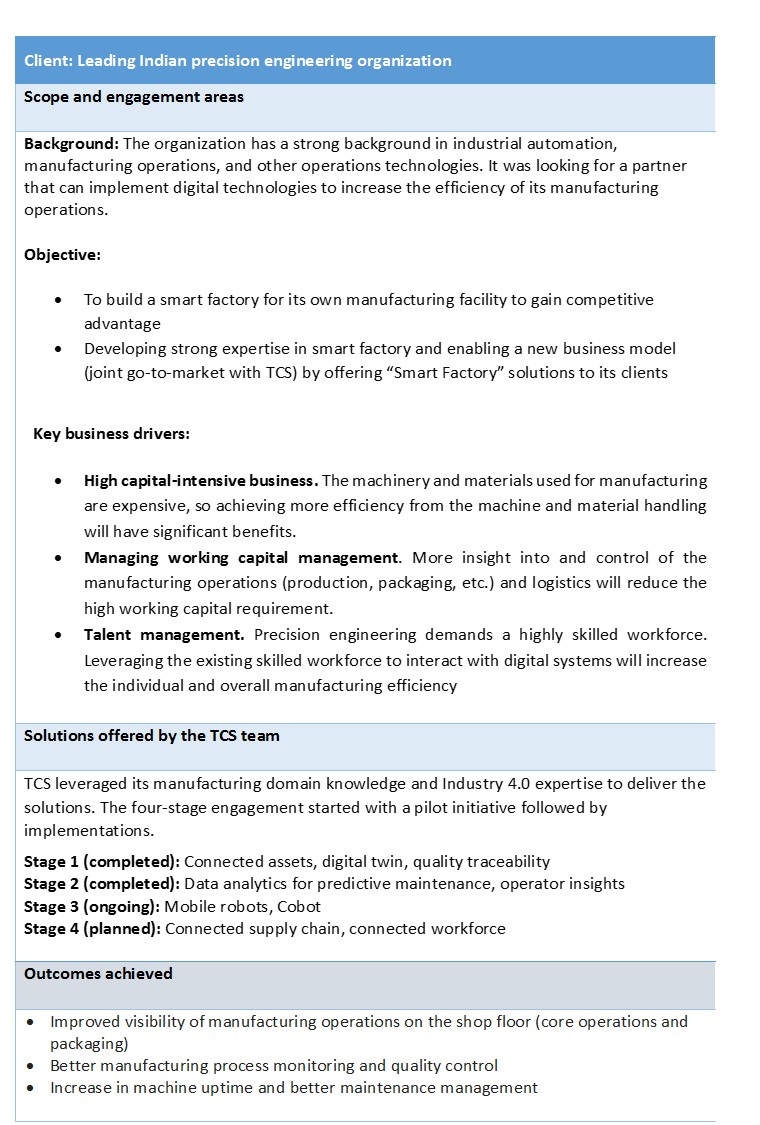
TCS has an ongoing Industry 4.0 engagement with an Indian precision engineering organization to implement some of the technology tenets as described in Exhibit 2. In most of the Industry 4.0 engagements, we have observed that the focus is on bottom-line improvement, but this initiative’s objective is to create a new revenue channel for the client—to offer “Smart Factory” as a service. Both the entities also plan to take the solution jointly in the market post the implementation.
Exhibit 2: TCS’ Industry 4.0 engagement with a leading Indian precision engineering organization
Source: HFS Research, TCS, 2019
Four action points for manufacturers for the success of Industry 4.0 initiatives
The key insights from this TCS initiative show us that while the outcomes of Industry 4.0 implementation look promising, manufacturers need to understand the scope and applications of digital technologies on core manufacturing systems and the workforce. Digital technology application is unfamiliar territory for several manufacturers because it challenges and changes their existing operating models. Here are four key pointers that manufacturers should keep in mind while implementing Industry 4.0.
Start with landscape assessment: Industry 4.0 requires digitalization of manufacturing activities, enabling some of the initiatives such as manufacturing process automation, connected components, and smart machines. Technology landscape assessment is necessary for creating a roadmap to realize the goal of a digital factory.
Bridge the gap between IT and OT: As most of the existing machinery is legacy equipment, it’s a challenge to unlock its digital value (e.g., limitations for putting on sensors, wiring). The availability of some critical data sets depends on the state of these machines. Connecting the OT with the IT side is of critical importance.
Augment the existing workforce’s skillset: Manufacturers often view industrial and manufacturing automation as a means to replace human workers with machines to save direct cost. This is not the right approach. Rather, the objective should be to increase the overall manufacturing efficiency. In the age of mass personalization, the role of the human workforce is critical for the “Factory of the Future.” We are still a long time away from the “lights-out” factory. Manufacturers should focus on augmenting the digital skillset of the existing workforce to manage digital manufacturing operations.
Deliver results from the bottom line to the top line: Most manufacturers focus on increasing manufacturing efficiency in the near term and optimizing manufacturing operations in the medium term. They should also focus on enabling new revenue channels through, for example, data monetization and new service offerings.
The Bottom Line: Weave the entire manufacturing thread through Industry 4.0 for the success of digital manufacturing initiatives
Manufacturers are obsessed with implementing emerging technologies in a factory context to gain immediate operational efficiency, resulting in several small–scale initiatives without weaving the entire thread of the manufacturing value chain. As a result, most of the initiatives are stuck in a PoC or pilot stage without sufficient scale to achieve sustained significant business outcomes. This engagement of TCS sets an example for manufacturers on how to go about Industry 4.0 implementations with a phased approach, keeping a bigger picture in mind.
Register now for immediate access of HFS' research, data and forward looking trends.
Get StartedIf you don't have an account, Register here |
With the exception of our Horizons reports, most of our research is available for free on our website. Sign up for a free account and start realizing the power of insights now.
Our premium subscription gives enterprise clients access to our complete library of proprietary research, direct access to our industry analysts, and other benefits.
Contact us at [email protected] for more information on premium access.

