This HFS Point of View is for CIOs, technology leaders, and enterprise boards not evaluating modernization investments through the lens of AI readiness and Enterprise Intelligence.
“Modernization” has long been the business equivalent of finally cleaning out the garage: necessary, overdue, and unlikely to get anyone particularly excited. AI has changed that completely because modernization no longer determines only how efficiently technology runs, but also how enterprises can deploy AI safely, reinvent how work gets done, and continuously turn human expertise into intelligence that the business owns. What used to mean migrating applications, reducing technical debt, and lowering infrastructure costs has become the price of admission to the AI-native operating model every board is being asked to fund.
Consider a global insurer embarking on a major modernization program. Five years ago, success would have been measured by how many legacy applications it retired, how much infrastructure cost disappeared, and whether it moved its policy administration systems to the cloud. Today, the board is asking a very different question: will this investment help AI settle claims faster, improve underwriting decisions, detect fraud earlier, and make the organization smarter every time it serves a customer?
The question that should now sit at the center of every CIO’s modernization agenda is “Does this modernization wave make our AI smarter?”
For the past two decades, modernization has had a familiar and perfectly defensible business case. CIOs migrated workloads to the cloud, rationalized application portfolios, retired legacy platforms, reduced technical debt, and measured success through lower total cost of ownership (TCO) and a simpler technology estate. The problem was that many of these programs ended with lower operating costs but little discernible improvement in business performance.
Those objectives still matter, but they no longer define the prize, because AI has changed the destination. Ambitious enterprises are no longer investing in technology simply to run existing operations more efficiently. Today, they are investing in automating complex work, personalizing customer experiences, improving decisions, and creating operating models that learn through execution.
Our insurer may achieve a 30% reduction in infrastructure costs, but those savings are increasingly incidental to the larger opportunity. The real value emerges when every claim processed, every fraud investigation completed, and every underwriting decision strengthens the company’s own intelligence rather than simply completing another transaction. A modernization program that reduces cost but leaves the insurer unable to deploy agents safely, access trusted data, or learn consistently from business outcomes has optimized the wrong result.
Modernization should, therefore, no longer be measured primarily by what it removes from the technology estate but by what it enables across the enterprise.
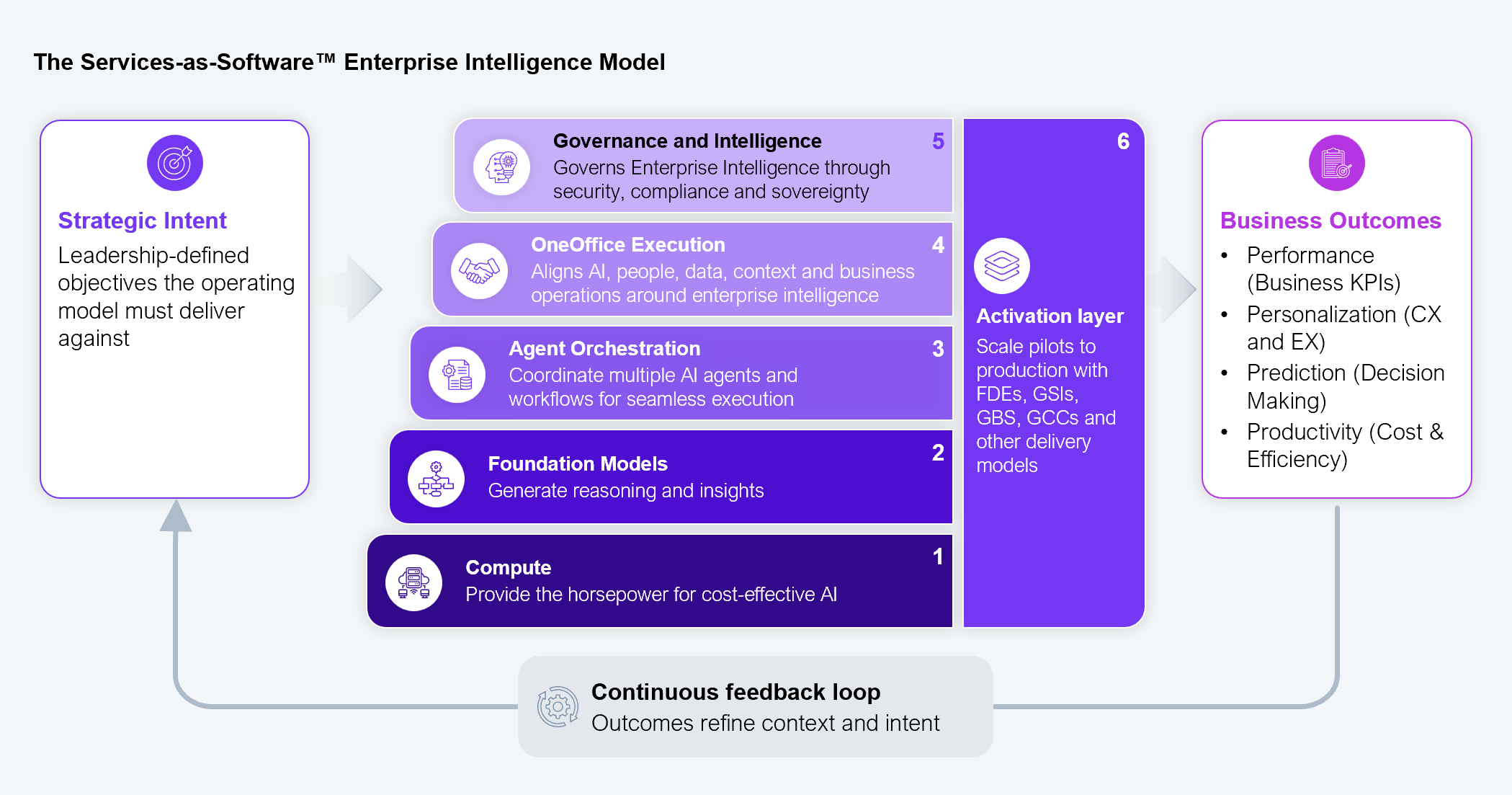
The HFS Services-as-Software Enterprise Intelligence Model provides a different way to frame modernization because it begins with the operating model the enterprise is trying to create, rather than the technology it is trying to replace. Services-as-Software is a delivery paradigm where AI-native execution increasingly replaces labor arbitrage, outcomes replace hours, and continuous telemetry replaces static contracts and periodic performance reviews.
This is not simply another technology stack. It describes what enterprise operations look like when work is delivered through an integrated system of models, agents, workflows, proprietary Enterprise Intelligence, and human oversight, with the organization continuously learning from every action and outcome.
For our insurer, this means modernizing technology alone will not make AI a better claims assessor or a more effective underwriting assistant. The enterprise must also capture the expertise of its underwriters, claim adjusters, fraud investigators, and customer service teams, then encode that knowledge into governed workflows that AI can execute, evaluate, and improve over time. The goal is not merely to install smarter technology, but to create an operating model that becomes more intelligent through use.
Source: HFS Research, 2026
The SaS Enterprise Intelligence Model places demands on the organization that most traditional modernization programs were never designed to address. Business outcomes must take precedence over technical service levels, data must be trusted at the semantic layer, workflows must be instrumented so agents can execute and learn safely, and identity systems must account for non-human actors operating inside critical business processes.
Governance can no longer be added after deployment because policy engines, human oversight, evaluation mechanisms, and audit trails are prerequisites for making agentic AI defensible in production. An AI agent that can access a claims platform but cannot interpret policy exceptions, escalate ambiguous cases, or explain why it recommended a particular decision is not an enterprise capability. It is an unmanaged risk.
Our insurer quickly discovers that moving policy systems to the cloud was the relatively easy part. The harder task is ensuring that its agents can navigate policy rules consistently across jurisdictions, understand which claims require human judgment, detect when outcomes begin to drift, and learn from the decisions of experienced employees without violating regulatory or privacy requirements.
This is why modernization is no longer downstream of the enterprise AI strategy. It is now upstream of every meaningful AI investment the enterprise is funding.
Many organizations are investing more heavily in modernization than ever, yet their programs are still built around conventions created for an earlier technology era. Success is measured through project completion, budget adherence, migration milestones, and cost reduction, while business transformation, process redesign, data modernization, and technology delivery continue to operate as separate workstreams.
AI does not respect those organizational boundaries because intelligent execution depends on all of them working together. An enterprise cannot become AI-native when its data is fragmented, its processes vary by region, its governance is applied inconsistently, and its modernization team is rewarded for moving applications rather than improving outcomes.
If our insurer modernizes purely for cloud efficiency, it may still declare the program a technical success. Yet six months later, its AI agents may remain unable to navigate fragmented policy data, claims workflows may still differ across business units, and every new automation initiative may require another costly integration effort. The technology estate is cleaner, but the operating model has barely changed.
That is the danger facing many CIOs today. Their modernization programs are delivering exactly what they were designed to deliver, but what they were designed to deliver is no longer enough.
Every time AI executes a process, it creates new operational intelligence. A claims agent learns which cases require escalation, an underwriting assistant identifies new risk patterns, and a fraud model becomes more accurate as it observes how investigators resolve complex cases. The critical question is whether that intelligence accumulates inside the enterprise or quietly enriches the external platforms supporting the workflow.
The original modernization agenda rarely had to confront this issue because the objective was to improve systems rather than create intelligence. In the AI era, enterprises must be able to state clearly where their data, models, agents, workflows, and accumulated knowledge reside, who controls them, and whether that intelligence can move when the organization changes providers. Most current cloud AI deployments have not fully answered those questions, which means many enterprises are unknowingly ceding compounding value to their platform partners.
Modernization has therefore become an issue of enterprise sovereignty as much as technical capability. A modern technology estate that leaves the enterprise dependent on someone else’s intelligence is not genuinely modern.
The sourcing conversation also changes when modernization targets a Services-as-Software operating model. Traditional modernization could be purchased from almost any capable systems integrator because the objectives were largely standardized: migrate applications, reduce costs, consolidate infrastructure, and improve operational efficiency.
Services-as-Software changes that equation because the delivery model becomes part of what the enterprise is building. Whether modernization is delivered through Forward Deployed Engineers, global systems integrators, GBS organizations, or GCCs directly influences how business knowledge is captured, how workflows are redesigned, and whether Enterprise Intelligence remains under the organization’s control.
The systems integrator supporting our insurer is no longer simply migrating policy administration systems or rationalizing applications. It is helping encode decades of underwriting expertise, claims-handling practices, fraud-detection techniques, regulatory controls, and escalation rules into reusable operating intelligence that AI can apply repeatedly.
Pricing that work entirely through hours and headcount increasingly misses the point because the value lies in the intelligence created, not the labor consumed. A partner that finishes the migration but fails to capture the expertise required to operate the business intelligently has completed the technical work while leaving much of the strategic value behind.
CIOs should therefore rewrite modernization RFPs around a different set of questions. Does the provider understand the Services-as-Software destination? Can it redesign processes and operating models rather than simply migrate technology? Will it commit to measurable outcomes instead of activity levels? Can it help the enterprise retain ownership of the intelligence created through execution?
Most importantly, the CIO should keep asking the same question throughout the selection process: Will this partner make our AI smarter, or merely make our technology newer?
For years, modernization sat comfortably inside IT budgets, where its success was measured through technical efficiency and remained largely invisible outside the technology organization. AI has elevated it into a board-level priority because modernization now determines whether AI remains a collection of disconnected experiments or becomes embedded in how the enterprise actually operates.
When the board of our insurer reviews its modernization program three years from now, it will not be particularly excited by how many applications were retired or how much technical debt disappeared. It will ask whether claims are settled faster, whether underwriting decisions have improved, whether fraud is detected earlier, whether employees are spending more time on complex work, and whether the organization becomes smarter every time AI executes a process.
Those are fundamentally different measures of success, and they explain why modernization has suddenly become sexy. It is not because cloud migration has become more interesting or because technical debt has somehow become fashionable. It is because modernization now sits at the intersection of technology, operating models, business outcomes, and Enterprise Intelligence.
The enterprises that understand this shift will build organizations that continuously learn from execution. Those that do not will simply end up running yesterday’s business on newer technology.
Treat modernization as the foundation of your AI operating model, not as an exercise in cleaning up technical debt. Every investment should strengthen the enterprise’s ability to capture proprietary intelligence, orchestrate AI safely, protect its sovereignty, and deliver measurable outcomes through Services-as-Software.
Before approving another cloud migration, application rationalization, or systems integration project, every CIO and board member should ask one simple question: Does this modernization make our AI smarter?
If the answer is unclear, the enterprise is probably modernizing for the wrong future.
Register now for immediate access of HFS' research, data and forward looking trends.
Get StartedIf you don't have an account, Register here |
With the exception of our Horizons reports, most of our research is available for free on our website. Sign up for a free account and start realizing the power of insights now.
Our premium subscription gives enterprise clients access to our complete library of proprietary research, direct access to our industry analysts, and other benefits.
Contact us at [email protected] for more information on premium access.