This HFS point of view is for chief AI officers, CIOs, and chief operating officers designing agentic AI programs that compound instead of plateau.
Enterprises are spending heavily on agentic AI for the outcomes leaders want. Most chief AI, information, and operating officers see early wins from agentic AI, but the value soon plateaus. Only 10% of enterprises can scale the tech, with only 2 in 10 generating new value from it. The usual explanation that the models are not good enough is incorrect. The actual barrier is treating scaling as a checklist of tools to install, when durable gains and the eventual $1.5 trillion shift from headcount-driven delivery to Services-as-Software™ come from a system that compounds.
The enterprises pulling ahead treat agentic AI as a flywheel (see Exhibit 1). At its center is a continuous-learning loop, surrounded by enablers across enterprise foundations, the execution model, and commercial value and people. Each cycle is designed to improve the next. Early evidence supports the view that autonomy is already highest where the continuous loops are strongest, specifically IT operations and software engineering.
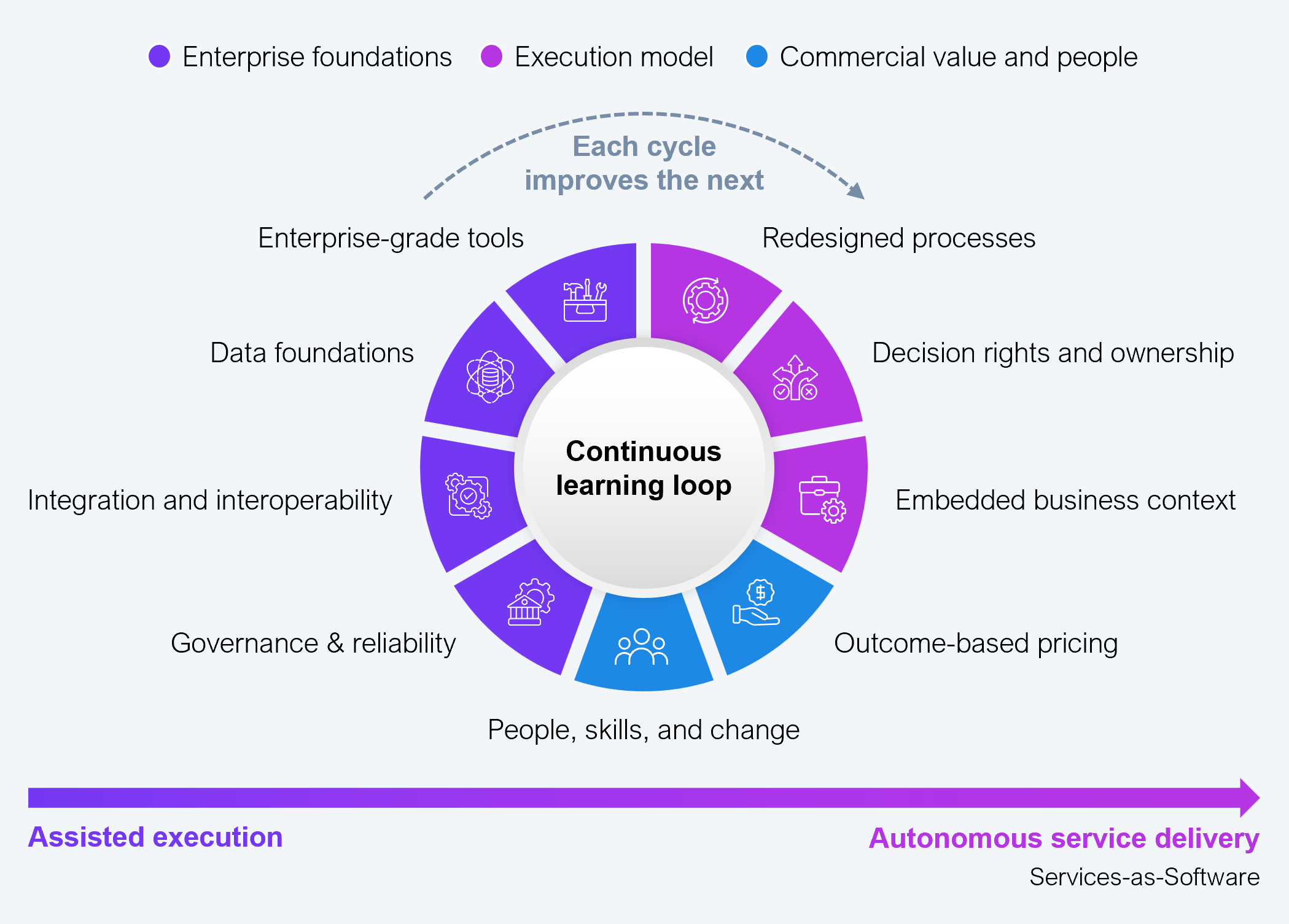
Note: The image indicates key enablers; not exhaustive
Source: HFS Research, 2026
The fact that only 10% of enterprises scaling agentic AI today is not an AI problem but an operating model problem. HFS’s assessment of 36 service providers found the market itself prioritizing scale-readiness over raw autonomy and exposed the real constraint as unresolved enterprise debt (data, process, tech, and skills) sitting inside the enterprise, not the vendor. The difference between automation that plateaus and autonomy that compounds is whether the system can learn from outcomes and improve subsequent decisions. That continuous learning loop is the element most roadmaps leave out. As a data and analytics chief officer explains, one must design for it deliberately:
Every time the agent does something, there is a breadcrumb that is left behind. When humans do it, that doesn’t always happen.
– Chief Data and Analytics Officer at a large US manufacturer
The loop is more than a technical mechanism. It runs on three sources of feedback: customer signals, employee input, and operational data. And it calibrates two things together: the business logic and the AI models. The business owns what a good outcome means. IT owns how the models learn. The loop closes only when both feed it.
The loop is not a standalone fix. It is one of the five tenets of the OneOffice operating model: enterprise context, shared accountability, AI agents at work, trust and governance, and the continuous learning loop. This report singles the continuous learning loop out as the focus area, the part that turns the other four into compounding returns.
Strong foundations with no change to how work gets done produce capable agents no one trusts to act, while new ways of working built on weak foundations produce autonomy that cannot be controlled. Three enabler groups are necessary to address this, and a gap in any of them keeps the program stuck at assisted execution:
1. Enterprise foundations. These include enterprise-grade tools, data foundations, governance and reliability, and integration and interoperability. Agents are only as trustworthy as the data they reason over and only as safe as the controls around them. Leading enterprises have a strong data layer in place, with governance and security guardrails, before scaling. Integration and observability are equally vital so that agents can work across existing systems and get caught when they drift. Strong foundations move agents along the four stages of the HFS AI Trust Curve: model confidence, data credibility, behavioral trust, decision reliance.
2. Execution model. This is where autonomy is actually granted: redesigned processes, decision rights and ownership, and embedded business context. Putting an agent into a workflow built for people only automates the inefficiency an enterprise already has. The question is not whether to keep a human in the loop, but precisely where.
The human has to be in the loop. But where the human comes in is the question.
– Chief Risk Officer at a large North American fund management company
3. Commercial value and people. These include outcome-based pricing and the workforce behind the delivery. Services-as-Software is a different economic model, and it cannot realize its full economic potential when value remains tethered to FTE-based pricing. So outcome-based terms must evolve alongside the technology. Many enterprises are investing in autonomous delivery while still buying services as if labor hours determine value. Autonomy is built by the people who own the work and cannot be bought from a provider.
Eighty to ninety percent of the work will really be done by people who own the work themselves.
– Technology Transformation and Operations Lead at a large US-based insurance company
That makes skills and change management a continuous need instead of a one-time workshop. A recent study showed that 92% of employees received agentic AI training, yet nearly 90% found it insufficient. Additionally, in customer facing use cases, customer signals determine whether the value is real. Resolution, satisfaction, retention, and new-customer growth are the outcomes enterprises must price on, and they also feed back into the loop to keep the agents aligned to them.
The enablers are not the same kind of thing. Foundations are what you build, the execution model is how you put them to work, and commercial value and people are the returns and the workforce behind them. Embedded business context is not a standalone technology layer; it emerges from connecting governed data, domain expertise and redesigned processes.
The proof is solid in IT operations and software engineering where autonomy is already approaching 70%. In IT operations, agents run on strong telemetry feedback loops and mature processes. In software engineering, they run on rapid learning cycles and API-native toolchains, with human oversight supervisory rather than operational. Both are areas where the system can see what it did and learn from it. However, research points to a failure pattern: unresolved enterprise debt in data, process, and skills is the most-cited reason why agentic efforts stall after early wins. Autonomy compounds only when continuous learning loop and the enablers are deliberately built in.
DBS Bank shows what this flywheel looks like in practice. The firm anchors its AI in an in-house data platform, ADA, which holds 5.3 petabytes of well-governed data. It standardizes delivery through an internal protocol called ALAN, which helped scaled the bank to more than 800 models across 350 use cases. Every use case runs through the bank’s PURE governance framework and the regulator’s FEAT principles, with human-supervised oversight built in, including defined escalation paths, audit trails, and fallback mechanisms.
The system also learns in a loop. In scam detection, human experts set the risk thresholds, curate the customer nudges, and review outcomes to continuously refine the model. It can now flag high-risk transactions in 25 milliseconds and lift funds saved from scams by 17%, with alert models five times more effective than before. DBS also placed more than 10,000 employees on AI learning roadmaps. It built the enablers together and is now extending that base to agentic AI.
Four moves turn the flywheel from an idea into an operating model:
Buying more capability is not the same as building something that compounds. The advantage goes to enterprises that make each agent action teach the next. Everyone else just automates faster.
Register now for immediate access of HFS' research, data and forward looking trends.
Get StartedIf you don't have an account, Register here |
With the exception of our Horizons reports, most of our research is available for free on our website. Sign up for a free account and start realizing the power of insights now.
Our premium subscription gives enterprise clients access to our complete library of proprietary research, direct access to our industry analysts, and other benefits.
Contact us at [email protected] for more information on premium access.