This HFS Research Point of View is for CEOs, CIOs, Chief AI officers, and boards setting the reliability evidence and control thresholds that decide how much authority AI is granted.
The CEO now owns the consequences when AI makes a wrong decision, making AI reliability an enterprise management discipline. The tech is already making decisions about customers, pricing, and risk. But if the CEO or board asks for proof that those decisions are sound, the answer will be technical: uptime, latency, model accuracy. None of them says whether the business can stand behind what AI just did.
That gap between what AI already decides and what the business can prove changes what trust in AI means. It is no longer confidence in the technology. As AI makes decisions that carry real consequences, trust must be earned through evidence that the tech delivers the intended business outcome within enterprise-defined boundaries and can be corrected or stopped when it does not.
This changes the reliability conversation. Reliability must determine what AI can be trusted to do, what evidence is needed to prove it, and how much authority the enterprise is prepared to give it.
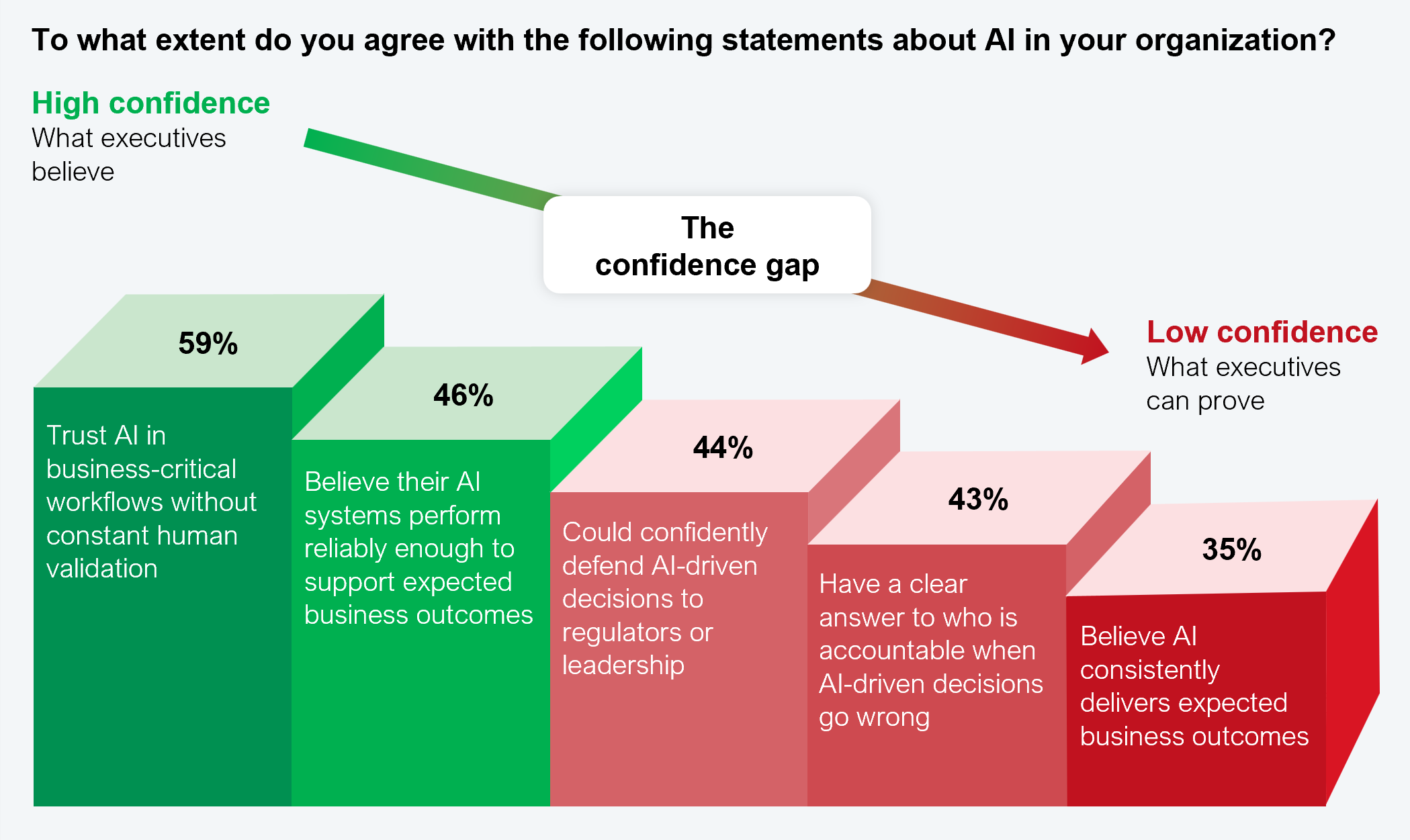
Enterprises are becoming comfortable putting AI into critical workflows. But that confidence is outpacing their ability to prove that it is justified. Recent HFS research, in collaboration with TCS, shows that 59% of executives trust AI to operate in business-critical workflows without constant human validation. Yet only 35% say their AI systems perform reliably enough today to support the business outcomes expected from them (see Exhibit 1).
An enterprise can be confident that an AI system works without demonstrating that it consistently produces the right business outcome. As AI moves from employee productivity tools into customer interactions and revenue-generating decisions, that distinction starts to carry real cost. The enterprise test for trust must therefore move from “Does the AI work?” to “Can we stand behind what it does?”
Sample size: 101 C-suite and technology leaders across North America
Source: HFS Research, 2026
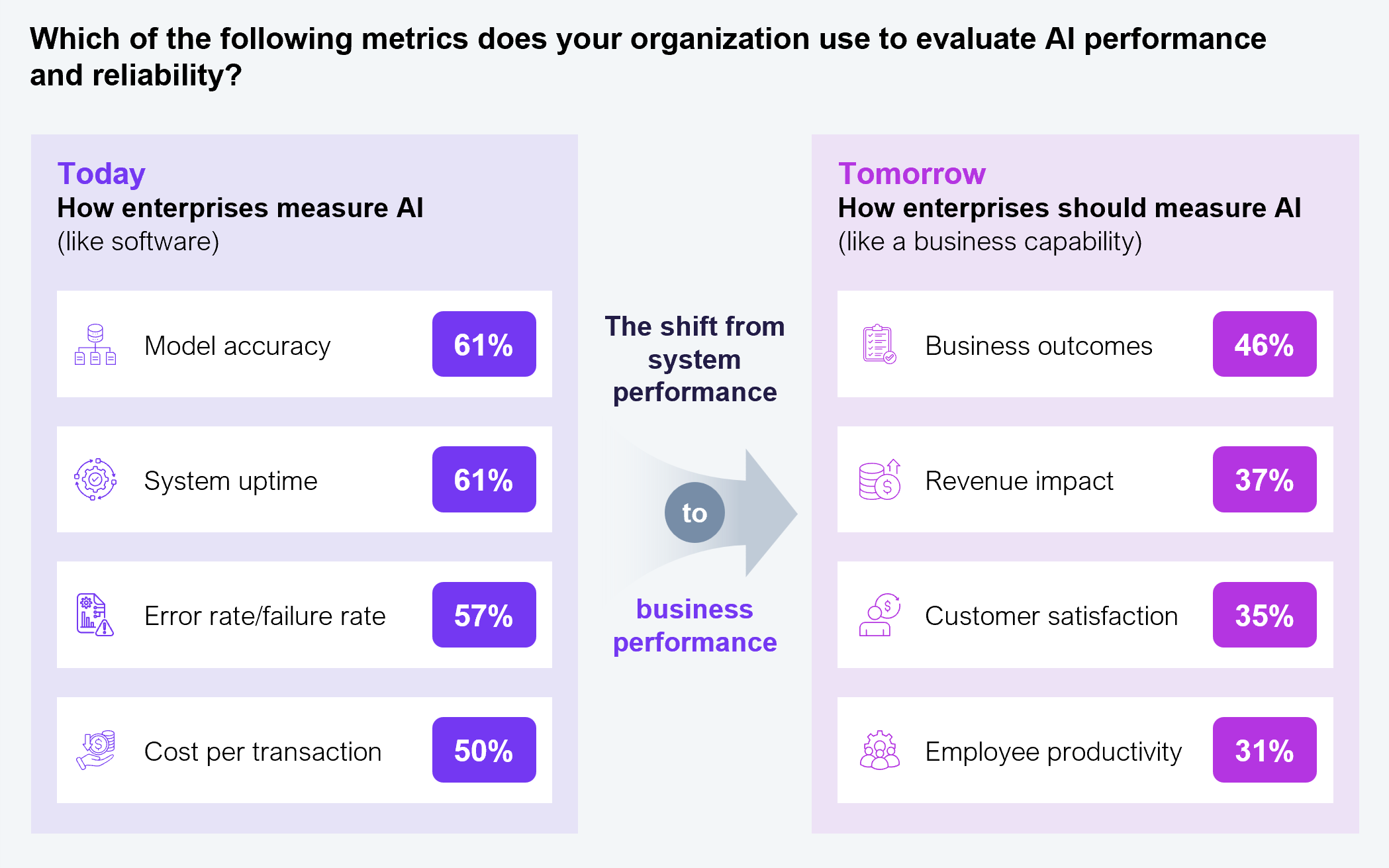
Enterprises are still measuring AI like traditional IT; 61% track technical performance metrics such as uptime, latency, and error rates, while only 46% measure the impact on business outcomes (see Exhibit 2). That gap becomes a business exposure as AI moves deeper into decisions that touch customers and revenue.
A healthy AI system, though, can still produce an unhealthy business outcome. Reliability must therefore go beyond whether the technology is available and accurate. It should establish whether AI produces outcomes that the business can defend.
Enterprise leaders need to connect technical performance to operational consequences and business outcomes, setting reliability thresholds based on the value and risk of each use case. A customer-facing agent, a fraud decision, and an employee copilot should not be held to the same reliability threshold.
Sample size: 101 C-suite and technology leaders across North America
Source: HFS Research, 2026
AI reliability becomes more consequential when AI moves from recommending an action to executing it. At that point, the enterprise has moved from adopting technology to delegating authority.
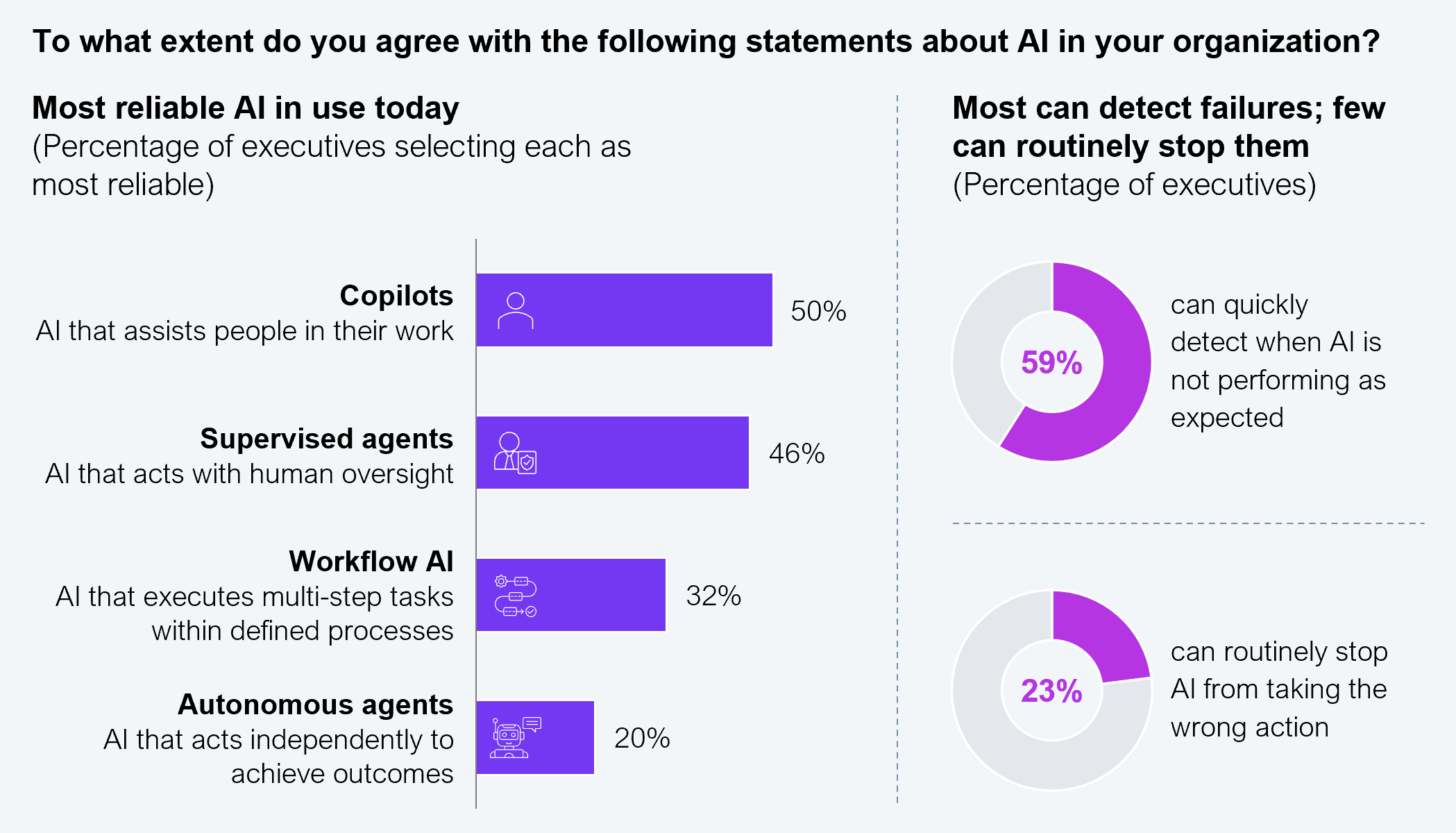
Yet enterprise control capabilities are lagging; 59% can routinely or automatically detect when AI is behaving unexpectedly, but only 23% can stop it from taking further action (see Exhibit 3). Detection without containment leaves the business consequences in play, turning reliability from a monitoring problem into an enterprise control problem.
As enterprises scale agentic AI, they need to determine how much autonomy each process can absorb based on the consequences of failure and their ability to intervene and recover. A customer service agent and an autonomous financial decision maker should not be granted the same authority simply because the technology can support both. Autonomy must be earned through demonstrated reliability.
Sample size: 101 C-suite and technology leaders across North America
Source: HFS Research, 2026
Gaps like these are not technology problems. AI reliability can no longer sit solely with the CIO and technology teams. When AI influences customers, revenue, and compliance, the consequences of failure fall on the business, regardless of who owns the technology. That puts AI reliability squarely on the CEO agenda.
CEOs and their leadership teams, therefore, need to set conditions under which AI is allowed to operate:
This is already starting to show up in enterprise investment priorities. Reliability spending is moving beyond model tuning toward data quality and grounding, guardrails, process redesign, monitoring, and human-AI operating models. The spending pattern says what the metrics do not: AI reliability is an operating model challenge that model tuning alone cannot solve.
This gets harder as AI takes on more of the work. CEOs and their leadership will have to make deliberate choices about where AI can act independently, where people still need to step in, and what proof they need before loosening those controls. Getting those choices right for each use case is how they can earn that trust.
Register now for immediate access of HFS' research, data and forward looking trends.
Get StartedIf you don't have an account, Register here |
With the exception of our Horizons reports, most of our research is available for free on our website. Sign up for a free account and start realizing the power of insights now.
Our premium subscription gives enterprise clients access to our complete library of proprietary research, direct access to our industry analysts, and other benefits.
Contact us at [email protected] for more information on premium access.