
This HFS Point of View is for GBS leaders, global process owners, COOs, and transformation executives converting AI accountability into authority over applications, governance, and decision rights.
AI is changing the unit of value from transactions processed to business outcomes orchestrated, and Wall Street has already repriced the service providers that missed the shift: pure-play IT/BPO services firms trade at roughly 1.5x sales, while the S&P 500 averages 3.7x and AI-native companies around 46x (see Exhibit 1). Global business services (GBS) leaders face the same repricing internally, at a lag, as budget scrutiny and functions pulling work back.
GBS is uniquely positioned to own the shift because it already spans enterprise processes, data flows, and functional boundaries. At the same time, it cannot be held accountable for AI outcomes without authority over the applications, governance, and decision rights that determine them. HFS’s view is that GBS must claim the space between business and IT within two years, or the functions will reclaim the work.
If your GBS organization had a market cap, what would its price-to-sales ratio (PSR) be? The providers listed in Exhibit 1 are not failing businesses; they posted mid-single-digit growth and stable margins. The market has simply stopped paying for revenue that scales with headcount, and GBS runs a similar linear economic model, only with internal customers.
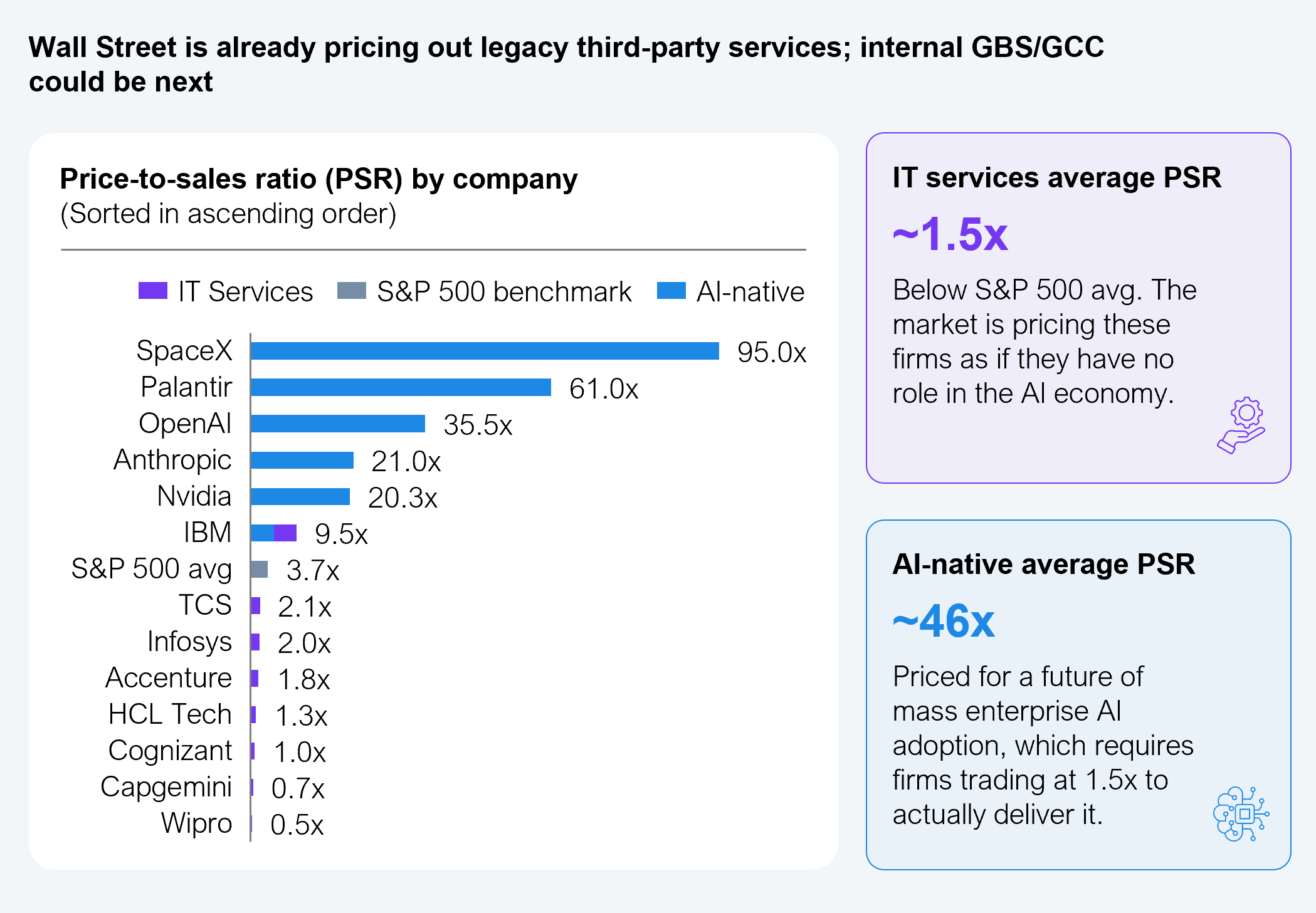
Note: The ~1.5x IT services average covers the seven pure-play firms and excludes IBM, whose revenue mix spans hardware and software; Nvidia appears as an AI-native reference point.
Source: HFS Research analysis based on publicly announced statistics, June 2026
The repricing is the symptom. The cause is structural, as HFS President Saurabh Gupta framed it for the room:
We are in 2026, trying to capture value from AI. But we are stuck in a 2010 operating model, especially for GBS.
— Saurabh Gupta, President, HFS Research
To identify the challenges enterprise face and the changes required to capture business value from AI at scale, HFS convened an executive roundtable with IBM in New York in July 2026, attended by senior operations, finance, and transformation leaders from banking, property and casualty insurance, mortgage servicing, pharmaceuticals, medical devices, beauty, consumer packaged goods, automotive, media, and industrial services (pictured below).
The consensus was that the main problem is an accountability and authority gap, not a technology gap. GBS is asked to deliver AI outcomes without any control over the data, platforms, or decision rights needed to deliver them. Until the middle layer between business and IT gets real authority over applications, context, and P&L, agentic AI will keep producing pilots that never reach production.
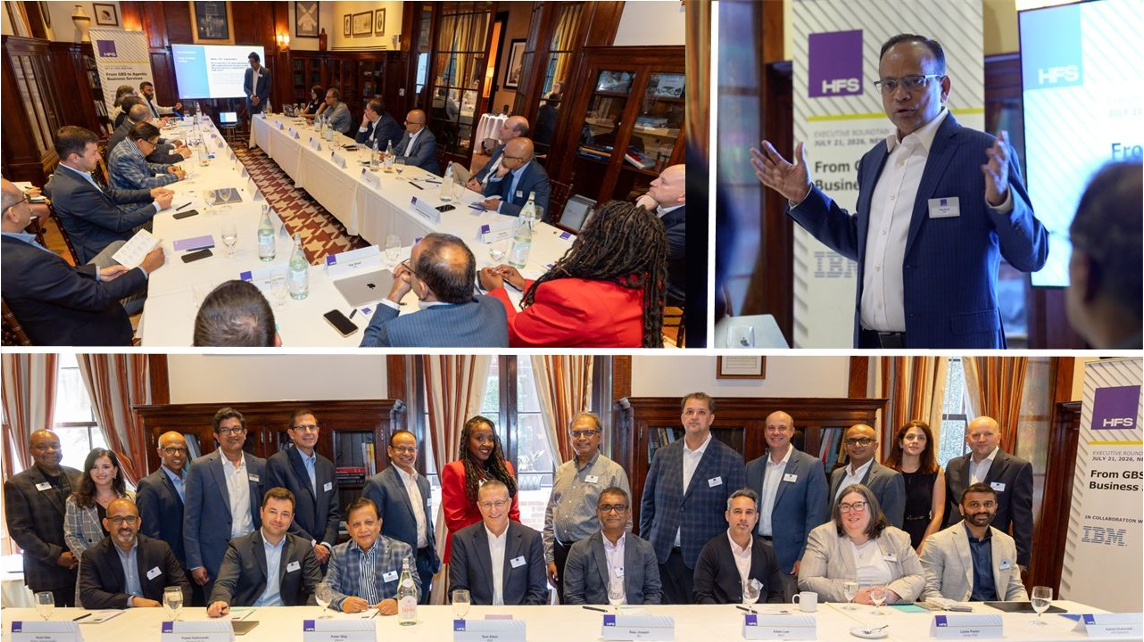
Source: HFS Research and IBM, 2026
Industry leaders across the room surfaced similar structural failures. Each pointed back to an operating model built for labor arbitrage, now asked to deliver autonomous execution.
Our global process owners are accountable, but they cannot act. We keep mixing up accountability with authority.
— GBS leader at a global industrial services company
The three threads build on one another: maturity is uneven, a missing mandate stops the mature pockets from scaling, and even a granted mandate fails without adoption and trust.
Pockets of maturity do not add up to organizational readiness. One automotive leader rated his platforms at 7 or 8 out of 10, but his organization at 1. Islands of excellence built on a disconnected operating model do not compound into an end-to-end capability.
The mandate is political, and few CEOs have granted it. The authority gap described above is the symptom. The cause is that cross-functional decision rights are conferred from the top, and participants consistently described that grant as absent. Agentic work cuts across silos by design, so GBS needs a mandate from the CEO rather than permissions negotiated function by function.
Change management and cultural readiness weigh as much as technical readiness. The leaders furthest along spent more effort on adoption, trust, and narrative than on the technology. Process debt can be engineered away; a workforce that does not trust an agent to act cannot.
If work is going back to the functions, it is not because we succeeded. It is because we failed to earn their trust
— Shared services transformation leader at a global consumer products enterprise
Three patterns recurred across the more advanced examples discussed, and all three are structural rather than technical.
You do not start with technology. You start with where the workflows are broken and where the connective tissue between functions is missing. GBS leaders created shared services by co-locating functions, but they never connected finance to supply chain to marketing to operations. IBM Business Orchestration Services was built to close that exact gap, and when somebody comes to me for simple labor arbitrage, I am learning to say no.
— Yogendra (Yogi) Goyal, Global Managing Partner, Business Orchestration Services, IBM Consulting
IBM’s client evidence points the same way. At a multinational consumer goods company, a single-accountability model with IBM Consulting reduced the cost of finance from 100 to 62 basis points between 2023 and 2025. Automation reached 70% to 90% across high-volume transactions, cash application, SAP payments, and intercompany invoicing, and reconciliation productivity improved 50% in more than 60 markets. The larger point is positional: finance moved from a transactional back office toward business partnering, a shift that GBS must now make at an enterprise scale.
Business sets intent; IT enables and executes it. GBS work sits between them and belongs to neither, which is why so much of it stalls (see Exhibit 2). One delegate launched an agentic finance pilot with finance on one side, IT on the other, and the AI expertise missing from both, so they went outside for it. HFS describes this layer as the OneOffice operating model: business intent and IT execution sharing one accountability and one scorecard, with AI agents working inside a single governance loop.
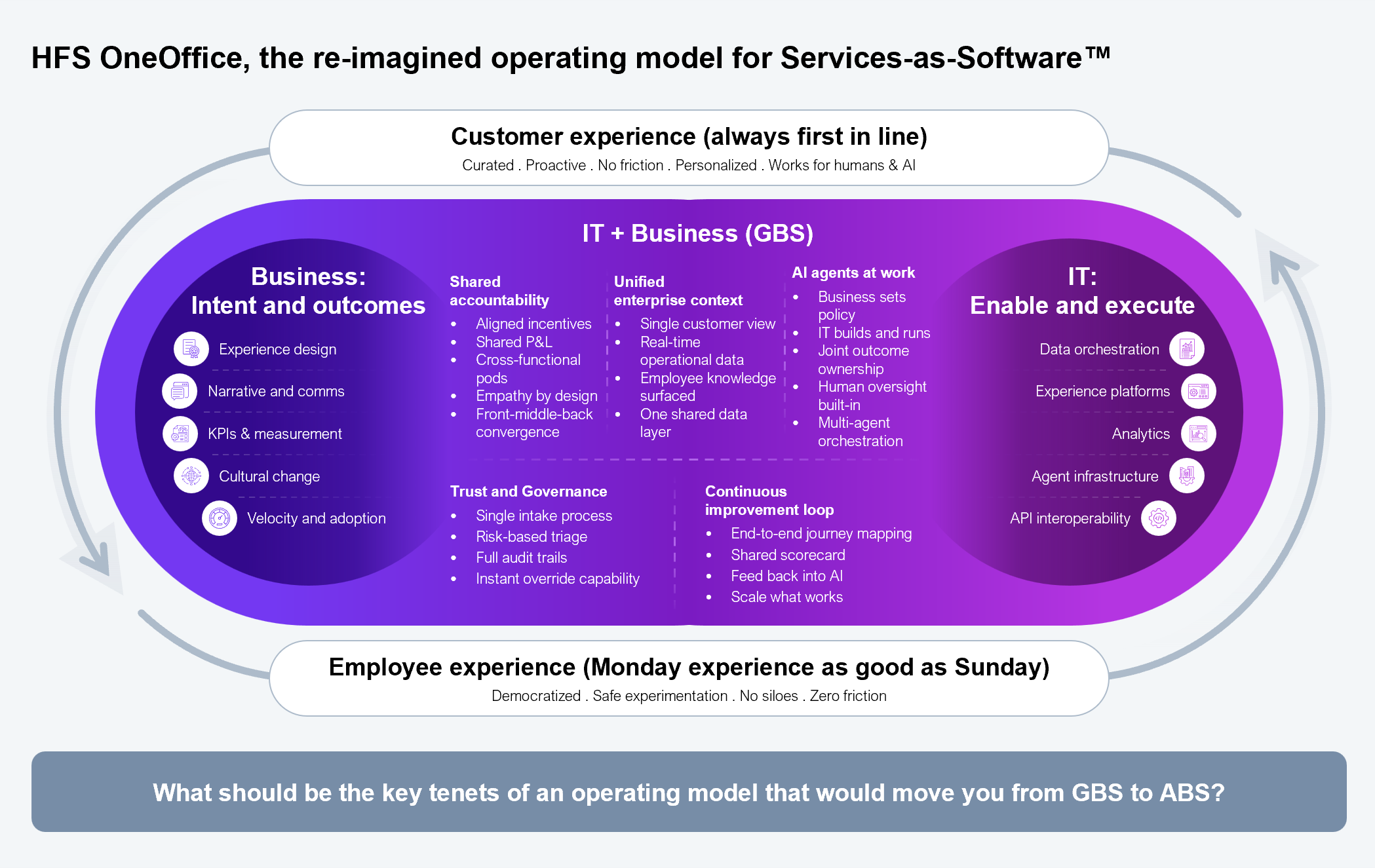
Source: HFS Research, 2026
HFS’s view is that the middle layer needs four capabilities. GBS already has three and needs to build on the fourth one.
Each move transfers a decision right into the middle layer, and none waits for better technology.
Almost every blocker raised at the three-hour roundtable was structural: fragmented ownership, applications in the wrong function, decision rights that exist nowhere, process debt, an obsolete process owner profile, and no governance over the new cost line. All can be solved through authority, which is the one thing GBS keeps asking for rather than taking.
This creates one test for every GBS investment: does it move authority into the middle layer, and does it move the enterprise up the HFS AI Trust Curve from model confidence toward decision reliance? If not, you’re just buying a faster version of 2010.
Register now for immediate access of HFS' research, data and forward looking trends.
Get Started

If you don't have an account, Register here |
With the exception of our Horizons reports, most of our research is available for free on our website. Sign up for a free account and start realizing the power of insights now.
Our premium subscription gives enterprise clients access to our complete library of proprietary research, direct access to our industry analysts, and other benefits.
Contact us at [email protected] for more information on premium access.

