
The cloud wars have been raging for well over a decade now, with AWS swiftly becoming the dominant force in the market (see Exhibit 1). In our previous analysis, we’ve discussed how the Google Cloud Platform (GCP) is uniquely positioned to bring an arsenal of features and capability to the market, but only if it brings the firm’s arguably limitless brains and brawn into battle in the same way AWS mothership Amazon did in the early days. With AWS wrestling with fears of lock-in and client competition (as Amazon grows into all verticals, it’s not just retail clients that want to avoid giving a competitor money through the back door), now is the right time for Google to arm up and bring the offensive to the enemy—and it better hurry before Alibaba’s movements gain significant momentum.
Exhibit 1: Hyperscale cloud providers performance
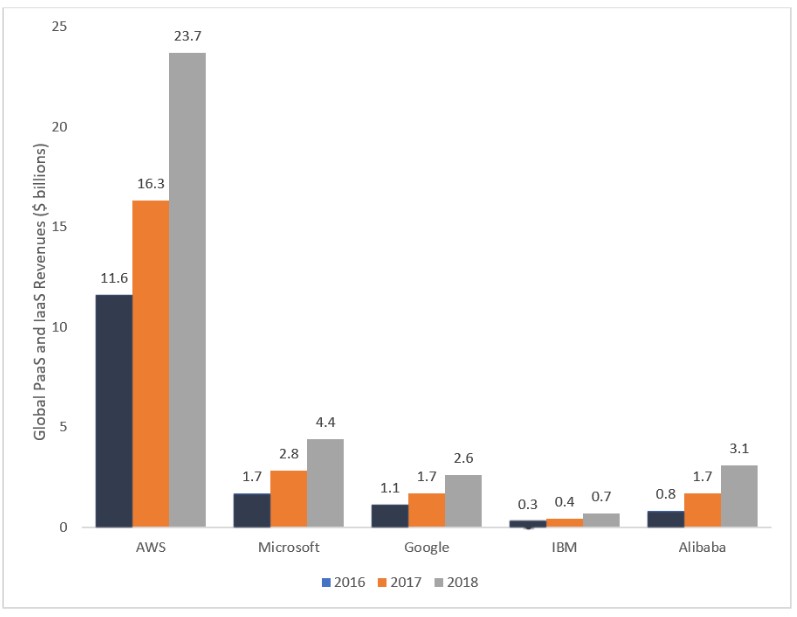
Source: HFS Research based on company financials and estimates where public data does not exist
Google plans to triple its global sales team over the next few years
At a recent analyst event hosted by Google’s cloud team, Google announced that while it recognized it was behind in the enterprise cloud space, the battle is far from decided. It’s a testament to this that the firm announced a plan to triple its sales team globally within the next few years, an expansion plan that could quickly become a thorn in the side of AWS and Microsoft, which up until now have had the lion’s share of the market.
According to executives from the firm’s EMEA team, Europe is a key battleground because of the region’s growing maturity in cloud technology. Enterprises there are looking beyond cost savings and basic data migration and toward viewing the cloud as a business enabler and change agent. This strategic view plays directly into Google’s hands—stack ‘em high, sell ‘em cheap hyperscale capability is a game Google has been reluctant to play, leaving AWS in particular to take the lion’s share. According to the major IT services firms, Google has rapidly become more price–competitive (cheaper). It’s the struggle partners have had finding google-certified professional services talent that’s pushed prices comparatively higher than the other major hyperscale firms.
With this in mind, Google could find itself relatively easily competing with firms that have pushed cloud as a cost–cutting toolset, as well as those associating the technology with higher value engagements. Interestingly, Google noted that while it’s still partner first, it has to provide more professional services support because that is what customers expect and demand.
Scaling talent internally and across partner networks will be the firm’s biggest challenge
Talent is the biggest challenge facing Google’s big push into cloud domination, both internally and across partner networks. In candid conversations with Google, its leaders argue the biggest issue is meeting talent growth plans while maintaining the stringent recruitment processes the firm has become famous, indeed notorious, for.
While Google benefits from a powerful reputation and brand in the consumer and enterprise technology space, that doesn’t mean the firm is immune to an ongoing battle for core talent and skills—including the elusive data scientists that are finding themselves in high demand regardless of technology, vertical, or region. Nevertheless, we suspect that if Google wants to push a major recruitment drive, it won’t have too much trouble bringing in the best and brightest.
But this can have a knock-on effect for one of the other major strategic imperatives for Google: Building out a robust partner network. Over the years, we’ve seen GCP feature more prominently in the strategic partnerships of major IT services firms, but looks can be deceiving. According to partners, there is a punitive talent war taking place, not just for core skillsets but with those familiar and skilled with GCP. And the worst culprit, according to many, is Google itself—as experts and specialists’ skill up with services firms and then use their skillset to pitch for a role with the mothership.
Certification is also a challenge. According to a major consulting firm, it’s relatively easy to find AWS– and Azure– certified professionals, but GCP–certified professionals are elusive. If Google Cloud is to meet its goals of both growing internal talent and supporting the expansion of partner teams, something will need to change. One solution cited by a Google executive is to share talent pipelines with partners. Understandably, Google receives a large volume of applications every year; allowing partners to tap into this could fuel the growth of professionals. Regulatory and data privacy issues might make it difficult to do this in the short term, but going forward, a simple tick–box on the application form to explicitly allow permission could yield some benefits for all parties.
The Bottom Line: Now is the right time for Google Cloud to strike, but it will need to hit talent growth targets to sustain the battle against entrenched rivals.
Google Cloud is uniquely positioned in the hyperscale cloud market. AWS is increasingly coming under attack for directly competing with clients—such as retail and logistics, sketchy business ethics, and lock-in horror stories. Microsoft Azure may also benefit from AWS backlash. It is struggling to find its feet in a market that is increasingly about innovation and business enablement rather than cost reduction. Google’s quest for innovation, track-record of delivery in the consumer space, and largely neutral competitive position with potential clients mean now is the right time to strike to dominate the cloud market. But first, the firm must shake up its internal and partner talent model to ensure it has the soldiers necessary to bring the battle to its entrenched rivals. Despite all efforts to resist building a professional services organization, the partner–first model faces a challenge when customers demand Google engineers.
Register now for immediate access of HFS' research, data and forward looking trends.
Get StartedIf you don't have an account, Register here |
With the exception of our Horizons reports, most of our research is available for free on our website. Sign up for a free account and start realizing the power of insights now.
Our premium subscription gives enterprise clients access to our complete library of proprietary research, direct access to our industry analysts, and other benefits.
Contact us at [email protected] for more information on premium access.

