
This HFS Point of View is for enterprise CIOs and CFOs deciding whether to reset an existing global capability center before scaling, expanding, or innovating within it.
Enterprise CIOs and CFOs often consider greenfield global capability centers (GCCs) when the enterprise wants to relocate both business operations and innovation to navigate business challenges. The important question is whether the GCC you already operate is ready for what comes next. Your current GCC may have real scale, deep process knowledge, solid credibility, and people who understand the enterprise better than any new center could. However, its charter, talent model, governance, data access, and metrics still often reflect an outdated goal of low-cost delivery.
This viewpoint builds on earlier HFS research about new GCC economics and Services-as-Software™. It argued that these centers need trust, authority, clearer KPIs, and reusable software-led capacity to deliver real value. So before you open another center, add a function, or push more work into the system, ask whether your GCC has evolved to address the next challenge.
The next GCC opportunity lies within the centers that enterprises already operate. Our GCC Services Horizons research shows that brownfield engagements account for 52% of GCC-provider activity compared with 43% for greenfield and 5% for center of excellence (CoE)-led models. Furthermore, 62% of engagements now focus on AI, covering AI CoEs, AI analytics, agentic AI, AI automation, and AI-led innovation (see Exhibit 1). In other words, most investments are directed toward transforming existing GCCs rather than building new ones.
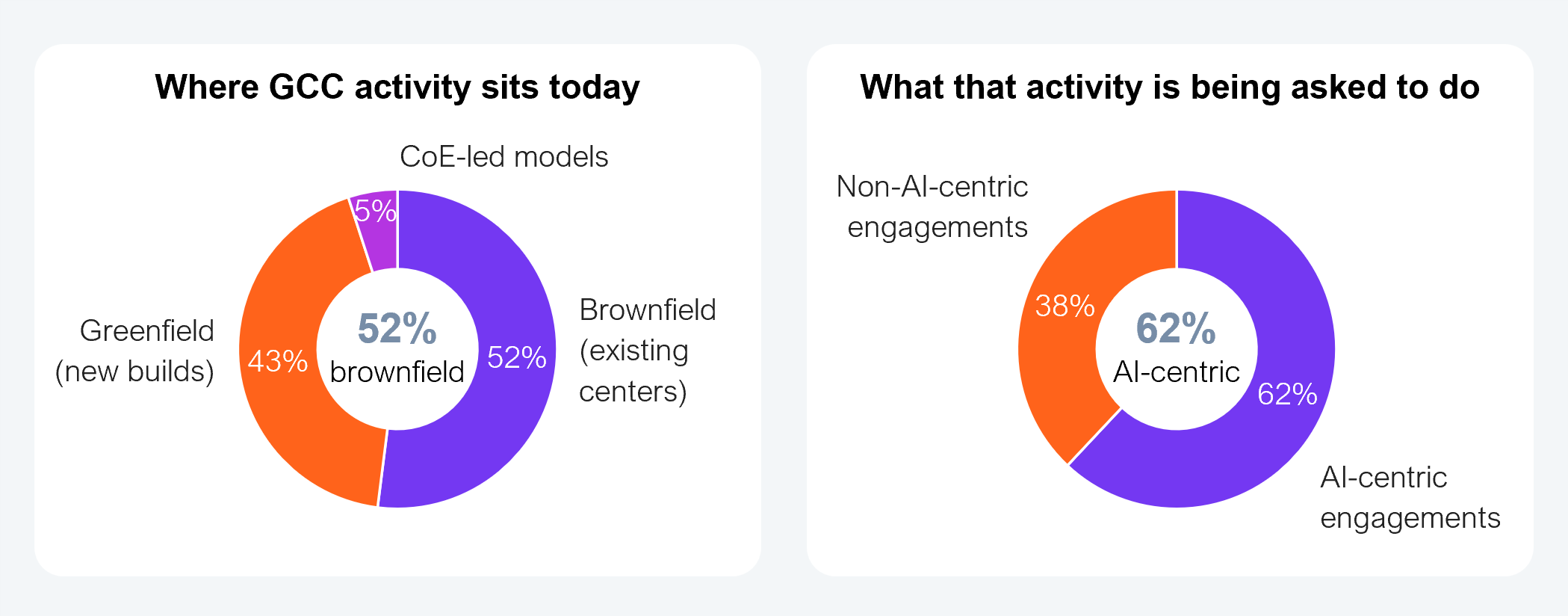
Source: HFS Research, June 2026
Large GCCs look mature because they have already established governance routines, delivery dashboards, escalation paths, and functional scale. These are real signs of operational discipline, but they don’t prove that these centers are ready for a mandate around product ownership, decision support, Services-as-Software, resilience, and innovation. Many have already realized that the programs in place are eating up resources and delaying innovation and execution. For example, Wells Fargo, Novartis, and JPMC are shrinking their GCCs and reducing the operational cost, focusing on innovation and AI-driven value outcomes.
The gap between their maturity and readiness stems from six challenges: setting the right charter, running complex operating models, finding and keeping niche talent, integrating culturally and organizationally, moving from cost center to value hub, and measuring business outcomes. When the mandate is unclear, investment scatters, expectations diverge, and the center never becomes a strategic asset.
The brownfield trap is evident through everyday signals. The center continues to grow, yet the business views it as merely a delivery arm. Automation is implemented, but productivity does not show in enterprise metrics. Data teams exist, but the decision rights remain with headquarters. Leaders speak of innovation, yet the talent mix leans heavily toward execution. The center manages numerous dashboards, but few indicate what changed for customers, products, risk, or revenue. This requires a reset from an execution hub to the enterprise innovation hub.
Brownfield transformation starts with discipline: enterprises should not keep shifting more work to a center whose role has not been renewed. A reset is not a rebranding exercise. It forces leaders to decide what the GCC should stop doing, what it should own, and where it should be funded differently (see Exhibit 2).
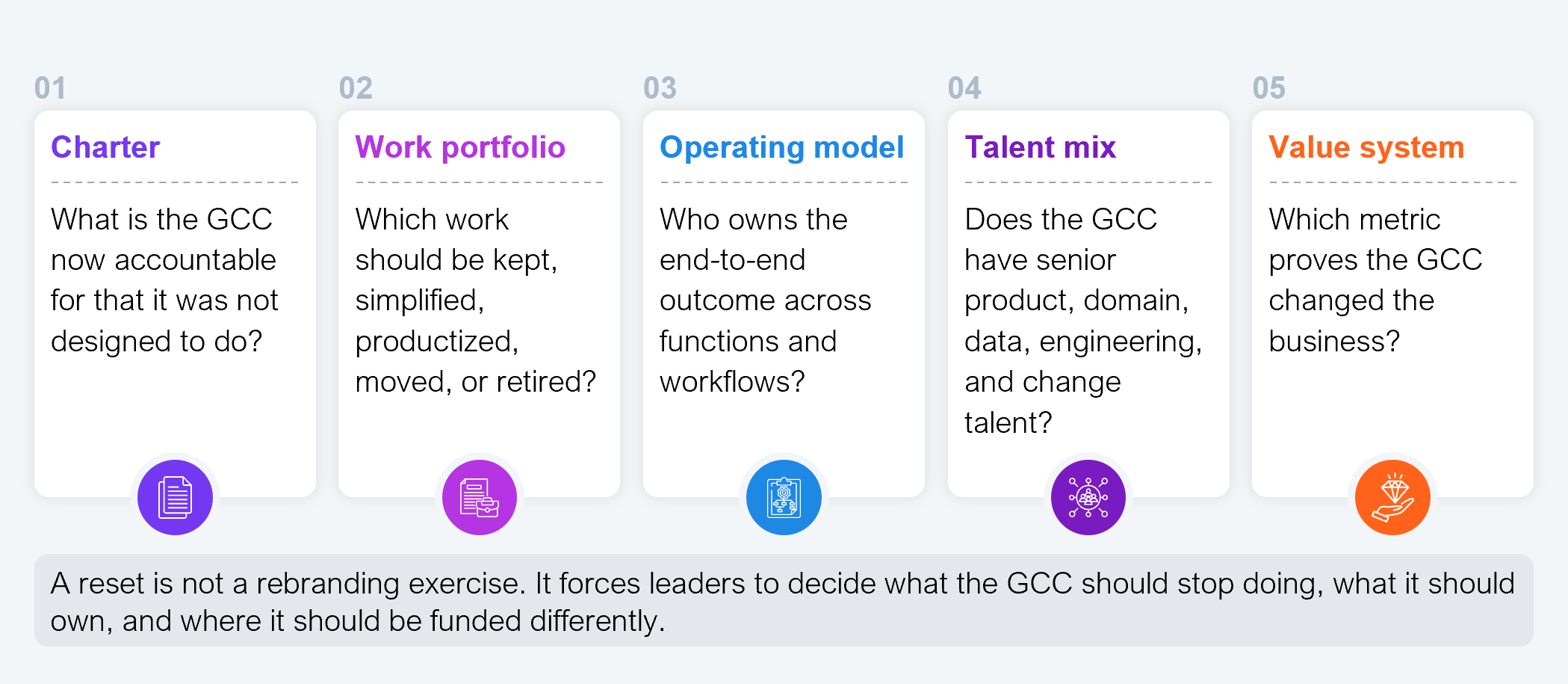
Source: HFS Research, June 2026
A center focused on inherited work will continue protecting it until the enterprise provides a clearer mandate to reset.
Greenfield decisions are typically made to optimize talent, cost, footprint strategy, or market entry. A brownfield reset is prompted by friction in the operating model, indicating that a center has outgrown its original mandate (see Exhibit 3).
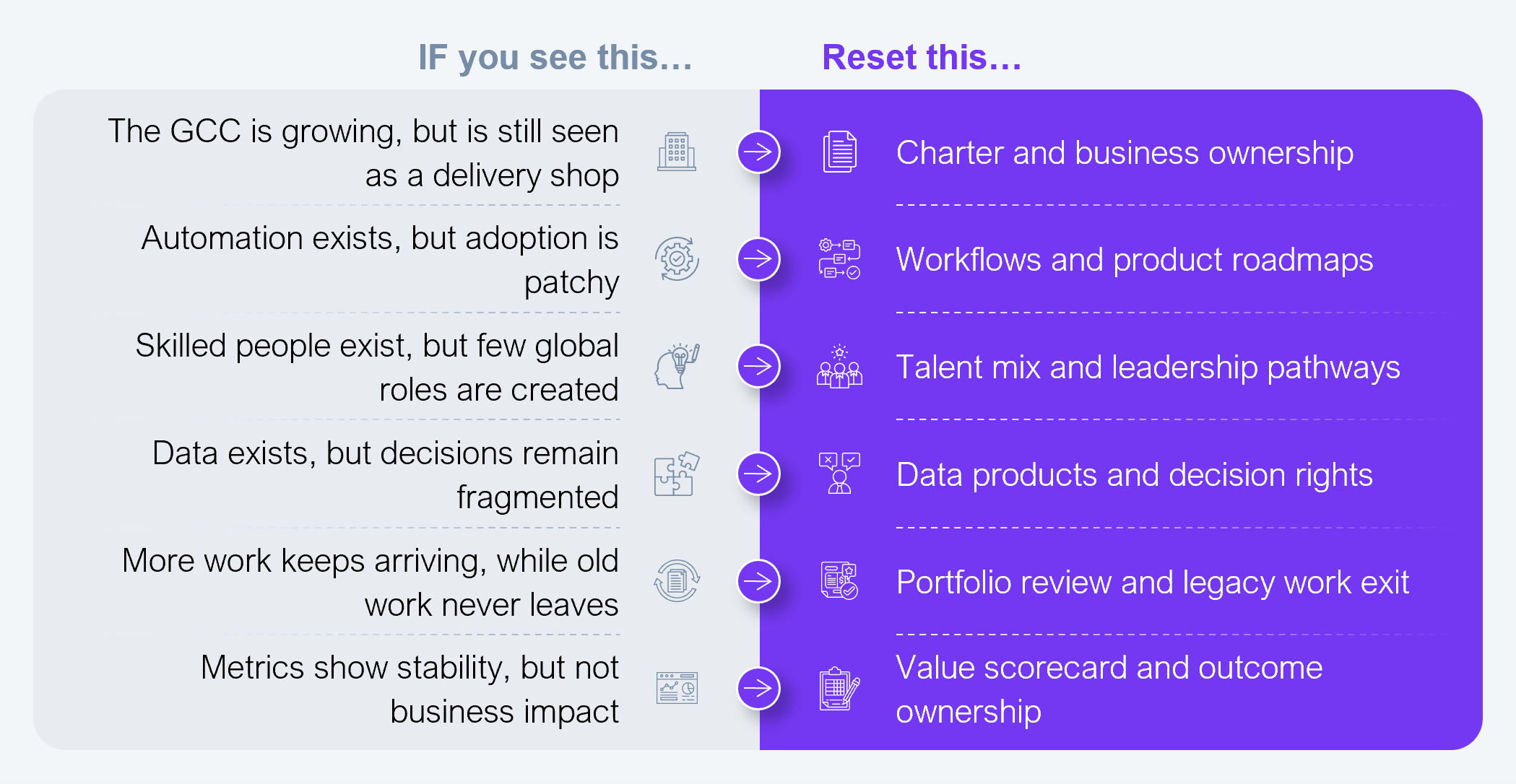
Source: HFS Research, 2026
These signals often get dismissed as growing pains when they are typically design issues. If ignored, they add weight to the center each year, increasing work, stakeholders, governance, and costs, while the enterprise waits for an impact the model was never designed to deliver.
First, the enterprise should decide the outcomes the GCC should deliver over the next 12 to 24 months. Second, the GCC and headquarters should agree on which work to simplify, productize, retain, or move. Third, leadership should identify what authority the GCC needs to accomplish the new mandate.
What follows is straightforward portfolio management: protect the work that deserves it, productize the work that can be repeated, retire any work that no longer warrants scarce talent, empower the GCC where results are expected, and fund the center based on the value it is meant to generate.
HFS GCC case studies show that brownfield resets are already evident in enterprise GCCs restructured around clearer mandates, such as digital product ownership, operational performance, engineering productivity, and workflow automation while being leaner and focused. Here are a few examples:
A brownfield center has already established scale, people, and industry knowledge that a new GCC would take years to develop. By rethinking its charter, operations, hiring, and values, it can drive real innovation. Simply adding more tasks to the existing mandate would lead to higher costs without addressing the core issues. A GCC designed for outdated goals won’t improve with growth; it just becomes more cumbersome and vulnerable to consolidation, offshoring, or outsourcing during cost reviews.
Register now for immediate access of HFS' research, data and forward looking trends.
Get StartedIf you don't have an account, Register here |
With the exception of our Horizons reports, most of our research is available for free on our website. Sign up for a free account and start realizing the power of insights now.
Our premium subscription gives enterprise clients access to our complete library of proprietary research, direct access to our industry analysts, and other benefits.
Contact us at [email protected] for more information on premium access.


