Point of View

Trust your GCC, train your talent, and redesign the FTE economics for real AI value

This HFS Point of View is for CIOs, CFOs, and GCC leaders redesigning operating models and FTE economics to turn AI ambition into measurable productivity and innovation.

Enterprise CIOs and CFOs have given global capability centers (GCCs) a more ambitious mandate: deliver higher productivity, increase efficiency, and accelerate AI innovation. However, many GCCs still lack the authority, data access, and sponsorship to turn these ambitions into actual outcomes. GCCs are strategically positioned as a transformation engine, but often serve as an execution arm in day-to-day operations.

Closing this gap requires boards to give GCC leaders decision-making authority, change the operating model, create innovative partnerships, and adopt new approaches to drive AI initiatives. Without these structural changes, GCCs will remain operating centers rather than evolve into innovation hubs capable of delivering enterprise-wide impact.

Most enterprises are failing to realize AI-led productivity due to gaps in the operating model

According to HFS Pulse data, 55% of GCC leaders described their centers as strategic hubs for AI-led innovation, and about 49% are expecting to accelerate operational efficiency through AI and automation (see Exhibit 1). These findings indicate that conversations between GCCs and their partners are now moving beyond cost, productivity, and talent to AI-led innovation.
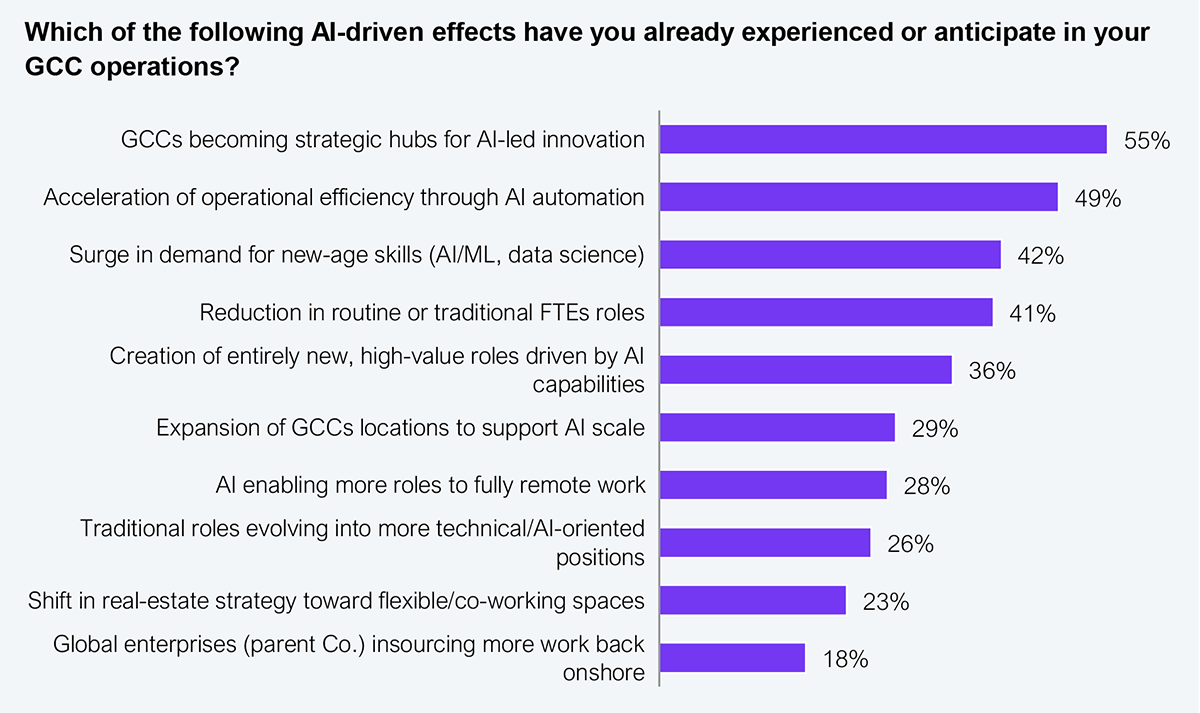
Exhibit 1: AI-led innovation and automation are the most prominent changes in GCCs

Horizontal bar chart showing the share of respondents who have experienced or anticipate each AI-driven effect in their GCC operations, in answer to the question "Which of the following AI-driven effects have you already experienced or anticipate in your GCC operations?" The categories and values are: GCCs becoming strategic hubs for AI-led innovation, 55%; acceleration of operational efficiency through AI automation, 49%; surge in demand for new-age skills such as AI/ML and data science, 42%; reduction in routine or traditional FTE roles, 41%; creation of entirely new, high-value roles driven by AI capabilities, 36%; expansion of GCC locations to support AI scale, 29%; AI enabling more roles to fully remote work, 28%; traditional roles evolving into more technical or AI-oriented positions, 26%; shift in real-estate strategy toward flexible or co-working spaces, 23%; and global enterprises (parent company) insourcing more work back onshore, 18%. Sample: 204 major enterprise decision makers; total does not add to 100% due to multiple selection options. Source: HFS Research, 2025.

Sample: 204 major enterprise decision makers; total does not add to 100% due to multiple selection options
Source: HFS Research GCC Pulse, 2025

However, the situation on the ground is different. AI productivity remains limited due to enterprise-level challenges and ineffective partnerships. Our Global Capability Centers (GCC) Services, 2026 report found that while more than 70% of GCC leaders achieved measurable outcomes on cost, quality, reliability, and access to niche talent through partnerships, only 32% achieved AI-driven productivity and just 16% saw innovation yields (see Exhibit 2). Realizing true value requires CIOs and CFOs to unify data across the enterprise and share the AI-led innovation agenda with headquarters, partners, and GCCs.
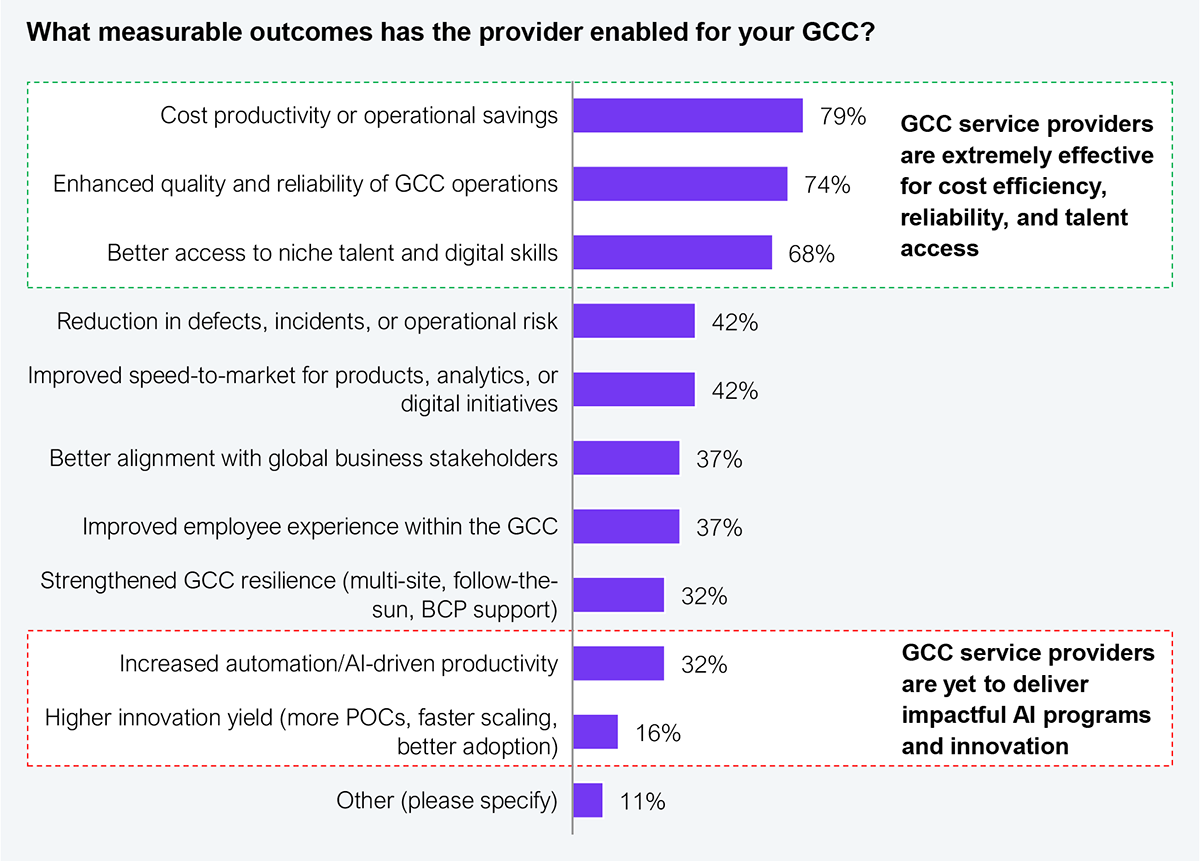
Exhibit 2: GCCs can see the outcomes on saving, reliability, talent, but not AI-led productivity

Horizontal bar chart showing the measurable outcomes providers have enabled for GCCs, in answer to the question "What measurable outcomes has the provider enabled for your GCC?" The categories and values are: cost productivity or operational savings, 79%; enhanced quality and reliability of GCC operations, 74%; better access to niche talent and digital skills, 68%; reduction in defects, incidents, or operational risk, 42%; improved speed-to-market for products, analytics, or digital initiatives, 42%; better alignment with global business stakeholders, 37%; improved employee experience within the GCC, 37%; strengthened GCC resilience through multi-site, follow-the-sun, and BCP support, 32%; increased automation or AI-driven productivity, 32%; higher innovation yield such as more POCs, faster scaling, and better adoption, 16%; and other, 11%. The chart groups the top three outcomes with the annotation that GCC service providers are extremely effective for cost efficiency, reliability, and talent access, and groups the lowest AI-related outcomes with the annotation that GCC service providers are yet to deliver impactful AI programs and innovation. Sample: 19 enterprise GCC leaders participated in the survey and interviews. Source: HFS Research, 2026.

Sample: 19 enterprise GCC leaders participated in the survey and interviews
Source: HFS Research, April 2026

Increased productivity requires AI alignment across the ecosystem, not FTE-based economics

Most GCCs operate under an economic model based on capacity. Headcount is the unit of value. Utilization is the proxy for performance. Billing, budgets, planning, leadership KPIs, and headquarters chargebacks all rest on the same FTE foundation. That model worked when the GCC’s job was predictable, repeatable execution at lower cost. It now punishes AI productivity.

The moment an AI agent or copilot removes the need for a junior engineer, the GCC’s scorecard goes the wrong way. Utilization dips, chargebacks shrink, and headcount growth stalls. The cost-per-FTE metric that headquarters use to justify the GCC costs starts looking worse. The model rewards keeping people busy rather than eliminating work. Procurement reinforces it from the headquarters side, benchmarking the GCC on rate cards and the pyramid mix rather than on cycle-time reductions or decisions automated. Until GCCs rewire their economics around throughput and business outcomes, AI productivity has nowhere to land.

Some enterprises are breaking this pattern by enabling AI alignment across headquarters, GCCs, and partners. The proliferation of new GCCs being set up in India, in partnership with providers, is driving AI-led productivity with new economics and innovative approaches. For example, a global logistics provider rewired its economics around AI productivity rather than capacity growth, aligning the entire ecosystem to a single end-to-end value stream, i.e., ship to collect, with shared accountability for outcomes, not just inputs.

New approaches, talent development, and change in mindset will help GCCs deliver AI-enabled outcomes

The current operating model is unsustainable. GCCs can no longer be viewed as delivery centers if they’re expected to deliver greater productivity and innovation. Realizing true value requires CIOs and CFOs to make clear decisions on GCC authority, redesign the operating model, sponsor AI innovation, and work alongside ecosystem partners with outcome-based expectations. Here are some approaches to enable this:

  • Identify the outcomes through workshops: Conduct workshops with all the CXOs and functional business heads to determine the outcomes. Use providers as accountable ecosystem partners focused on adoption, productivity, and innovation outcomes, rather than staffing, tools, and operational support.
  • Enterprise AI council: Create an enterprise AI council that can drive outcomes at the functional level all the way to the enterprise level. Make each functional head part of the AI council to frame a clear agenda to drive the periodic focused workshops.
  • Train talent to retain them: Preserve junior-heavy talent pyramids, but build mixed teams of domain experts, engineers, data specialists, and product owners working in close collaboration with headquarters. The more you empower employees, the greater the chance of retaining them.
  • Coach leadership to change their mindset: To maintain enterprise priorities, shift mindsets at both GCCs and headquarters. GCC leaders should embrace ownership of AI productivity, while headquarters leaders must view these centers as integral to the enterprise rather than competitors.
  • Showcase the benefits: Educate employees on how AI-driven outcomes can help them (productivity), the organization (cost savings), and the overall ecosystem (faster innovation across stakeholders).
The Bottom Line: Real AI value only starts when GCCs are trusted, empowered, and rewarded for outcomes, not headcount.

To transform your GCC from a cost-savings center into an AI-driven innovation hub, adopt capacity-utilization economics to drive AI productivity, make structural changes to the operating model, and, more importantly, shift the leadership’s mindset.

Sign in to view or download this research.

Login

Register

Insight. Inspiration. Impact.

Register now for immediate access of HFS' research, data and forward looking trends.

Get Started

Download Research

    Sign In

    Sign up for a free
    research account

    With the exception of our Horizons reports, most of our research is available for free on our website. Sign up for a free account and start realizing the power of insights now.

    Digests/Newsletters: Overviews of the latest news, insight, and research by HFS.

    HFS Events: Exclusive invitations to HFS webinars, roundtables, and summits, bringing together key industry stakeholders focused on major innovations impacting business operations.

    By registering you agree to our privacy policy.

    I hereby consent that HFS Research can process my personal data.

    Premium Access

    Our premium subscription gives enterprise clients access to our complete library of proprietary research, direct access to our industry analysts, and other benefits.

    Contact us at [email protected] for more information on premium access.

    Help

    If you are looking for help getting in touch with someone from HFS, please click the chat button to the bottom right of your screen to start a conversation with a member of our team.

    [email protected]

      Contact Ask HFS AI Support