
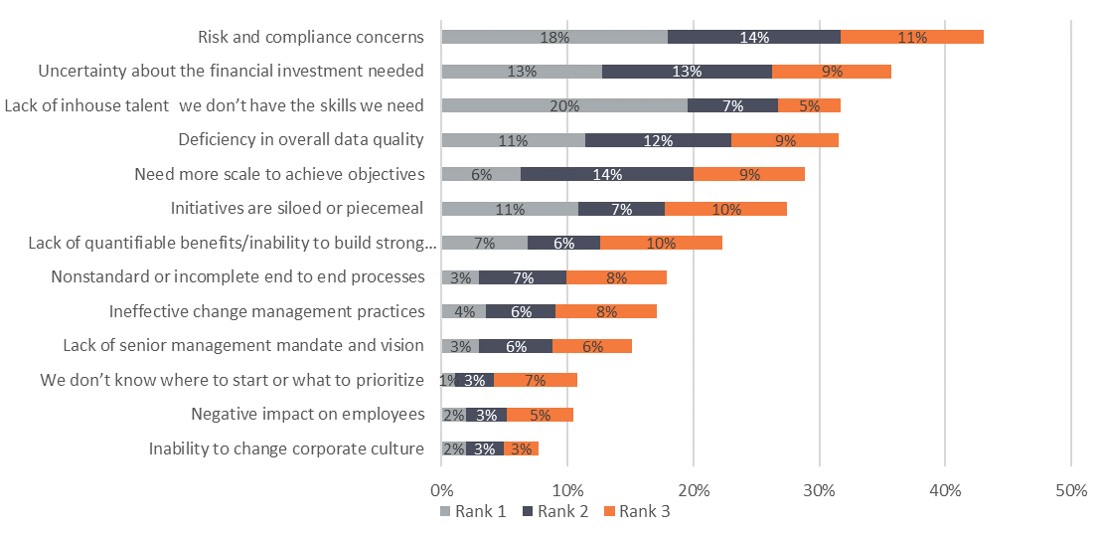
Enterprises and service providers have perfected the traditional labor arbitrage model for sourcing technical talent. Outsourcing has been the core model for bringing in the skills and experience, enterprises need to tackle specific business objectives. However, the world is changing, and the growing emphasis of technology in modern business has sparked skill shortages across industries and geographies. In fact, exhibit 1 explains that the problem is so severe that 20% of respondents ranked lack of inhouse talent as their number one inhibitor, which, in short, can only be satisfied by rethinking how enterprises and providers source talent.
Exhibit 1: Lack of talent is a leading inhibitor for enterprise embarking on digital transformation.
N=368
Source: HFS Research, 2019
One model that has risen to new prominence is crowdsourcing, which is the process of leveraging large pools of individuals to drive solutions and ideas – HFS has already researched this model. Some enterprises might shy away from innovative talent sourcing models hitting the market, but providers like Wipro are proving that crowdsourcing is both reliable enough to assuage any security or delivery concerns and that leveraging the collective brains and brawn of thousands of talented individuals, to solve a business challenge can make all the difference.
Unique to many of the other platforms out there, Wipro offers clients a unique opportunity to blend engagements across delivery models by leveraging its Topcoder platform to crowdsource particular activities, projects and leaning on other traditional delivery capabilities to tie in the rest. This model has enabled the firm to take on large transformation projects for large clients. This report will examine how Wipro and Topcoder helped two household names deliver real business value through innovative talent models.
Topcoder has a community with more than 1.5 million members in its armory, bringing scale and fresh perspective to complex challenges
Founded in 2001, Topcoder set out to create a transparent rating system for developers and a platform to access them on demand, representing a crucial shift from traditional labor models to an outcome-based model. The benefits range from increased speed of delivery to improved productivity and quality, which are essential qualities for every enterprise as they maneuver the increasingly complex and fast-moving digital technology landscape. Topcoder’s edge, according to its clients, is its substantial community, which gains a reported 1,800 members a week and allows the firm to boast five times the engineering bench of Microsoft, Facebook, and Twitter combined.
Since being acquired by Wipro, the platform has become a key ingredient for the provider’s innovation efforts, leading to an increase in potential engagements
Wipro recognized that enterprises constantly demand innovative methods of meeting and exceeding business outcomes, which led to the firm developing its Business Enablement Factory. This factory leverages Topcoder’s community extensively to solve complex business problems at speed and scale. This factory uses its CROP framework (in Exhibit 1), which employs the latest thinking in digital technologies to drive business outcomes.
Exhibit 2: Innovative thinking drives business outcomes
|
Phase |
Tasks |
|
Customer experience |
· Discuss UI/UX from proof of value to deployment · Map journey with service design |
|
Revenue |
· Identify revenue streams for development · Prevent revenue leakage |
|
Operational efficiency |
· Use intelligent automation and cognitive automation to maximise efficiency from front to back office |
|
People and partner experience |
· Maximize experience for talent, community, and clients |
Source: HFS, Topcoder, 2019
This framework and Topcoder’s increased engagement ensure that clients can be confident that the platform is thriving. The interesting projects for which Wipro leverages Topcoder talent satisfy client demand and generate attractive projects for the Topcoder community.
Client in focus: Microsoft leverages the Topcoder community to redesign quality assurance (QA) testing with crowdsourcing
Let’s dig into a specific example of an enterprise leveraging the platform. Microsoft historically found product testing time consuming and longwinded. Its pursuit of high-quality, fast turnarounds led to crowdsourcing. Platforms often comprise either testers that are 100% captive assigned or testers that are selected from a small pool, skewing results and slowing the overall process. But Topcoder is different, as Caleb Tseng, a Microsoft Senior Software Engineer explains,
“One of the things about the Topcoder model is that it truly is crowdsourced in the sense that we don’t know who is going to be testing our feature set week to week.”
Testers from different backgrounds see from different perspectives, offering a host of benefits; for example, using the product in different regions and languages means a higher chance of identifying bugs, while the tight feedback loop allowed Microsoft to continue development and implementation at speed. One important benefit is the ability to easily fit testing to requirements. Through Topcoder, Microsoft was able to scale testing as necessary and offer essential flexibility, allowing the QA testing to grow at the same rate as the products.
However, the model didn’t come without challenges. The number of devices and operating systems available to consumers continues to grow, making it crucial to develop new products that function on them all to meet consumer demand. Leveraging a “truly crowdsourced” platform means working with new testers weekly, making it difficult to ensure the product is tested on the necessary range of devices. But this isn’t the only challenge created; for example, bug feedback is a crucial element of QA testing, and this becomes increasingly difficult to provide when the testers are changing weekly.
T-Mobile is crowdsourcing non-domain specific tasks through Topcoder, driving productivity, total output, and delivery speed.
Another firm leveraging the platform is T-Mobile. One T-Mobile team was faced with tight deadlines, working at capacity—the perfect environment to foster mistakes, rushed tasks, and burnt-out employees. Kendrick Burson, Principal Engineer, CSM, CSPO, Next-Gen UI Architect for T-Mobile, recognized this and began seeking solutions. The outcome was Topcoder. When asked about the value Topcoder offered, he explained:
“It’s to supplement the team so that my team can focus on the domain-specific solutions, while the supporting solutions are taken by Topcoder.”
T-Mobile began using Topcoder to farm out non-domain specific tasks throughout the project’s development, including creating new tools, building scripts, and undertaking offline research. The main benefits of this are improvements in quality and speed of work. The size of Topcoder’s community means it likely holds members with niche and complex skills that are often difficult to find through traditional recruitment avenues. It allows the T-Mobile team to focus on domain-specific tasks. In fact, T-Mobile believes that an application that previously would have taken three to four months to build can now be completed in two weeks by leveraging Topcoder.
But once again, this model comes with challenges of its own, such as client confidentiality, identifying the necessary “prize money” to attract the right talent, and ensuring the chosen platform has the required individuals. Another is company culture; an incorrectly used crowdsourcing model can directly threaten company culture. Topcoder continues to evolve its model by adding innovative new features and models to incentivize talent and deliver against client requirements. Nevertheless, executives must tread carefully when selecting tasks to offer communities and ensure their goal is to supplement their existing employees rather than replace them. Not all tasks are ideally suited to the model. Smart executives will match the right talent model to the task.
The Bottom Line: Crowdsourcing can be a crucial ingredient in your enterprise’s success, but finding the right partner is essential.
Effectively using crowdsourcing to leverage new talent sourcing models can drive enterprise efficiency, allowing the firm to deliver high-quality projects quickly. Enterprises must understand that the success of any crowdsourcing project is reliant on the community it is pitched to—which means finding a platform with the right blend of incentives, talent, and skillset is vital to your enterprise’s move into crowdsourcing solutions. Ultimately, the proof is in the pudding, and both the case studies from Microsoft and T-Mobile highlight the value of the community Topcoder offers, be it diverse QA testers or individuals with niche skillsets.
Register now for immediate access of HFS' research, data and forward looking trends.
Get StartedIf you don't have an account, Register here |
With the exception of our Horizons reports, most of our research is available for free on our website. Sign up for a free account and start realizing the power of insights now.
Our premium subscription gives enterprise clients access to our complete library of proprietary research, direct access to our industry analysts, and other benefits.
Contact us at [email protected] for more information on premium access.

