
Three eras of sustainability services have brought us to where we are today: corporate social responsibility (CSR), understanding sustainability’s value, and now, business reengineering. We spoke with Justin Keeble, an MD leading the sustainability arm within Accenture Strategy, about the past, present, and future of sustainability services—a space that’s yet to be defined, but is very much there and growing rapidly. To play in the sustainability services game, service providers must reach across their functions and expertise to provide the breadth and depth that sustainable transformation demands.
Keeble cited three eras of sustainability consulting and services, beginning with the “CSR era” of the early 2000s. This first era involved the push for enterprises to understand their issues, responsibilities, measures, disclosures, and engagements when it came to sustainability.
In the second era, enterprises sought to align their sustainability goals with value creation through the improved efficiency of operations, supply chains, and so on. They identified which segments were sustainability-driven and then went about molding their strategies and portfolios to take advantage.
We currently sit in the third era of sustainability services, where industries are in transition. Take the energy sector as an example. It moved from a centralized, carbon-intensive, unintelligent industry to the complete opposite, with disrupting business models existentially threatening incumbents. Also consider the emerging definitions of the “energy” industry: traditional oil and gas majors are repositioning themselves as energy companies because the move away from fossil fuels threatens their brands and long-term existence.
Both the energy and utilities spaces are major industries for Accenture’s sustainability consulting and services offerings. The chemicals and FMCG sectors are moving quickly; Keeble sees the same happening in banking, insurance, and other verticals soon, as pressure to respond ramps up. Calls to divest from fossil fuels piles on pressure to wealthy institutions, and a recent example from The Economist drew on insurers’ dilemma when assessing risk incorporating the increasingly unpredictable effects of climate change’s intensification of natural disasters.
Providers and their clients have historically overlooked the value of sustainability services as a “nice to have” that doesn’t generate business value
The services space has stubbornly held a siloed view of outsourcing and cost reduction, and the modern C-Suite is starting to look restless and frustrated (see Exhibit 1).
Exhibit 1: C-suite satisfaction with cost-savings is low
How satisfied is your C-suite with your organization’s ability to deliver against the following? (Just scores of 5 & 4 – very satisfied and satisfied)
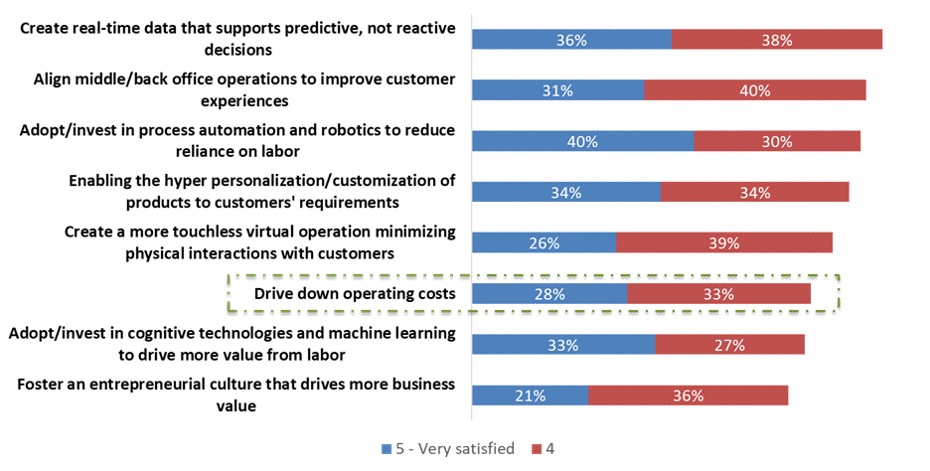
Source: HFS Research in Conjunction with KPMG, “State of Operations and Outsourcing 2018, May 2018 Sample: Global 2000 Enterprise Buyers = 381
A recent survey by the UN Global Company and Accenture unearthed a plethora of CEO views, which . The most compelling results were that 71% thought businesses should have a critical role in meeting the Global Goals (formerly the UN Sustainable Development Goals or SDGs), but only 21% felt that businesses were playing that critical role; 55% cited competing with extreme cost-consciousness.
A key differentiator for Accenture’s Sustainability arm has been helping mature, traditionally cost-focused companies drive opportunities for sustainable transformation forward: building their partnerships, re-focusing their markets, and discovering sustainability’s wide-ranging impact on their business.
For Accenture to help clients transform, Keeble emphasized Accenture’s need to unlock all of their own capabilities as a leading service provider. Accenture Strategy calls on policy, consumer insight, industry strategy, digital, technology, and so many other capabilities throughout the company to determine how to best shape a direction for their clients.
The value of building sustainability solutions from across a service provider’s business arms extends to the framing of its business value to the client. When an enterprise puts sustainability in a box by itself, people still generally think that you can either have sustainability or cost-savings, but not both—that it’s a “nice to have.” Drawing on technology, customer insight, and every function possible allows for the highest chance of achieving a genuine win-win of sustainability and value.
Enterprises should be skeptical of a provider that claims to support a transformation, let alone something as holistic as sustainability, without drawing on all their capabilities; silos won’t work for sustainability—just like they don’t work for data.
Many politicians these days talk about “decarbonizing capitalism” and other variants of completely overhauling the way businesses operate. It’s not about doing away with profit and value—instead, it’s a reengineering. This is particularly why it’s so vital for service providers to use all of their capabilities. Sustainability must be embedded in enterprise strategies and touch on the whole enterprise from the CEO and CFO down to the culture on the ground.
It may seem that businesses are moving to sustainability, but many have a long way to go, and the lack of a defined sustainability services industry is a testament to this. Service providers can reap the benefits, but they must start by recognizing that the demand is there, and pull together all of their expertise to play the game.
In Part 2, we delve into the rationale behind sustainability services and examine the dynamic between both a service provider’s whole range of capabilities and the whole enterprise and what many service providers will have to do in the face of being late to the space.
Register now for immediate access of HFS' research, data and forward looking trends.
Get StartedIf you don't have an account, Register here |
With the exception of our Horizons reports, most of our research is available for free on our website. Sign up for a free account and start realizing the power of insights now.
Our premium subscription gives enterprise clients access to our complete library of proprietary research, direct access to our industry analysts, and other benefits.
Contact us at [email protected] for more information on premium access.

