
SAP is set on a migration deadline to S/4HANA by 2025; the official line is that SAP will no longer support its legacy software afterward. Enterprise leaders must have a plan, or they face the uncertainty of not meeting the deadline, running the risk of costly customized support plans, or having no official support.
We’re still on the fence on whether we’ll see another stay of execution. Fueled by concerns of timelines and access to talent, SAP may well have to revise the current position to accommodate customers that cannot meet the deadline.
HANA is SAP’s own in-memory, column-oriented, relational database management system. Post-migration, you will have a new enterprise resource planning (ERP) system with a new enterprise process model. Nearly everything is changing in S4—from what can you automate to support for IoT—and this technology convergence demands conjoined analysis to deliver useful insight back to the business.
The journey to the deadline is challenging. First, a crippling talent shortage for all things new is hampering the industry, inevitably driving up costs as enterprises and providers go all-in on the talent war. Capgemini has invested heavily in SAP skills and tops the leaderboard of certified consultants by SAP’s recent count in Exhibit 1. Accenture leads in the total number of certifications held.
Exhibit 1: Capgemini and Accenture lead SAP’s counts of certified consultants and certifications
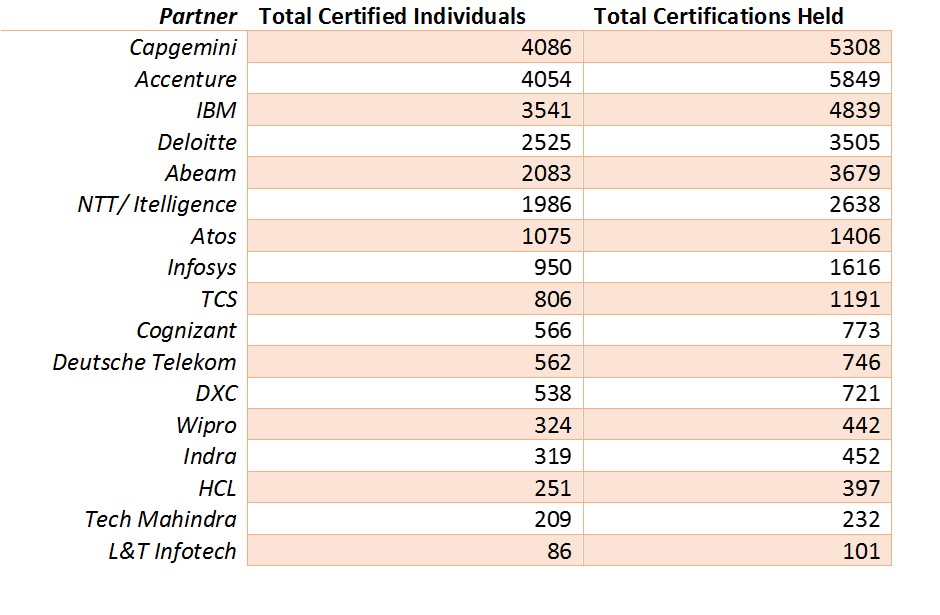
Source: SAP, September 2019
There’s also the issue of organizational fatigue. Candidly, in-the-know consultants told HFS some SAP customers have only just recovered from the last round of upgrades, and many are struggling to cobble together a firm business case for another sweeping technology upgrade, even with enticing new capabilities including AI, ML (Leonardo), RPA with S4, intelligent and predictive insights, and SAP analytics cloud (SAC).
Enterprises’ biggest struggle is understanding their SAP environments in the context of the future rather than the past. After we chewed over the subject with consultants and ERP luminaries, several broad categories across industries became apparent.
Many of the few first-movers in S/4 are reported to be greenfield—new to SAP. Few enterprises have this option as their starting point, and a clean slate is an exception, not the norm. A clean slate furnishes enterprises with greater freedom to implement SAP afresh or upgrade on their existing path. The consensus is if you’ve got SAP now, you’re probably stuck with it. And if you’re sticking with it, you’re almost certainly not sitting in the happy greenfield camp. Indeed, some say their SAP instances are more akin to cement poured through every layer of the organization.
The most common situation, and ultimately the one many services firms are banking on, is brownfield, with larger firms customizing layers of previous instances out of necessity—particularly in key verticals where SAP is already dominant, such as life sciences, oil and gas, and manufacturing.
This approach is effectively a “do-as-little-as-possible-because-it-must-be-done” option. And while It runs the risk of not realizing the potential value of S/4HANA, a looming deadline that could see support costs spiral will force some to do the very minimum. Much like forced SAP migrations in the past—those that can automate the migration, will. Customization matters here, and more customization equates to more effort to migrate. But people have woken up to the downside of bespoke SAP customizations (or so they tell us), and SAP has better processes now to incorporate customer requirements built into the core product. For example, bespoke code for system performance should no longer be necessary, nor should much of the customization in the graphical user interface (GUI) that was commonplace.
Capitalizing on the prevalence of greenfield and brownfield terminology, one of the many tools that have emerged in the SAP migration space is cleverly named Bluefield. It’s effectively brownfield without using the SAP data conversion SLO (system landscape optimization) services that are usually needed. The point here is to automate as much of the migration as possible, wherever possible. Robotic process automation (RPA) is another option—EY, UiPath, and BluePrism have collaborated on this method with the EY Intelligent Transformation platform, a tool for migrating to S/4. Winshuttle, an SAP automation tool supplier, advocates a phased approach to mitigate risk and facilitate change management.
The Bottom Line: It may be tempting, but kicking the SAP can down the road doesn’t qualify as a strategic plan. It’s high-time enterprises assessed their situation and built a migration roadmap.
In truth, SAP is not renowned for stellar innovation—not at the core and not like newer players with innovation deep in their cultures such as Google, Microsoft, and AWS. The HANA enterprise cloud has been deprioritized as public cloud hyper-scalers march forward relentlessly, a fact not lost on SAP, which is keen to partner up. As the backbone of many enterprises, SAP S/4HANA is a route to necessary future-proofing. But as many execs who were on the carousel for the last upgrade will tell you, it’s far from a flick of a switch. Luckily, 2025 is still far enough out for you to make a solid plan.
To deliver the most value, that plan must
Register now for immediate access of HFS' research, data and forward looking trends.
Get StartedIf you don't have an account, Register here |
With the exception of our Horizons reports, most of our research is available for free on our website. Sign up for a free account and start realizing the power of insights now.
Our premium subscription gives enterprise clients access to our complete library of proprietary research, direct access to our industry analysts, and other benefits.
Contact us at [email protected] for more information on premium access.

