
Providers are rapidly moving toward end-to-end IoT (Internet of Things) solutions, fueled by expanding ecosystems of partnerships. Your IoT strategy must have the same ambition that we’re seeing in the service provider community; it needs to take advantage of the right change agents and requires security ingrained from the beginning, alongside the expertise of providers and partners. You don’t want to be left generating meaningless data, or worse, with a failed project and sunk capital—just another IoT white elephant.
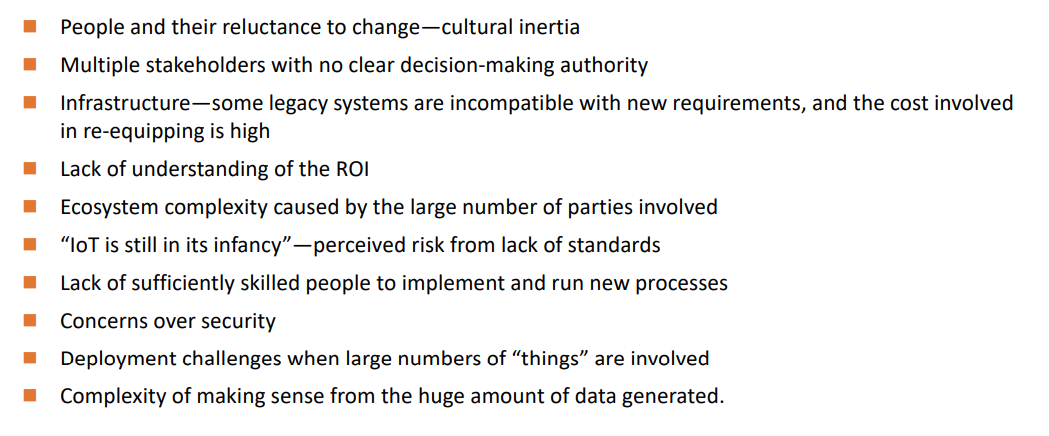
IoT projects that don’t aspire from the outset to drive business value often fail to move past the proof of concept (PoC) stage (see Exhibit 1). IoT projects without a clear understanding of the business benefits (and the right security) are pure vanity. However, they can be revolutionary with the right combination of emerging change agents, particularly AI and smart analytics, alongside the right mix of internal and external talent to drive home the IoT’s value potential.
Exhibit 1: The HFS 2018 IoT Services Blueprint report found multiple reasons why IoT projects fail to move past the PoC stage
Source: HFS Research, 2018
Avoid these pitfalls and take the following pathways to ensure your project has a fighting chance.
Multiple stakeholders lead to a lack of clear decision-making authority; inherent ecosystem complexity is exaggerated by the large number of parties involved. Every enterprise wants a piece of the IoT pie, which means service providers are investing heavily to succeed. They must have a solution and an ecosystem if they want to offer all-inclusive customer solutions. To be credible in IoT, service providers are partnering with platform providers, device suppliers, telecoms firms, cloud services vendors, and vendors of new technologies and techniques.
The sheer vastness of IoT technology and its potential applications and value to enterprises mean leaders must embrace the service providers who have done the heavy lifting by building ecosystems and expertise.
The IoT’s ballooning surface area is giving attackers a disproportionate advantage. They need only find a single point of weakness to access entire networks. We discuss in more detail how IoT strategies must have intrinsic security before regulation enforces it as mandatory.
Many vendor solutions are including end-to-end cybersecurity, leaving clients free to focus on their core activity. IoT innovation will stall if security is not ingrained, which we discuss, along with the vendors pioneering this message, in future research.
Pathway #3: From the outset, ingrain change agents such as AI and smart analytics in your IoT solutions
Deployment challenges emerge when large numbers of “things” are involved; making sense from the huge amount of data generated becomes increasingly complex. From the beginning, you must design IoT projects with analytics and any supplementary change agents necessary to realize the full value of the data generated.
Clients are getting more ambitious with IoT—make sure you do too. Overcome the historical lack of understanding of the IoT’s ROI. Many a firm now has a vision of the digitalized organization and the massive ROI it could offer. When they look to choose an IoT service provider, our research confirms that scalability and upgradability are key—enterprises have their eyes on a big IoT prize.
Leading providers are pushing integrated solutions, but there’s also value out there in an IoT startup sphere littered with multiple change agents. Forbes Top 25 IoT Startups to Watch in 2019 includes a vast number taking advantage of AI and smart analytics. Outside of these change agents, Xage Security uses blockchain to secure IoT networks. Briefly, the more nodes in an IoT network, the more secure that network becomes—combating one of the IoT’s biggest challenges.
The IoT keeps experiencing tremendous advances, but we are light-years away from the world of standardization. For example, IoT platforms can be viewed as analogous to PC operating systems; Windows and Mac OS dominate the world of personal computers, but, by comparison, service providers indicated to us that they had used over 30 different IoT platforms in 2017.
The providers that offer the market-leading standard are in place to govern the regulation, with their clients benefiting from a best-in-class advantage. Again, we draw attention to the need for cybersecurity to embody IoT projects as governments begin to.
Pathway #5: There remains a lack of sufficiently skilled people to implement and run new IoT processes
The talent crunch keeps popping up. The explosion of IoT demand is stretching service providers. In addition to using partnerships, they are meeting demand by frequently turning to acquisitions. Solutions can then take on characteristics from outside of providers’ core expertise—which is dangerous if enterprises accept them without question.
Enterprises must drive a better dialogue with their IoT service providers and their whole ecosystem of partnerships to ensure that the enterprise’s unique challenges are taken on board. Enterprises must ensure they get exactly and only the technologies they need, not an off-the-shelf solution patched together from a provider’s badly integrated acquisition.
The Bottom Line: As vendors’ solutions increasingly solve common IoT project pitfalls, enterprises should take advantage of outcome-driven pathways.
For enterprises to truly be pioneers of the IoT, they must choose a service provider whose solutions encompass
Register now for immediate access of HFS' research, data and forward looking trends.
Get StartedIf you don't have an account, Register here |
With the exception of our Horizons reports, most of our research is available for free on our website. Sign up for a free account and start realizing the power of insights now.
Our premium subscription gives enterprise clients access to our complete library of proprietary research, direct access to our industry analysts, and other benefits.
Contact us at [email protected] for more information on premium access.

