The energy and utility market has a long history of disruption, such as the emergence of digital technologies like smart meters and ever evolving energy trends which have culminated in a complex market environment riddled with inefficiencies. Huge barriers to entry – such as complex regulations, government controls, massive upfront investments, and monopolistic tactics – have made it very difficult for anyone, besides the established industry incumbents, to get a grip on the market. This oligopolistic model means consumers and businesses regularly spend unnecessary amounts on energy and impacts overall economic performance. However, this cozy oligopoly is now under significant threat, with the ongoing development of blockchain solutions and renewable sources of energy. The energy market may finally be opening up to new competition and much greater efficiency.
Our research is showing the energy and utilities industry is a leader in the race for blockchain adoption (Exhibit 1) as the technology increasingly proves itself to be finding a powerful home for its benefits. We’re likely to see this change as the development of a decentralized peer-to-peer energy marketplace that challenges incumbents’ models directly. If you hope to survive, you must adapt early to prepare yourself for this incoming blockchain revolution.
Exhibit 1: Enterprise blockchain has broader implications than just financial services
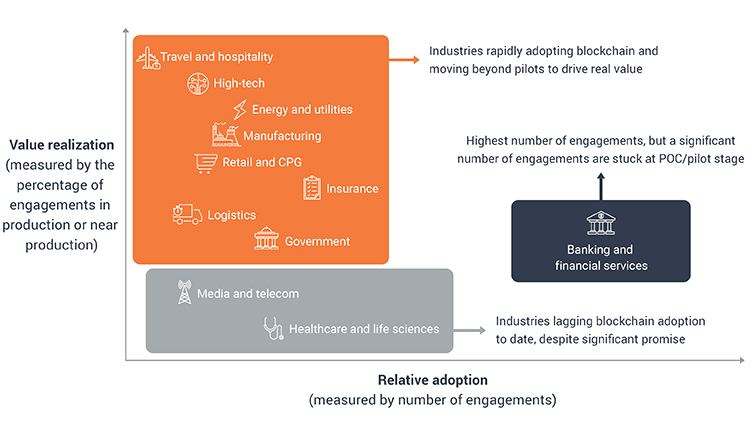
Sample: 550 blockchain engagements across 15 blockchain service providers
Source: HFS Research, Top 10 Blockchain Platforms 2018
Utility providers do not currently take advantage of new opportunities presented by the emergence of renewable energies
Renewable energies have led to the rise of energy prosumers—individuals, households, and enterprises all harvesting their own energy. The motivation is obvious: reduced costs and a lower carbon footprint. The problem, as Bill Gates outlined, is that energy is difficult and expensive to store, so anyone not using 100% of their produce is likely wasting the remainder. In 2017 the US wasted approximately 66.7% of its energy. For utilities providers this represents a missed opportunity—they could purchase wasted energy at a low cost, which would improve their margins and allow them to invest in their infrastructure to enhance customer experience.
A peer-to-peer marketplace would transform energy trading and directly challenge utilities providers’ models
If prosumers could sell their excess energy, it would help reduce wastage. A peer-to-peer marketplace using blockchain could enable exactly that by utilizing its smart contracts and decentralized database to create a marketplace for the immediate transfer of energy with a financial incentive. It would crash industry entry barriers and create a free market for energy with prices set by supply and demand instead of by huge firms with little competition that can, therefore, set prices to maximize profits.
A smart contract is an agreement between two individuals. The terms are written code and are run on blockchain. They work on a condition-based principle, which means both the funds and the right to the energy (as a token) are stored and automatically released once the contract is complete. If the consumer wants to purchase X amount of energy at Y price, once a producer advertises energy that satisfies the criteria, the smart contract will automatically execute the transaction and deliver the energy without human intervention. Wipro has already recognized the potential: with a large oil and gas company, Wipro has a matching algorithm in production that allows the recognition, tokenization, and exchange of prosumer-generated energy on a peer-to-peer blockchain network.
There is currently a pilot from LO3 Energy, which partnered with Siemens to produce a blockchain-powered localized energy marketplace facilitating energy trading on a microgrid. A small cluster of properties can run solely on energy produced and traded within their grid—but members still have access to main grid infrastructure if required. This project has successfully eliminated the need for intermediaries.
LO3 Energy also apply IoT technology; consumers install smart meters, which monitor their energy production and consumption. The smart meter translates any excess energy into tradable tokens, which an app uses to set the desired purchase price and sale price of the tokens. When the prices align, the smart contract automatically completes the transaction. Once a consumer purchases tokens, the consumer’s smart meter will automatically erase them when they use the corresponding energy.
But it’s not all good news – opening the energy industry to the free market without a regulator could lead to market failure.
A free market offers significant benefits; it’s a model customers will surely hope to adopt, but there is one great hurdle to overcome first—governance. Without a governing body, the door is wide open for market failure; you only have to look at the oil market to see that. A situation could arise where individuals and enterprise collude and purchase huge quantities of energy tokens to reduce supply in the market and artificially drive up prices. Artificial price inflation presents a substantial problem; energy is essential for both maintaining a basic standard of living and keeping businesses functioning. Any shortage could lead to an economic crisis—it could leave households without heating, which can be life-threatening, and might force businesses to close their doors.
The Bottom Line: A peer-to-peer energy marketplace represents not only a direct threat to the model of incumbent utilities providers, but it could also incite a race to solve the governance conundrum.
Exhibit 2: There is still time for providers to experiment with blockchain
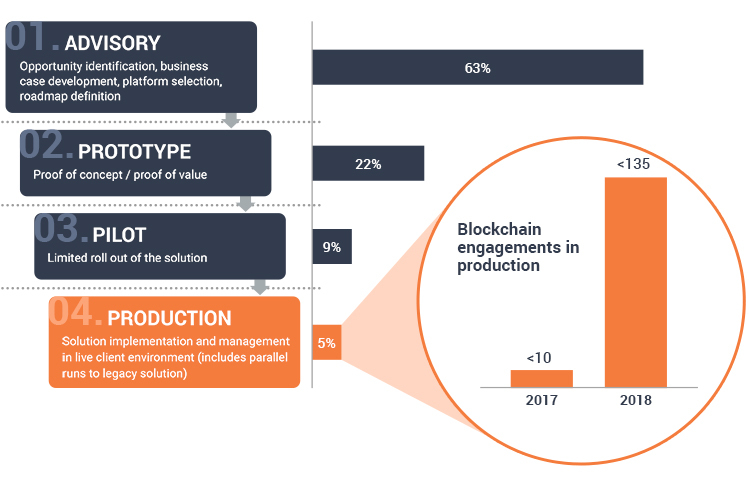
Sample: 550 blockchain engagements across 15 blockchain service providers
Source: HFS Research, Top 10 Blockchain Platforms 2018
Utilities providers must act now to prepare themselves from the blockchain bulldozer that is going to plow through their industry. First, they need to look past the hype and understand that blockchain is still in its early stages of development. Only 14% of blockchain engagements are beyond the pilot phase (see Exhibit 2). The low implementation rate means that utilities providers still have time to experiment and invest in blockchain in an attempt to develop their own governed, peer-to-peer renewable energy marketplace that allows their customers to trade renewable energies among themselves, for a transaction fee, while also purchasing traditional fuels from the provider. Ultimately, providers need to understand that the cost of experimenting with blockchain is considerably lower than that of becoming obsolete or being a late adopter—the time to invest is now.
Register now for immediate access of HFS' research, data and forward looking trends.
Get StartedIf you don't have an account, Register here |
With the exception of our Horizons reports, most of our research is available for free on our website. Sign up for a free account and start realizing the power of insights now.
Our premium subscription gives enterprise clients access to our complete library of proprietary research, direct access to our industry analysts, and other benefits.
Contact us at [email protected] for more information on premium access.