
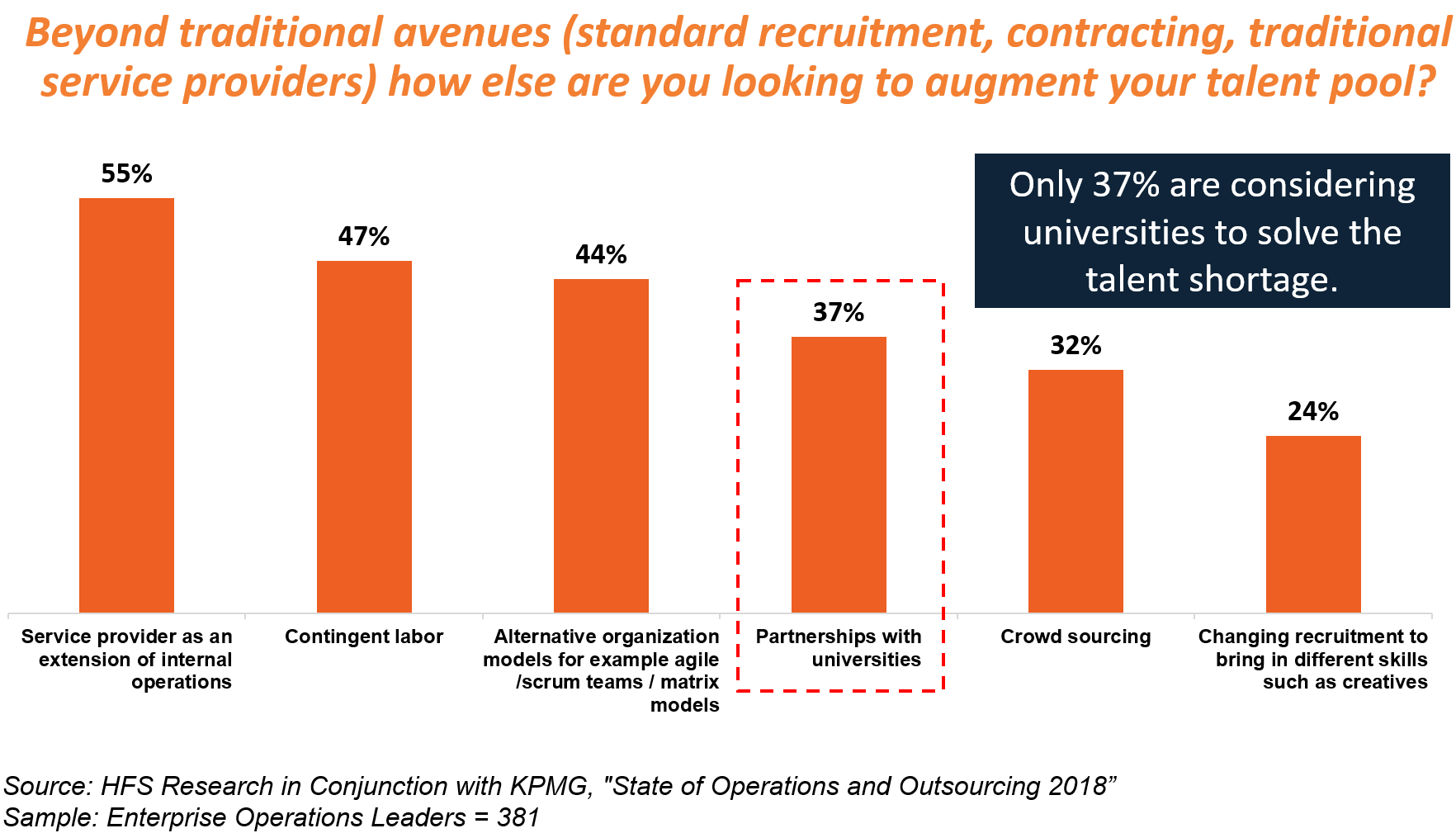
Enterprises are fretting over the talent shortage blocking their path to being a major player in the hyperconnected economy; 45% see a lack of internal talent as a major inhibitor. Despite this, only 14% are taking action, and of those, only 37% are looking at partnerships with academia.
Enterprises often dismiss academia as irrelevant or idealistic; historic communication failures have led to a poor understanding of what each side wants and what they have to offer each other. Enterprise leaders need to quickly understand the value of academia or continue paying extortionate consultancy fees. Well-managed partnerships with academia can help enterprises master technical knowledge and comprehensively understand their ecosystems.
Exhibit 1: Enterprise leaders are not taking enough interest in academia to bridge the talent gap
Take the analogy of an engineering intern at an old factory: the intern feels he has the intelligence and technical know-how to reinvent a business that has existed for decades–while the operators who have worked there, possibly for decades, understand the intricacies of the processes, what equipment is a “little dodgy,” and the limitations that mean the “obvious” solutions cannot work in practice. They have seen it all before, every year, as a new batch of interns turn up—some operators take great pride in knocking them down a notch.
To bridge this divide, both groups must see what the other has to offer and build the best collaborative solution for the enterprise. The operator has invaluable experience and knows the plant like the back of their hand, while the student comes with a technical understanding and a fresh perspective – just as valuable if managed in the right way.
Not every word of an academic paper needs to be read. Methodology subtleties that keep the journal editors happy are of little use to enterprises. However, academia’s high value comes from either having a complex understanding of a niche or a comprehensive understanding of a broader subject.
This isn’t just applicable to computer science and emerging or futuristic technologies. In the manufacturing space, back-to-basics approaches often find improvement opportunities that have been overlooked: In the cement industry, whose processes were thought to have been optimized for decades, Cambridge University researchers found a fundamental way to save 7% of the industry’s total energy use and 20% of its fuel-derived CO2 emissions; the cement industry emits 8% of all global CO2 and still widely fuels its processes with coal—it’s not hard to see the value created.
Almost every academic wants to have a real-world impact; the value proposition they see from enterprises is knowledge and/or a case-study, rather than financial.
Collaboration between academia and industry is obviously nothing new. Engineering departments are funded by big oil companies, while business schools work with big enterprises and promote startups. This doesn’t mean that both parties are always getting the most out of these partnerships.
Sources in Cambridge University were very open in sharing that academia can be cynical in its own way—they feel that businesses have hidden motives. Enterprise leaders must dispel this feeling and show academia how both parties can help each other to achieve revolutionary results.
While academics must realize that they often fail to present their value proposition in a company-useful way—when enterprises interact with academics, they should remind themselves of the engineering intern, who learns to see the value of both parties to create the best overall result. With some nurtured guidance of their business goals, and how the academic individual or group can have a real-world impact—working together can produce world-leading solutions.
Accenture Development Partnerships (ADP), who we met with recently to discuss their sustainable development services, emphasize the gap between academia and business. Academia, while having the technical know-how, often lacks business awareness, and therefore struggles to bridge the gap to enterprises. Enterprises must be very clear about what both parties want from a relationship—and they should understand that both sides’ goals should be different. Louise James, Managing Director of ADP, comments on the importance of “Critical Friend Partnerships”:
Everyone claims that cooperation and communication are key, but it’s now up to enterprise leaders to make the first move. Decision makers within enterprise and academic groups mistrust their counterparts; a belief that they are the more important, the more useful, the worldlier, etc. means that there is a huge divide. Enterprise leaders must be the ones to bridge the gap to accelerate their own causes and achieve real value.
The hyperconnected economy will be led by powerhouse partnerships—enterprises who don’t embrace all the available resources will be doomed to fail as their talent shortages grow out of control.
Register now for immediate access of HFS' research, data and forward looking trends.
Get StartedIf you don't have an account, Register here |
With the exception of our Horizons reports, most of our research is available for free on our website. Sign up for a free account and start realizing the power of insights now.
Our premium subscription gives enterprise clients access to our complete library of proprietary research, direct access to our industry analysts, and other benefits.
Contact us at [email protected] for more information on premium access.

