
Catering to consumers who want sustainable products is retail’s megatrend, with two-thirds willing to pay a premium. Retailers are feeling the pressure to jump on the fair trade, organic, and vegan bandwagons, and address serious issues such as modern slavery. Technology-savvy consumers are demanding greater transparency to see for themselves whether products are as ethical as the logos on them indicate—whether that’s farming practices or factory conditions.
Is there a way to ensure that working practices are as sustainable as they claim, where workers get real value for their efforts? Where retailers can comply with stricter regulations? And where consumers can trust retailers? Blockchain seems to have the answers.
The sad truth of fair trade labeling is that only a small fraction of the higher price goes to the original farmer; criticism of fair trade is widespread—focusing on many issues such as reduced yields, lower sales in-store, inconsistent standards, corruption, and money being siphoned away before it reaches those most in need.
Besides top-line impacts (i.e. consumers willing to pay more), retailers are desperate to improve their compliance. Regulations are only getting stricter, and the financial and branding penalties of non-compliance are soaring.
The 2017 World Investment Report detailed the low maturity of transparency and traceability along supply chains (see page 180 for the full digital transformation maturity ratings).
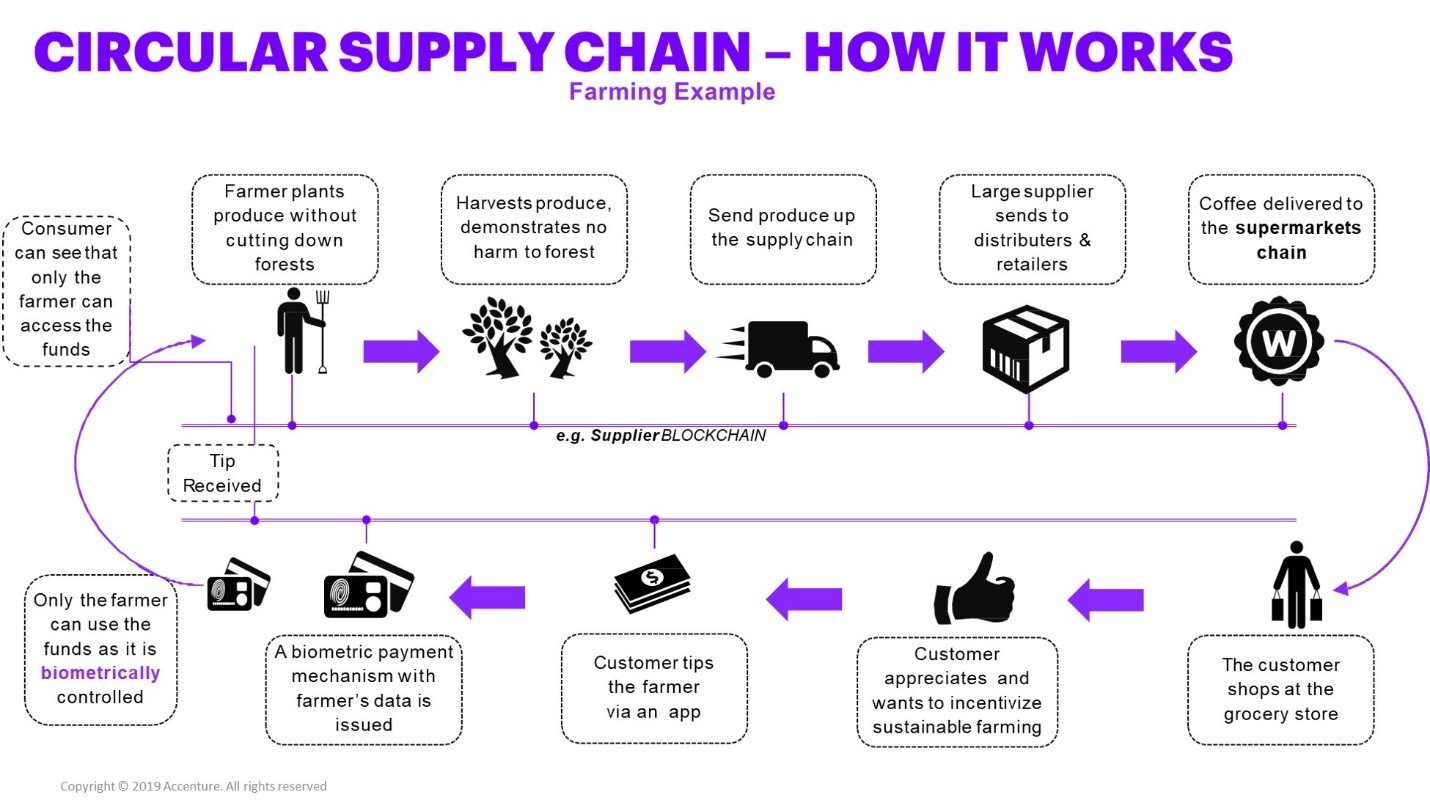
Walmart has, since then, been a pioneer—working in collaboration with IBM to reduce the traceability of food along the supply chain from 7 days to 2 seconds. Consortiums are also beginning to work together to take on the mammoth task of opening up supply chains to consumers. A recent press release details Accenture’s collaboration with Mastercard, Amazon Web Services, Everledger, and Mercy Corps to improve the sustainability and fairness of global supply chains. Digital payments, biometric and identity technologies, and blockchain allow customers to identify the end producer, check their certifications, read their stories, and, building on the supply chain traceability achievements of Walmart and IBM, contribute with a tip. Producers, meanwhile, can better manage their inventory.
Exhibit 1: Accenture’s vision of the circular supply chain – connecting the consumer to the farmer
Source: Accenture, 2019
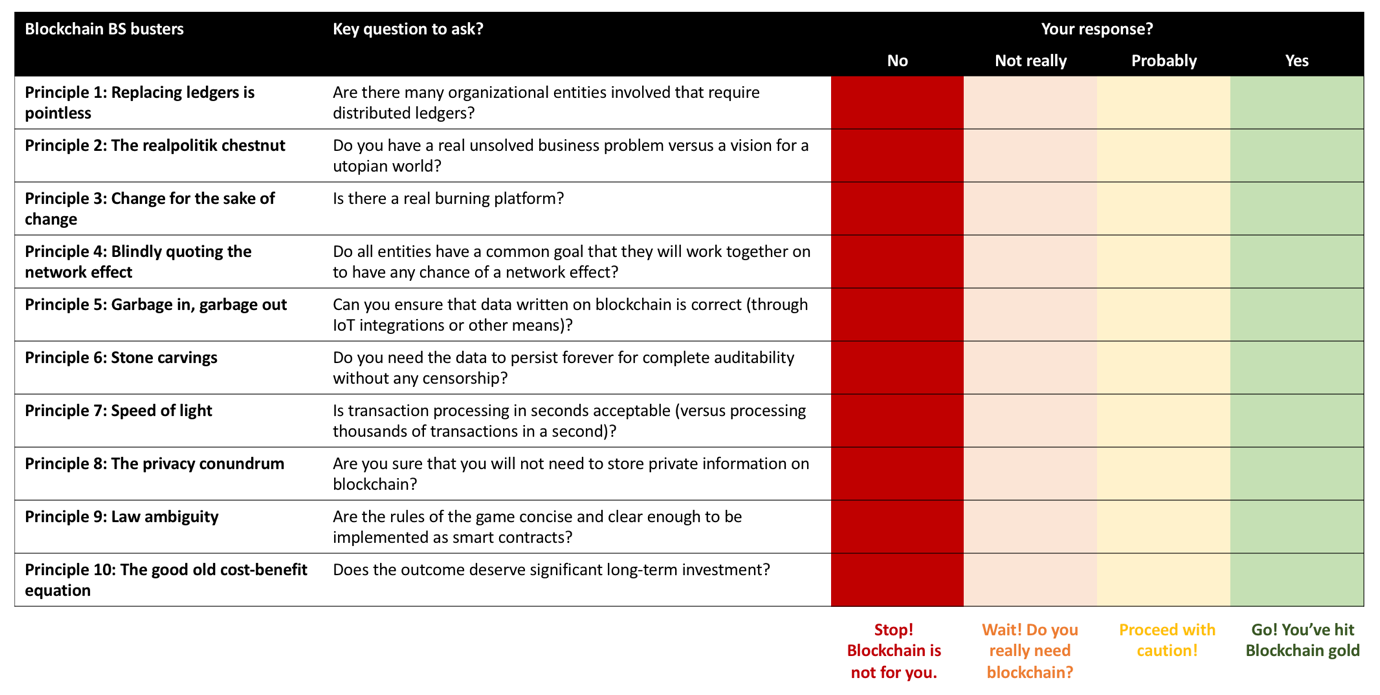
Blockchain-powered supply chain traceability passes most of the principles of the HFS Blockchain Bullshit Buster (see Exhibit 2). Walmart’s aforementioned achievement shows the value potential, while our Bullshit Buster further unearths blockchain’s prospect of connecting siloed stakeholders in the supply chain (Principle 1), and solving supply chain disruption problems that can be exceedingly costly to businesses—the long-standing “Bullwhip Effect” is but one example (Principle 2).
Exhibit 2: The HFS Blockchain Bullshit Buster helps to map out the potential value and pitfalls of blockchain initiatives
Source: HFS Research, 2018
However, there are three areas that must be questioned.
Principle 4 – “Blindly quoting the network effect” asks if all entities have a common goal that they will work together to have any chance of a network effect? The hurdle of creating an ecosystem with full buy-in from its multiple actors cannot be understated in order to have a noticeable network effect. Consortiums are not new, but few works well in practice due to infighting, poor clarity on overall governance and decision-making rights. Supply chain traceability pioneers must show nuance in their partnership management—as supply chains become increasingly complex, no single player will be able to govern and drive improvements on their own.
Principle 5 – The “garbage in, garbage out” principle critiques the validity of data being uploaded to a blockchain. Biometric identification and increasingly-prominent digital wallets in developing countries can potentially help to avoid garbage in, garbage out. However, infrastructure is a limitation. A challenging onus will be on enterprises to ensure workers along their “Circular Supply Chains” have the means to access devices, apps, and biometric technologies.
Principle 10 – “The good old cost-benefit equation.” Sustainability will become increasingly prevalent in the long-term; for companies investing to play the game, this growing demand will more than satisfy the cost-benefit tradeoff, but this seems to be a long-term play, not a quick ROI.
Any business that operates a supply chain must consider the bottom link of that chain. As traceability of goods becomes ever more unavoidable, enterprises can’t afford to be left behind by using “black box” sourcing. Connecting consumers and workers at the far ends of the supply chain, and crucially a financial “tipping” function, brings challenges, but the personal touch in a world of corporate brands will be a breath of fresh air.
The issue, however, is not the underlying distributed ledger technology—there are enough pilots out there demonstrating it can work. The challenge is developing partnerships and the right operating models to meet the expectations of today and tomorrow’s consumers. A “Hyperconnected Future State” will be required… but it is easier said than done.
Register now for immediate access of HFS' research, data and forward looking trends.
Get StartedIf you don't have an account, Register here |
With the exception of our Horizons reports, most of our research is available for free on our website. Sign up for a free account and start realizing the power of insights now.
Our premium subscription gives enterprise clients access to our complete library of proprietary research, direct access to our industry analysts, and other benefits.
Contact us at [email protected] for more information on premium access.

