
Most likely not. An HFS study on machine learning (ML) adoption shows that more than 50% of respondents indicate that they need more and more people to enhance their organizations’ AI-ML capabilities (see Exhibit 1). Unfortunately, there are just not that many people with the right talent and skillsets in the market yet.
Enterprise AI leaders and their HR or talent practice partners will have to fundamentally shift their thinking from “hiring” AI talent to dynamically right-sourcing the right talent for the right duration to work on the right problems. Crowdsourcing—using freelancers to work on specific projects—has become a viable channel. On the user skills and adoption fronts, however, AI user teams are going to be part of the organization. Hence, an obvious way to motivate them to acquire the right AI usage skills is through gamification—motivating and incentivizing users to adopt new systems and solutions and change their work practices by using games and competitive exercises.
Exhibit 1: How many more people do you need?
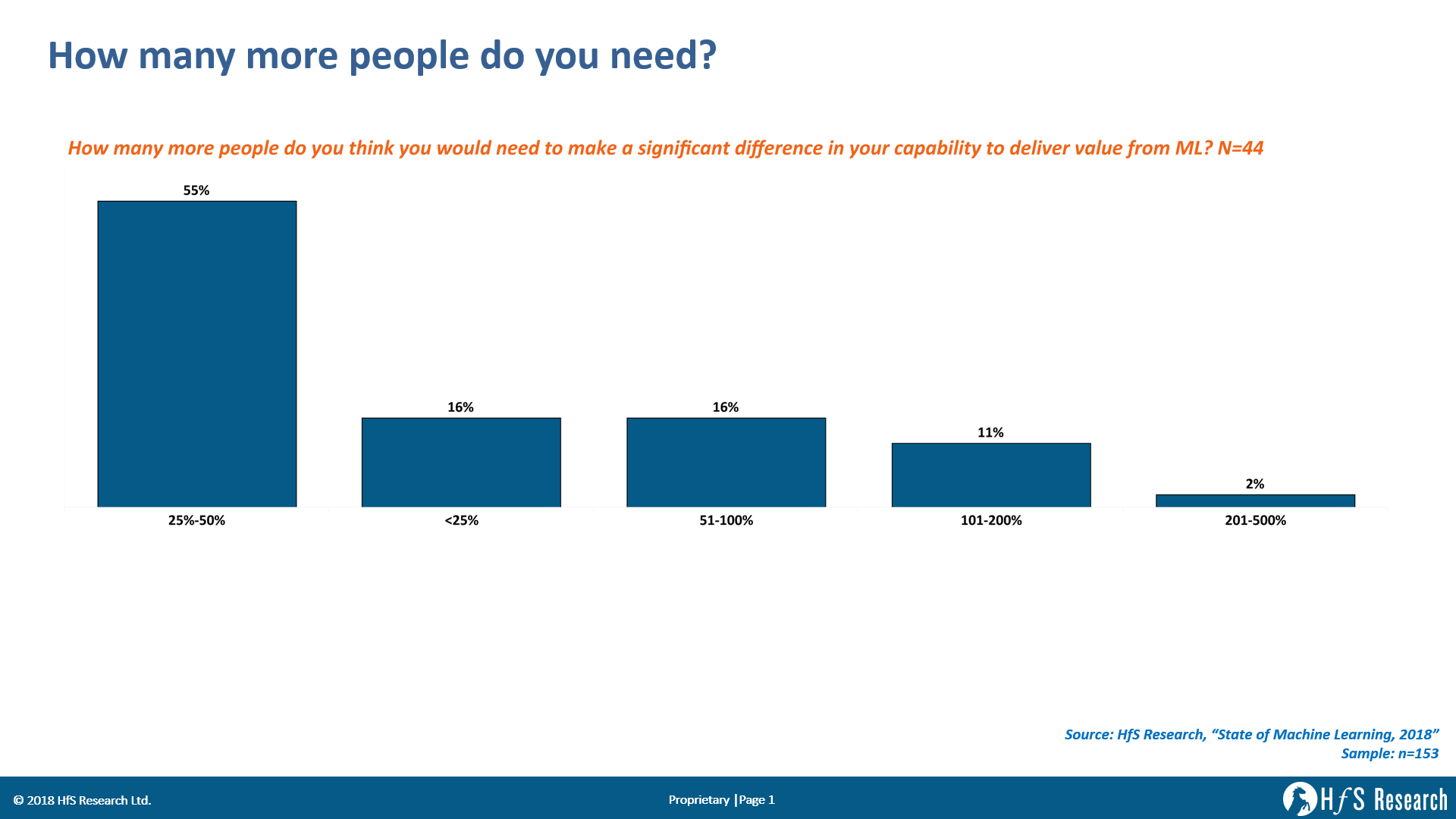
Sample: 153 senior level executives from organizations with $1 billion or more in revenues
Source: HFS Research, 2018
Adopt the following best practices to tackle the AI talent and skills challenges effectively to drive development and adoption:
1. Change your HR strategy, objectives, and policies from the idea of “owning” talent within the four walls of your enterprise to having dynamic, need-based access to the right talent for the right problems at the right time.
You will never be able to hire enough and close the AI talent and skills demand-supply gap at the right time, for three reasons:
Therefore, for enterprise AI leaders and their HR partners, the most pragmatic way of tackling this AI development talent conundrum is to design a “talent right-sourcing” strategy that will focus on building access and visibility into large and dynamic AI talent pools outside of your organizational boundaries and leverage them at the right time for the right problem. Executing this forward-looking HR strategy requires a paradigm shift in the traditional mindset and risk-averse working practices of the HR teams. But, given the yawning gap between demand and supply sides of AI talent, this change is imperative for solving the talent problem.
2. Start using mature crowdsourcing platforms extensively for complex AI use case development work.
Crowdsourcing on well-established, industry-accepted talent platforms like Kaggle, Fiverr and Topcoder, with mature talent, skills evaluation, and quality standards, offers an optimal and efficient solution to your AI talent problem. To be able to leverage these platforms successfully, you must:
3. Create multi-skilled teams encouraging cross-pollination.
If you’re only looking to staff a team with data scientists, you’ll always have a talent crisis, and the outcome will be poor. Enterprise AI solutions need different types of skills across all phases of lifecycle, be it requirements analysis, design, building the data pipeline, training and validation of the models and finally deployment and adoption. You need business analysts who understand the business problem and context, use-case designers who can put the user persona’s at the center and build their journey-maps, and then you need statisticians, data scientists, data engineers who can clean up and test the data, maintain the data pipeline, and technologists and algorithms experts who develop, run, update and maintain the code. Therefore, AI solutions are best developed with multi-faceted teams where data, domain and algorithms talents exchange their viewpoints and collaboratively build a holistic solution.
4. Use internal gamification extensively to identify AI talents from within.
For example, if you are planning to build a set of intelligent-resolution and request-fulfillment bots for self-service of certain IT and business processes, then:
5. Look beyond the usual suspects when you are identifying the AI enthusiasts across the enterprise to participate in developing AI solutions, and incentivize them publicly.
Enterprises come to recruitment with a fixed idea of what the ideal candidate looks like. Recruitment and retention needs to evolve to make the most out of the diverse ecosystem around us, not only to represent protected characteristics, but also other forms of diversity such as cognitive capability – a candidate that gives the best interview may not be the best for the job and vice versa. Current recruitment processes are outdated and ineffective when looking to get the best people in. For example, one best practice for enterprise AI leaders is to measure and identify the gains that the AI enthusiast business process leaders and/or functional team leaders have achieved over their counterparts, such as demonstrating a measurable and tangible hike in a process’ or function’s outcomes in terms of:
Showcase these gains in numerical terms. Celebrate these successes by setting them up as potential performance benchmarks for others. For example, by using AI-based ticket classification and root-cause identification tools, if a service desk engineer can improve her productivity from an average of 3 tickets per day to more than 10, can show a 20% to 30% improvement in her CSat score due to reduced waiting times and queues, and reduce reopening rates by 10%, then these numbers can set new performance baselines for the entire group. The engineer who took this initiative proactively can then be nominated as an AI champion and should be invited to be part of the relevant AI solutions design teams.
Work with your HR partners to design differentiated rewards and recognition programs for the proactive AI enthusiasts identified across the organization:
Crowdsourcing on established and mature partner platforms is imperative for tackling the AI development talent challenge successfully. For widening the available internal talent pool, gamification and incentivizing the right behavior are critical steps. These two approaches must be utilized to their fullest potential for success of enterprise AI.
Register now for immediate access of HFS' research, data and forward looking trends.
Get StartedIf you don't have an account, Register here |
With the exception of our Horizons reports, most of our research is available for free on our website. Sign up for a free account and start realizing the power of insights now.
Our premium subscription gives enterprise clients access to our complete library of proprietary research, direct access to our industry analysts, and other benefits.
Contact us at [email protected] for more information on premium access.

