
A recent HFS study on machine learning (ML) adoption, shows ML one of the biggest categories of AI techniques and applications.
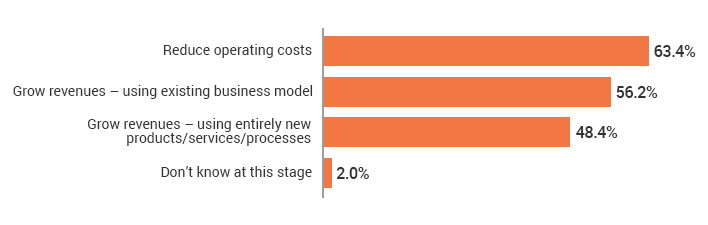
About 63% of enterprise respondents (see Exhibit 1) mentioned they see the biggest impact of this technology on reducing operating costs, and more than 50% said they see it impacting their revenue growth with existing business models. The question is: How effectively are enterprise AI leaders measuring and reporting the value and impact of their AI investments on both their leadership and the market?
Exhibit 1. Where is machine learning expected to provide impact?
What is the biggest source of business impact you expect from using machine learning?
 Sample: 153 senior level executives from organizations with $1 billion or more in revenues
Source: HFS Research, 2018
Enterprise leaders are expecting significant impact from AI and automation technologies on their operating costs and revenue growth, because the investments are high:
Right now, AI is in its heyday with money pouring in from central corporate functions and business unit leaders sponsoring and even initiating AI programs. Once this zest of gestation is over, the inevitable question will start hounding AI evangelists across the technology and business spectrums.
To answer that imminent question, it is imperative that AI leaders have solid pre and post measures defined and monitored, at least on the processes that are the first candidates for AI and automation transformation.
Some common metrics organizations are already reporting include:
However, these are only activity metrics, and they don’t directly reflect cost reductions or gains in business value. You need both bottom-line and top-line metrics to measure project impact.
Exhibit 2: Examples and indicative benchmarks for business-relevant AI key value metrics
|
Impact |
Example metrics and KPIs |
Specific use case and process examples |
Indicative benchmarks (achieved by some early adopters) |
|
Cost-based and bottom-line-impacting KPIs |
Cost of fulfilling service requests |
IT service requests, standard business service requests |
30% to 50% cost reduction achieved, depending on depth of AI applications |
|
Cost of transactions |
Autonomous ordering |
40% to 60% cost reduction in autonomous mode |
|
|
Cost of contact or communication |
Chat-based customer service |
50% to 60% reduction in cost-per-chat instance-based pricing |
|
|
Cost of ticket resolution |
IT incident resolutions |
40% to 60% reduction based on complexity, e.g., L1, L2, or L3 |
|
|
Cost of a part or whole business process |
Fraud detection |
70% to 80% reduction in autonomous mode |
|
|
Value-based and top-line-impacting KPIs |
Time to market |
Solution development |
Minimum 60% to 70% faster TTM |
|
Time to value |
Customer relationship going live in a retail banking or telecom scenario |
Minimum 2x to 3x faster TTV |
|
|
Customer satisfaction score |
Faster fulfilment, reduced waiting time in autonomous mode |
50% to 60% improvement |
|
|
NPS |
Improved customer experience and consistency, reduced human errors |
40% to 50% improvement |
Start now: Action items for next Monday morning
AI practitioners and leaders must define the key value and impact metrics from their AI programs in a business-relevant manner.
Exhibit 3: Action items for next Monday morning
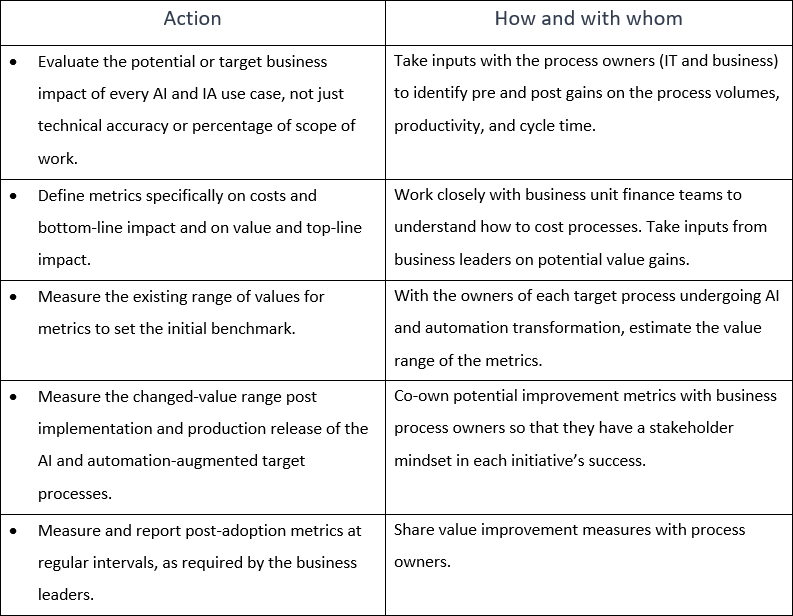
Business leaders are eager to see tangible gains from AI investments. In the absence of visible non-linear improvements in key business outcomes resulting from these investments, businesses will soon start questioning AI initiatives. To respond effectively to those pertinent questions, enterprise AI leaders must build business-relevant cost and value metrics definitions and measurement procedures for all their AI and automation initiatives.
Register now for immediate access of HFS' research, data and forward looking trends.
Get StartedIf you don't have an account, Register here |
With the exception of our Horizons reports, most of our research is available for free on our website. Sign up for a free account and start realizing the power of insights now.
Our premium subscription gives enterprise clients access to our complete library of proprietary research, direct access to our industry analysts, and other benefits.
Contact us at [email protected] for more information on premium access.

