This Take 5 Report is for CIOs, CISOs, and Chief Risk Officers evaluating the governance, orchestration, and auditability foundations required to scale AI and agentic workflows safely across enterprise operations.
We are in the early stages of scaling AI and agentic processes, but momentum is accelerating.
Reaching the tipping point of rapid scale requires robust orchestration and disciplined control frameworks in data privacy and enforceable business rules. These are non-negotiable foundations for scaling AI. Executives prioritize customer impact, improved outcomes, and deploying talent to high-value work. Investment urgency is real. AI scale is a growth lever, not a technology experiment, but the urgency carries risk. Control frameworks are immature. In the interim, human-in-the-loop oversight and risk analytics will serve as compensating safeguards. Modernization and legacy retirement will continue as consequences of AI scale, but they are not seen as its drivers. Layering AI onto already fragile legacy estates risks increased complexity and may limit the ability to fully leverage proprietary data for competitive advantage.
HFS Research, in partnership with Pega®, surveyed 101 senior enterprise leaders in North America to understand how enterprises are seeking to scale AI and agentic solutions and the implications for IT modernization and legacy retirement.


The Bottom Line: AI scaling safely is elusive. Confidence, not intent, is the constraint. A unified orchestration fabric underpinning strong governance, data privacy, traceability, and auditability is a milestone on the path to the AI scale tipping point.
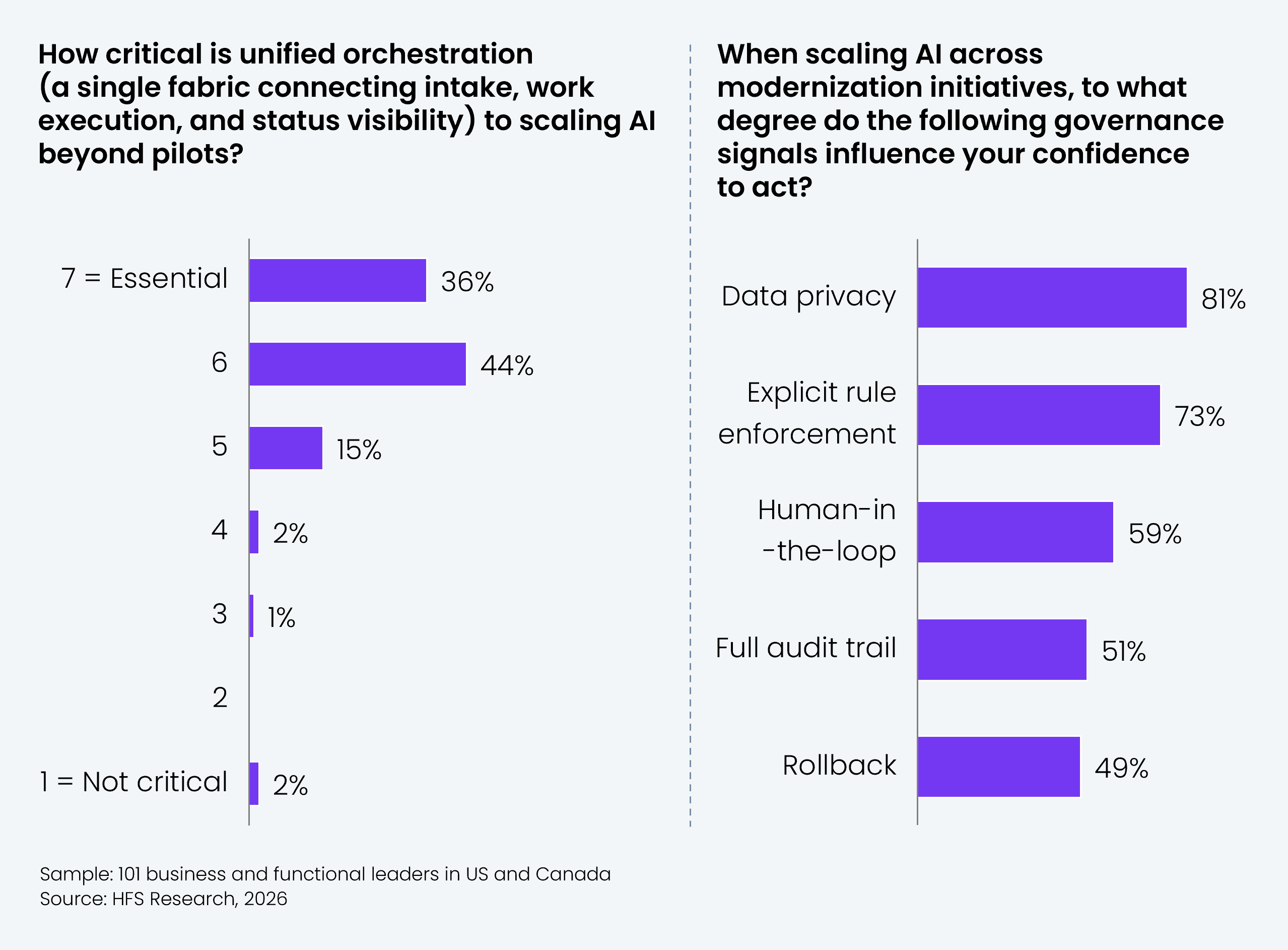
Unified orchestration is essential. Executives overwhelmingly (80%) acknowledge that AI-driven transformation cannot scale without a single fabric coordinating control, execution, and visibility.
Without the visibility and reassurance that an orchestration platform can provide, executives will lack confidence in plans to scale.
AI transformation is not stalled by a lack of intent. It is gated by confidence in governance, and that confidence depends on unified orchestration.
Eighty-one percent (81%) of executives cite data privacy, and 73% cite explicit rule enforcement as critical to AI scale confidence. Confidence in governance and unified orchestration together are prerequisites to successful scaling.
Until confidence through experience in production is achieved, executives will rely on trusted humans-in-the-loop, auditing, and rollback.
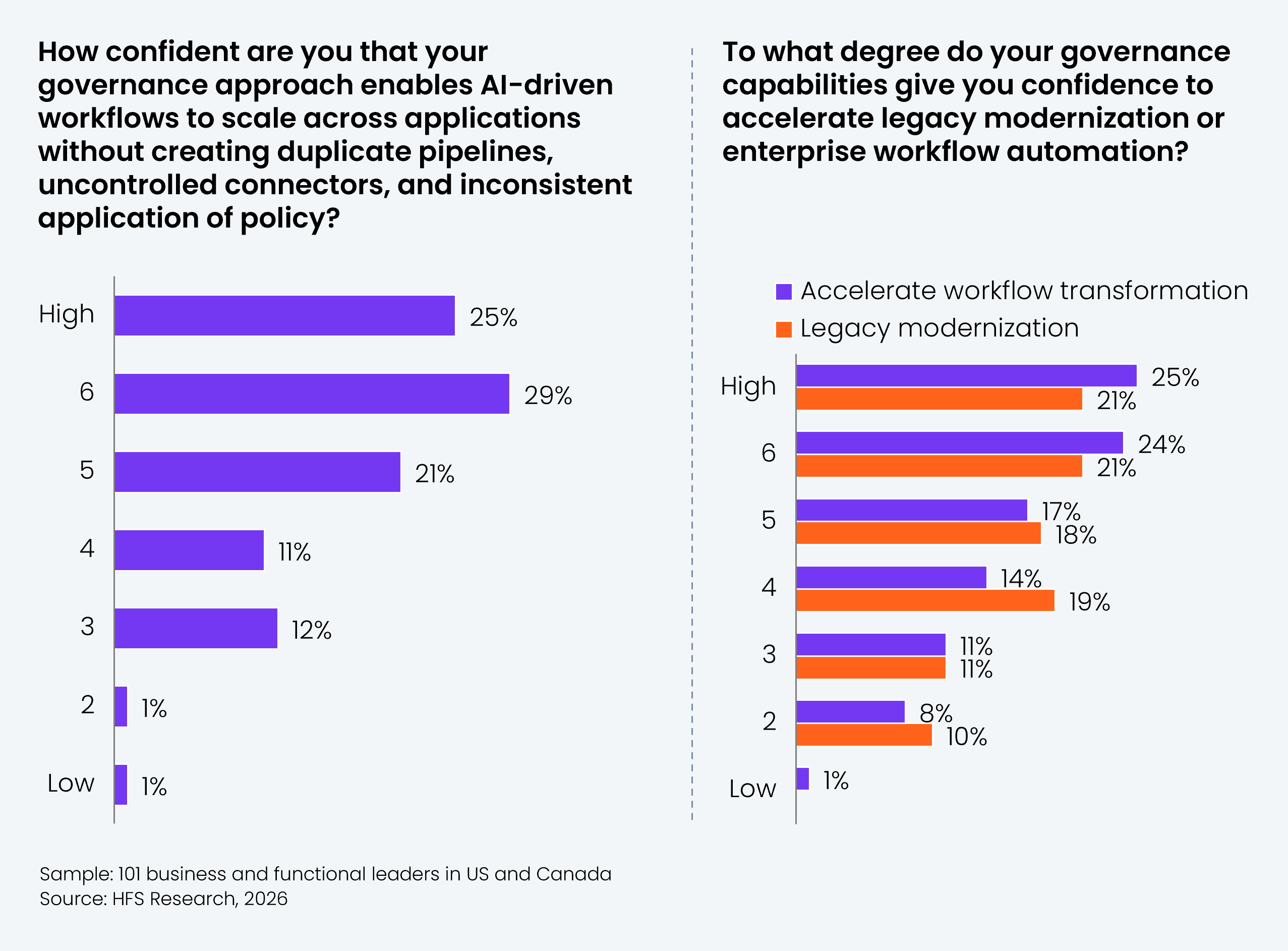
Fifty-four percent (54%) of executives believe their governance approach can prevent AI sprawl, duplicate capabilities, and integration complexity. Forty-six percent (46%) remain unconvinced, highlighting a major confidence gap in the controls required to scale safely. One in four expresses serious concern about their ability to scale AI safely.
That uncertainty is slowing transformation. Only 21% report full confidence in governance to accelerate AI-led legacy modernization
Just 25% say the same for workflow transformation.
Most enterprises sit in the uncertain middle, caught between urgency to scale AI and hesitation about governance readiness, and 40% see no acceleration in legacy modernization.
AI ambition is high, but governance confidence is not yet decisive.
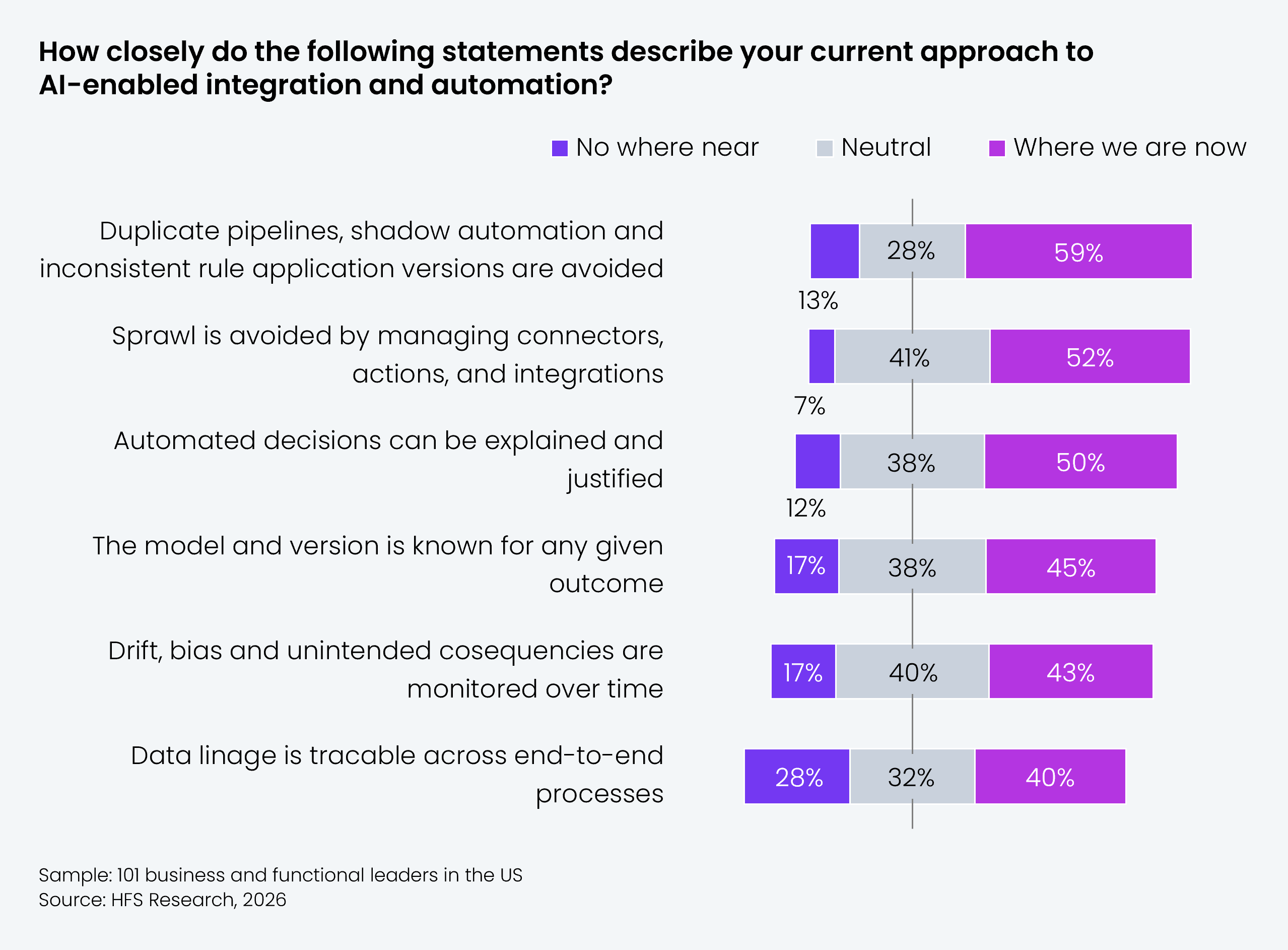
Fifty-nine percent (59%) report strong alignment in avoiding duplicate pipelines and shadow automation, the strongest governance capability in the survey. But hygiene is not the same as control.
Traceability is the structural gap. Only 40% demonstrate strong end-to-end data lineage. Most organizations cannot fully prove where data moved, how it was transformed, or which logic governed the outcome.
Explainability remains fragile, with just 50% able to confidently explain and justify automated decisions, leaving nearly half exposed when scrutiny arises.
Enterprises are getting better at managing operational complexity. They are less mature at proving accountability and decision integrity.
A unified control model requires
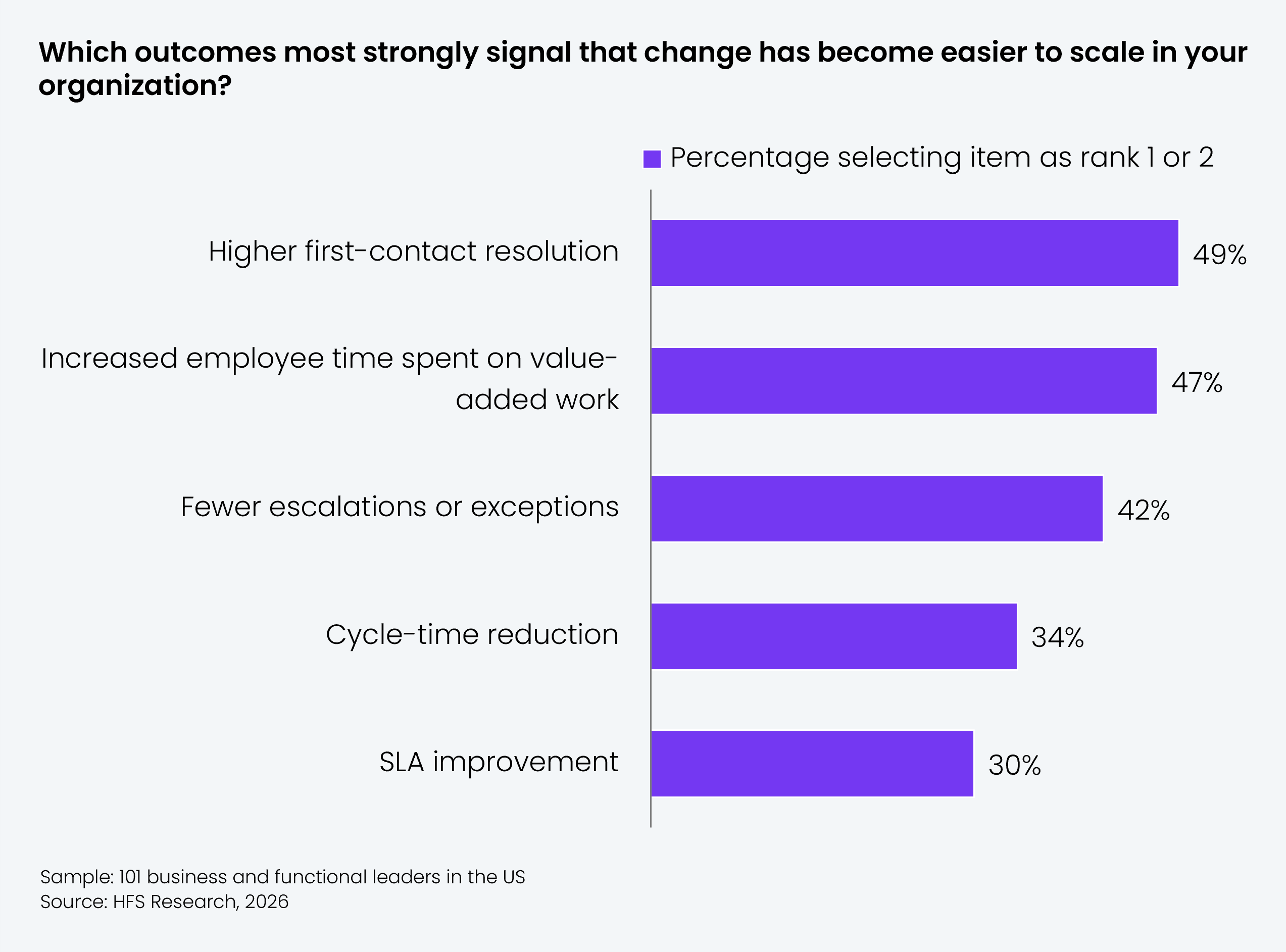
Customer-facing impact is the primary proof of AI transformation. Nearly half of all executives rank first-contact resolution among the strongest signals of scalable change.
Escalation reduction and workforce redeployment matter, but they are secondary. Executives judge AI scale by visible service improvement, not internal efficiency alone.
Yet measurement maturity remains uneven. Many organizations are extrapolating from pilots rather than enterprise deployment.
The signal is clear:
AI must prove itself at the customer interface, and sustained proof requires the control, orchestration, and governance discipline to scale safely.
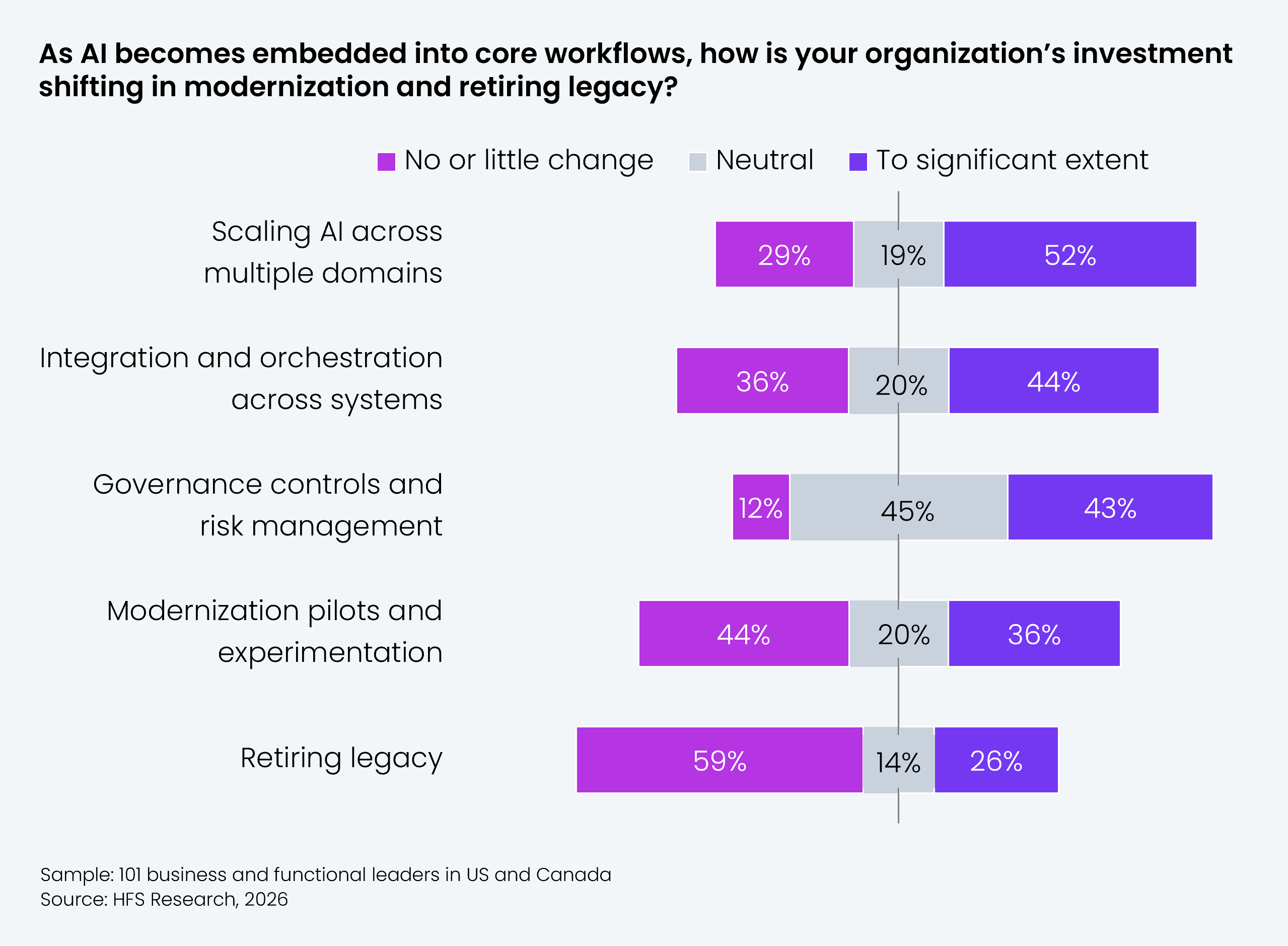
Scaling AI across multiple domains and cross system integration will attract the bulk of investment, despite most enterprises not being AI-ready.
Instead, they will rely on human-in-the-loop oversight and downstream risk detection to catch failures at the expense of STP and near-term ROI. Automation is advancing, but cautiously, as control frameworks catch up.
Forty-four percent (44%) are ramping investment in orchestration and 43% in risk management, reflecting their recognition of the structural gap. Enterprises understand that scaling AI safely requires connective tissue not just smarter agents.
For 59% of executives, retiring legacy is not a priority. This layering will risk increased architectural complexity, data quality erosion limiting institutional knowledge leverage and competitive advantage from AI.
Enterprises are universally committed to scaling AI and agentic workflows. Across business, risk, and IT, leaders agree: A unified orchestration fabric is an essential foundation for an AI-enabled hybrid operating model. For CIOs, this creates a clear mandate. The CIO must own the orchestration narrative and establish the architectural foundation that enables the safe, progressive rollout of AI and agents across workflows and business lines, avoiding inconsistent deployment, duplicated capabilities, rising costs, gaps in auditability, and data traceability.
Future competitive advantage will depend on a well-architected orchestration layer and seamless integration with the enterprise’s proprietary data, business rules, and codified expertise. CIOs must drive workflow modernization and address legacy complexity where fragmented architectures and poor data quality constrain new AI capabilities.
Governance must remain uncompromising, and CISOs and Chief Risk Officers must act as the guardians of control frameworks, ensuring enforcement of privacy, auditability, and data lineage across AI deployments. Without this partnership between orchestration leadership and governance oversight, AI will scale, but not safely.



Register now for immediate access of HFS' research, data and forward looking trends.
Get StartedIf you don't have an account, Register here |
With the exception of our Horizons reports, most of our research is available for free on our website. Sign up for a free account and start realizing the power of insights now.
Our premium subscription gives enterprise clients access to our complete library of proprietary research, direct access to our industry analysts, and other benefits.
Contact us at [email protected] for more information on premium access.