
This Market Impact Report is for CIOs, chief AI officers, enterprise transformation leaders, and operations executives evaluating how to scale agentic AI beyond supervised pilots into autonomous execution.
The hard part of agentic AI was never going to be the technology alone. Enterprises have already proven that AI can make employees faster, processes leaner, and decisions more informed. The models work. The pilots deliver. What remains unresolved is whether organizations are ready to allow AI systems to execute work autonomously and whether their people, roles, and oversight structures are ready to evolve with them.
For enterprise leaders, this marks a different kind of transformation challenge. Agentic AI changes the nature of enterprise responsibility. Instead of simply generating outputs that humans review, agentic systems can coordinate tasks, trigger actions, and make operational decisions across workflows. This shifts the bottleneck from technical capability to organizational readiness.
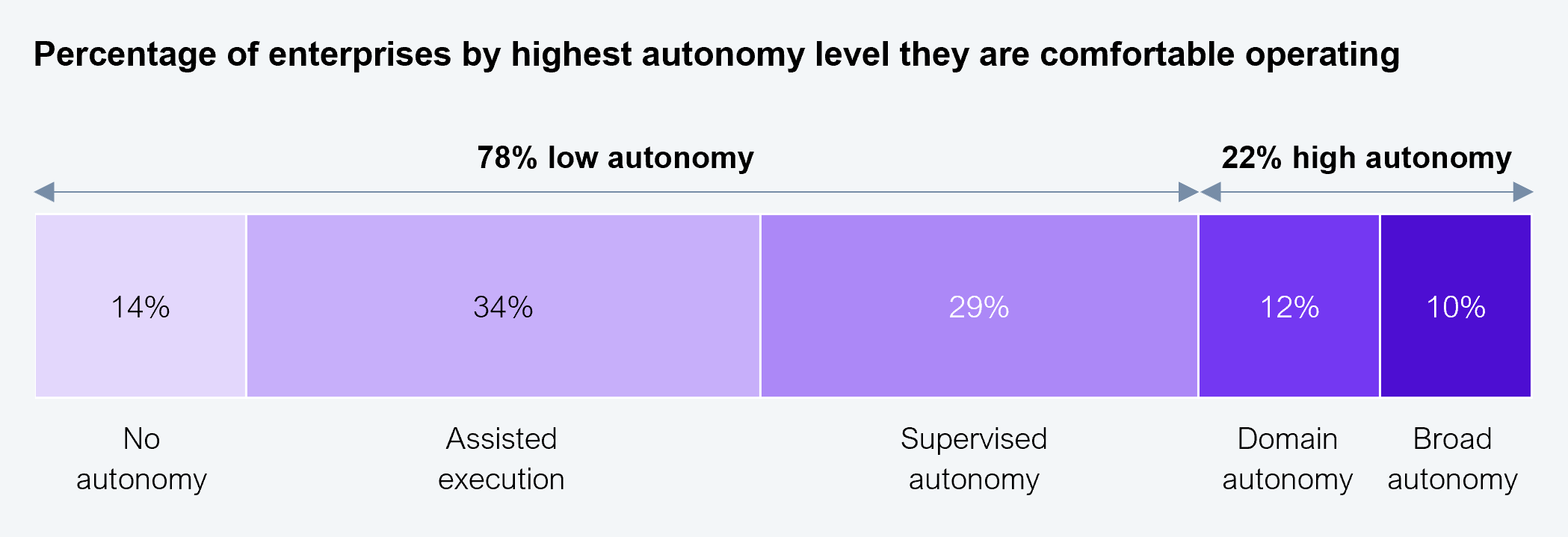
To understand how prepared enterprises are for this shift, HFS Research, in partnership with Genpact, surveyed 545 senior executives across 11 industries and conducted interviews with leaders from Fortune 2000 companies. The results reveal a market aligned on direction but divided on readiness. Ninety-two percent (92%) of executives believe that agentic AI will fundamentally change how work is executed. Yet nearly 80% still operate these systems in assisted or supervised modes, with humans retaining approval authority over key decisions.
Our research shows that four organizational decisions determine whether agentic AI becomes real enterprise-scale autonomous execution or remains tightly supervised experimentation.


Enterprises often frame agentic AI as a technology transformation. In practice, the organizations that succeed treat it as an operating model redesign.
The leaders who scale agentic systems first will not necessarily be the ones moving fastest. They will be the ones resolving these four constraints that determine whether autonomous execution is possible: accountability, measurement, people, and process.
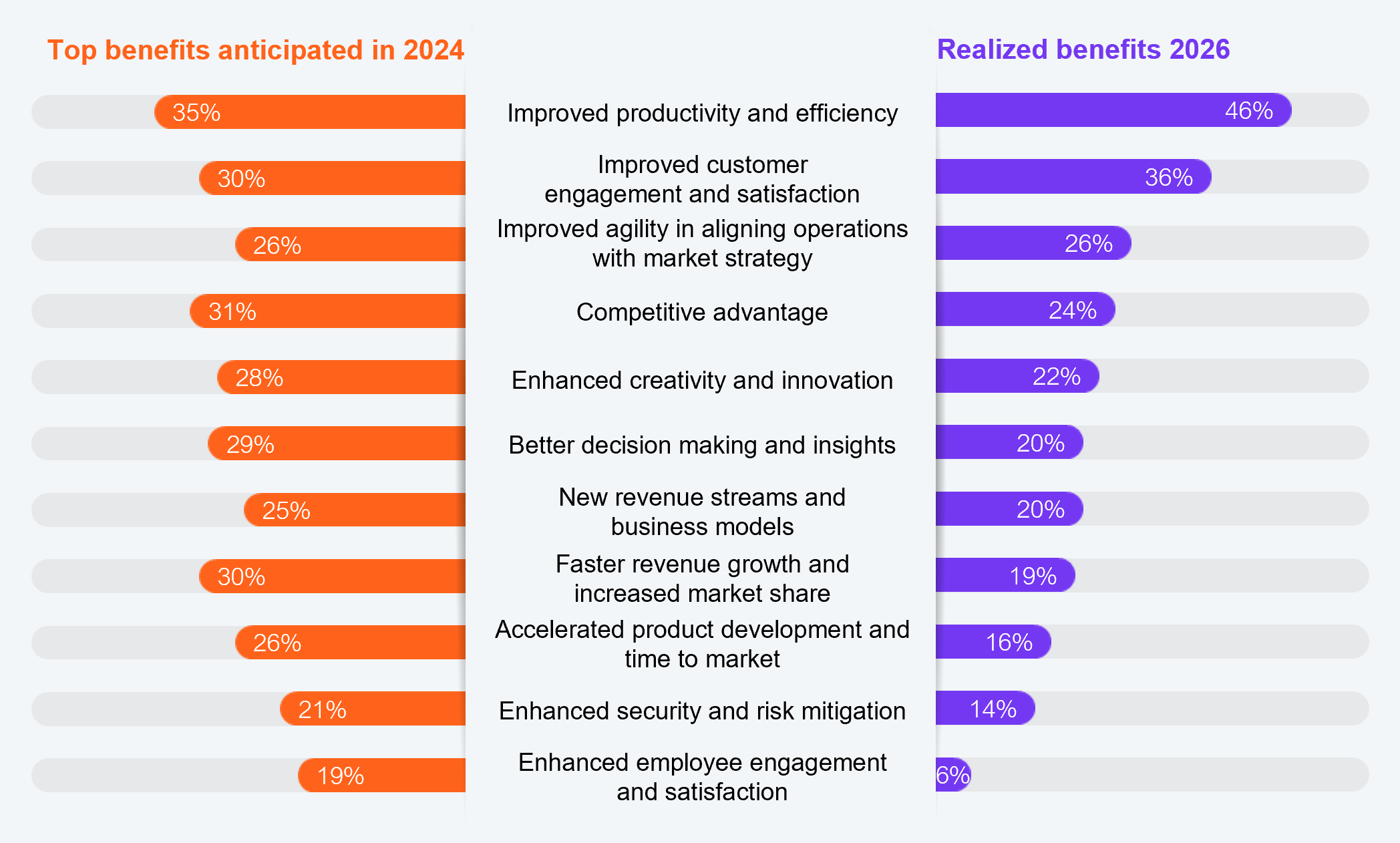
To understand the rise of agentic AI, we first need to understand what GenAI changed and what it did not. Two years ago, HFS and Genpact’s two-year GenAI countdown study captured a wave of enterprise ambition around GenAI. Looking back now, many of those early gains materialized quickly. Productivity improvements were the most widely realized outcome, achieved by 46% of enterprises, followed by improvements in customer engagement and satisfaction at 36% (see Exhibit 1).
What stands out in the data is where the impact plateaued. The outcomes leaders associated with transformation, including new business models, faster innovation, and sustained competitive advantage, were much harder to achieve. While GenAI has improved how work is performed, it has not fundamentally changed how enterprises execute it. Tasks accelerated inside existing workflows, but the structures governing decisions, accountability, and coordination remained largely unchanged.
Sample: 550 senior executives (2024) and 545 senior executives (2026) from Fortune 2000 firms
Source: HFS Research, 2026
The expectations now placed on agentic AI reflect precisely what GenAI could not deliver. Rather than simply assisting employees, agentic systems are designed to coordinate work across applications, trigger actions across processes, and make decisions without continuous human direction. The ambition is no longer incremental productivity but a shift in how work itself is executed.
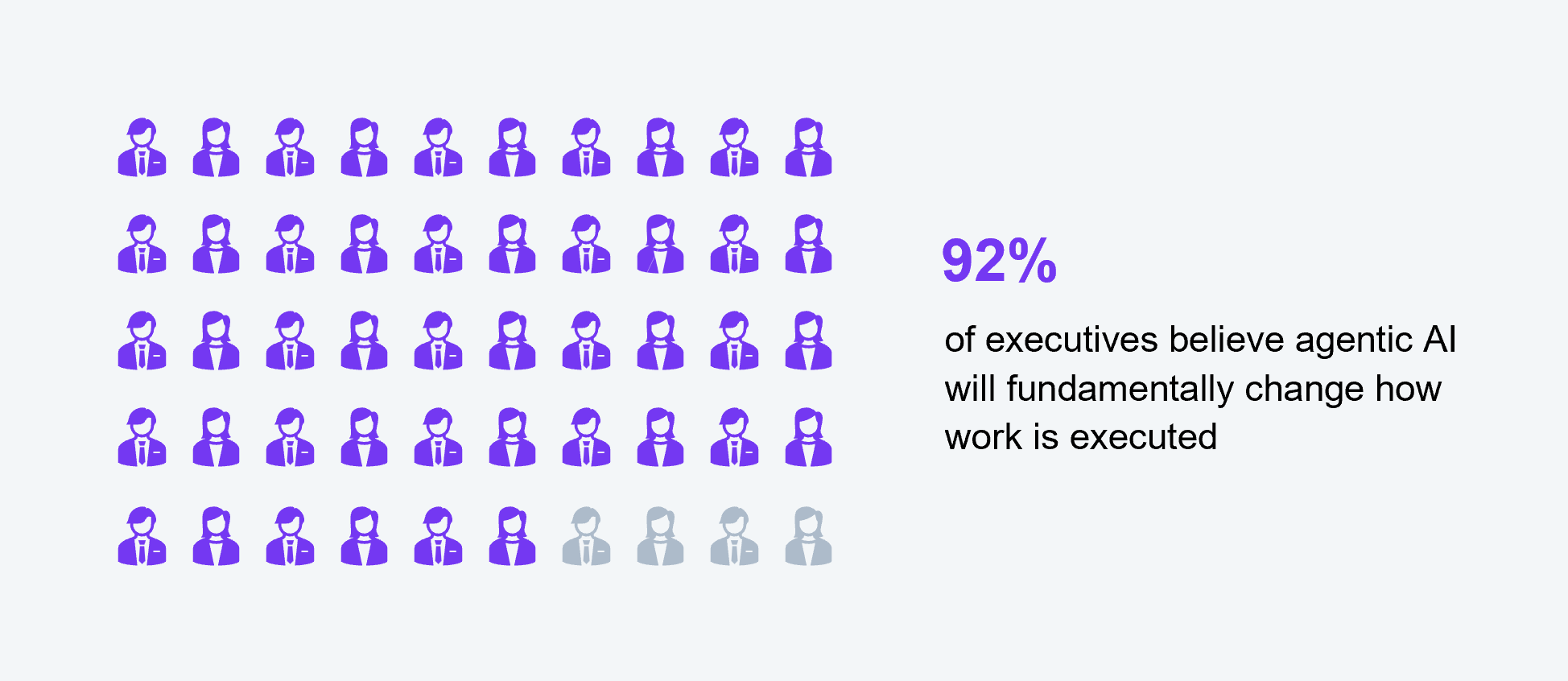
Enterprise leaders recognize the significance of that shift. Ninety-two percent (92%) of executives believe agentic AI will fundamentally change how work is executed across their organizations (see Exhibit 2). The expectation is that AI systems will move beyond generating insights to managing workflows, resolving exceptions, and coordinating activity across functions, freeing humans for higher-value judgment and oversight.
As a VP at a Fortune 2000 financial services firm told us, “We are not looking at agents as another layer of productivity tooling. We are looking at them as the next operating model for how work gets done.”
Sample: 545 senior executives from Fortune 2000 firms
Source: HFS Research, 2026
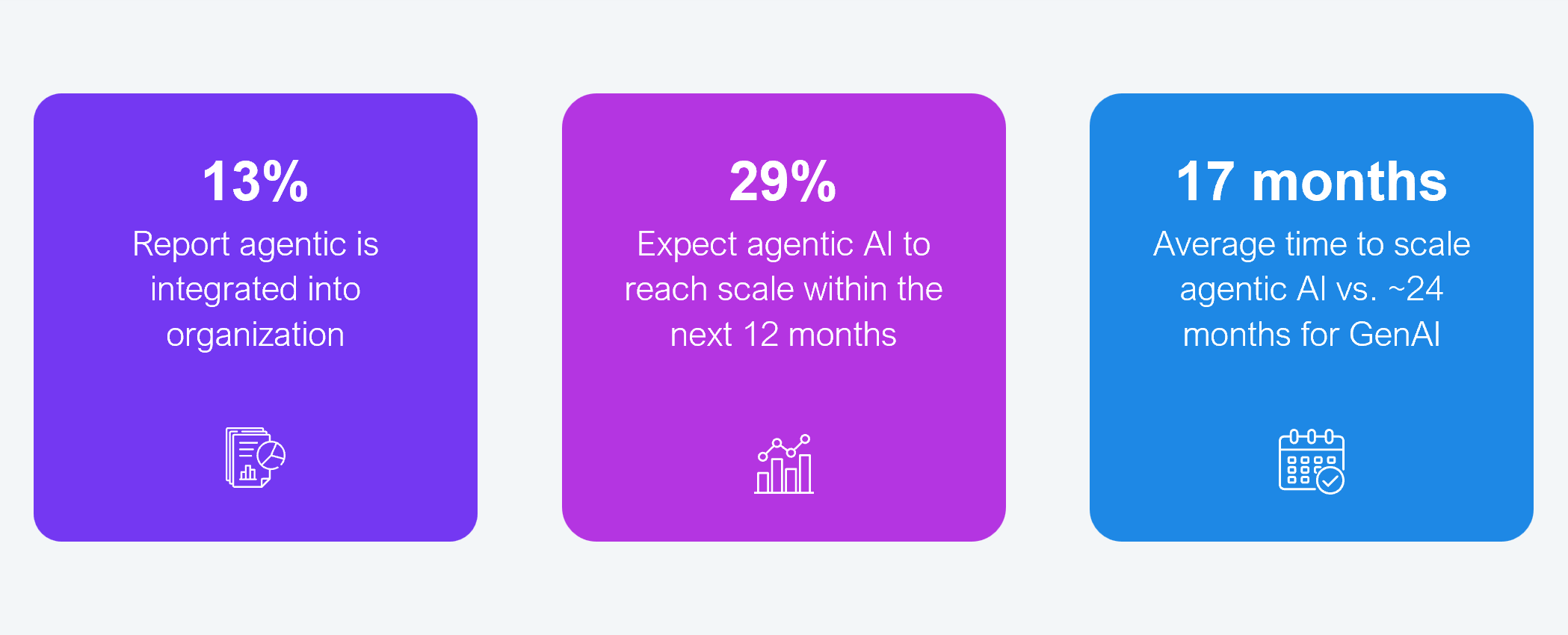
The pace at which organizations expect this transition to happen is notable. On average, enterprises expect to scale agentic AI across the business within a 17-month horizon, which means moving from pilots to production where agents are embedded in live workflows and delivering measurable impact on execution, outcomes, and process performance. Thirteen percent (13%) report that agentic AI is already integrated into their organizations, and another 29% expect to reach scale within a year (see Exhibit 3).
These timelines show that enterprises are not treating agentic AI as a distant transformation. They see it as the next stage of AI adoption after their GenAI investments. Yet the organizational conditions required for autonomous systems to operate safely at scale are still emerging. In practice, most enterprises continue to run agentic systems under close supervision, with humans retaining authority over approval for most actions.
That is the contradiction now shaping the agentic AI market. Enterprises expect AI systems to take on more execution, but most have not yet resolved what it means to let them act. The next challenge is not a technical possibility. It is organizational permission.
Sample: 545 senior executives from Fortune 2000 firms
Source: HFS Research, 2026
Enterprises are already proving that agentic systems can summarize, route, prioritize, draft, and coordinate. What they are unable to prove at scale is that those systems can be trusted to act independently within real workflows. The issue is no longer whether agents can generate value, but whether organizations are prepared to let them own outcomes.
That is why trust matters so much here. Agentic AI asks them to trust not only what the system recommends, but also what it decides and does. That is a different threshold entirely.
As a VP of enterprise automation at a global financial services firm put it, “The opportunity is obvious. The hesitation starts the moment the system is allowed to do something that can’t be quietly reversed.” That is where most enterprises still stop.
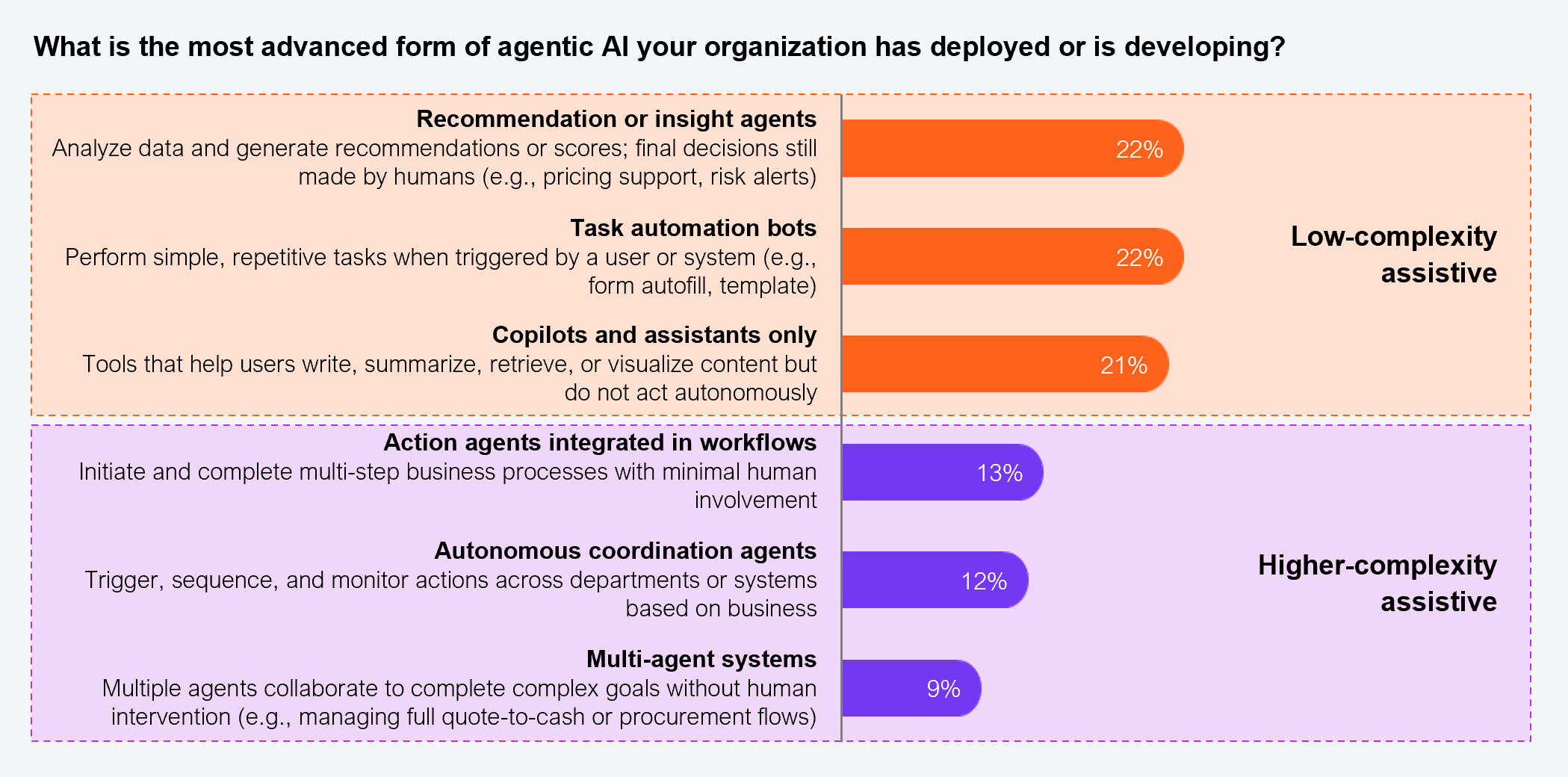
Many enterprises are implementing agentic systems, yet most deployments remain concentrated on recommendation, support, and task assistance rather than autonomous execution. Copilots, task bots, and recommendation agents account for most current activity, while action agents, autonomous coordination, and multi-agent systems remain far less common (see Exhibit 4). This pattern shows where enterprise confidence currently sits. Organizations are far more hesitant to allow autonomous execution, even when they are comfortable with autonomous decision support.
As an AI leader in a large retail bank noted, “We keep saying we want agents, but what we actually approve are better assistants.” The gap between ambition and authorization reflects a trust boundary that many enterprises are still navigating.
Sample: 545 senior executives from Fortune 2000 firms
Source: HFS Research, 2026
The trust boundary becomes even clearer when examining how enterprises authorize agent behavior. Most continue to operate agents in assisted or supervised modes, with humans retaining approval authority over key actions (see Exhibit 5). This can make autonomy seem binary when, in reality, it is conditional. Enterprises grant autonomy incrementally. They adjust permissions based on context and risk, not through a single flip from supervision to full independence.
This creates the central trust gap in the market. Enterprises increasingly believe that agentic AI will transform execution, yet most still govern these systems as if they were tightly bound automation tools. Human checkpoints remain embedded across workflows. Agents may analyze, draft, and recommend, but when responsibility becomes material, the decision, the action, or both still return to a person.
A senior executive at a global bank summarized the issue directly: “We do not have a technology problem. We have a risk appetite problem.” The ambition for autonomy is real, but the organizational confidence to authorize it remains uneven.
Sample: 545 senior executives from Fortune 2000 firms
Source: HFS Research, 2026
As enterprises move deeper into agentic deployments, the conversation shifts. The debate becomes less about whether models perform well and more about who owns the consequences, both operationally and legally, and whether those decisions can be mapped to existing regulatory and liability frameworks when autonomous systems act.
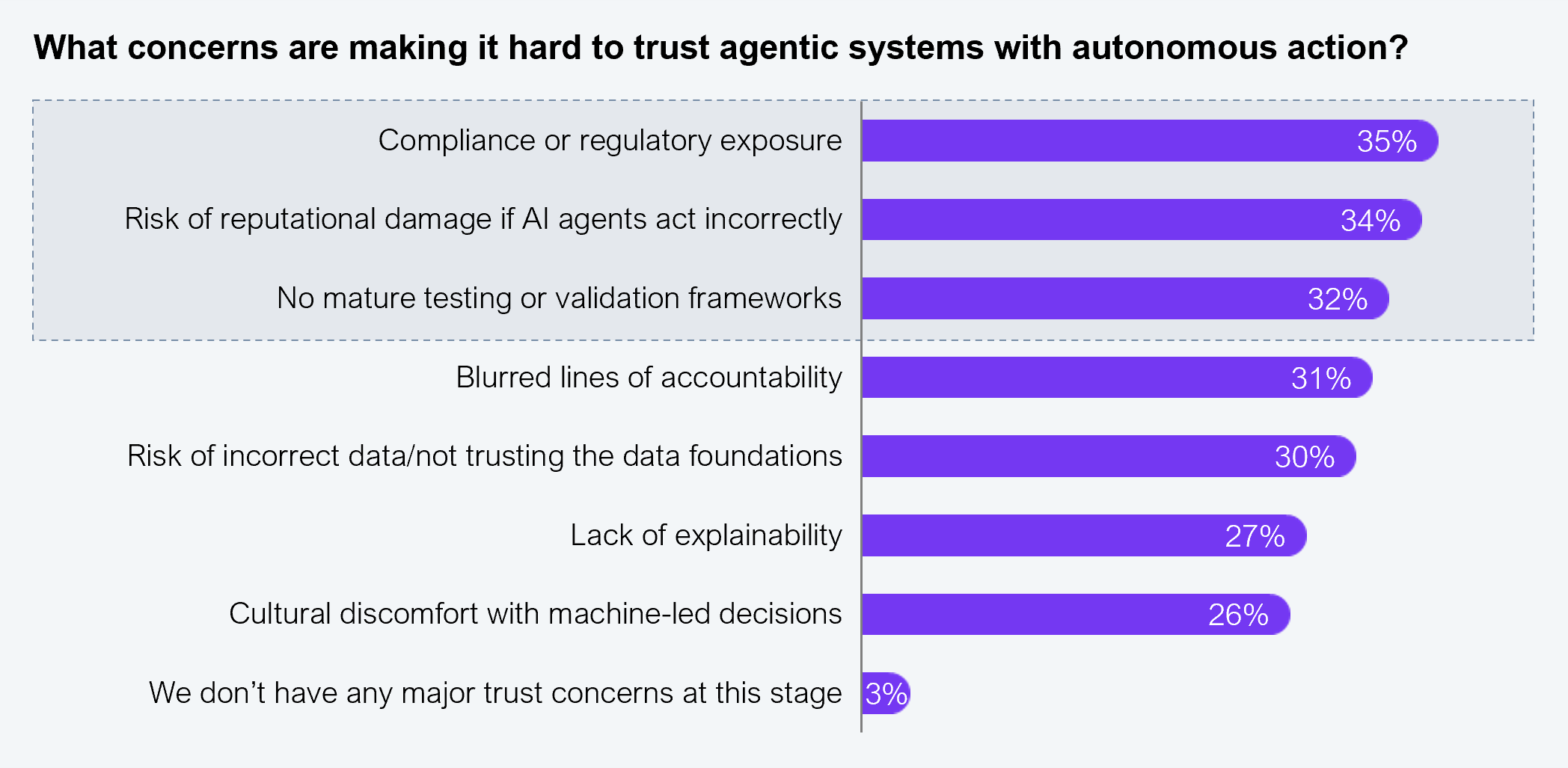
This is reflected in the concerns executives often raise around agentic AI. Compliance exposure, reputational risk, lack of explainability, and unclear accountability are among the top barriers to expanding autonomy, especially when decisions can’t be easily mapped to existing legal or regulatory frameworks (see Exhibit 6).
Sample: 545 senior executives from Fortune 2000 firms
Source: HFS Research, 2026
The shift from the GenAI era to the agentic one becomes clear here. With GenAI, the primary question was whether the system produced useful outputs. With agentic AI, it is whether the organization can stand behind what happens when the system takes action. A healthcare executive captured this insight clearly: “The challenge is not getting the model to respond, but being able to stand behind what it just did.”
The organizations moving ahead are not waiting for trust to emerge on its own. They are designing systems, so autonomy remains governable. Instead of relying on humans to approve every action, these enterprises define where agents can act independently, where they must escalate, and what evidence must be captured when they do. Controls are built into the operating model itself rather than layered on through manual approvals.
In these environments, autonomy is not treated as a leap of faith. It is treated as something observable, controllable, containable, or reversible when needed, and defensible under pressure.
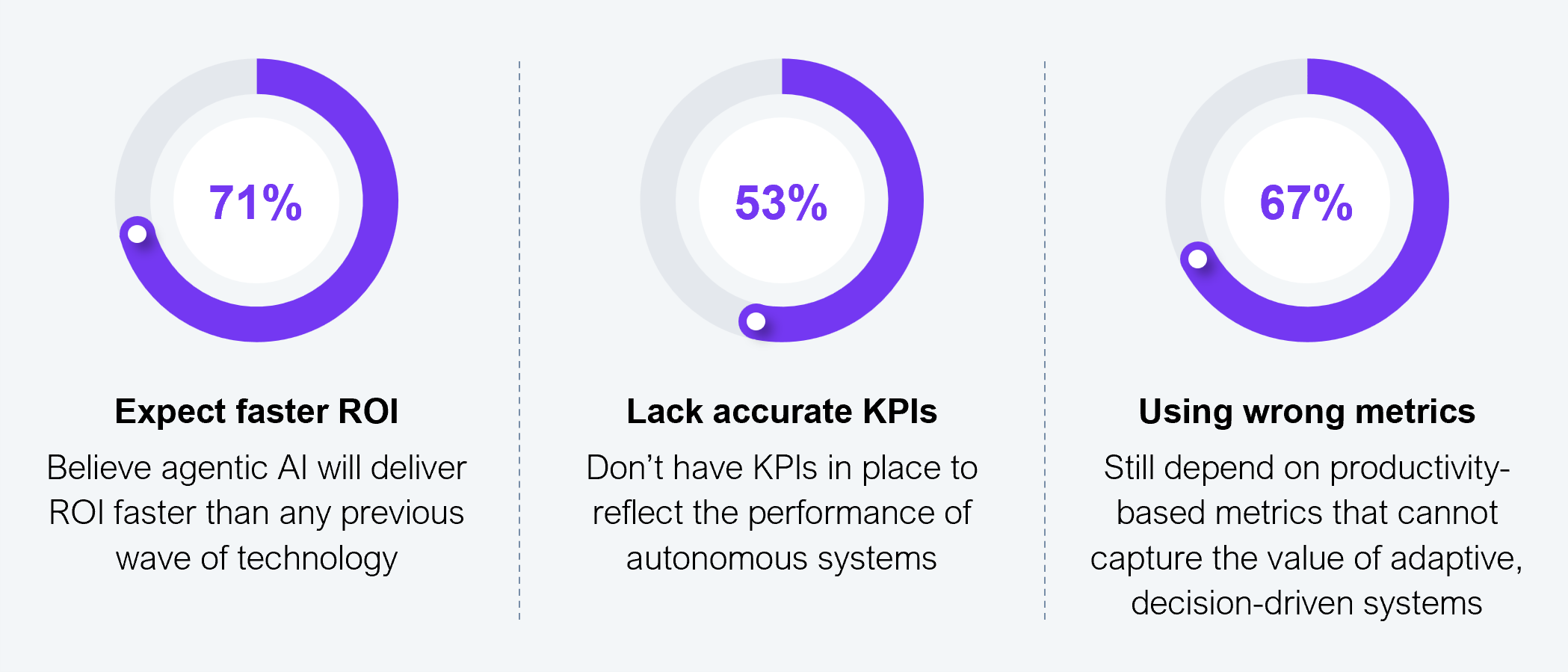
Executive expectations for agentic AI are unusually high. Seventy-one percent (71%) of senior executives believe it will deliver ROI faster than any previous wave of technology, including cloud and robotic process automation (RPA), and the first generation of enterprise AI.
What makes this striking is that this confidence exists alongside weak measurement readiness. More than half of enterprises report they don’t yet have KPIs to reflect the performance of autonomous systems accurately, and 67% say they still rely on productivity-based metrics that can’t capture the value of adaptive, decision-driven systems (see Exhibit 7).
This creates an immediate tension. Leaders expect agentic AI to transform execution, but most organizations still lack the measurement framework required to demonstrate whether it is actually delivering that impact.
Sample: 545 senior executives from Fortune 2000 firms
Source: HFS Research, 2026
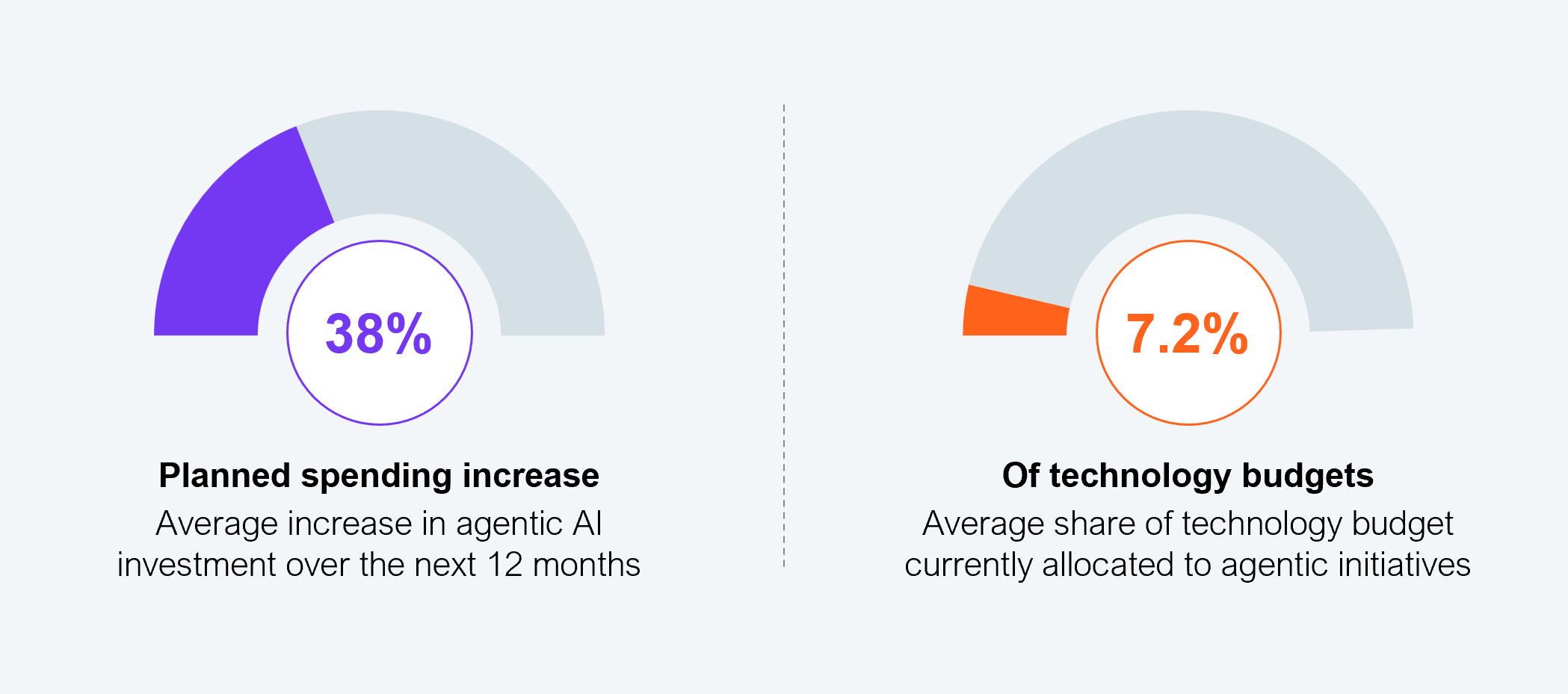
That confidence is already shaping capital allocation. Agentic initiatives account for an average of 7.2% of enterprise technology budgets today, with planned spending increases of 38% over the next twelve months (see Exhibit 8).
Enterprises are not hedging on agentic AI. Budgets are moving, timelines are compressing, and leadership teams are increasingly positioning autonomous systems as part of the next operating model. But commitment and accountability are different things. Investment is accelerating faster than the infrastructure needed to evaluate it.
If organizations can’t measure what these systems are doing, they will struggle to defend the investment, identify which deployments are working, or determine when autonomy should expand.
Sample: 545 senior executives from Fortune 2000 firms
Source: HFS Research, 2026
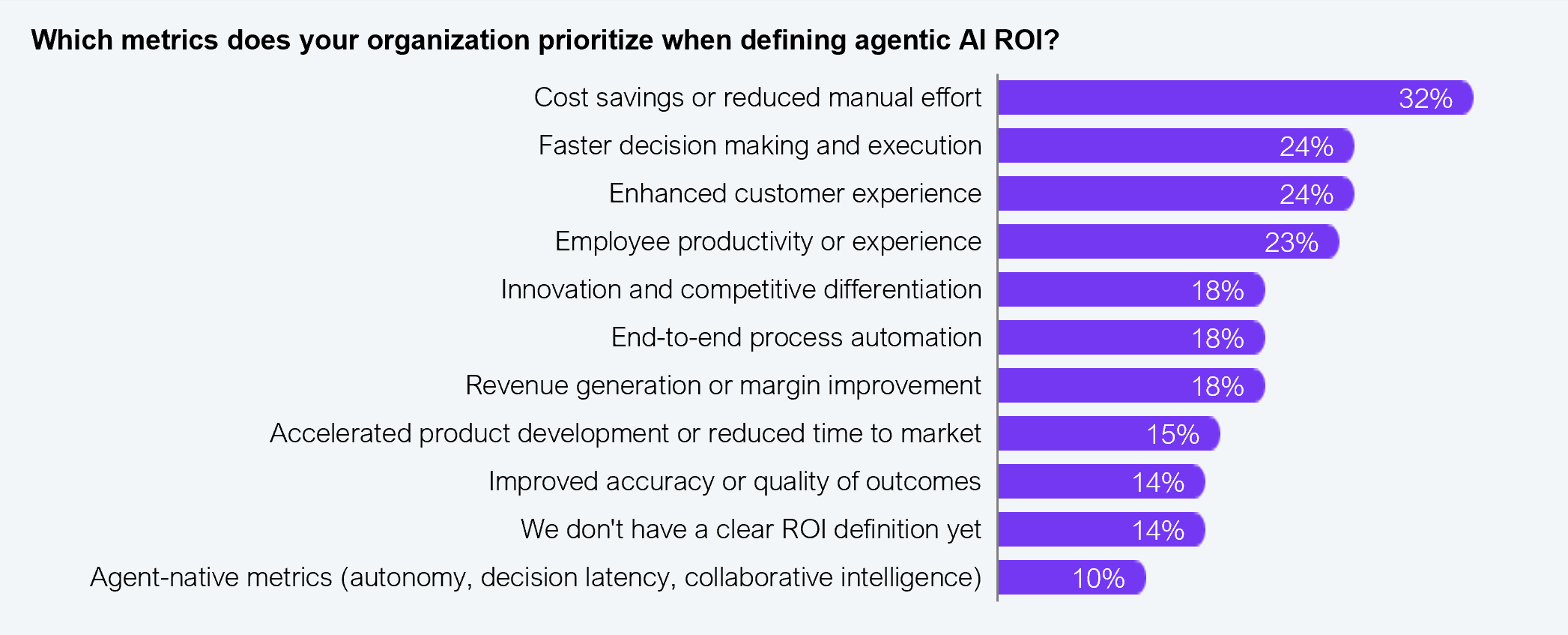
The measurement gap becomes clearer when examining how enterprises currently evaluate agentic systems. Cost savings, productivity gains, and cycle-time reduction dominate the metrics leaders are using today (see Exhibit 9).
Those measures made sense for earlier automation waves such as RPA and assistive AI tools. They are far less suited to systems designed to coordinate work across processes, resolve exceptions, and execute decisions with limited human intervention.
Only 10% of enterprises report using agent-native measures that reflect the outcomes autonomous systems are intended to produce. These include resolving decisions without escalation, completing workflows end to end without human intervention, and handling operational exceptions autonomously.
As a technology executive at a healthcare enterprise explained, productivity metrics show whether employees are working faster. Agentic systems force organizations to ask a different question: whether the system itself is beginning to carry part of the work.
Sample: 545 senior executives from Fortune 2000 firms
Source: HFS Research, 2026
Organizations that move ahead will not simply invest more aggressively. They will redefine how success is measured.
Agentic systems require metrics that capture execution rather than activity, including autonomous workflow completion, reduced escalation, and independent exception handling. Without that shift, enterprises risk judging agentic AI through a productivity lens designed for assistive tools.
And once organizations begin measuring execution rather than activity, another constraint becomes visible. As systems take on more work, enterprises must also redefine how human roles, oversight responsibilities, and workforce structures evolve alongside them.
Agentic AI is not only changing what work gets done. It is also changing what the organization expects people to oversee, authorize, and own. Structural redesign is already underway, but the workforce expected to operate within that redesign is still emerging. The result is a widening gap between how enterprises intend to run work and whether their people are equipped and clear about their roles to govern it.
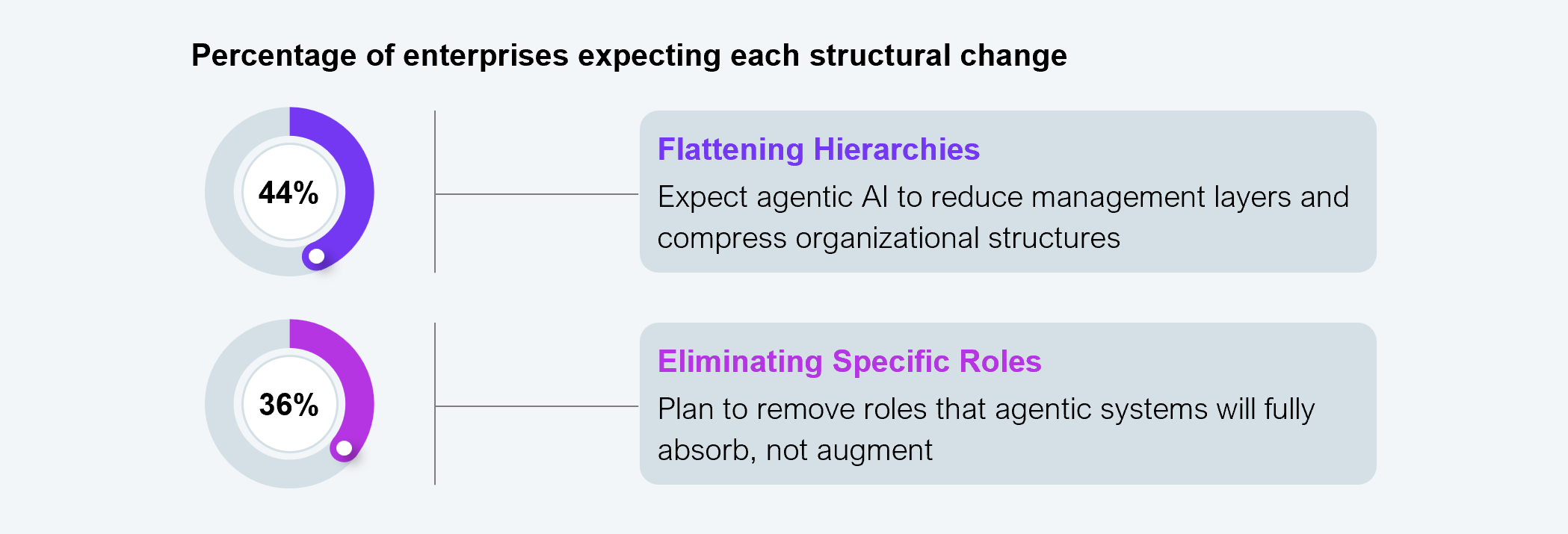
The structural changes are already visible. Forty-four percent (44%) of enterprises expect agentic AI to flatten traditional hierarchies by reducing management layers, while 36% expect to eliminate specific roles entirely rather than augment them (see Exhibit 10). These are not incremental adjustments. They reflect growing expectations that agentic systems will absorb coordination and oversight tasks historically performed by middle management. This shifts not only work but also decision authority, raising new governance, ethical, and leadership questions.
The challenge is that these structural bets imply different futures for the workforce. Flattening hierarchies assumes humans shift toward higher-order judgment, exception handling, and oversight. Eliminating roles assumes the loop no longer requires human involvement. Many enterprises seem to be pursuing both simultaneously, often without a clear framework for which roles evolve, which ones disappear, and which new responsibilities emerge.
As an operations leader at a global telecommunications firm explained, “We are reorganizing around speed and autonomy, but the human role in that model is still being invented.” In many organizations, structural redesign is moving faster than role design.
Sample: 545 senior executives from Fortune 2000 firms
Source: HFS Research, 2026
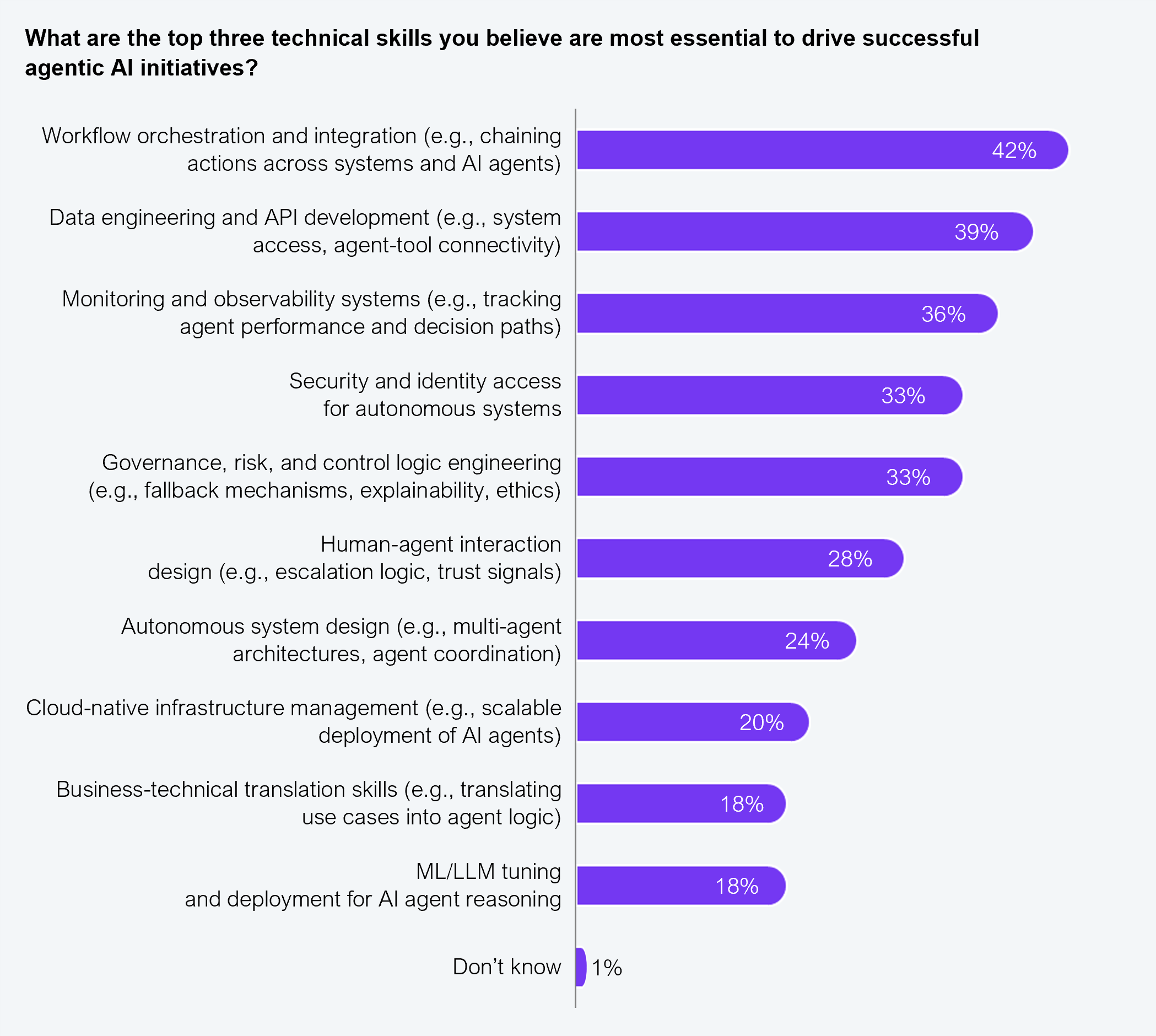
The skills enterprises now prioritize reinforce this shift. Workflow orchestration and integration top the list at 42%, followed by data engineering at 39% and monitoring and observability at 36% (see Exhibit 11). These are not capabilities required to build AI models. They are the capabilities required once systems are embedded in workflows and must be connected, monitored, and governed in real time.
Sample: 545 senior executives from Fortune 2000 firms
Source: HFS Research, 2026
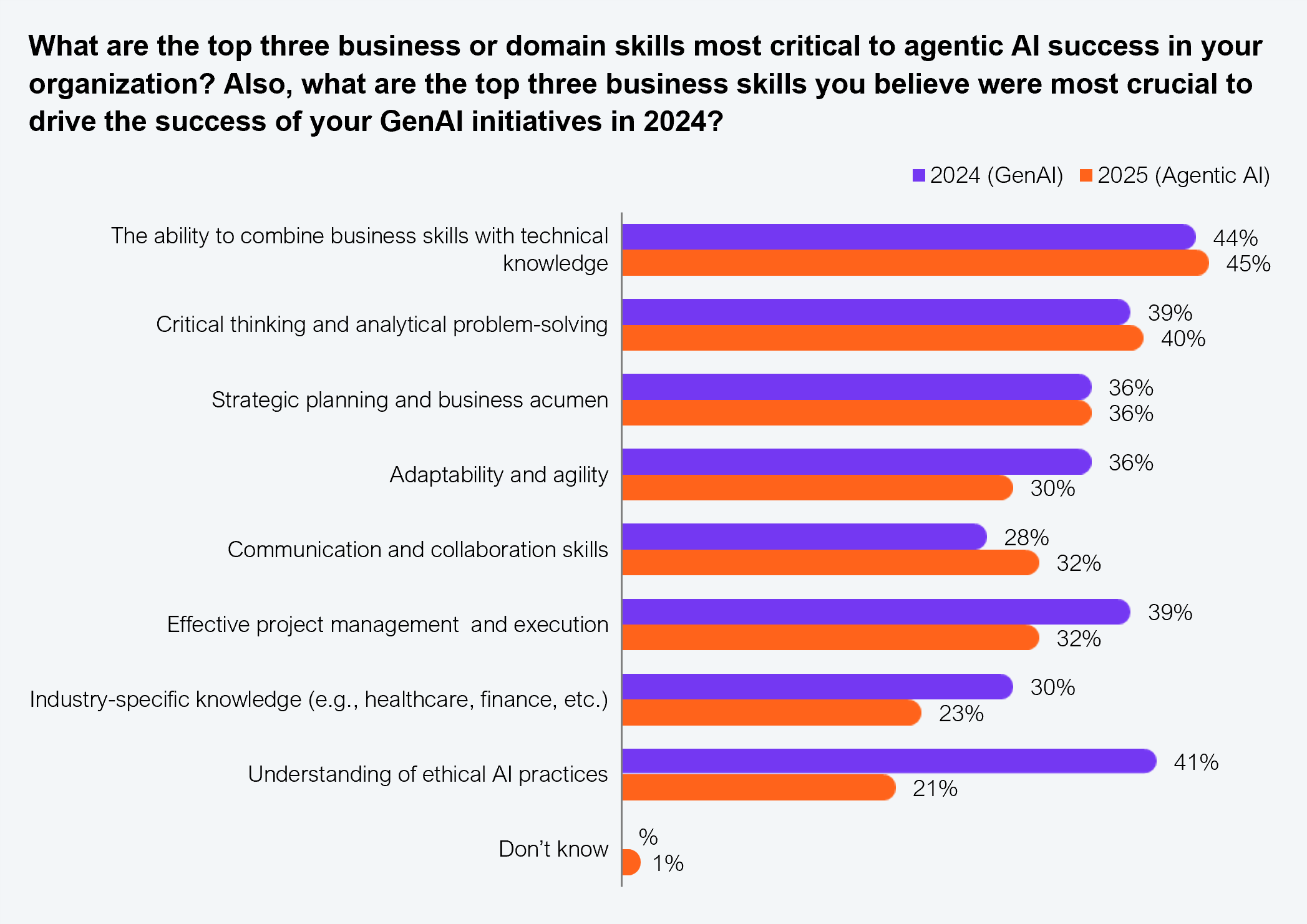
The business skills story reinforces the same shift. Enterprises increasingly prioritize business and domain knowledge combined with technical fluency, followed by critical thinking, strategic planning, and accountability and judgment (see Exhibit 12). The emphasis is moving away from simply using AI tools toward supervising how autonomous systems operate.
What really stands out in the skills data is the drop in understanding ethical AI, from 41% to 21% in two years, the steepest decline on the list. This suggests that many organizations believe that governance mechanisms and guardrails are already in place. Earlier findings on trust indicate that most enterprises are still building them.
Sample: 545 senior executives from Fortune 2000 firms
Source: HFS Research, 2026
Employee sentiment toward agentic AI is neither overwhelmingly positive nor overwhelmingly negative. Instead, it is fragmented in ways that reveal how unevenly enterprises are managing the transition. Only 16% of organizations report very positive sentiment toward agentic AI, while 60% feel neutral or negative (see Exhibit 13).
Where sentiment becomes negative, the drivers are consistent. Employees cite concerns about job security, lack of clarity around how AI decisions will be governed, and discomfort with the pace of change. These reactions reflect uncertainty about responsibility rather than skepticism about the technology itself.
Organizations reporting stronger workforce acceptance emphasize transparency around how agents operate, structured training programs, and clearer communication about how human roles will evolve. Confidence increases when employees understand the boundaries between human accountability and system autonomy.
![Three-part composite exhibit. Part 1: horizontal bar chart showing overall employee sentiment distribution. Question asked: How would you characterize employee sentiment toward agentic AI in your organization overall? Very negative (worried or resistant to working alongside autonomous AI systems): 15%; Somewhat negative (concerned about job impact, reliability, or changes to their work): 23%; Neutral (mixed feelings or haven't formed strong opinions yet): 22%; Somewhat positive (generally optimistic but have some reservations or questions): 24%; Very positive (enthusiastic and actively seeking opportunities to work with agentic AI): 16%. Part 2: horizontal bar chart: What is driving negative sentiment in foundational enterprises? Employees may resist giving up control or decision-making authority: 42%; Our managers are unclear about how accountability works with autonomous systems: 38%; There are concerns about morale, engagement, or perceived job threat: 37%; We lack the skills or behavioral readiness to collaborate with agentic AI: 30%; There is no incentive model aligned with AI-driven outcomes: 25%; Agentic AI could create confusion about roles or career paths: 24%; There is no incentive model aligned with AI upskilling for our people: 23%; We risk making work more transactional or dehumanizing: 18%. Part 3: horizontal bar chart: How does a transformational organization foster positive sentiments? Successful pilot programs or early implementations: 50%; Clear communication about how agentic AI will enhance rather than replace jobs: 33%; Strong change management and training programs: 33%; Confidence in the organization's ability to manage the transition: 29%; Leadership is actively promoting the benefits and opportunities: 25%; Culture of innovation and technology adoption: 24%; Employees have had positive experiences with AI tools already: 23%; [eighth bar not fully legible]: 8%. Sample: 545 senior executives from Fortune 2000 firms. Source: HFS Research, 2026.](https://www.hfsresearch.com/wp-content/uploads/13.-workforce-governance-clarity.png)
Sample: 545 senior executives from Fortune 2000 firms
Source: HFS Research, 2026
The workforce challenge is not simply one of training. It is one of the roles of design, accountability, and organizational clarity. Enterprises can’t scale agentic systems if the people expected to oversee them don’t understand where their responsibility begins and ends, and how their work changes alongside autonomous execution.
As agentic systems assume more responsibilities, the workforce challenge becomes inseparable from a process challenge. Enterprises must not only redefine human oversight, but also redesign the workflows those systems are expected to govern.
Most enterprises are not automating work. They are automating the symptoms of broken work. The process logic underneath remains intact, which is why autonomy often becomes brittle, ROI remains difficult to demonstrate, and accountability stays unclear.
Agentic AI is no longer confined to isolated pilots. Workflow redesign is underway in customer service, IT infrastructure, and finance, functions where decision volume is high, exceptions are frequent, and the cost of manual coordination is most visible. Nearly half of enterprises report reworking customer service workflows so agents can manage decision chains rather than individual tasks. IT and finance follow closely behind (see Exhibit 14).
The pattern is not accidental. These functions sit at the intersection of data, decisions, and coordination across organizational boundaries. They are also where traditional process logic breaks first when systems attempt to act autonomously. In many cases, redesign is not a planned transformation. It is the process forcing itself to change because the existing structure can’t support autonomous execution.
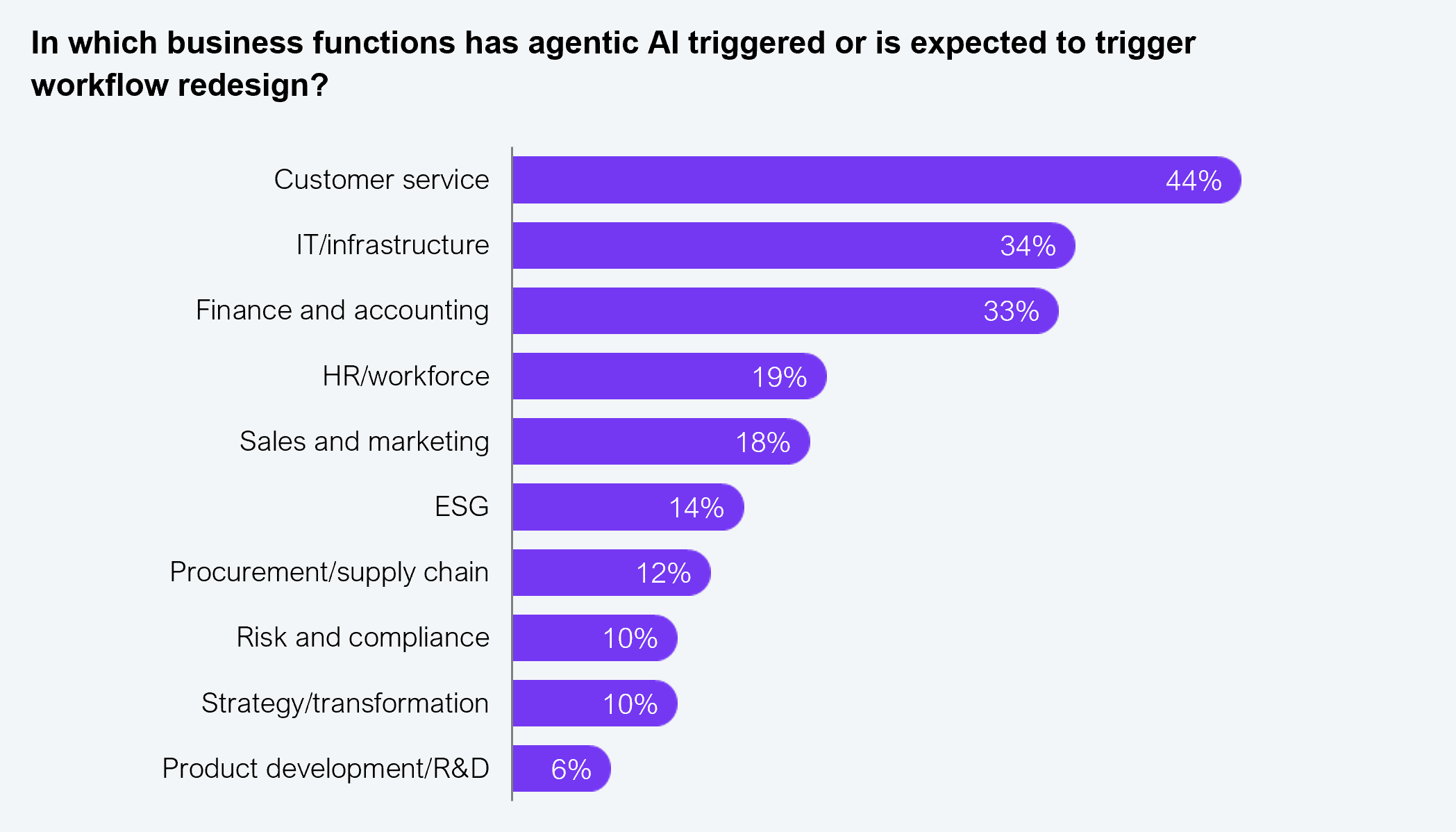
Sample: 545 senior executives from Fortune 2000 firms
Source: HFS Research, 2026
Process readiness has emerged as the top barrier to agentic AI adoption, ahead of governance concerns, expertise gaps, regulatory risk, and budget constraints (see Exhibit 15). This finding connects many of the challenges observed across the market.
Trust is difficult to establish in a process that does not make accountability visible. ROI is difficult to measure when workflows rely on human judgment at every step rather than explicitly surfacing decision logic. Governance is difficult to embed in processes designed for sequential handoffs rather than distributed decision making.
The barriers listed below the top line reinforce the same structural problem. Lack of governance structures, shortage of internal expertise, and difficulty scaling beyond pilots often reflect workflows that were never redesigned for autonomous execution. Enterprises attempting to layer autonomy onto legacy process logic are not scaling agentic AI. They are discovering where the process itself is not ready for it.
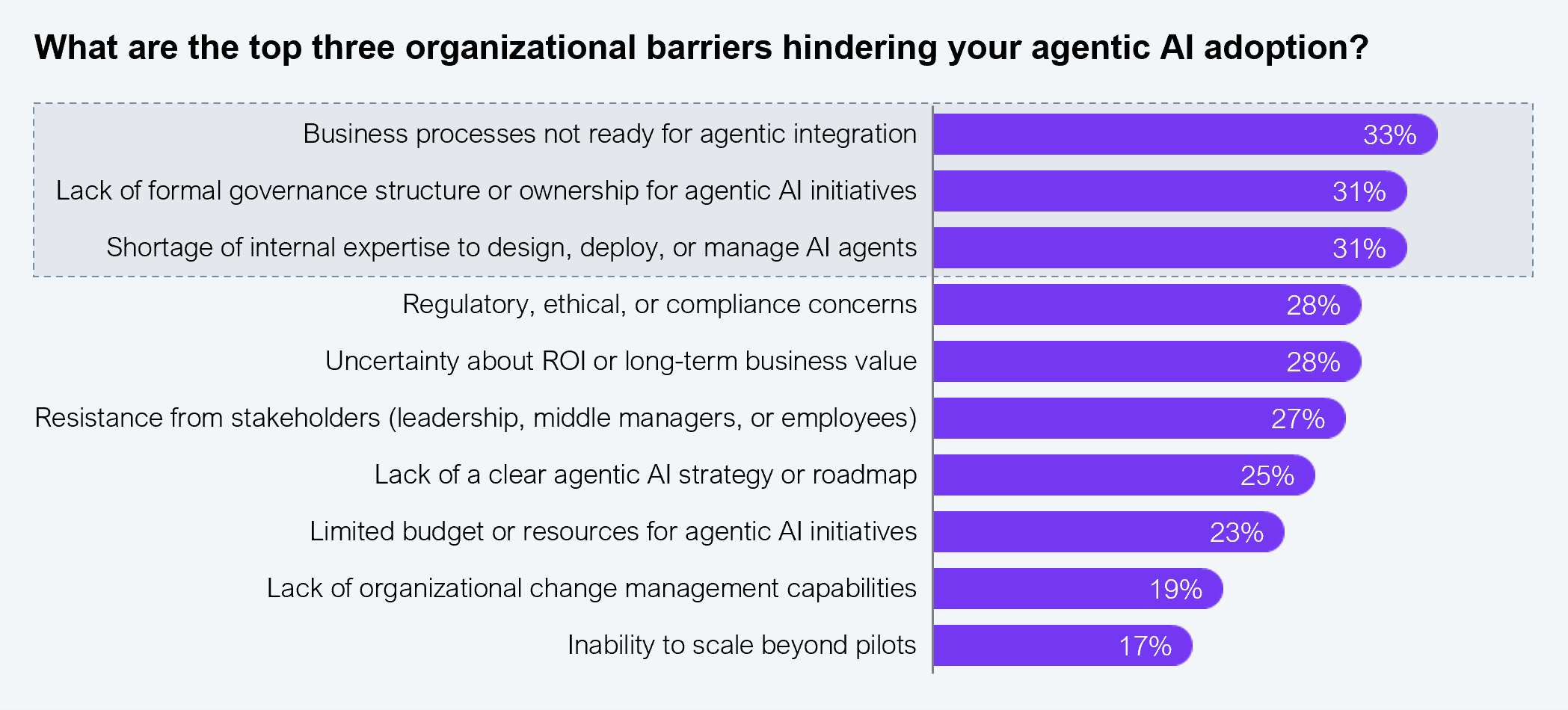
Sample: 545 senior executives from Fortune 2000 firms
Source: HFS Research, 2026
Enterprises making progress share a common approach. They stop optimizing individual tasks and begin redesigning workflows end to end. Sequential approvals that assume a human will authorize each step are removed. Decision ownership is clarified so accountability remains visible when agents act across functions. Manual handoffs are replaced with system triggers designed for autonomous execution.
However, as workflows become more compressed, risk can also become more concentrated. Fewer handoffs may mean fewer control points, increasing the blast radius when failures occur. In practice, every workflow left undesigned becomes a ceiling on how far autonomy can expand.
Four decisions separate enterprises compounding value from those running expensive pilots that never scale.




As organizations address those constraints, they are doing more than preparing AI to execute work. They are redefining how decisions are governed, how responsibility is assigned, and where control sits when systems begin to act.
Register now for immediate access of HFS' research, data and forward looking trends.
Get Started



If you don't have an account, Register here |
With the exception of our Horizons reports, most of our research is available for free on our website. Sign up for a free account and start realizing the power of insights now.
Our premium subscription gives enterprise clients access to our complete library of proprietary research, direct access to our industry analysts, and other benefits.
Contact us at [email protected] for more information on premium access.

