
Where talent and infrastructure can be in short supply for enterprises, executives must think outside the box to develop their blockchain solutions while simultaneously driving new efficiencies and cost-savings for their firm. Piloting blockchain initiatives in partnership with academia can accelerate the proof of concept (PoC) to implementation process while also saving cost and organizational commitment—as long as enterprises can master the relationship management that academia demands in HFS’ separate guide.
The advent of blockchain led to excitement, hype, and an array of dubious use cases, but we’re finally beginning to see blockchain offer genuine business value; however, the list of actual applications is not yet definitive. Blockchain is still in its experimental stage, and there remains a need for the “wait, is this garbage?” test—that’s where the HFS Blockchain Bullshit Buster comes in—but it’s after this step that the real work begins. The process from PoC to implementation is lengthy, expensive, and time-consuming when it comes to blockchain, but academia can lend a helping hand. Universities worldwide boast some of the most impressive talent, all keen to build use cases, making them an ultra-low-cost method of piloting enterprise blockchain initiatives.
IT failures in any business environment can cause serious real-world problems—just look at British Airways’ recent IT glitch that saw hundreds of flights canceled or delayed; implementing technological change without sufficiently rigorous testing can be truly disastrous. Given blockchain’s unknown nature, a proper piloting process is critical to ultimately achieving business benefits and value.
Twenty-six percent (26%) of executives report that their blockchain initiatives are stuck in the pilot phase. Often, they find that the technology didn’t drive enough business value or the technology wasn’t appropriate, which means that enterprises cut their losses and scrap their projects.
Exhibit 1: Over a quarter of blockchain initiatives remain in the piloting phase
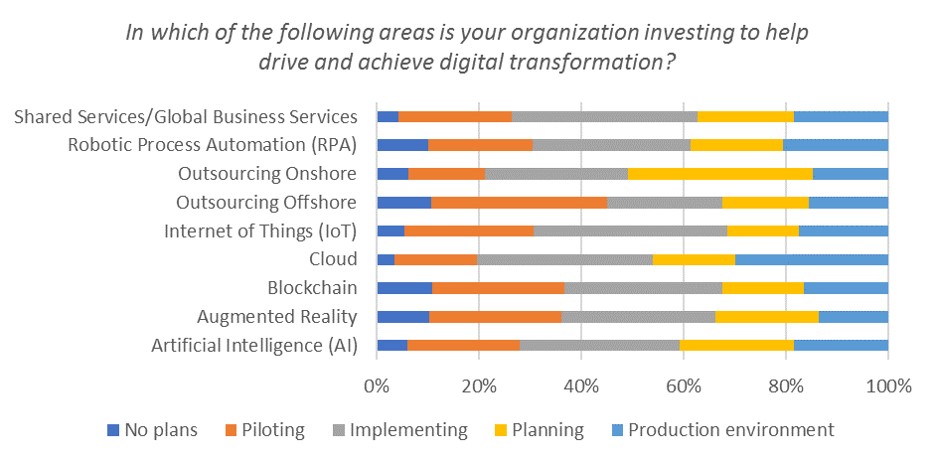
Source: HFS Research, 2019
Academia can offer an accelerated and low-cost alternative to traditional service providers when it comes to the R&D process. Big service providers must cover their own high salaries, pensions, and marketing expenses, which are passed onto clients. While academia needs its own funding sources and has methodological constraints that can be frustrating to profit-driven businesses, their demands of a piloting partner will be far more favorable.
University and student interest in blockchain technologies is on the rise; 34% of students surveyed expressed interest in taking a course on crypto or blockchain, and 56% of universities offered at least one crypto or blockchain program. Enterprises looking to pioneer the blockchain space should look to build partnerships in academia to quickly and cost-effectively complement their R&D efforts.
One early project in this area is a collaboration of The University of Cambridge and Caterpillar. The manufacturer offers customizable engines to meet end-users’ needs, meaning a complex and historically manual customer order management process—with phone calls, emails, and even faxes regularly exchanged. The order process would last up to a week, require six employees, and foster regular miscommunications and human error.
Caterpillar contemplated using blockchain to streamline the process, hoping to maximize efficiency while making it simpler to track transactions and modifications. Caterpillar approached the university to build a pilot blockchain at a low cost, requiring little time investment from the organization. The project took three students and a supervisor six weeks, but pinpointed not only the idea’s validity but also concrete benefits and business value:
Caterpillar isn’t the only firm leveraging academia for blockchain efforts; Imperial College London has partnered with OutlierVentures.io for a three-year R&D program exploring the meeting of blockchain and other change agents. Tecnológico de Monterrey, a Mexican university, partnered with Grupo CICE and Hutchison Ports Mexico to run a blockchain pilot in the Port of Veracruz to improve transparency and efficiency, similarly to the Caterpillar and Cambridge case. For enterprises who want to move from being blockchain-curious to first movers in what is still a nascent technological space—the academic partners are out there, and the value is clear to see.
Academia has already proven it can be an accelerating and ultra-low-cost partner to drive the current multitude of blockchain cases stuck in pilot purgatory into implemented value-creating applications. Enterprises must, however, remain realistic in their expectations; firstly, it may be unrealistic to expect a team of students and academics to fully deliver a project of the same quality as a giant service provider with a seemingly endless talent supply and war chest, which is why academia is tailor-made for the piloting phase, but likely no further. Furthermore, while academia can offer blockchain-curious enterprises a faster piloting process, it is possible that methodological constraints (see our separate guide for enterprises looking to work with academia) can extend lead-times and build tensions between business partners who see the clock ticking, profit margins tightening, and competitors moving in.
Register now for immediate access of HFS' research, data and forward looking trends.
Get StartedIf you don't have an account, Register here |
With the exception of our Horizons reports, most of our research is available for free on our website. Sign up for a free account and start realizing the power of insights now.
Our premium subscription gives enterprise clients access to our complete library of proprietary research, direct access to our industry analysts, and other benefits.
Contact us at [email protected] for more information on premium access.

