Integrated automation can enable a OneOffice experience by breaking down silos across an enterprises’ customers and employees
In December 2019, HFS hosted an executive roundtable in London to debate the impact of integrated automation on the customer experience. Customer experience and operations leaders representing enterprises across multiple industries came together to cross-pollinate their progress towards integrating automation to enable their customer experiences. Service provider Tech Mahindra supported the event.
Across the various industries represented, including social media, banking, retail, manufacturing and life sciences, many challenges and opportunities were consistent. Organizational silos present difficulties when adopting emerging technologies at scale to create and maintain good customer experience (CX). Too often intelligence resides at a functional or divisional level, rather than shared. Fragmented experiences are commonplace, too. Enterprises need to rethink how to serve customers better in a more human and customer-centric way.

The customer is not always necessarily the paying customer, CX should be considered an umbrella term for the experience interacting with an entire organization, whether it’s the customer, partner, employee or any other entity. The delegates agreed that employee experience is often overlooked. An employee experience culture is one where people work together shifting from transactional interactions to deeper relationships.
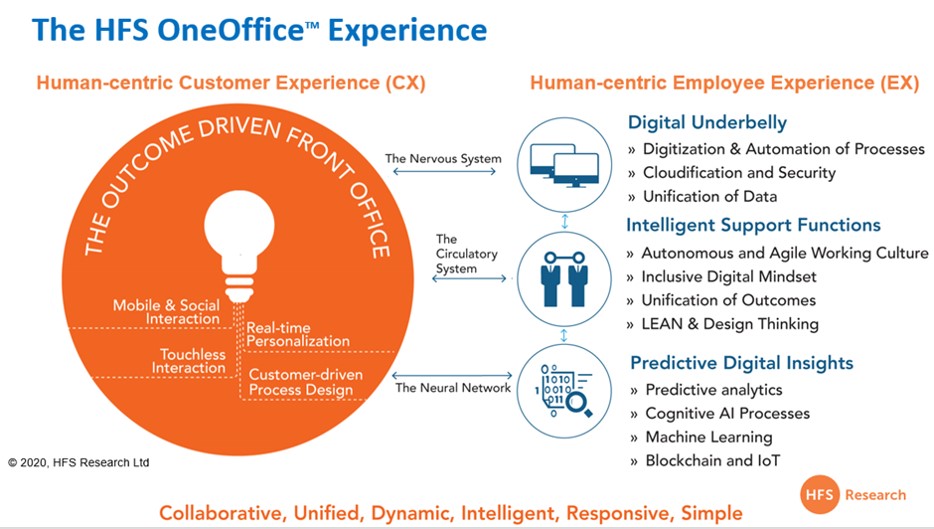
Organizations need to ensure they get the balance right; which includes optimizing the use of emerging technology with a robust business case to improve CX to the long-term benefit of the business, getting the right information flows in place, eliciting strategic advantage and ensuring exceptional CX. The HFS OneOffice Experience (Exhibit 1) typifies how customer, partner and employee experience are coming together to drive a unified mindset, goals and business outcomes. OneOffice conceptualizes how customer-centric experiences can be designed and supported by end-to-end processes across what we used to term front and back offices.
Exhibit 1: The HFS OneOffice Experience drives meaningful CX and EX
Rolling out technology and hoping “box ticked, job done” will suffice, is unlikely to end well. Only your customer can judge the success of technology initiatives, so make sure you’re measuring what matters: sentiment, preferences, engagement levels, propensity to consume, customer lifetime value, employee satisfaction.
Despite the many challenges in aligning to experiences, most organizations see themselves as ahead of their competition (see Exhibit 2). This means that there’s a sense of complacency when it comes to designing customer experiences. Disruption is to be expected everywhere and if a better customer experience is possible in your space then it’s only a matter of time before it emerges. Enterprises need to get smart about using customer data to improve experiences and their competitiveness. It is pointless to expect customers to subscribe to rigid formats; instead, let them interact how they want and take on the effort to structure the data. There is a multitude of intelligent automation solutions that can structure data for further absorption analysis and processing downstream. True real-time customer understanding demands empathetic data and streamlined data flows.
Participants from the retail sector report that supporting the business with data is still a challenge; personalization, segmentation, search and recommendations facilities have room for improvement. A 360-degree view of customers is still elusive across industry verticals. But, data lakes and data warehouses are very expensive to maintain, so don’t go a data intensive route without a solid data strategy.
Exhibit 2: Enterprises ooze digital complacency
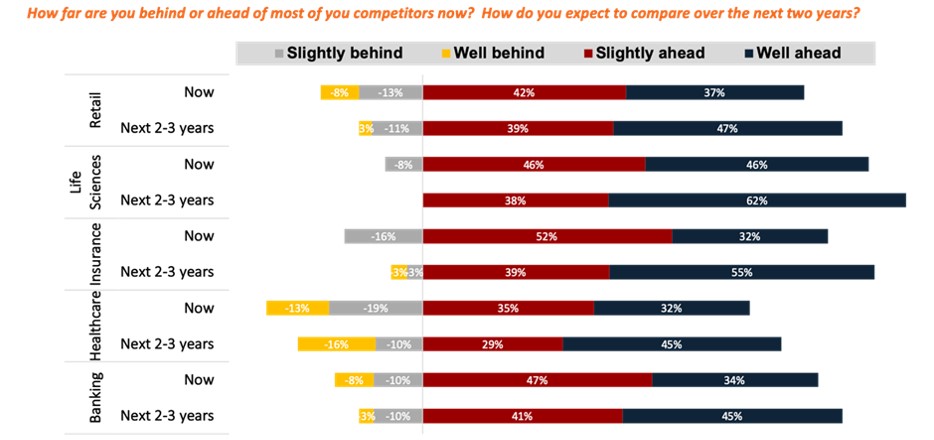
Source: HFS Research 2019 “Journey to the Digital One Office”
Sample: n=395 Enterprise Digital Leaders
Many corporate environments stifle creativity; this creates a void. An upsurge in design thinking and creative collaboration facilitation in recent years seeks to fill this gap. Historically, design was too often an early casualty of cost cutting exercises, but the tide is turning on the long-term consequences of scrimping on design. Customer centricity is the defining construct of good design and organizations are embracing enlightened principles such as enriching people’s day with interactions and identifying vulnerable people. Spotting behaviour trends and changing behaviours is often amongst the objectives too. The goal of good design is building better products, this translates to better experiences when the product is already a service and increasingly, as products are digitized into services. And design thinking is applied to more customer journeys and other user journeys now before and after the main event of purchase or consumption.
During a spotlight session with Lloyds Bank, Director of Design Jesse Lewis highlighted how Lloyds is using design to align to CX outcomes. He emphasized that collaboration and co-creation can make a big impact in customer experience design. Designing new experiences with customers is better than designing experiences for customers. Breaking down social barriers, building relationships all the time asking “how can I help?” as opposed to “what do I need the customer to do next?” Removing complexity is key, delighting the customer is the aim.
The Bottom Line: Simplified experiences and journeys merit time and effort – and you must co-create these with your customers and employees, using technology as an enabler
If you want people to do something, make it easy for them to do. A persistent layering of technology in a system centric way adds both technical debt and friction points that clog both the flow of experiences and data flows. Instead, aim for a better human-centric approach and design it with the values your company stands for and its mission in mind. Consider the value equation holistically, not just revenue models, profit and loss. There is increasing demand from millennials and Gen Zs on both the consumer and employee front for sustainability, community, inclusivity and purpose. Some business models value apparent intangibles for long term success e.g. engagement levels of non-paying users on social media and relationship building in banking. Successful organizations are looking at experiences across all of their stakeholders rather than just looking to provide a return to shareholders.
Now is a good time to reflect on possibilities, starting with what you might have done before, or might even have tried before and failed. Because new technology (automation, AI) brings better possibilities. Proceed carefully, but not cautiously, by having conversations and an open willingness to engage with all relevant stakeholders to get to a better CX.
Register now for immediate access of HFS' research, data and forward looking trends.
Get StartedIf you don't have an account, Register here |
With the exception of our Horizons reports, most of our research is available for free on our website. Sign up for a free account and start realizing the power of insights now.
Our premium subscription gives enterprise clients access to our complete library of proprietary research, direct access to our industry analysts, and other benefits.
Contact us at [email protected] for more information on premium access.