
A recent HFS study found that, contrary to high expectations, enterprises can achieve only moderate business value from many enterprise artificial intelligence and machine language (AI-ML) initiatives.
Exhibit 1: Business impact of AI-ML
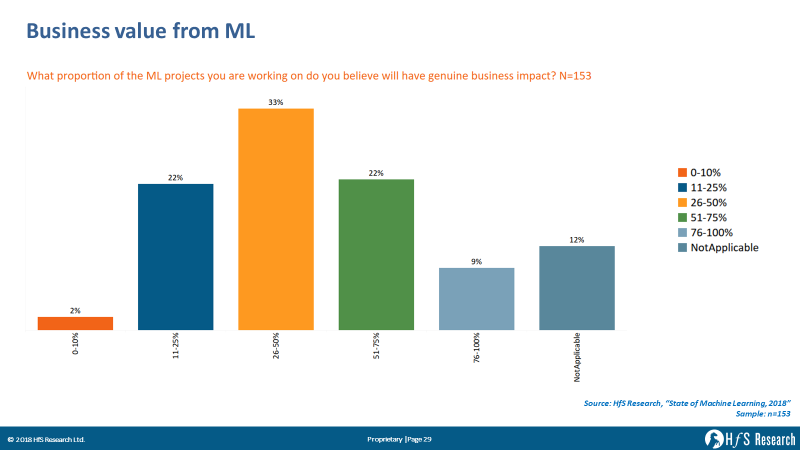
Sample: n=153
Source: HFS Research, “State of Machine Learning, 2018”
A key reason that many AI early adopters are not too happy with AI’s business value is that in several cases, the journey map had a technology-first direction, but they should have had a business-first focus. This business-first approach is imperative to AI’s success, and each program must start with a business consulting-driven engagement.
Several enterprises are getting help in their AI journeys from their strategic service providers, whether they had been investing in building AI CoEs (centers of excellence) internally or are in early stages of POCs.
Involving your strategic service providers as partners in AI journeys is imperative for three key reasons:
Providers foresaw and prepared for the AI talent crunch
The supply gap for the millions of data scientists and AI technology experts that are required to scale up AI applications in end-user enterprises is growing by the day. Enterprises cannot solve the talent shortage on their own. Many mature service providers anticipated this gap, and over the last four years, they have been running massive internal re-skilling programs for thousands of employees that are willing and able to make the switch. Enterprises are pragmatic to tap into service providers’ resource pools rather than try to do it themselves.
Providers have the required technology infrastructure
AI requires massive investments in data and computing infrastructure technology stacks, which makes the cloud an essential preference. Several service providers have mature cloud-based infrastructure management services, which is another pragmatic option for end-user enterprises to tap instead of creating siloed infrastructures in their own landscape or carrying larger technical debt.
Blended domain capabilities are a unique requirement of AI
Service providers’ ability to serve different verticals and domains provides a unique and valuable vantage point. Enterprise AI applications require this unique blend of knowledge both across verticals and deep into vertical and function processes to ensure that enterprises are implementing the correct AI techniques for each use case. Learnings across verticals and cross-pollination of AI application ideas and practical experiences are especially relevant during this nascent stage of AI implementation. Their depth and breadth of knowledge is a crucial reason why capable service providers are well-positioned to help their enterprise clients to reap the best possible benefits from AI investments.
While it is most reasonable and pragmatic of end-user enterprises to seek help with their AI initiatives from their service providers, they must also be careful to evaluate different providers’ AI capabilities and approaches correctly. Enterprise AI leaders must prioritize their choice of AI partners with these criteria:
Seek a business consulting-driven approach—not a technology
A technology-first approach may work well in siloes for specific pilots and POCs on small, well-defined use cases. However, the non-linear benefits of AI can only come from end-to-end complex problem-solving scenarios and business value-driven initiatives at scale, which require strong business consulting capabilities beyond technical assets and implementation prowess. Therefore, enterprises that are in the long haul to scale and leverage AI to improve business outcomes beyond piecemeal operational goals must prefer service providers with a strong business consulting talent pool and the capability to work hand-in-hand for multi-year programs in their AI journeys.
Evaluate the maturity and depth of providers’ best practices and frameworks
Enterprise AI leaders must critically evaluate their service providers’ ability and willingness to learn from other clients and their AI journeys, which should be codified into best practices and frameworks and then used for
Assess the consulting team’s depth of domain and functional capabilities
Enterprise AI leaders should also critically assess the service providers’ consulting teams’ capabilities for business orientation, domain knowledge and experience, focus on process outcomes, end-to-end visibility, and understanding of process chains within and across functions.
Explore experiences across verticals and domains to cross-pollinate ideas for innovative AI journeys
Enterprises that are keen on leveraging AI for strategic transformation and sustainable competitive advantage must be open to learning from others—not just within their current verticals but also from completely different verticals and domains—and leverage the learnings to drive AI innovations. To do this, enterprise AI leaders will need service partners with strong and tightly integrated consulting and AI practices where the knowledge from consulting across domains and verticals can percolate into the AI offerings and capabilities in a frictionless and seamless manner.
Infosys Limited, headquartered in Bengaluru, India, is a highly regarded global corporation and a trusted provider of business consulting, information technology, and outsourcing services to its large client base. On March 29, 2019, its market capitalization was $46.52 billion.
Infosys is well-known for its consulting capabilities and business outcome-focused approaches. It has leveraged this capability well for its AI services offerings by closely integrating its consulting and AI services teams, from the top leadership through to the operational execution layers. We can see this integrated approach in several examples from the company.
In Exhibit 2, which displays Infosys’ approach to AI projects, technology is a distant third in the journey-map. First and foremost is the strategic importance of viewing AI as a journey and not just an immediate destination reached with a few POCs and pilots here and there. The approach also emphasizes that for AI to scale successfully, a project must be a business-driven initiative and not just an IT initiative run by the CIO team. The CIO team must remain a crucial partner in the journey, however, because of the technology, infrastructure, governance, and security requirements.
For a good while, to test the waters, enterprises have been playing around with PoCs and pilots but haven’t got a good idea of the ROI of these piecemeal AI investments. To achieve significant success, AI deployment cannot be confined to siloes; instead, it should cut across the organization. The focus should be on end-to-end use cases. To achieve this, enterprises need to have a skilled talent pool consisting of data scientists and architects. Resources with these skills are very scarce, and if they are available, they are very expensive. Therefore, from people-process-technology and most importantly, business perspectives, an end-to-end value creation view is essential for getting justifiable ROI from AI investments.
Exhibit 2: Infosys’ view on clients’ multi-stage, consulting-led AI journey
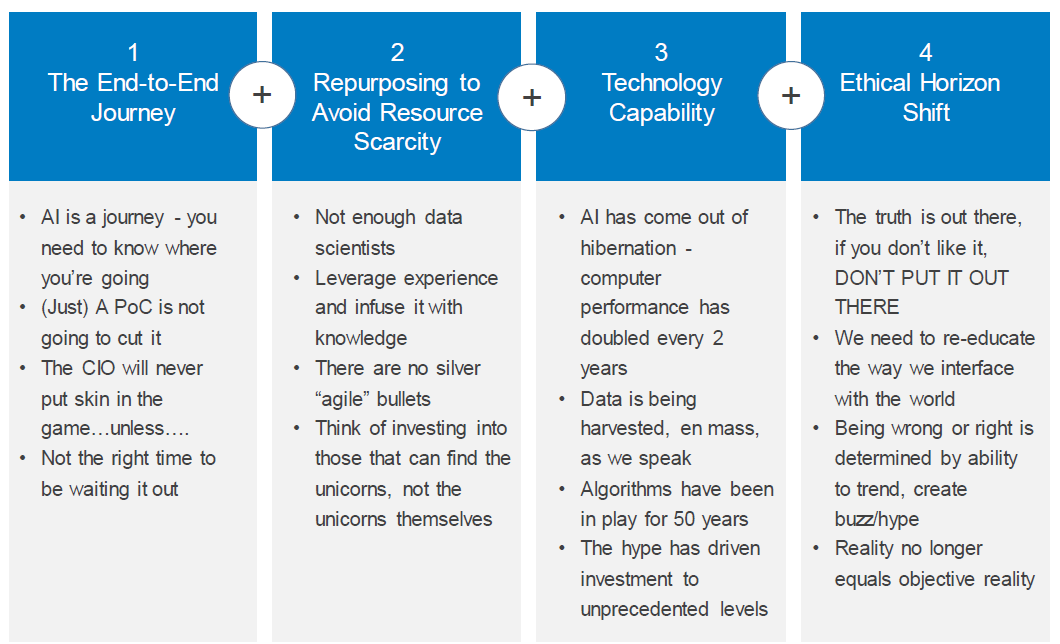
Source: Infosys, 2019
AI deployments can be overwhelming for enterprises. Infosys Consulting acts as a trusted advisor to client leaders and teams to help them navigate through this journey. While technology can solve the problems, the business must solve the right problems. The AI experts and consulting talents, driven by the design thinking approach, focus on identifying the problems that the enterprise is struggling with. As corroborated by the first step of design thinking, empathy with the customer is key to identifying the problem areas. This outside-in approach helps the client’s team and Infosys’ team look at the situation together from the perspective of the end user. That is essential to problem definition and value creation for clients.
Change management is a critical success lever
AI, as a set of technologies, is very powerful and can provide answers to multiple problems that saddle every organization. However, any technological transformation requires a similar effort on the change management front to align the cultural mindsets of the employees with the organizations’ mission. Every stakeholder should be enabled to think differently and adopt the change rather than view it as a threat. Change management is the most critical success lever, and clients cannot accomplish it with a technology-led approach.
Security and ethical governance are required
The growing awareness of data privacy and regulations and increased skepticism across the world impact AI. Making algorithms justifiable and explainable can improve their acceptability, which makes organizational change management easier for scale and adoption. Organizations are moving away from black-box AI and embracing the need to understand and appreciate the results. Data used for training ML models should cover necessary diverse user data to eliminate any specific user biases. That is why, in a consulting-driven approach towards AI, fairness has to be a core principle of all the frameworks a provider prescribes for clients’ AI projects.
A client’s experience with Infosys on the AI path
The experience articulated by Kallol Dutta, a senior leader from SPARK ANZ, captures the need for consulting-led, integrated, process-first, and domain-rich flexible approaches. As he described most aptly;
“Getting started, converting the ideas into real business cases, overcoming the employees’ fear of automation, and ultimately scaling the applications of AI
and automation across different functions and activities of the enterprise represent the key challenges in the journey path.“
Infosys handled these key challenges in a practical, innovative, and collaborative manner.
Getting started—finding and implementing the best first use cases
While there are plenty of potential AI use cases to start with, it can be overwhelming to prioritize the potential use case candidates in the first few waves of adoption; build practical, useful, tangible business cases; and ultimately convert the ideas to solid, real, executable use cases on the ground that can produce demonstrable value to users and leaders alike. The client team along with Infosys started with small, specific problems that were not among the most complex organizational problems to solve but that were sure to prove and show value, for example, AI and predictive ML applications in network capacity planning and server patching. As experienced by the client teams, defining the right starting point is a very critical success factor because this will determine the impetus and momentum for further initiatives and investments.
Organizational change—overcoming employees’ fear of automation
Change management—of people, culture, and work practices—is a very real and practical problem, and it’s also one of the toughest stumbling blocks in the way of AI adoption and scaling. Just putting bots in place doesn’t automatically make employees happy and willing to accept their invisible digital colleagues and work with them from day one without showing any resistance to change their years-old working habits. The client team and Infosys together had tried some innovative and interesting approaches that worked
Scaling–growing from five to fifty bots
As the client teams experienced, moving from five bots to fifty bots is not just incremental multiplication—it is changing the game altogether. Scaling up exponentially required significant investments in orchestration, management, security, lifecycle management, and governance of checks and balances. Scaling up significantly is another area where best practices and learnings from the partners can be extremely useful and handy.
Here are three essential practices to leverage a consulting-driven approach from your service provider partners to ensure that your AI initiatives are successful and yield high business impact:
Start business-inward, not algorithms-outward
Several AI initiatives have started as over-enthusiastic “jump on the bandwagon” initiatives—technology-outward. Leaders across end-user enterprises have been eagerly putting the heavyweight technology cart before the business horse, an approach that has not delivered much beyond just crippling and choking the horse. When the horse is choking, the airflow (i.e., money) into AI projects will also choke. Naturally, without sufficient funds, the projects will shrink rather than expand. A good AI implementation partner must enlighten its clients’ AI leaders about the looming danger of taking a technology-first approach in AI adoption. The enterprise AI leaders, too, while engaging an AI service partner, must ensure that the partner brings in its best and most relevant business and process consulting talent with a deep understanding of business problems and domain. It will start there—with business knowledge—rather than with some AI experts or tech geeks throwing around jargon about which algorithms they are going to use.
Integrated capabilities create a winning formula for clients
Infosys, for example, has its AI and automation services offerings intertwined with its consulting offerings, and revenue targets and business goals are shared. The teams’ competencies are complementary. The technology practice brings in AI technology capabilities, and the consulting team discovers and identifies the best-fit business opportunities and brings in domain expertise—the most critical block in the jigsaw puzzle of gaining business-relevant value from AI and automation programs.
Focus on the process first
Analyze the targeted business process end-to-end and across all aspects, including the pain points, priorities, and constraints, and share them. Focus on productivity, performance, and quality aspects. Jumping into applying AI and automation to a process without extensive due diligence will most likely make it even messier.
Start with consulting
Infosys’ AI and automation team starts every client program with three key sets of analysis: context and domain consulting, process consulting, and technology consulting. Process discovery, opportunity identification, and pre- and post-automation value assessment precede every technical solution activity.
Use your partners’ assets to drive and scale up the adoption of AI and automation solutions and new, transformed ways of working. “The proof of a pudding is in the eating”—the proverb couldn’t be truer, especially in case of AI during the early stages of large-scale enterprise adoption. Implementing the solutions during the training phase and then using the inferences in the production environment is only the beginning of the journey. Enterprises can taste the real success of AI and automation if—and only if—users pick it up en masse. Only then will they achieve the targeted business impact. For scaling up adoption, consulting partners must drive active and engaging storyboarding and storytelling, build internal evangelists across the organizations, and make sure the intended users understand their new roles and responsibilities and have acquired the skills needed to leverage the AI-based solutions that will augment their work quality and productivity. Changing the organizational culture at the client’s end is the toughest task, and the consultants must act as positive catalysts.
Take a life-cycle management view
The joint working model between Infosys’ AI and automation team and consulting team continues throughout the lifecycle of a client’s program—throughout implementation, deployment, and training, and ultimately driving large-scale adoption in production.
Starting with a detailed understanding and analysis of the business and process problems is the first step toward delivering and deploying successful AI solutions that yield high business impact. Expert domain and process consultants from the AI implementation partners in end-user industries need to drive this due diligence.
Register now for immediate access of HFS' research, data and forward looking trends.
Get StartedIf you don't have an account, Register here |
With the exception of our Horizons reports, most of our research is available for free on our website. Sign up for a free account and start realizing the power of insights now.
Our premium subscription gives enterprise clients access to our complete library of proprietary research, direct access to our industry analysts, and other benefits.
Contact us at [email protected] for more information on premium access.

