
This Point of View from an HFS Research and Publicis Sapient Roundtable is for CIOs, CTOs, and enterprise transformation leaders confronting the technical, data, process, and context debts that block AI at scale.
Enterprises of all shapes and sizes are racing to position themselves as AI leaders, but most look to the future while the real challenge lies in managing the past. Decades of piecemeal transformation have successfully augmented traditional labor models, but they have left organizations with significant technical debt. In fact, HFS estimates that Global 2000 enterprises are suffocating under $1.5 trillion of technical debt, shown in Exhibit 1.
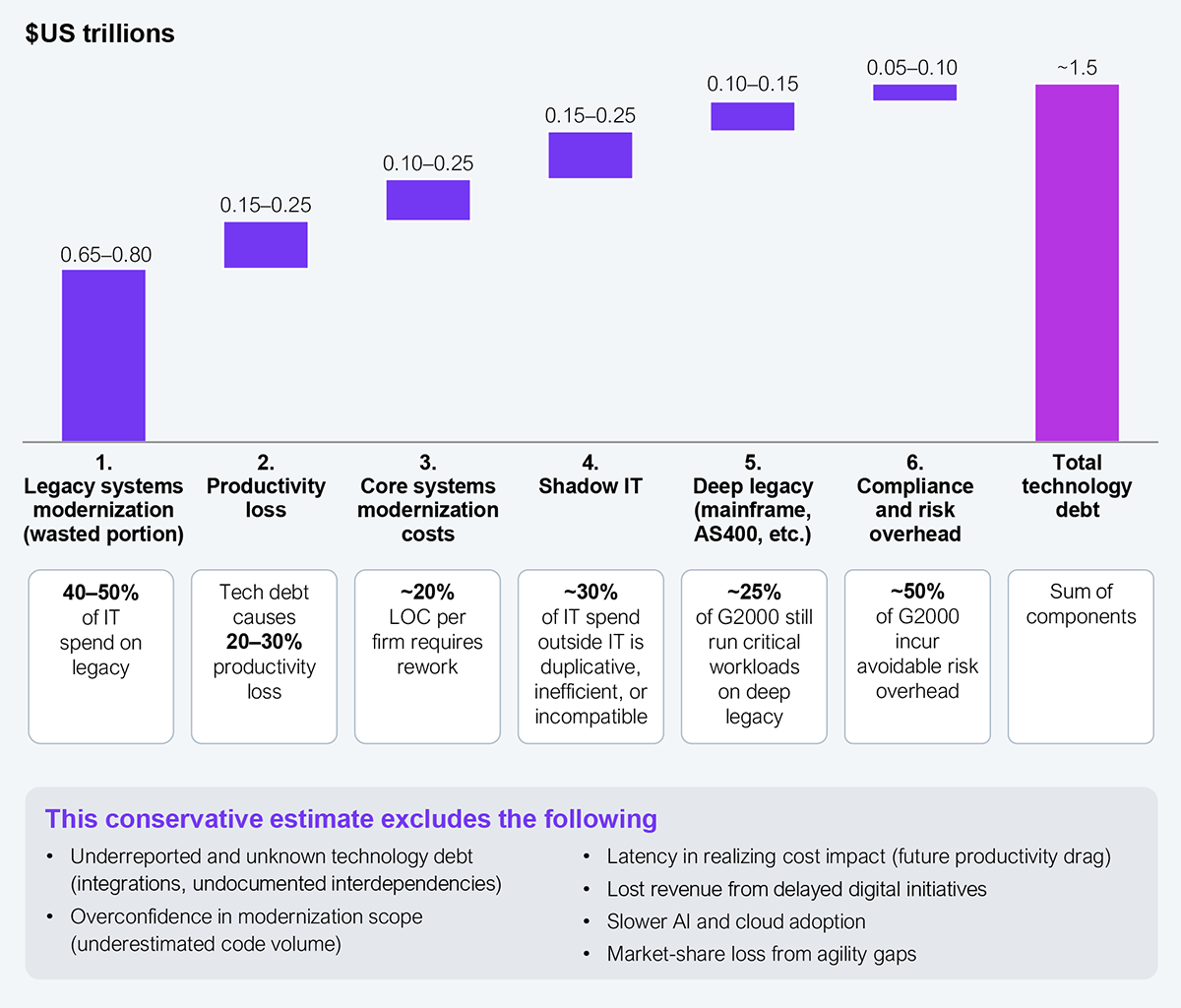
Source: HFS Research, 2026
That’s why HFS, in partnership with Publicis Sapient, brought together 20 enterprise leaders for an HFS Roundtable in London; you can see the event in Exhibit 2. While the conversation centered on confronting the reality of how enterprises can smash through technical debt, one message cut through clearly: AI is ready for the enterprise, but the enterprise is not ready for AI.

Source: HFS Research, 2026
$1.5 trillion might grab headlines, but leaders were quick to point out it’s just part of the problem. Fragmented systems, legacy platforms, and decades of bolted-on complexity have created an infrastructure that has been creaking for decades. Put simply, technical debt is the symptom, but the issues are much deeper-rooted.
Data is fragmented and inconsistent, processes vary across regions and functions, and vital business context is stuck on paper, or even worse, in employees’ heads. One delegate explained:
We think we operate on rules and policies, but we don’t. We operate on exceptions.
That describes yet another debt, context debt. These issues don’t just coexist with technical debt; they create it. Historically, enterprises could ignore their debts, but AI demands clean, connected data and workflows, something legacy infrastructures simply weren’t designed for. Without it, AI can’t deliver meaningful insights or make intelligent decisions. In fact, AI without the right infrastructure is more of a liability than a value add.
This is a bigger challenge for European enterprises, said leaders in the room. The highly regulated market means it takes longer to navigate internal governance and align compliance, legal, and security teams before even considering a transformation project. As a result, this slows their ability to address technical debt, which limits their capacity to leverage AI. One leader explained that the US innovates while the EU regulates, which adds more complexity to any transformation effort.
HFS’ take
The $1.5 trillion technical debt headline is a distraction if it’s all you focus on. Enterprise leaders need to be honest about the debts that lie beneath. Everything from data debt to process debt and context debt is hindering your AI success. Address your core, with governance at the core, before funding new projects that paper over cracks and ultimately deliver poor outcomes.
Every use case looks exciting in the proof-of-concept stage, but the reality is typically very different when it’s deployed in a real-world environment. Today, these use cases typically center on efficiency. Too many enterprises are chasing cost savings that look great on paper but, in reality, never reach the scale needed to really impact their bottom line. That’s because the enterprise debts prevent them from ever scaling.
As one attendee put it:
Developing AI on top of legacy is fool’s gold; AI investment is only worthwhile with modernized data and tech.
HFS’ own research shows that European enterprises are laser-focused on framing AI in terms of cost and efficiency, while North American firms focus on product innovation for growth.
This reinforces a clear disconnect between the use cases enterprises pursue and those that are driving value. While leaders chase cost efficiency, never moving beyond proof-of-concept, HFS’ research shows that most production-grade engagements focus on performance, personalization, and prediction.
They succeed because they reinvent a small part of the business rather than requiring enterprise-wide scale to justify investment. They deliver better customer experiences, improved decision-making, and even new revenue streams.
HFS’ take
You can’t measure AI success through just a productivity lens. Chasing efficiency gains is putting enterprises on the wrong path, and it’s not a technology problem; it’s a strategy problem. In particular, the risk for European enterprises is that they remain trapped in a cycle of optimization and efficiency, while their US counterparts improve broken systems and ultimately reinvent themselves.
The most well-planned technology rollout will fail if the employees using it aren’t equipped or willing to do so. In most organizations, they aren’t. The harsh reality is that enterprises are investing heavily in the technology itself, but doing little to support the people expected to deliver the transformation. One enterprise leader explained, their experience:
99% of agendas I see talk about AI and data, but nobody is talking about the people.
When you add boards pitching AI as a cost-saving tool to replace employees, and headlines dominated by AI-driven layoffs, you can see why employees are hesitant to champion its adoption. And without employee buy-in, your reinvention will never happen.
The answer isn’t training employees to use new tools. It’s rethinking the fundamentals of how work gets done and placing the employee at the core of everything you do. That means helping employees understand how their roles work with AI, creating space for them to experiment with new technologies, and having the honesty at the leadership level to admit it’s about the people more than the technology. One leader even told us:
Unless we are very people-first about this, the change will not land.
HFS’ take
Your people aren’t resisting AI itself; they are resisting how enterprises are framing it. Once you stop leading with cost savings and job losses, and start leading with capability and possibilities, your employees will see AI as an opportunity rather than a threat. That’s when you can truly drive reinvention.
Even enterprises that understand their enterprise debts often find themselves trapped in the same cycle. The reality is they can’t fix it themselves. While global systems integrators (GSIs) have contributed to the problem, historically layering solutions on enterprises’ broken foundations to drive revenue, they are evolving their approach.
Publicis Sapient, for example, has developed Sapient Slingshot, its AI platform that automates and accelerates the software development lifecycle. As one delegate explained, it automates what code programmers have done manually for decades. It signals a shift in how they operate, pivoting away from people-first labor to software-driven transformation, and that’s the shift that enterprises must look for when selecting their partner.
The winners in the AI era won’t be those who adopt the technology first, with limited value creation. It will be those who choose not to cake AI onto creaking systems, don’t chase efficiency gains, and refuse to implement technology without bringing their people on the journey.
Service providers like Publicis Sapient are arming themselves with products like Sapient Slingshot to help enterprises tackle their debts, but enterprises must be willing to use them. Getting this transformation right, with the right partner, matters much more than getting there first.
Register now for immediate access of HFS' research, data and forward looking trends.
Get StartedIf you don't have an account, Register here |
With the exception of our Horizons reports, most of our research is available for free on our website. Sign up for a free account and start realizing the power of insights now.
Our premium subscription gives enterprise clients access to our complete library of proprietary research, direct access to our industry analysts, and other benefits.
Contact us at [email protected] for more information on premium access.


