This HFS Point of View, developed in partnership with EY, is for CIOs, chief AI officers, and transformation leaders working to scale agentic AI beyond isolated pilots.
Enterprises accelerating investment in AI with advanced, agentic models that promise to transform the detailed functional model largely remain unable to scale beyond pilots. Despite rapid experimentation, enterprises struggle to move from isolated use cases to repeatable, industrialized delivery where intelligence is embedded into the flow of work and supported at enterprise scale.
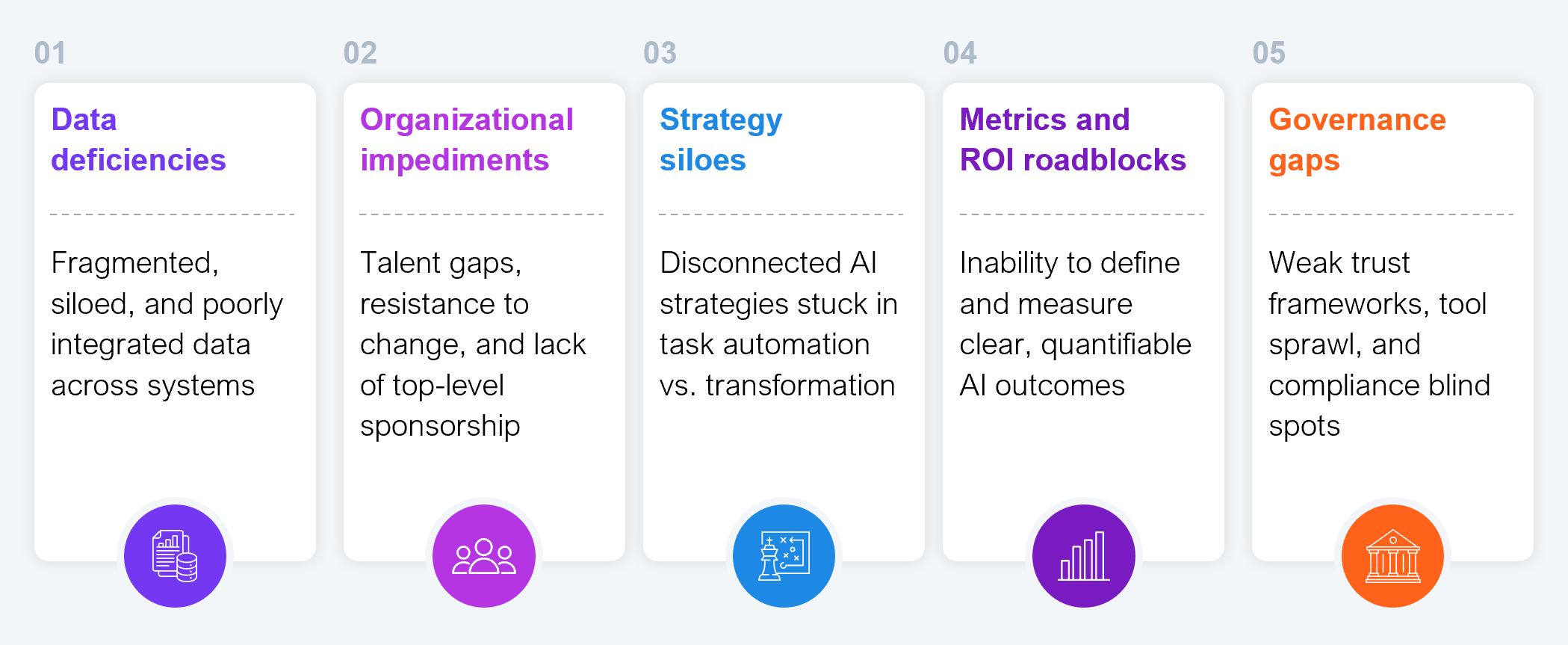
Our research found that to operationalize agentic AI at enterprise scale, organizations must address five interdependent friction areas together: data deficiencies, organizational impediments, strategy silos, metrics and ROI roadblocks, and governance gaps. Addressing these friction areas in isolation is insufficient. Only by tackling them collectively can enterprises move beyond pilots and unlock sustainable value from agentic AI at enterprise scale.
This analysis delineates the reasons for structural enterprise friction when adopting AI at scale, including process inefficiencies, fragmented data, limited automation, unclear governance, and misaligned operating models. Organizations making progress are rearchitecting enterprise foundations to “recode the core.”
Managed services are shifting from execution support to orchestration partners, facilitating the transition from pilots to enterprise scale and unlocking business value across core functions. EY’s framework to effectively recode the core includes modernizing AI ready data and infrastructure, embedding AI directly into workflows rather than layering disconnected tools, and evolving operating models to support execution, scaling, and embedding of intelligence.

Vivek Nijhon
EY Global Vice Chair – Managed Services
Enterprises advancing quickly on agentic AI are not defined by model strength. They’re the ones with transformation leaders that modernized their data over the last decade, sponsored AI from the top, and put governance in place before they tried to scale.
Everyone else is stuck on the same five friction areas:


Transformation leaders cannot ease AI friction in isolation. Fixing data without executive sponsorship or automating without governance produces more pilots that never industrialize. Enterprises have to work all five at once and rearchitect the foundation of work rather than bolt agentic onto an operating model that wasn’t designed for an AI-first world. Managed services, evolving from execution support to orchestration partners, are emerging as the connective tissue that makes this rearchitecting possible at scale.
The analysis for this Point of View is based on deep-dive qualitative research with over 20 enterprise decision makers and technology leaders responsible for implementing AI and agentic technologies in the financial services, life sciences, and logistics industries. We also draw on HFS’s 2025 quantitative research, which included over 300 survey participants, on topics related to leading-edge technology and operating-model implementation decisions.
While AI adoption is accelerating, most enterprises are still in the early stages of operational maturity. The challenge is no longer whether AI models work, but whether organizations can embed them consistently and at scale into core processes and decision-making environments.
Enterprises are moving from experimenting with AI to confronting the realities of scaling and operationalizing intelligence models across complex systems. In this context, agentic AI represents the next evolution, shifting from task-level augmentation to more autonomous, end-to-end process orchestration. Still, it also amplifies long-existing enterprise challenges.
Organizations successfully moving forward are rearchitecting enterprise foundations to support the advanced models they are adopting. This includes strengthening data architecture, embedding AI into workflows rather than layering tools, and evolving managed services from execution engines into orchestration partners that can support increasingly agentic operating models.
The next phase of enterprise transformation will not be defined by AI adoption alone, but by how efficiently organizations operationalize and scale intelligence across the enterprise.
Let’s explore the five friction areas for scaling agentic AI: data deficiencies, organizational impediments, strategy silos, metrics and ROI roadblocks, and governance gaps. Enterprises must address all of them before they can brand themselves as new-age agentic organizations.
Source: HFS Research, 2026
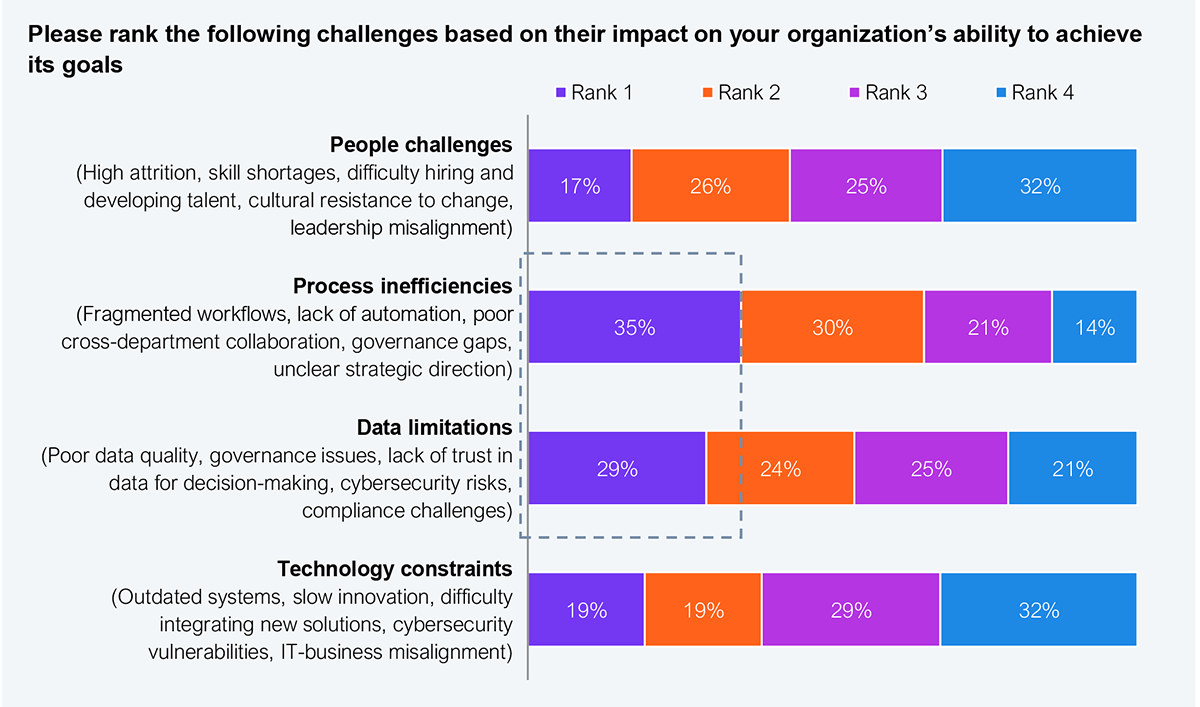
Data fragmentation and legacy systems remain a primary barrier to scaling AI. Enterprise data is often inconsistent, siloed, and poorly integrated across systems, making it difficult to deploy AI reliably across workflows, as reflected in
Exhibit 2. In a recent HFS survey, thirty-five percent (35%) of leaders ranked process inefficiencies in the form of fragmented workflows, limited automation, and unclear governance as the biggest challenge to achieving enterprise goals, while 29% ranked poor data quality and the inability to trust it for decision making as the top drag on goal attainment. This was also cited as a primary friction area across all stakeholder interviews, with equal importance among industries.
Sample: 305 survey participants, 2025
Source: HFS Research, 2026
Take a data-first mindset
Data modernization sets the stage for all agentic activities. Our interviews revealed that agentic-mature companies have been updating their data infrastructure over the last decade, starting with major ERP deployments. For enterprises behind the curve, a crash data modernization program is essential for catching up.
Organizational readiness remains a major constraint on AI adoption, as employees often resist AI due to fear of job disruption, changes to established workflows, and uncertainty about evolving roles, leading to performative adoption rather than meaningful behavioral change. At the same time, many organizations lack the skills required to design, deploy, govern, and maintain AI systems at scale, increasing reliance on external partners and slowing the development of internal capabilities.
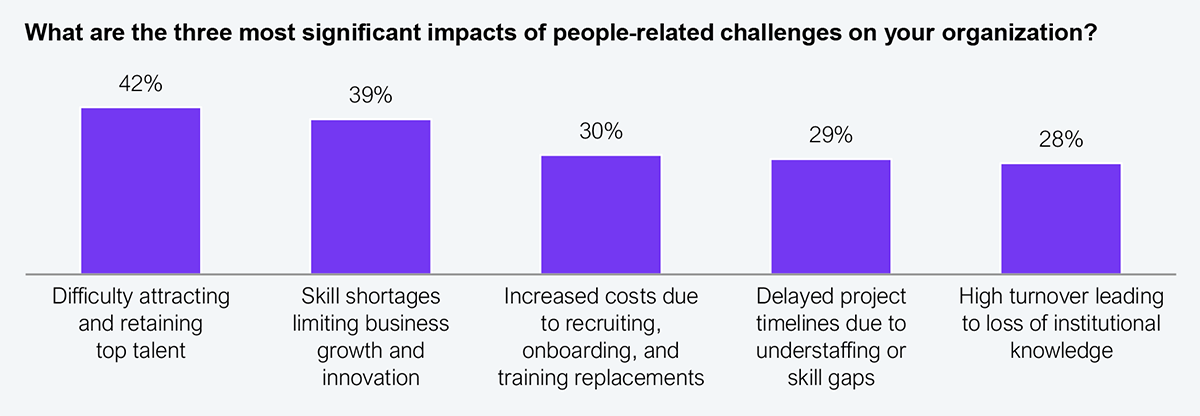
Exhibit 3 highlights the scale of the talent challenge. Difficulty attracting and retaining top talent (42%) and skill shortages limiting business growth and innovation (39%) are the most significant barriers, followed by rising costs of hiring and training (30%) and delays in execution due to understaffing (29%). High turnover further compounds the issue, eroding institutional knowledge (28%). These findings reinforce that talent constraints are systemic barriers to enterprise AI readiness.
Sample: 130 survey participants, 2025
Source: HFS Research, 2026
The qualitative evidence further suggests that effective AI scaling requires clear direction and sponsorship from the very top of the organization, as AI is fundamentally an enterprise transformation agenda rather than a stand-alone technology initiative.
Change the organizational priorities before you change the process
In our research, we uncovered that the organizations with successfully scaled AI projects shared five organizational characteristics: top-level sponsorship, clear governance, centralized capability building, workforce reskilling, and well-defined ownership structures. Building this organizational foundation must be a priority for enterprise leaders who deploy agentic for meaningful change.
We have observed that successful enterprises adopt a phased approach to AI transformation, beginning with automation of existing human-built processes before moving toward broader reimagination of value chains through agentic AI.
Successful early AI adoption is typically concentrated in workflow automation, report generation, and other data-rich, rule-based processes that offer measurable impact and manageable risk, allowing firms to build confidence, develop internal capabilities, and demonstrate returns before undertaking more complex transformation. As organizations mature, AI typically moves beyond task and functional automation into core operations and decision-making, enabling broader operating model changes and greater business impact.
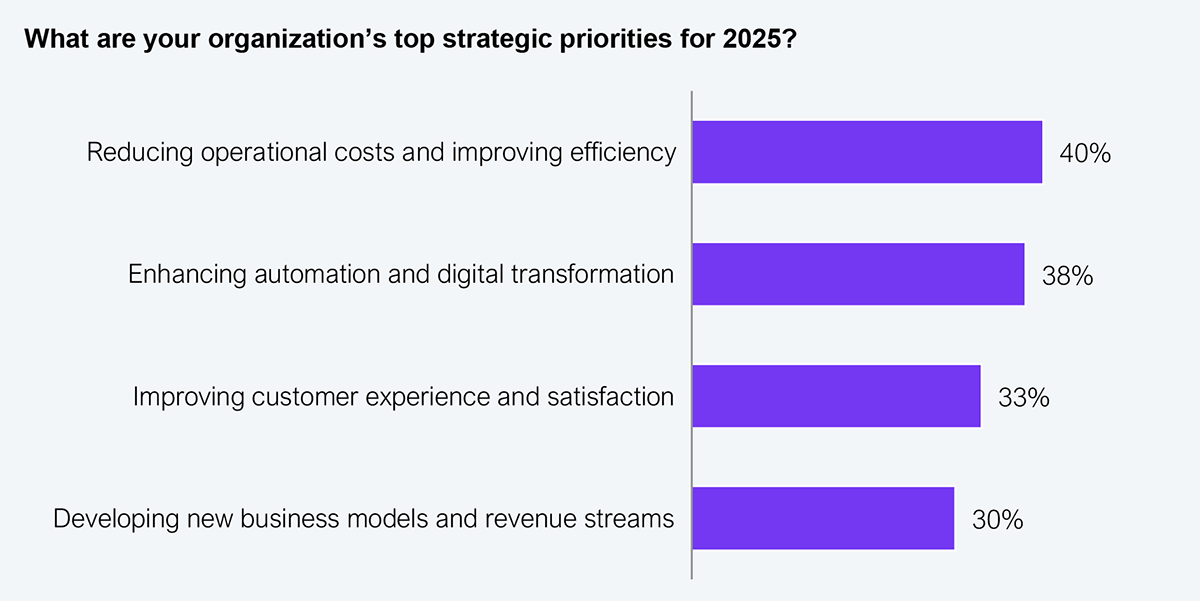
Exhibit 4 reinforces this sequencing, showing that 40% of firms identify cost reduction and efficiency as their top strategic priority for 2025, 38% cite automation and digital transformation, and only then do 30% prioritize new business models and revenue streams, indicating that enterprises are still grounding their AI agendas in pragmatic efficiency gains before pursuing full-scale reinvention. These data points underscore the difficulty in breaking the strategy silo syndrome.
Sample: 305 survey participants, 2025
Source: HFS Research, 2026
A useful example from the interview findings is logistics, where one service center leader described AI not simply as a tool for isolated automation, but as an enabler of a broader shift from shipping execution to supply chain management through better use of data and platforms; however, even in that case, the transformation logic begins with better orchestration, optimization, and operational efficiency before expanding into a more reimagined business model.
Be logical and disciplined in strategy decisions
Overall, the research suggests an effective way to reduce friction around strategy and prioritization sequencing is to adopt a two-stage strategy: automate high-volume processes first to create near-term value and organizational readiness, then reimagine core value chains once data, governance, and operating maturity are sufficiently advanced to support transformation at scale. The key to a successful agentic enterprise strategy is moving beyond task automation and purely cost-saving initiatives as quickly as possible.
Our discussions with technology and business executives revealed that measuring the success of AI initiatives remains a significant challenge for enterprises, particularly as organizations move from experimentation toward scaled deployment. While traditional return on investment (ROI) metrics continue to be used, many firms struggle to define clear, quantifiable outcomes for AI, especially in early stages where benefits are diffuse and long-term. At the same time, expectations for AI are high, with organizations we spoke to targeting tangible gains such as 10%–30% productivity improvements, 50%–60% faster content turnaround, and accelerated regulatory approvals and time-to-market.
Develop a robust measurement system for agentic AI, beyond pure financial ROI
Enterprises are increasingly expanding their measurement frameworks beyond traditional cost-based ROI toward broader operational and business outcome metrics. These include improvements in decision velocity, risk mitigation, operational accuracy, and speed to market—indicators that better capture the transformational potential of AI but are also more complex to measure and attribute. Qualitative findings further suggest that only a small proportion of enterprises have successfully embedded AI into their operating models, underscoring the difficulty of measuring the impact of pilot success on sustained value.
Governance and trust have emerged as central constraints on enterprise AI adoption, particularly as organizations move from experimentation to embedding AI within core business processes. Concerns about transparency, bias, data security, and model reliability continue to limit confidence in AI systems, underscoring that trust is a foundational requirement for scaling AI.
To address this, organizations are increasingly embedding human oversight, improving model explainability, and implementing robust compliance frameworks, especially in regulated environments where auditability and accountability are critical.
Simultaneously, enterprises are grappling with operational challenges such as tool sprawl, fragmented workflows, and poor user experience, often stemming from the deployment of multiple disconnected AI applications. This leads to increased context switching and reduced productivity, undermining the intended benefits of AI. As a result, leading organizations are shifting toward embedding AI directly into existing workflows rather than layering new tools on top, supported by governance frameworks that include lifecycle management, model validation, auditability, and compliance tracking.
These governance and operational requirements become more pronounced as enterprises move toward scaling AI and adopting agentic models. Scaling AI is no longer simply an implementation challenge; it requires orchestration across platforms, processes, and stakeholders to ensure consistent performance, cost control, and compliance.
In this context, managed services providers play an increasingly critical role as orchestrators of AI ecosystems, integrating platforms, managing data pipelines, and ensuring governance at scale. The rise of agentic delivery models further accelerates this shift. Agentic services are expected to move toward subscription-based models to mitigate upfront capital costs, while large-scale deployment will require sustained human-agent collaboration rather than full automation. As agentic systems are applied to more complex, end-to-end processes, they are also likely to drive increased computational demand, putting upward pressure on token and infrastructure costs. These dynamics reinforce the need for managed services to provide structured, scalable access to agentic capabilities across functions such as compliance, risk, and finance and accounting, thereby mitigating implementation risk and aligning costs more closely with business outcomes.
Orchestrate levers across all delivery points in the enterprise
Looking ahead, the enterprise operating model may evolve toward a predominantly agentic structure, supported by multiple delivery approaches, with managed services emerging as both a transitional enabler and a long-term solution.
Ultimately, the challenge for enterprises is to govern and orchestrate intelligent systems in a way that seamlessly embeds intelligence into the flow of work while maintaining trust, control, and economic viability at scale.
Managed services act as orchestration partners, and the requirement for effective, system-wide collaboration is why they are becoming more important in the AI and agentic era. Their role is evolving from traditional execution support toward orchestration, integration, governance, and outcome assurance, helping clients move toward AI-first delivery and, over time, elements of Services-as-Software™ where appropriate.
In many enterprises, managed services will serve as both a stepping-stone and a long-term enabler of agentic transformation, helping organizations mitigate implementation risk, make investments more predictable, and scale intelligent capabilities across compliance, risk, finance, operations, and other core functions. Subscription-oriented and outcome-linked delivery models may further accelerate this shift by aligning the cost of AI and agentic deployment more closely to business performance rather than one-time capital commitments.
The challenge facing enterprises isn’t simply how to adopt AI, but how to operate in a way that is repeatable, trusted, integrated, and economically sustainable across the enterprise.
As enterprises move from task-level augmentation to increasingly autonomous and orchestrated process execution, the demands on operating models, governance, and delivery structures will intensify. Agentic systems will require stronger data foundations, clearer accountability, more robust human oversight, tighter integration into workflows, and a more disciplined approach to trust, compliance, and cost management. At scale, the future will be defined by how effectively enterprises redesign work itself around human-agent collaboration across business processes and functions.
The views reflected in this article are the views of the author and do not necessarily reflect the views of the global EY organization or its member firms.
Register now for immediate access of HFS' research, data and forward looking trends.
Get StartedIf you don't have an account, Register here |
With the exception of our Horizons reports, most of our research is available for free on our website. Sign up for a free account and start realizing the power of insights now.
Our premium subscription gives enterprise clients access to our complete library of proprietary research, direct access to our industry analysts, and other benefits.
Contact us at [email protected] for more information on premium access.