
We often talk about how the blockchain market is maturing and we can finally witness the technology in action, as numerous use-cases have finally reached the production phase. Yet when we speak to enterprises considering blockchain, they frequently cite a lack of use cases in the public eye as a roadblock for adoption. They are eager to see examples of blockchain in the production environment, and witness for themselves the business value it can provide, but thus far these case studies are not readily available. When connecting with Tech Mahindra’s blockchain leadership team as a part of the research for our upcoming Enterprise Blockchain Top 10, they told us how the Telecom Regulatory Authority of India (TRAI) had created a regulation mandating a blockchain solution aimed at combatting spam calls in India’s telecoms industry, and how they developed a solution, and we quickly recognized it as a potentially great example of blockchain deployed at scale.
The Covid-19 pandemic impacted the global economy like never before, and it means businesses must focus on ‘have-to-have’ investments.
By now, we all know how much damage the pandemic has done to the global economy; countless businesses ceased to exist while others had to drastically pivot their business model to survive. But there’s one common theme; capital conservation. Businesses both big and small have actively worked to build capital reserves, which means re-evaluating every investment and focusing on initiatives that will provide the fastest ROI. If we look at Exhibit 1, we can see despite a growing number of blockchain engagements reaching the production environment, a shocking number are still stuck in the earlier stages, which means they aren’t yet providing any real business value. Thanks to the pandemic, this proof-of-concept game must come to an end, and businesses must instead focus on the small number of engagements that can deliver genuine business value and drive them into the production environment.
Exhibit 1: While the number of engagements reaching production build is increasing, it is still a small amount
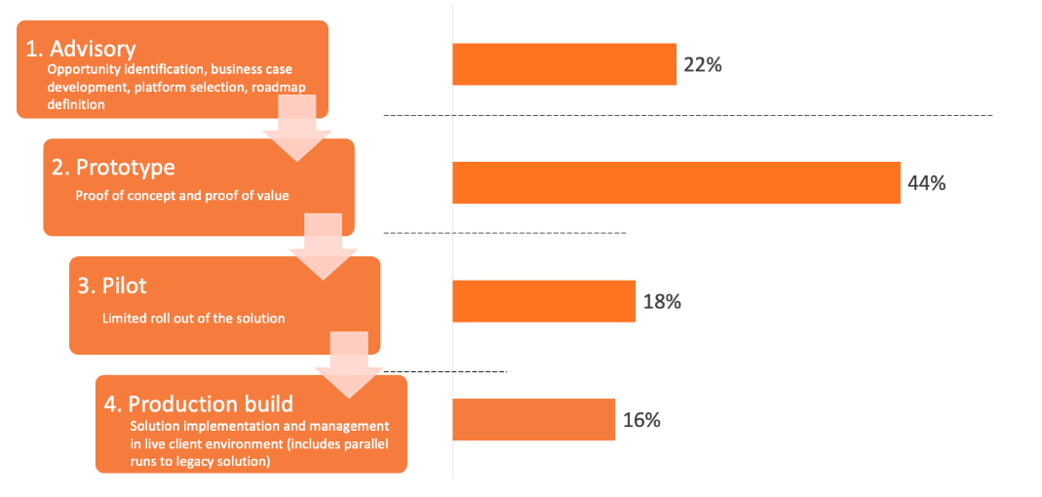
Source: HFS Research, 2021
Sample: 4,200 blockchain engagements across 12 service providers (Accenture, Cognizant, DXC, EY, IBM, Infosys, KPMG, LTI, Mphasis, NTT DATA, TCS, and Wipro)
TRAI looked towards blockchain to solve a genuine problem in India’s telecom sector; spam phone calls, and Tech Mahindra answered their call.
A constant challenge that faces the citizens of India is the number of unsolicited calls and messages they receive from marketers – with many reports advising they are a daily occurrence. Historically, citizens could opt-out of these marketing calls and spam texts, but marketers frequently ignored this and continued contacting them anyway, with little consequence. To tackle this, the TRAI released a set of regulations which outlined a blockchain solution that it hoped would shield individuals from unwanted contact by introducing consent-based permissions. The idea was that service providers could then develop their own blockchain solutions within these regulations and offer them to telecom providers. The first question we asked was quite simple, why blockchain? The answer is the inefficient existing process, it puts the pressure on marketers to oblige by the regulations, but a blockchain solution shifted the responsibility to telecoms providers to block these calls, and created accountability making it easier for regulators to enforce penalties. As well as this, the pre-existing system allowed marketers access to citizen’s personal data, including a list of who had opted-in-and-out of their calls, while the blockchain solution protects this information. Lastly, the telecom operators did not have access to information pertaining to subscribers who had opted for Do-Not-Disturb (DND) from another operator leading to loopholes that telemarketers exploited to their advantage.
Tech Mahindra quickly identified this opportunity and developed a blockchain based solution that collects, saves and shares each user’s consent preferences across the blockchain network, allowing telecom providers to block spam calls and messages according to the citizen’s preferences. Critically, thanks to tokenization, the solution hides this information from the telemarketers, meaning they have no way of knowing which individuals opted-in to contact from them. Furthermore, Tech Mahindra’s solution allows customers to file complaints, which are stored in the blockchain, forcing telecom providers to address them promptly, and thanks to the auditable trail makes it simpler for regulators to follow when required. Tech Mahindra’s blockchain leadership advised that this solution is already being leveraged by leading telecoms providers in India, predicting that it could quickly expand to and impact a significant portion of the 800 million active phone subscribers in India.
Bottom Line: TRAI saw a genuine challenge that blockchain could solve, and they provided value to all key stakeholders, making it a potentially great example of blockchain in action.
As businesses continue to battle the economic crisis brought on by the Covid-19 pandemic, it will become more important than ever for investments to yield quick returns. This could be a fatal blow to the proof-of-concept game that’s plagued blockchain for some years now. This means service providers will have a harder job of convincing clients to invest in blockchain projects, and they must work to identify which use cases to take forward – pushing blockchain success stories and case studies into the public domain is a great way of doing this. TRAI’s willingness to deploy blockchain, and Tech Mahindra’s ability to develop an effective solution, is just one example of blockchain attempting to solve a genuine challenge and prove its value in the sector.
But that doesn’t mean it’s going to be without its challenges. In March, TRAI temporarily suspended the rollout of the solution thanks to a problem with one-time passwords (OTPs). OTPs are often used to enhance security when making financial transactions, or logging into secure online accounts, and the blockchain-fueled solution was blocking citizens from receiving these messages, essentially denying them access to their finances and accounts. Both TRAI and the telecoms operators claim this is just a short-term roadblock, with many placing the blame on enterprises for not properly navigating the new system, but it highlights the importance of change management when implementing a complete overhaul like this – and it’s something service providers and enterprises alike must not overlook.
Register now for immediate access of HFS' research, data and forward looking trends.
Get StartedIf you don't have an account, Register here |
With the exception of our Horizons reports, most of our research is available for free on our website. Sign up for a free account and start realizing the power of insights now.
Our premium subscription gives enterprise clients access to our complete library of proprietary research, direct access to our industry analysts, and other benefits.
Contact us at [email protected] for more information on premium access.

