Over the past decade, Capgemini has fought to establish its true place in the global services and consulting industry – but still struggles to compete as effectively as it should alongside the likes of Accenture and Deloitte. If it is not careful, it could find itself stranded in the desert between the classical “Big 4” and the rampant Indian-heritage leaders Cognizant, Infosys, TCS et al. This is not a position where Capgemini wants to be as we approach the New Dawn, when this pandemic fades and recovery emerges.
With 2021 on the horizon, enterprises are thinking hard about what their long-term pivots are – what did the pandemic reveal as irreparably broken, what needs immediate investment, what will we never go back to, and how can we thrive? IT and business process service providers are on the front lines of these discussions as they are going through it themselves and their go-to-market strategies are always a reflection of what their clients need most.
This was the HFS state of mind going into Capgemini’s global analyst and advisor virtual summit in October 2020. We were looking for a substantive pivot update and answers to key questions such as how is the integration of the Altran acquisition progressing, where is Aiman Ezzat steering the firm as its new CEO, how is the firm reacting to clients’ shifting priorities, and what progress is Capgemini making on its stated objective of driving “multi-tower” deals that bring the full complement of its capabilities to work for its clients. What we got was directionally positive, a continuation of its portfolio-led approach, but perhaps not quite ready for prime time.
Ezzat picks up where Hermelin left off
Ezzat, a long-time Capgemini veteran and its former COO and CFO, took the reins from Paul Hermelin in May 2020. During the event, he laid out four key levers Capgemini will use to help drive value creation for its clients:
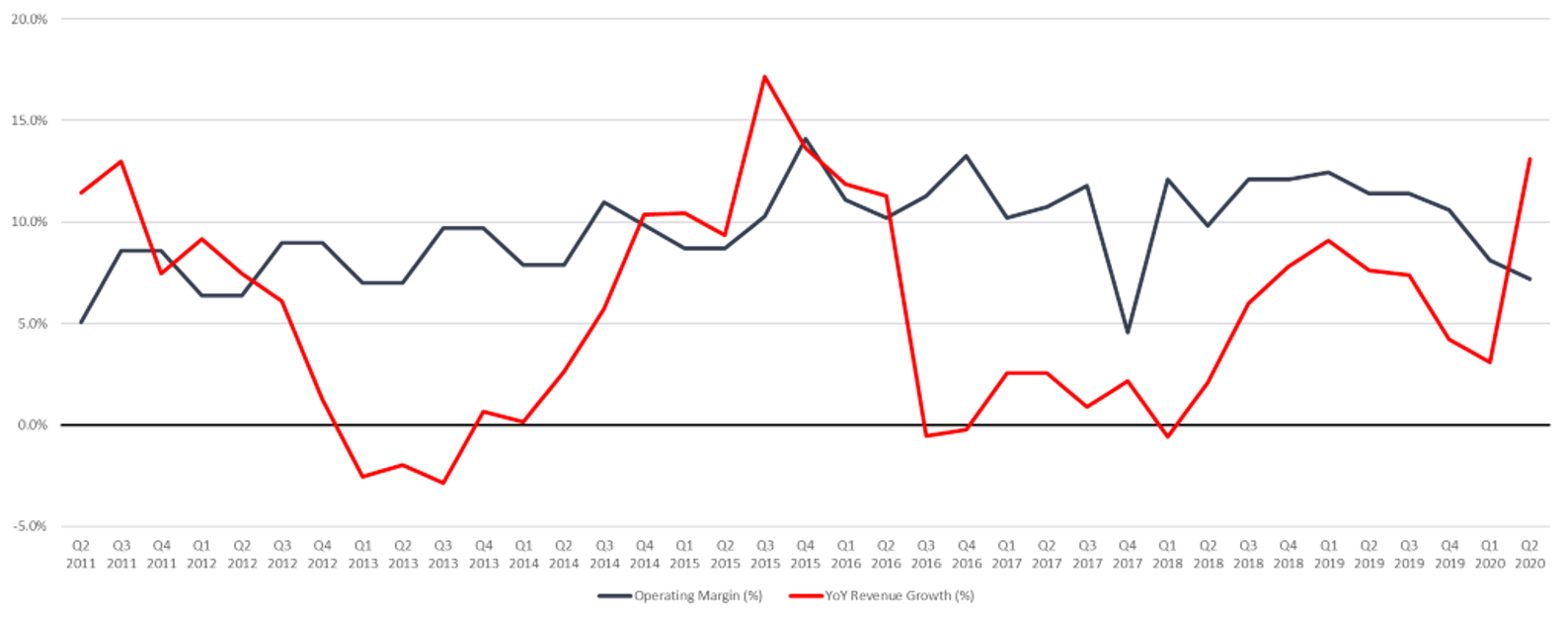
While much of this was a rehash from its September 1H 2020 results announcement, the new news was really some refinement of the strategic fit for Altran as well as showcasing the go-to-market approach that will logically allow them to bring its broad capabilities together for clients. HFS views this as a refinement of its portfolio approach launched in 2018 aligned to seven key priorities: CX, cloud, cybersecurity, AI & data, digital manufacturing, digital core, and ADMnext. The mission of its portfolio management approach was to inject these seven priorities across the firm rather than allowing them to exist in comfortable and often competing siloes. The approach, often referred to as “new” ostensibly digital services in its financial reporting, has helped the firm drive mixed bag growth since Q1 2018. Q2 2020 showed strong growth amidst pandemic struggles but was buoyed by the roll-in of the Altran acquisition (Exhibit 1). 1H 2020 organic growth was stated to be a 3.2% YoY decline.
Exhibit 1. Capgemini revenue and margin history – through Q2 2020
Source: HFS Research, 2020
Data and cloud pillars have been elevated as the elements that Capgemini wants to bring to every engagement – these enable clients to transform and are core building blocks that work across every industry. They are moving from data as an enabler to helping clients activate and better monetize data. Similarly, for its cloud approach, they’re focused on moving from cloud migration to cloud native applications and enablement of new business models. HFS observes that cloud is evolving into everyone’s favorite new panacea for digital salvation.
This is complemented by distinct go–to–market approaches intentionally appealing to different CxOs across marketing, operations, engineering, and IT. It is continuing its focus on Intelligent Enterprise as its engineering pillar and home of Altran increasingly focused on the convergence of IT and engineering.
The firm mentioned it is imminently launching several new offerings combining the best of Capgemini and Altran related to 5G, autonomous driving, and the life sciences industry in the coming days (announcement details here). Shame they could not have managed that before or in tandem with the event. As HFS has written about recently, Capgemini is also increasingly prioritizing the APAC region.
What do clients think?
Capgemini had a good showing of six major clients aligned largely to retail and CPG and BFSI sectors and was one of the highlights of the virtual event. Capgemini even managed to incorporate “the scribe”, a recent digital tradition whereby one of its design experts draws narrations of the client testimonials. The clients were a mixed bag of old and new showcasing the intersection of enterprise management and/or customer experience with data and cloud. Some notable examples:
In all cases, the clients were effective examples of digital transformation in play and positioned Capgemini as an solid transformation partner. They also showed how the criticality of the respective initiatives has increased because of the pandemic. What was not showcased was its intelligent industry capabilities and it missed the opportunity to spotlight how Capgemini’s broad range of capabilities is essential to the execution of these transformation initiatives. Essentially, despite a very solid portfolio, Capgemini still showcases pockets of excellence rather than the full power of the firm.
The Bottom Line. Everyone wants a piece of the transformation pie. Capgemini needs to showcase better the power of the complete firm to truly be considered as a transformation partner beyond apps and infrastructure migration.
Like IBM and Accenture, the Big 4, and increasingly Infosys and TCS, Capgemini wants in on the big deal transformation initiatives. The pandemic is serving as a magnifying glass helping enterprises realize and prioritize what needs to be done for future success. Ezzat mentioned that the growth of its top accounts is higher than the overall group average and more profitable, fueled by multi-tower deals. They are getting better at bringing a broader swath of what Capgemini has to offer to its clients. This is clearly the path forward and showcases some of the strides that its portfolio-based approach is bringing to the firm. However, the event showcased more theory than practice and the perpetuation of Capgemini as a partner in siloed domains. We want to see the full power of the firm showcased, and how it is addressing evolving challenges both internally and with clients and prospects.
Register now for immediate access of HFS' research, data and forward looking trends.
Get StartedIf you don't have an account, Register here |
With the exception of our Horizons reports, most of our research is available for free on our website. Sign up for a free account and start realizing the power of insights now.
Our premium subscription gives enterprise clients access to our complete library of proprietary research, direct access to our industry analysts, and other benefits.
Contact us at [email protected] for more information on premium access.