
Focus your quantum conversations on:
1. Road–mapping and future potential
2. The ecosystem
3. Complementing existing technology—not replacing it
4. Business outcomes, as always…
Quantum computing will complement classical computing—not replace it. And like with all emerging technologies, it’s using them in combination that generates the most value: quantum computing will sit alongside any and all classical computers, to deal with complex algorithms sent via cloud and then back again, ultimately producing new insight.
Focusing on outcomes is as important for quantum conversations as it is for any other technology.
The point where quantum computers start to outperform our most powerful supercomputers—or “quantum advantage”—is 3 to 5 years away on IBM’s latest quantum roadmap. So, the conversation has to change if you’re hoping to reach these outcomes. Start with: what are the barriers to solving the most complex problems in my business and/or industry? Is it computing power, memory, cost, accuracy? Can quantum computing potentially remove these barriers? If the answer is yes—start planning your roadmap over the next 5 years and beyond.
We spoke with Bob Sutor, VP, IBM Quantum Ecosystem Development—and after lamenting not doing physics degrees, we started looking at it in the same light as any other emerging technology—it’s there to help you do your job better—and deliver better outcomes.
For more information and resources, see HFS’ own Quantum Computing Primer, or this particularly useful video from IBM.
IBM’s roadmap hits “quantum advantage” in 2023: when quantum computers will outperform our best currently available supercomputers. But even then, it’s not about replacing. It’s about complementing.
When it comes to any emerging technology, many are blinded by hype or “use cases” that aren’t really use cases, and are too quick to assume maturity and rush toward integrating it into their business… so naturally, some people could be disappointed by quantum computing. We’re still very much in the “making” phase of quantum hardware and software, and despite a range of quantum computers being operational, we’re not going to achieve the poster-child use cases i.e. beating classical computers, for 3 to 5 years in the eyes of IBM… and even then, it’ll be in hyper-specialized areas of chemistry and physics, finance, and optimization.
When we talk about quantum “use cases” now, what we’re really talking about is future potential:
If you’re aiming for one of these use cases, or something similar, start to think about what you might use quantum computing for within the problem: what bottlenecks will you face in using classical computing—power, memory, accuracy, or cost? And how might having an ultra-powerful quantum computing machine just a stone’s throw away (via cloud) help to complement other emerging technologies you’re throwing at the problem. For want of a better analogy: Quantum computing will be the ultimate outsourcing machine for complex calculations.
Quantum computing intersects with the emerging technology spectrum and could soon (ish) be IBM’s new Watson—but it must focus on business outcomes.
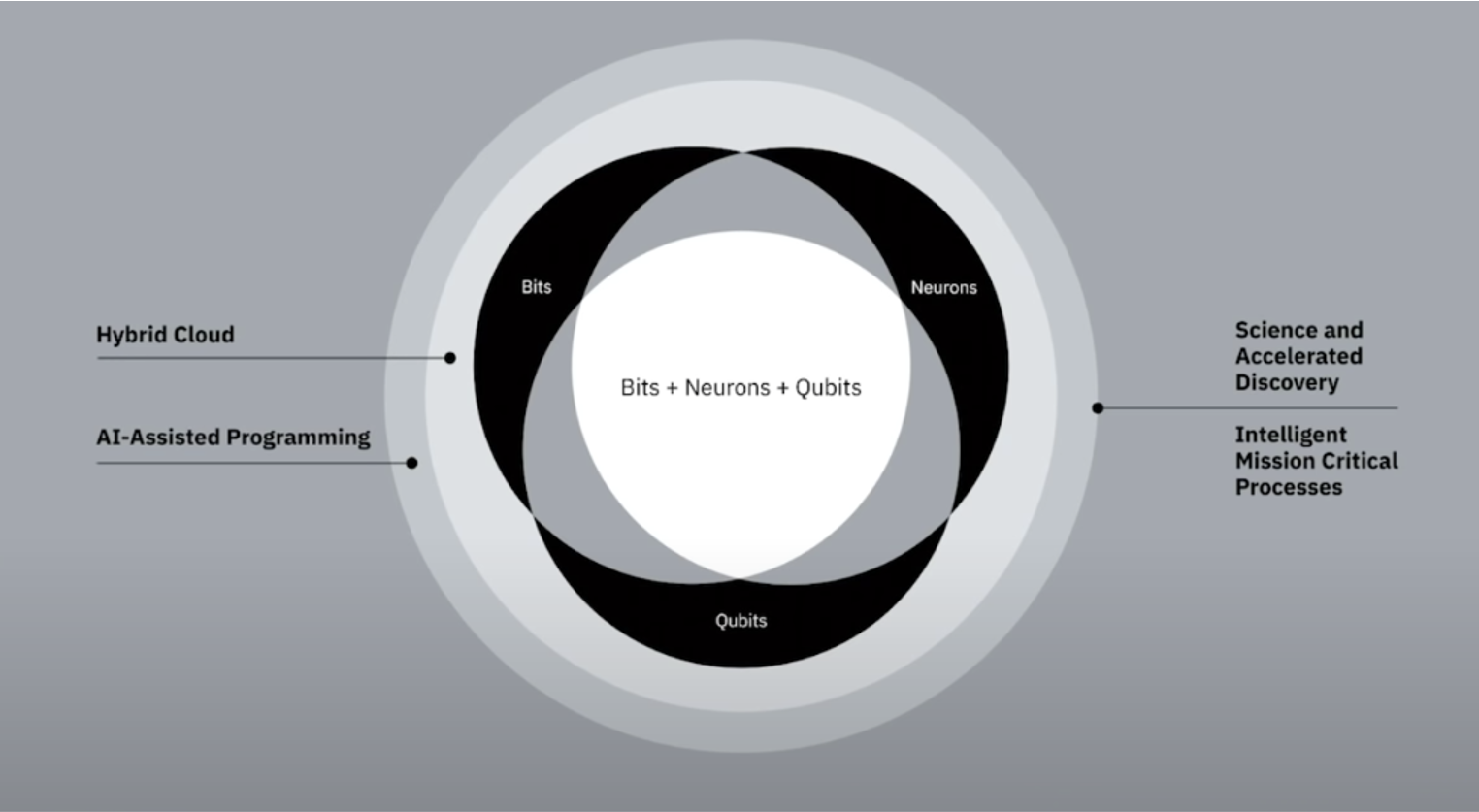
IBM emphasizes that quantum computing will not replace classical computers—it’ll augment classical computers, but also complement the ever-expanding toolbox of emerging technologies. Applied to AI applications, quantum computing is expecting to run them faster and more precisely to extract information we couldn’t see before from classical computers. The convergence of hybrid cloud and AI architectures assisted by quantum computers (see Exhibit 1) will help to no end in programming and will revolutionize the way science is fundamentally carried out to accelerate discovery and underpin a whole new class of mission-critical applications.
This fits the “new IBM” bill well—having spun-out its managed infrastructure business (see our separate piece)—as it doubles-down on hybrid cloud and AI. IBM must, however, maintain a laser-like focus on applications and business outcomes of all this technology—including quantum—so that it doesn’t get lost in its own riches.
Exhibit 1: Quantum computing intersects with AI and hybrid cloud.
Source: IBM, 2020
IBM currently has 20 quantum systems on its cloud—of which 10 are open and accessible to anyone.
Most of the 250,000+ users work through Jupyter notebooks, on Python code, via Qiskit, which’s seen over half a million downloads to-date.
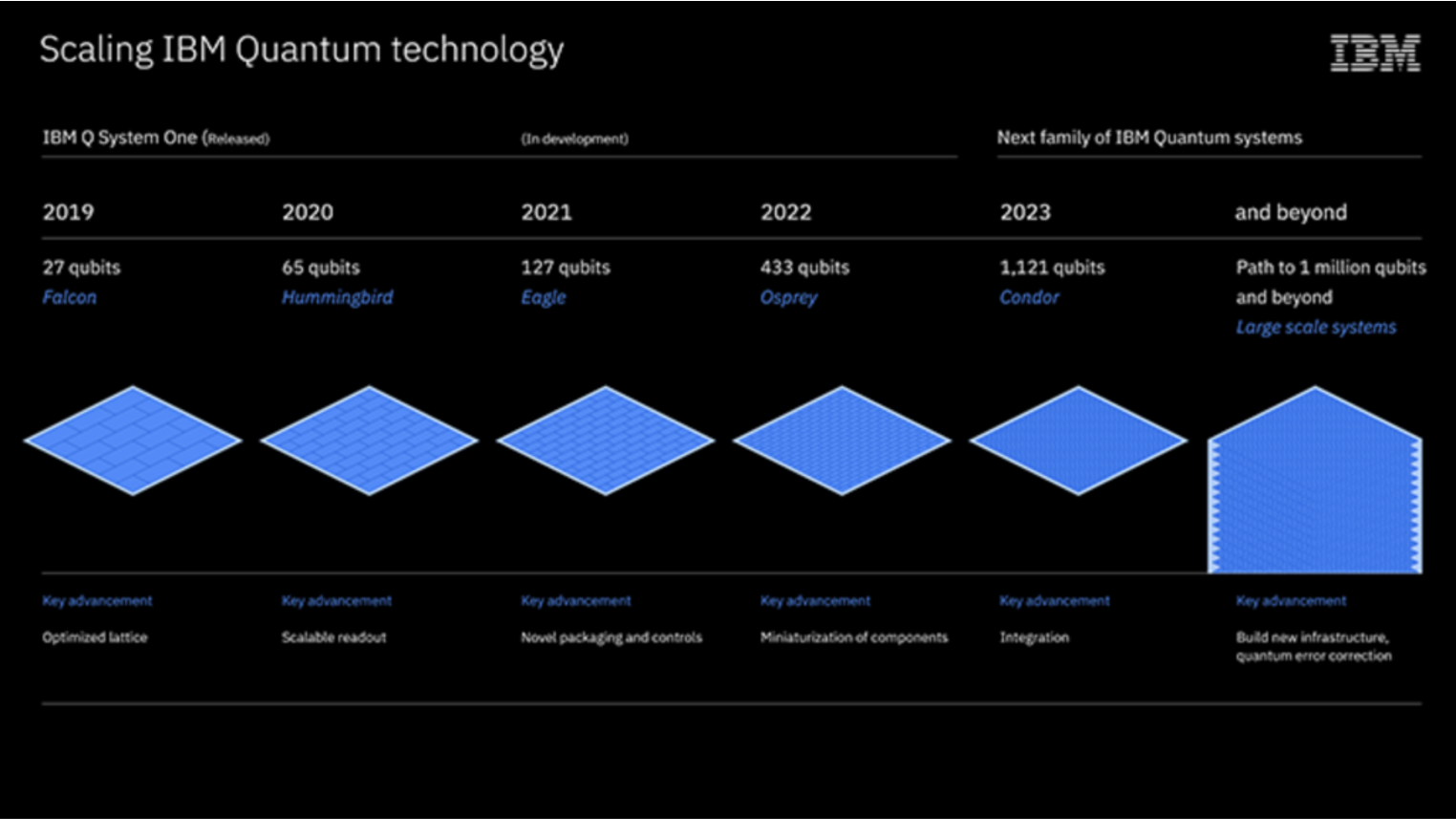
IBM’s first quantum computer came online in May 2016 at 5 qubits (the most common measure of a quantum computer’s power—analogous to a bit, but capable of existing in way more states than zero or one). Since then, over 536 billion quantum circuits have been performed (the transformational operations that manipulate qubits into their various states to calculate complex problems—in IBM’s case, “superconducting qubits” are manipulated by microwave pulses). Currently, the biggest system IBM has comes in at 65 qubits. IBM plans to hit 1000 qubits in 2023 and in doing so reach the “quantum advantage” point where the system can outperform the most powerful supercomputers we currently have (see Exhibit 2).
Exhibit 2: IBM’s roadmap to scale quantum computing has 2023 inked–in for quantum advantage.
Source: IBM, 2020
IBM is taking a Tesla-like approach to building the quantum computing ecosystem.
Google, Honeywell, and the startup landscape are where IBM sees the competition. But it’s more than competition. IBM is taking an ecosystem approach much like Tesla’s approach to the battery ecosystem: opening up its systems to promote innovation.
These firms all have different ways of making qubits: IBM and Google both use superconducting qubits; others use trapped ion or photonic qubits (*see below for more detail).
There are many options available when it comes to contracts, go-to-market, and partnership working for IBM in the quantum sphere: free–to–use computer systems are just one form of democratizing quantum computing by not restricting access. For IBM’s bigger quantum ecosystem partners like Exxon Mobil, BP, Daimler, JP Morgan, and others… it’s a case of co-innovation: these firms know their industry and IBM knows quantum computing—so they’re combining these competencies to prepare industry-specific applications for when the time (and technology) is right.
The Bottom Line: IBM and its partners need to educate the ecosystem as we move towards real business value in 3 to 5 years.
A quantum computing ecosystem, like any ecosystem, must include enterprise partners, startups, universities (and the students who will one day join the quantum workforce), potential clients, implementation partners… all of which IBM is building its Quantum Network. Enterprise leaders exploring quantum’s future in their business must become part of the ecosystem and focus their attention on a 5-year horizon towards the use cases where quantum computing might complement their existing AI, cloud, and other emerging technology plans to solve the problems these technologies cannot.
—
* Superconducting qubits are essentially analog devices (Josephson Junctions) to physically measure a variety of possible states; but these qubits must operate at a temperature close to absolute zero and require a phenomenal amount of cooling power. You can treat qubits like artificially created quantum particles you can then control with microwaves to change its states and ultimately collapse the multi-qubit system to 0 or 1 that tells you the answer.
“Trapped ion” systems use the energy levels of atoms to represent qubits; however, they tend to run away and are tough to control—you must excite and manipulate the energy levels with lasers, and while this represents natural quantum physics to an extent—it is very difficult to scale.
Photonic qubits, as the name might suggest, uses photon polarization horizontally and vertically—but manipulation is exceedingly difficult.
These methods come down to how the system manipulates the qubits into the multiple states that give quantum computing the advantage over classical computing. But it’s not just about the number of qubits, there’s also the error rate which combines into “quantum volume”. IBM’s roadmap is to hit 1000 qubits in 2023—but trapped ion and other systems will find it hard to reach 100 due to the controllability of the qubits.
Register now for immediate access of HFS' research, data and forward looking trends.
Get StartedIf you don't have an account, Register here |
With the exception of our Horizons reports, most of our research is available for free on our website. Sign up for a free account and start realizing the power of insights now.
Our premium subscription gives enterprise clients access to our complete library of proprietary research, direct access to our industry analysts, and other benefits.
Contact us at [email protected] for more information on premium access.

