
People and culture must be business leaders’ highest priorities as they grapple with the continuing – and in many cases deepening – impact of the pandemic on their journey to becoming Cloud Native.
Gathered for an HFS (supported by Wipro) Digital Roundtable about Becoming a Cloud Native Organization, leaders spoke frankly and openly about the challenges they face – across the impact of COVID-19, the battle for talent, and the role of culture in delivering maximum benefits from the cloud.
They shared concerns that while the pandemic has accelerated demand for cloud capabilities, it also exacts a high human price – sweeping through teams with as many as 40% of employees incapacitated by the virus at any one time.
Second wave of pandemic is throwing up roadblocks
As second and third waves sweep the globe this year, some leaders are pessimistic about their capacity to make substantial progress toward what they recognize are the true advantages of becoming cloud native, where:
Accelerating innovation remains an ambition for many
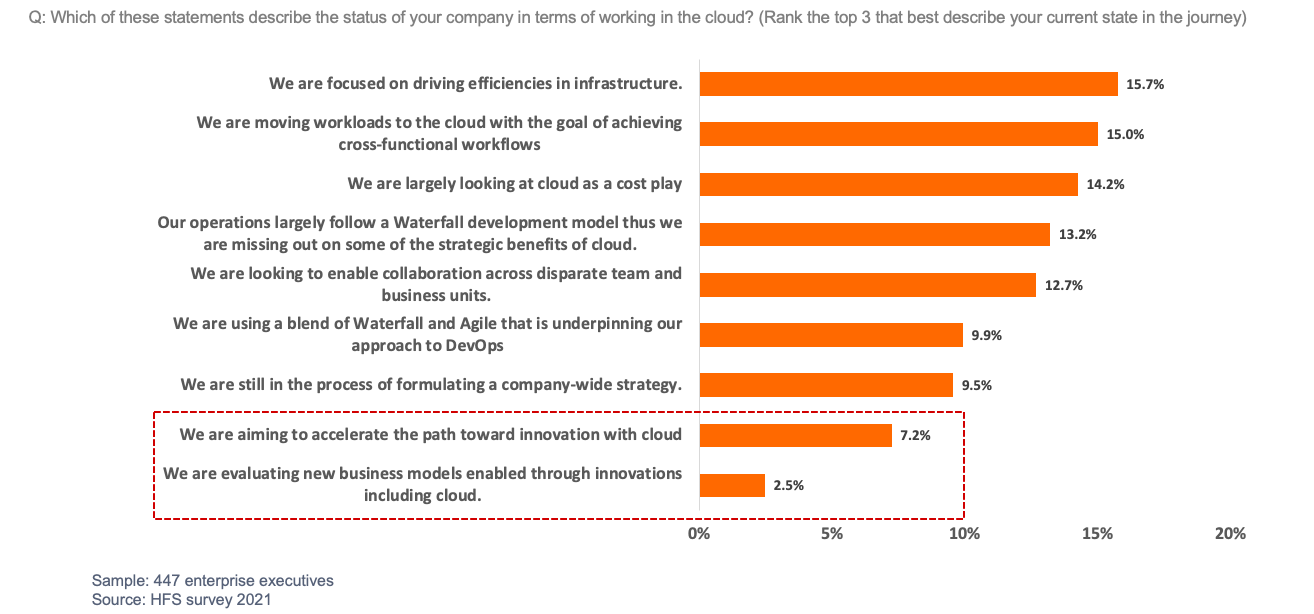
The reality for many, (Exhibit 1) explained HFS SVP Dr Tom Reuner, is that new business models and more innovation remain a distant dream – made even more distant by COVID-19’s deepening impact.
Exhibit 1: What companies are focused on with the cloud in 2021
A difficult year ahead – in which empathy is more important than ever
One leader captured the mood of the roundtable when he said: “This is a very difficult year for any enterprise… we are going to have to run harder. If 10 per cent of your workforce is in quarantine, that means the productivity of those remaining has to be 10-20 per cent more. We have to be very empathetic, and we have to educate our customers. We are not panicking, but the second wave is a very different wave all across the globe.”
HFS CEO and Chief Analyst Phil Fersht added: “We are entering the most acute phase of Covid. Health – and getting through this – is more critical than ever. We have to take care of colleagues, take care of each other.”
Alongside the increased pressures of demand and productivity, comes pressures from the CFO’s office. In many cases the shift to cloud has been found to ADD costs, according to attendees. There is a risk, said one leader in the retail sector – where cloud has supported the rush to e-commerce – that there could be a backlash against spiraling OPEX costs, and a worrying return to old ways of working.
Nagendra Bandaru, President and Managing Partner-iCORE Business Line, approaches this pragmatically: “Companies want to expand their footprint, extend their reach faster, and change plans when needed—and they’re realizing that cloud enables this flexibility. Organizations are looking for more than just bottomline cost reductions from the cloud and they’re seeing topline growth. In fact, other benefits that have emerged from increased use of the cloud include improved customer service and better support for collaboration.”
Attendees reported risks in paying twice (maintaining old systems while switching to new). “Decommissioning is very challenging. We struggle to get rid of the old – even our old emails. Getting rid of applications is hard for some of us – to let go,” said one.
The battle for talent has intensified – but that has benefits for diversity
While the deepening impact on productivity will inevitably drive demand for automation delivered in the cloud, the current talent gap makes responding to that demand ever greater.
Leaders, of even the biggest enterprises, are struggling to compete for cloud talent vs the hyperscalers. Google, Microsoft, AWS are sweeping up talent from industry as they seek to build out their vertical capabilities.
Leaders need a ‘full-stack-team’ approach for recruitment and retention
One example shared at the roundtable described an individual being lured from a consultancy with a salary offer higher than the wage bill of that consultancy’s entire executive team.
HFS VP – Cloud – Joel Martin – reported back from a break-out session on talent. He described how the talent battle was inspiring an increased emphasis on diversity. The work-from-anywhere post-Covid reality had widened everyone’s recruitment net.
He shared a group-recognized need to develop a ‘full stack team’ approach to recruitment and retention, with overlaps in capabilities, supported through training and development and focused on employee engagement. Without such an approach, every loss would continue to hurt.
Culture can help us shift from fire-fighting toward strategic benefits
The challenges facing the industry – the need to ‘just get through this’ – place immense pressure on realizing the greater, strategic benefits of being cloud native. To shift focus from the urgent toward the important, leaders recognize culture holds the key.
In our breakout session on cloud culture, one shared: “People underestimate the challenge because they miss the mindset piece.”
Another identified the need to have engineers with the right approach: “The biggest mistake people make is to see cloud as a tech problem… if your engineers don’t know how to do product-driven design, aren’t customer obsessed and don’t have a continuous build mindset, you’ll never realize the real value cloud can offer.”
“What the cloud enables must be tethered directly to business strategy,” a third leader, insisted.
IT is ground zero in the cultural journey to more value from the cloud
There was shared agreement that IT is ground zero in this journey. The IT team can be the most resistant of all. The cultural education needs to start there, infused with the business benefits and the reality that every business is headed towards becoming a cloud business.
“Focus less on cost savings… Cloud is a growth strategy. It enables the opening up of new businesses in new locations at the speed vital to succeed today,” said one business leader.
And, from lessons hard learned, the group also shared:
The Bottom Line: Focus on the culture or risk fighting fires, all year long
This pandemic threatens to keep us in crisis mode for much of this year. Business leaders must balance fire-fighting and care for their teams with the strategic requirement to extract more value from the cloud. The latter starts with doubling down on the cultural changes required to support the cloud native mindset, delivering business goals while attracting and retaining talent.
Register now for immediate access of HFS' research, data and forward looking trends.
Get StartedIf you don't have an account, Register here |
With the exception of our Horizons reports, most of our research is available for free on our website. Sign up for a free account and start realizing the power of insights now.
Our premium subscription gives enterprise clients access to our complete library of proprietary research, direct access to our industry analysts, and other benefits.
Contact us at [email protected] for more information on premium access.


