
Redwood Software, an IT and business automation provider, has announced a $380million strategic investment from private equity fund Turn/River Capital.
The announcement stands out for two reasons. First, it is a significant amount for an automation segment that is rarely hyped as RPA or AIOps can be. Second, Turn/River aims to unlock value from a disparate set of capabilities – with the IT-centric world of workload automation the starting point for mapping out the strategic opportunities.
The hunt is on for a common language both IT and business stakeholders can understand
Like many innovative companies, Redwood is on an arduous journey toward finding a positioning that reflects its capabilities and differentiation. With its finance automation offering, Redwood has to deal with all the noise of RPA marketing. Its workload automation capabilities may be less known in the broader market.
The challenge is to develop a holistic value proposition reflecting both disparate capabilities. The two strands mean they sell to both IT and business stakeholders – communities with different points of reference and, consequently, different ways of describing problems.
New complex frontiers emerge in managing workloads across cloud-native applications
Workload automation has connotations with traditional automation approaches – in particular, batch processing. Over the years it has evolved with deeper integrations across enterprise applications. The next frontier is managing workloads across cloud-native applications. This also why we see new descriptors such as Service Orchestration and Automation Platforms (SOAPs) emerging that are meant to capture the new complexity of managing cloud-native processes and applications. This is akin to AIOps in IT Operations and Observability in enterprise monitoring.
Already we see an overlap of the core activities across these various monikers. Event automation, monitoring and alerting as well as resource provisioning are examples of that.
Beyond that Redwood drives approaches such as DevOps Automation – aiming to provide a single view of process architecture and visually combines workflow steps into process chains so that organizations can progress toward an enterprise-level of workflows.
This workload automation capability and expertise offer some explanation for why Redwood was not a comfortable bedfellow when aligning itself with RPA.
Redwood can impact more enterprises by taking a page from the RPA playbook
Redwood’s challenges go beyond positioning. It is going very deep with a select set of customers. With those customers, it can sell its disparate set of capabilities. But it is struggling to reach new buying centers.
Investing in a partner program could help mitigate all the issues that we have highlighted. While the positioning around RPA hasn’t helped Redwood, there are lessons to be learned from the likes of UiPath, AutomationAnywhere, and Blue Prism in the way they have gone about building deep relationships with the partner channel. Following their example will provide a much broader market reach. This would also help to mitigate some of the challenges of having to reconcile disparate capabilities. Turn/River is unlikely to help directly with that, but it can leverage best practices gleaned from its investments in companies like ActiveBatch who is also positioning itself around workload automation.
To reap the benefits of the investment Redwood must push a cross-functional mindset
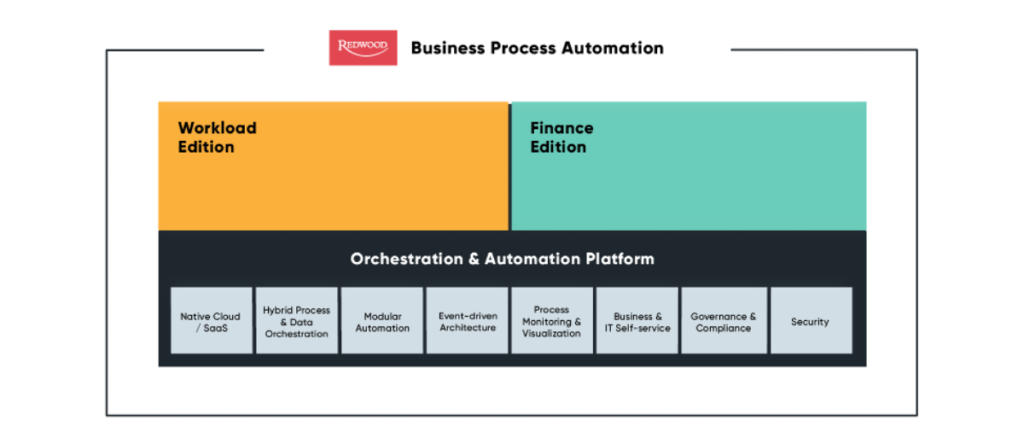
The commonalities of Redwood’s capabilities focus on two aspects. First, the intimate knowledge of the main ERP applications such as SAP and Oracle, which are Redwood’s heritage. Second, its capabilities are focused on automation. Therefore, what Redwood frames as “Business Process Automation” (see Exhibit 1) is underpinned by one platform that serves disparate requirements.
The opportunity for Redwood could be found in two areas. On the one hand, progress toward engaging around cross-functional workflows. ServiceNow is demonstrating the demand in the market for this. Thus, it would align itself with what HFS calls the OneOffice mindset, the intention to overcome the organizational boundaries of the front, middle, and back-office as well as of IT and business.
On the other hand, Redwood has re-architected its platform to become cloud-native. Thus, it should focus on de-emphasizing some of the traditional connotations of workload automation by demonstrating how it can help organizations manage and, ultimately, automate the new complexity of cloud-native environments.
Exhibit 1: Redwood’s positioning around Business Process Automation demonstrates the need for cross-functional workflows
Source: Redwood 2021
Bottom-line: Redwood must reinvent itself with a cross-functional mindset to become a leader in automating the complexity of cloud-native applications in the enterprise
With the new investment and an influx of new management talent, Redwood has the opportunity to move out of the shadows of the hyped automation segments. By aligning with cross-functional workflows – inherent in the OneOffice mindset – it could achieve much clearer differentiation. The commercial opportunity lies in demonstrating that it can help organizations manage and automate legacy and cloud-native environments, while a clear commitment to channel partners can provide the reach to transform itself into one of the leaders in (Intelligent) Automation.
Register now for immediate access of HFS' research, data and forward looking trends.
Get StartedIf you don't have an account, Register here |
With the exception of our Horizons reports, most of our research is available for free on our website. Sign up for a free account and start realizing the power of insights now.
Our premium subscription gives enterprise clients access to our complete library of proprietary research, direct access to our industry analysts, and other benefits.
Contact us at [email protected] for more information on premium access.


