
RPA hype, both positive and negative, continues to pervade the marketplace, making it very difficult for enterprises to discern viable execution and management strategies. To go beyond the hype, HFS, with support from Blue Prism, is showcasing real-life enterprise journeys with RPA. This report spotlights MetLife, a leading global provider of insurance, annuities, employee benefits, and asset management that has successfully scaled Blue Prism connected-RPA as a facet of its broader digital transformation journey.
RPA, AI, and smart analytics—HFS’ Triple-A Trifecta—are not magic; they are software tools. Enterprises that are achieving results with intelligent automation (IA) are not starting with the technology. They are starting with compelling business needs—a firm grasp on WHY they are investing or should invest in IA. They follow this with clear plans on WHAT the enablers and objectives are. With that in firm check, they move on to determining the HOW, which is all about integrated execution between people, process, and technology.
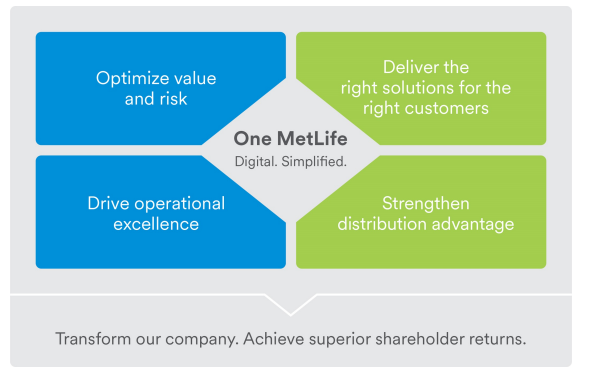
MetLife is a US-based, global provider of insurance, annuities, employee benefits, and asset management that was founded in 1868. In 2016, MetLife announced a refreshed enterprise strategy, encapsulated as One MetLife (see Exhibit 1), to reinvent how it does business as a company with digital transformation and simplicity as its central themes. Its approach serves as a real-life example of an enterprise striving for HFS’ Digital OneOffice concept. As part of the reinvention, MetLife has made a public commitment to invest $1 billion by 2020 to generate $800 million in pre-tax run-rate annual savings. The refreshed strategy is the firm’s WHY—a compelling and unifying business reason for embracing digital transformation, inclusive of RPA.
Exhibit 1: One MetLife—MetLife’s enterprise strategy framework for digital transformation
Source: MetLife, 2019
A gigantic objective like driving $800 million in savings through technology-enabled efficiency gains cannot and will never have a single decisive enabler. Digital transformation is a team sport of cross-silo collaboration that requires business and IT to work together.
MetLife was introduced to enterprise RPA in 2015 through its external service partners and decided to learn more. Through a competitive process, it selected Blue Prism. Key decision criteria included the enterprise-grade nature of Blue Prism’s software and its business-friendly configurability. The original focus for RPA was to drive process excellence and standardization, with business operations initially supporting policy administration and claims. After MetLife announced its refreshed strategy in 2016, it set up a digitally focused program as an enabling organizational construct. This program brought together existing capabilities such as automation, mobility, applications, and analytics in a hybrid business and IT structure to help enable the achievement of the strategy.
“The job and focus are not about RPA—they are about digital transformation. We identified transformative capabilities within MetLife and aligned them with a common purpose centered around our customer. Our integrated approach to digital is critical to our success.”
Eoin O’Reilly, Head of Digital Automation at MetLife
The Digital Automation business, led by Eoin O’Reilly, is one of four capabilities within MetLife’s Digital organization, and RPA is currently a vibrant component of that capability. According to O’Reilly, “The job and focus are not about RPA—they are about digital transformation. We identified transformative capabilities within MetLife and aligned them with a common purpose centered around our customer. Our integrated approach to digital is critical to our success.” The Digital organization within MetLife is responsible for defining the WHAT—the enabling technologies and approaches that support MetLife’s refreshed strategy, including RPA.
O’Reilly and his Digital Automation team’s ability to bring together and balance the critical elements of people, process, and technology have helped MetLife define HOW to effectively execute its RPA strategy and broader approach to digital transformation. O’Reilly points out that “We were trying to make RPA into a glass box, rather than a black box—ensuring transparency for all.”
“We were trying to make RPA into a glass box, rather than a black box—ensuring transparency for all.”
Eoin O’Reilly, Head of Digital Automation at MetLife
O’Reilly cited several execution principles that have been critical to his organization’s success with RPA:
MetLife has set forth an aggressive objective of achieving its own Digital OneOffice through its refreshed strategy and driving $800 million in savings by 2020. This is an all-hands-on-deck, massively unifying strategic objective that requires the entire company to define ways to contribute to the result. Intelligent automation, including RPA, is one of the levers MetLife is using to support its goals. For its IA program to be as effective as possible, it is essential that its approach to execution, the HOW, strikes a balance across people, process, and technology. IA alone cannot achieve MetLife’s objectives, but a well-executed program that emphasizes transparency with its human workforce, a strong interplay between IT and business, and continuous refinement and extension of enabling technology fosters an integrated approach to automation.
Register now for immediate access of HFS' research, data and forward looking trends.
Get StartedIf you don't have an account, Register here |
With the exception of our Horizons reports, most of our research is available for free on our website. Sign up for a free account and start realizing the power of insights now.
Our premium subscription gives enterprise clients access to our complete library of proprietary research, direct access to our industry analysts, and other benefits.
Contact us at [email protected] for more information on premium access.

