Point of View

How to scale-up enterprise IoT programs in five steps

The internet of things (IoT) technology trend has caught the imagination of technical and business folks alike with the promise of billions of connected devices and trillions of dollars of value creation for IoT-enabled opportunities such as smart homes, connected cities. For example, Vodafone and Samsung collaborates strategic to launch smart home services (home automation, security and safety products and services); Dubai envisions to be a smart city by 2021. IoT is set to bring a sea-change across many industries with changes in existing operating models and the introduction of new business models.


IoT project designs look easy on paper during the planning phase, but with implementation comes the real learning when it’s finally clear what is getting done and how. In this PoV, we explore pointers that an enterprise should follow to increase the success of IoT initiatives. 


Only 17% of the IoT engagements are in production stage and 45% of IoT initiatives are stuck in no plan and PoC or pilot stage


In 2019, HFS conducted an enterprise survey that highlighted the state of IoT projects across industries. With so much hype and focus on digital change, one might assume that IoT is now mature and well-tested and that it has proven business results.


The reality, though, is that for most industries, IoT projects are still in the planning, pilot, or early implementation stage, as described in Exhibit 1.


Exhibit 1: In which of the following areas is your organization investing to help drive and achieve digital transformation enabled by IoT?
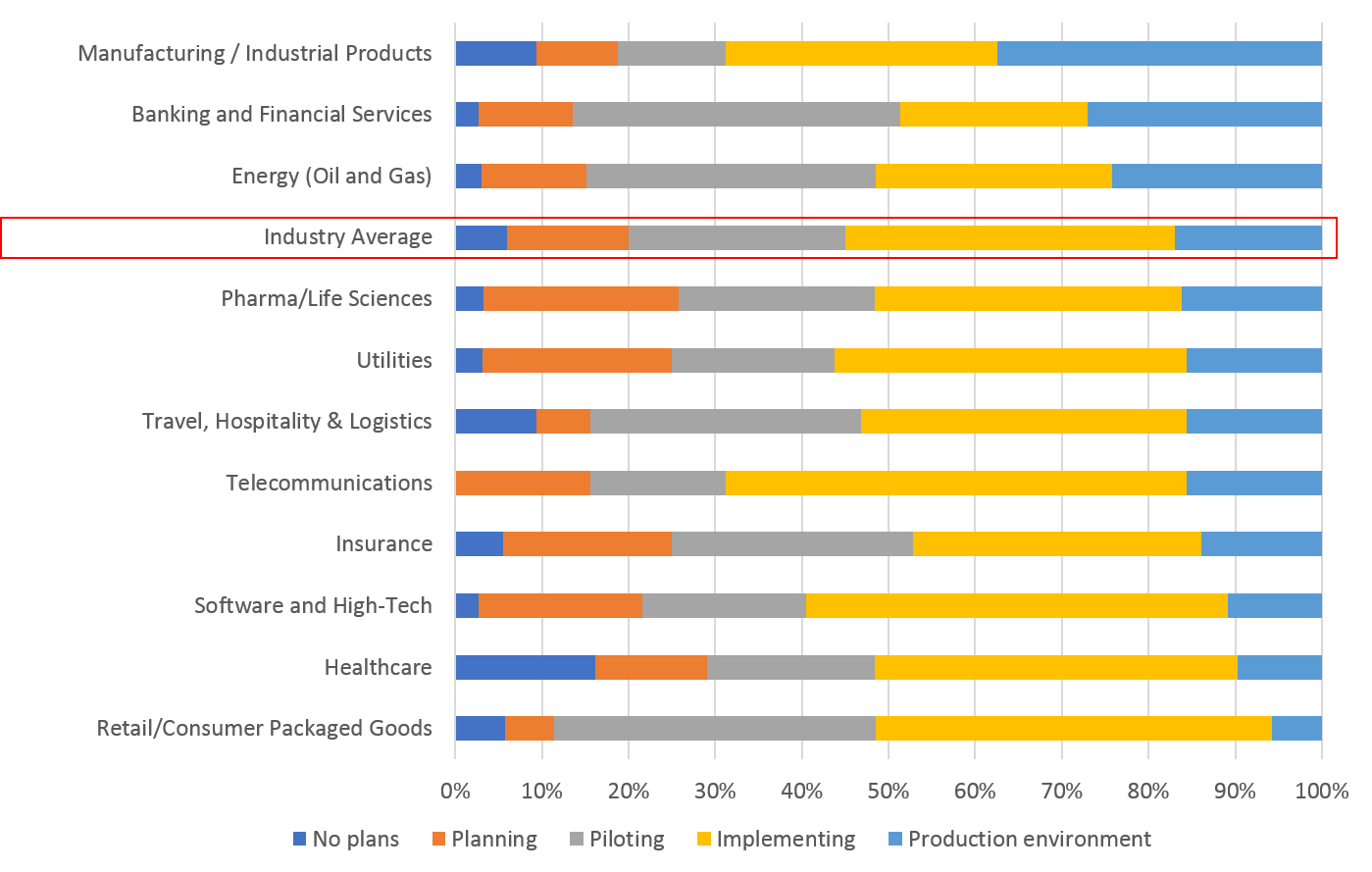


Source: HFS Research G200 Survey, n=368, 2019


The main roadblocks to IoT scaling are lack of planning and organizational behavior


Based on our conversations with enterprises, we have identified these five factors that pose the biggest challenges for scaling IoT initiatives.


  • Unclear project scoping: Enterprises face difficulty defining the boundaries of IoT projects, which often leads to failure. Leaders from different business units often keep adding or modifying project requirements, resulting in scope creep and delays. Also, too many initiatives for different objectives lose momentum due to lack of clarity, resources, and funding.


  • Technology-first approach: Many IoT projects start with the typical “cart-before-the-horse” syndrome in scenarios where IoT solutions are built first and then deployed against a business problem. Another complicating factor is that many customers confuse digital initiatives with IoT initiatives, which causes overlap and delays the project.


  • Organizational complexity: IoT demands more collaboration among different business units for real-time connectivity and data sharing. As many business units in an enterprise operate in silos, it becomes tough to break the boundaries and work together.


  • Integration challenges: In most sectors, there are many disparate systems that need to be integrated for IoT implementations. For example, in the manufacturing sector a single plant has myriad systems So a lot of IT-OT (Operations Technology) integration is needed for the IoT initiatives. Due to different hardware, protocols, and gateways, this integration is time-consuming and does not always produce intended results.


Follow an integrated solutions approach for IoT implementation


IoT is not an off-the-shelf technology for packaged implementation but a combination of several technologies, as described in Exhibit 2. Enterprises need to follow an integrated solutions approach by stitching together these technologies to achieve the objective of IoT implementation.


Exhibit 2: Representative technologies leveraged in IoT implementations
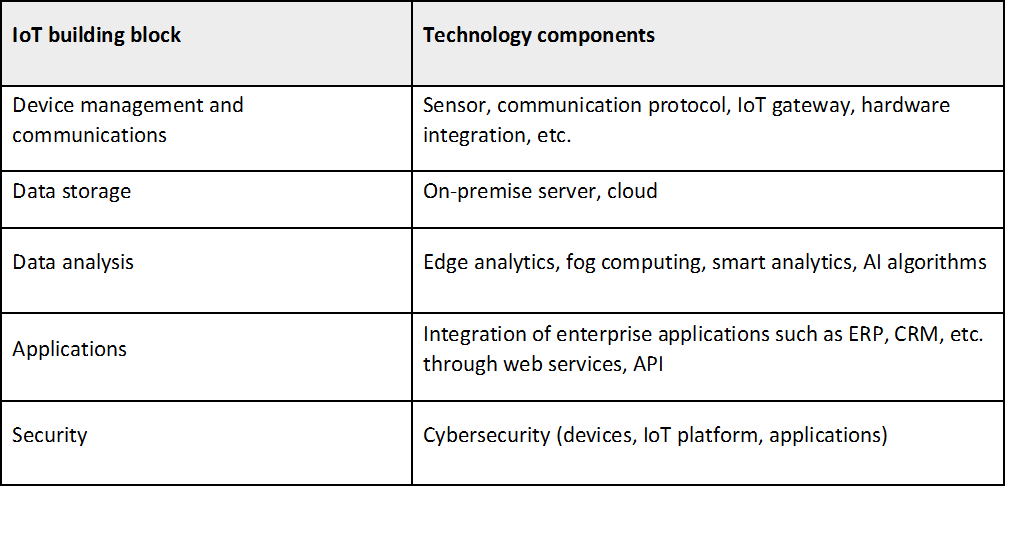


Source: HFS Research, 2019


Five steps to scale-up IoT initiatives


Though IoT enables digital transformation for organizations, enterprises need to scale their IoT initiatives to reap the benefits of IoT implementations. We have outlined five key points that will guide organizations in their IoT journey.


  1. Set the objective carefully. IoT implementation can have multiple objectives: cost reduction, better customer experience, the introduction of new business models, remote control of processes, etc. Enterprises should decide on the goal of IoT implementation and act accordingly. Targeting multiple objectives in the first attempt can be disastrous
  2. Transparency in decision making. IoT initiatives require a number of strategic decisions, such as whether to make or buy the IoT platform and whether to manage the initiatives in-house or to opt for consulting or technology outsourcing. Some of the IoT objectives can cause near-term turbulence within the enterprise. For example, introducing an IoT-enabled “pay-per-use” model can cannibalize the existing revenue model, creating a rift among some business units. Top leadership should discuss this thoroughly with the stakeholders to prepare for the future.
  3. Build a dedicated IoT team from cross-functional resources. Enterprises often leverage an existing IT team to manage IoT initiatives. Any non-co-operation from business units can create a stumbling block. Using members from cross-functional teams, build a separate and independent IoT team that reports directly to top-level leadership. The team will interact with the respective business unit leaders to implement the initiative.
  4. Prepare the workforce for the change. Enterprises need to design industry-specific training programs that include the effect of IoT and other digital technologies on core business processes. As IoT will digitize many existing manual processes such as…., the enterprise must train the workforce to interact with these digital systems.
  5. Leverage the partnership ecosystem. There are several IoT platforms, connectivity gateways, and protocols available. As the IoT ecosystem is yet to be fully mature and standardized, enterprises must build their partner ecosystem to accelerate their technology innovations. Enterprises must connect with IoT ISVs (Siemens, GE, Microsoft, PTC) and industry consortia such as Open Industry 4.0 Alliance (for manufacturing) to stay updated about the recent developments.


The Bottom Line: IoT is not a standalone technology. Leverage it as part of business operations and new offering development.


IoT is an ecosystem where different technologies, devices, and people components interact with each other. While technology is at the forefront of the change, the people factor and business objectives will drive the change. Enterprise executives must bridge the gap between technology, business, and operations to increase the success of IoT projects.

Sign in to view or download this research.

Login

Register

Insight. Inspiration. Impact.

Register now for immediate access of HFS' research, data and forward looking trends.

Get Started

Download Research

    Sign In

    Sign up for a free
    research account

    With the exception of our Horizons reports, most of our research is available for free on our website. Sign up for a free account and start realizing the power of insights now.

    Digests/Newsletters: Overviews of the latest news, insight, and research by HFS.

    HFS Events: Exclusive invitations to HFS webinars, roundtables, and summits, bringing together key industry stakeholders focused on major innovations impacting business operations.

    By registering you agree to our privacy policy.

    I hereby consent that HFS Research can process my personal data.

    Premium Access

    Our premium subscription gives enterprise clients access to our complete library of proprietary research, direct access to our industry analysts, and other benefits.

    Contact us at [email protected] for more information on premium access.

    Help

    If you are looking for help getting in touch with someone from HFS, please click the chat button to the bottom right of your screen to start a conversation with a member of our team.

    [email protected]

      Contact Ask HFS AI Support