
We’ve experienced a decade-long IT transformation, mainly driven by the increased utility that cloud-based services provide. During the next 10 years, we expect even more change as the technology shifts from the early days of virtual machines (VMs) to containers and serverless computing.
It’s easy to forget that the cloud as we know it has been around for over 13 years, since Amazon Web Services (AWS) launched Amazon Elastic Compute back in 2006. The industry has addressed the early battles around the cloud’s efficacy and importance and the concerns around security, particularly for the public cloud, as demonstrated by an almost insatiable enterprise appetite fueling the growth of the hyper-scalers and increased demand for innovation in cloud services.
While there are many ways to determine cloud maturity, HFS research focuses on two dimensions. The first dimension is platform strategy, which reflects platform maturity (the use of more “evolved” variants of cloud-like serverless and containers) and the amount of public cloud used alongside the complexity of the platform (such as hybrid and multi-cloud use). The second dimension reflects the use cases for cloud—the raw amount of cloud they use, how mission-critical the applications are, and the general variety of ways enterprises are leveraging the capability.
Exhibit 1: Cloud maturity by industry
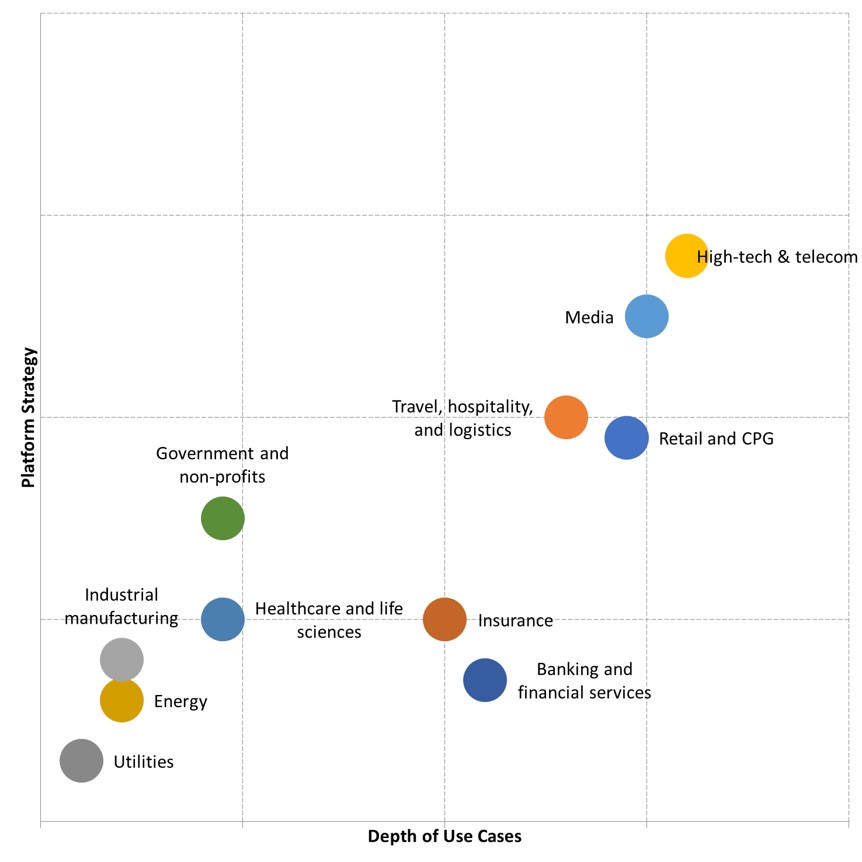
Chart shows relative maturity of different industries use of cloud technology.
The x-axis plots the maturity of the use cases for cloud within the industry. Essentially the variety of cloud uses and their depth.
The y-axis plots the maturity of the cloud platform, higher maturity includes more multi-cloud/hybrid, and use of more advanced virtualisation such as containers / serverless.
Source: HFS analysis from buyer conversations and survey analysis, 2019
In Exhibit 1, which shows the HFS view of cloud maturity across major industry groups using these parameters, we can see a great deal of variety in cloud use cases. What’s becoming clear is that the platform strategies of several industries are lagging, even when use cases for the space are relatively deep. It’s platform strategies where we expect to see the next wave of transformation and hybridization of cloud—we expect a further shift away from VMs and toward containers and serverless computing.
Defining a platform strategy for Cloud 2.0: choosing between serverless or containers?
Unfortunately, there doesn’t seem to be a one-size-fits-all option yet. There are some compelling pros for serverless, and we contend that this is where much of the new wave of transformation will happen. Serverless is more akin to the IT utility nirvana than any cloud variant thus far. It reduces the maintenance overhead on the buyer, and its scalability is much more on tap than containers or virtual machines. Additionally, there are cost considerations, at least from a consumption perspective. Because code doesn’t need to run constantly, you can scale cost down as well as up; applications only cost money when they are used, which affects costs more directly than containers.
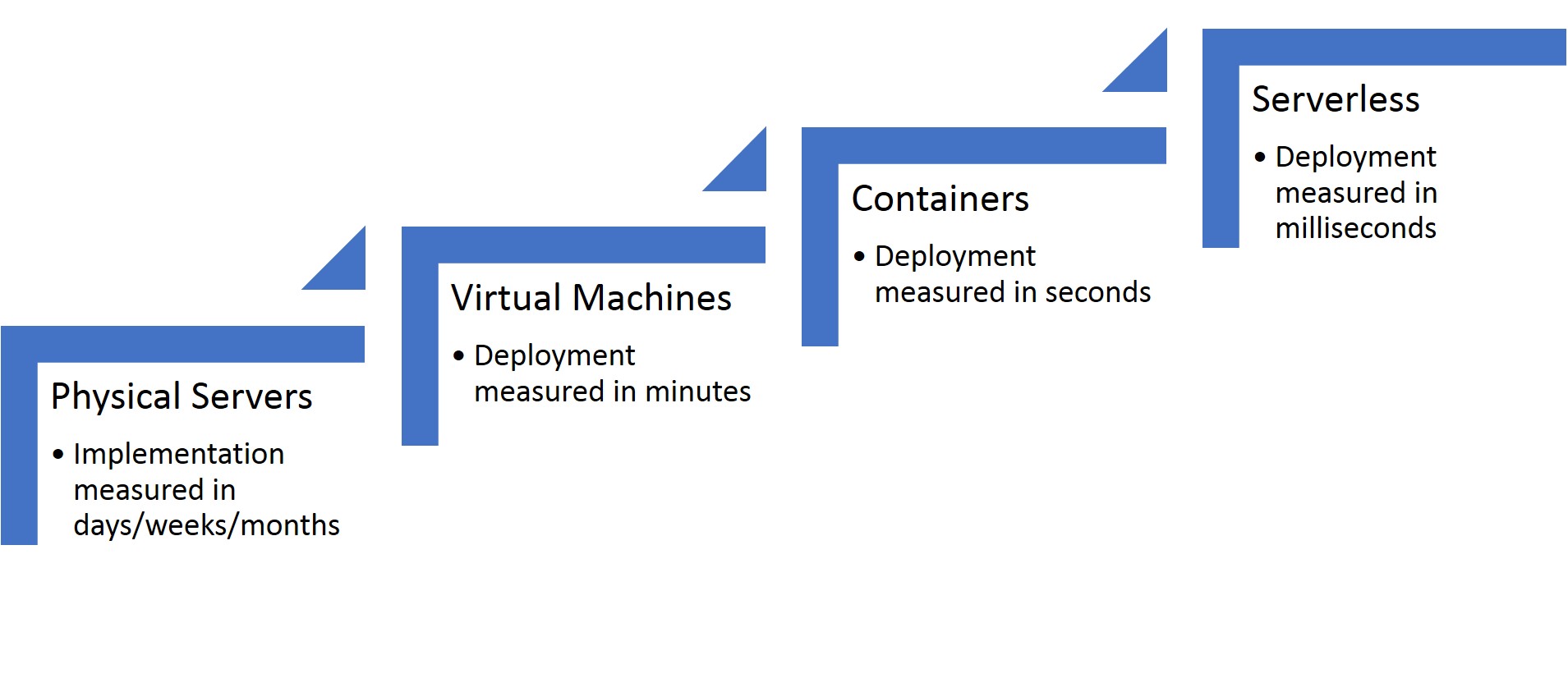
Additionally, serverless is much more developer-centric, partly because maintenance is taken care of by the provider, but also because of faster deployment. Exhibit 2 shows the progression we see in deployment time scales.
Exhibit 2. Cloud maturity by deployment speed
Source: HFS Research, 2020
The drawbacks to serverless are mostly about legacy environments and the portability of existing applications. Serverless can be harder to test, so it needs a testing environment that mirrors the actual deployment. Containers use microservices architecture, which is a great way to engineer inter-connecting software and makes containers an efficient way to program, particularly for complex and legacy environments. Functions, part of serverless, provide a solution, but at a smaller level. Arguably, this makes containers more flexible and the ideal choice for migrating applications, particularly where microservice architectures suit an existing legacy application better than breaking into microservices functions—and certainly with less recoding.
Is multi-cloud still a myth?
Maturity models from five years ago all had multi-cloud, moveable workloads and removal of lock-in as one of the key features of their most mature category. But in reality, most organizations haven’t achieved this nirvana. One CIO told us, “We planned to build a multi-cloud strategy bringing in best-of-breed, but when it came down to it, solutions were too complex and metrics too vague to build a solid business case… so we just went with AWS!”
Clients also struggle with spiraling cloud costs and vague infrastructure, all compounded by still unclear roadmaps and destinations. We’ve even come across analysts recommending that buyers retain staff to manage cloud costs and relationships instead of resolving the underlying issues.
In many cases, this spells opportunity for managed service providers, where they can leverage strong partnerships with cloud firms to help barter down costs and manage spending. A seat at the top table as a strategic partner with most hyper-scalers also gives services firms deeper insight into development roadmaps—helping to manage complexity and design exit strategies that help avoid lock-in. For many enterprises, it’s the provider community that can help architect genuine best-in-breed, multi-cloud solutions from day one.
The Bottom Line: The future is hybrid, and the reality is that the modern Cloud 2.0 strategy will likely contain everything from VMs to containers and serverless.
Undoubtedly, we’ll see both serverless and containers at the forefront of Cloud 2.0, with these technologies dominating the discussion about the cloud for the next 5 to 10 years. The scalability and low maintenance aspects of serverless make it a great choice for new development work, particularly in areas where organizations are unsure of the success of a product or service that is underpinned by cloud infrastructure. It takes the cloud to the next level and provides a perfect “fail fast” environment for products.
However, none of this will be possible unless the hybrid framework—the operating platform for an organization’s cloud and IT infrastructure—is correct. Enterprise customers should be able to utilize best-in-breed services across the hyperscale providers and take advantage of the benefits cloud has to offer, and they should not be stuck with one cloud service as the price goes up and up.
Register now for immediate access of HFS' research, data and forward looking trends.
Get StartedIf you don't have an account, Register here |
With the exception of our Horizons reports, most of our research is available for free on our website. Sign up for a free account and start realizing the power of insights now.
Our premium subscription gives enterprise clients access to our complete library of proprietary research, direct access to our industry analysts, and other benefits.
Contact us at [email protected] for more information on premium access.

