
This Market Impact Report is for CIOs, chief procurement officers, chief operating officers, and enterprise sourcing and transformation leaders evaluating how to restructure delivery models, vendor contracts, and automation strategies in response to trade volatility and tariff risk.
Tariffs are back in the headlines, causing business headaches—but they’re not the root problem. They’re a symptom of a deeper issue: enterprises are operating in a world of sustained volatility.
The past five years have hurled enterprises into a relentless storm of pandemics, geopolitical tensions, snarled supply chains, inflation spikes, and shifting regulations. Trade policy isn’t a standalone headache; it’s woven deeply into a continuous cycle of disruption. Even if tariffs haven’t yet hit many enterprises head-on, the mere shadow of trade disruption has laid bare glaring vulnerabilities: stubbornly inflexible delivery models, dangerously concentrated vendor dependencies, and woefully inadequate scenario planning.
To understand how leaders navigate these dynamics, HFS Research, in collaboration with KPMG LLP (KPMG), surveyed 402 US-based senior executives across seven major industries and conducted in-depth interviews with senior executives from Global 2000 organizations. The focus was to understand both the short and long-term impacts of trade policies on services delivery and outsourcing among major enterprises. The findings revealed that while most enterprises remain reactive, a significant minority is engaged in fundamentally re-architecting how services are delivered, governed, and protected.


This isn’t a story about tariffs—it’s about adaptation. While 69% of enterprises remain frozen or reactive, the transformative 22% are using uncertainty to restructure and gain lasting advantages. Organizations investing in real resilience today will move forward as volatility becomes the permanent backdrop to business.
Tariffs aren’t triggering panic; they’re exposing paralysis. Enterprises are frozen at the edge of transformation.
Tariffs aren’t existential threats for most enterprises. Instead, they’re shining an uncomfortable light on brittle operating models designed for a bygone era of steady growth, predictable supply chains, and frictionless globalization.
Volatility today doesn’t start and stop at supply chains. It cuts across consumer demand, regulatory exposure, service delivery, and innovation planning. When we asked enterprise leaders to rank their top global concerns, they cited the usual suspects: trade wars, supply chain disruption, and rising offshore labor costs. However, a different story emerged when we shifted the lens to local and downstream impacts. The top concerns were consumer demand contraction, slowdowns in innovation and R&D, and increased compliance burdens (see Exhibit 1).
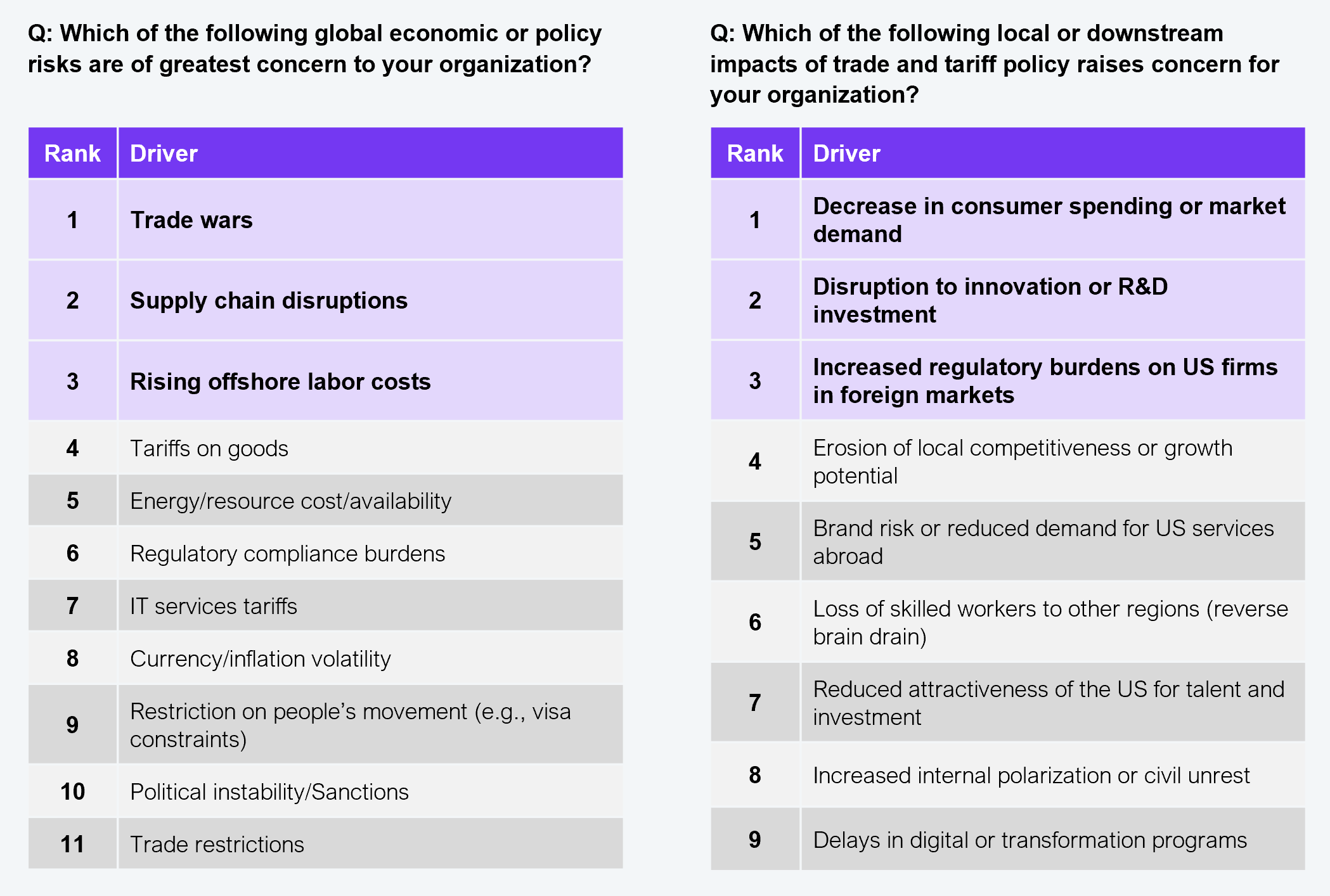
Sample: 402 US-based senior executives
Source: HFS Research in collaboration with KPMG, 2025
This distinction matters. A senior global operations executive at a leading US-based beauty brand explained: “Tariffs weren’t the problem. We were already known for being a ‘made in America’ company. The retaliatory threats and drop in customer demand could shift everything.” Even companies with low direct exposure to cross-border trade are experiencing ripple effects in their growth plans, sourcing models, and customer outlook.
Yet, despite these signals, enterprise response remains sluggish. While most firms report that the current US trade policy is hurting their operations, only 22% are actively scenario planning for escalation or structural change (see Exhibit 2). Most are stuck in a reactive mode, delaying transformation, defaulting to cost containment, and waiting for clarity.
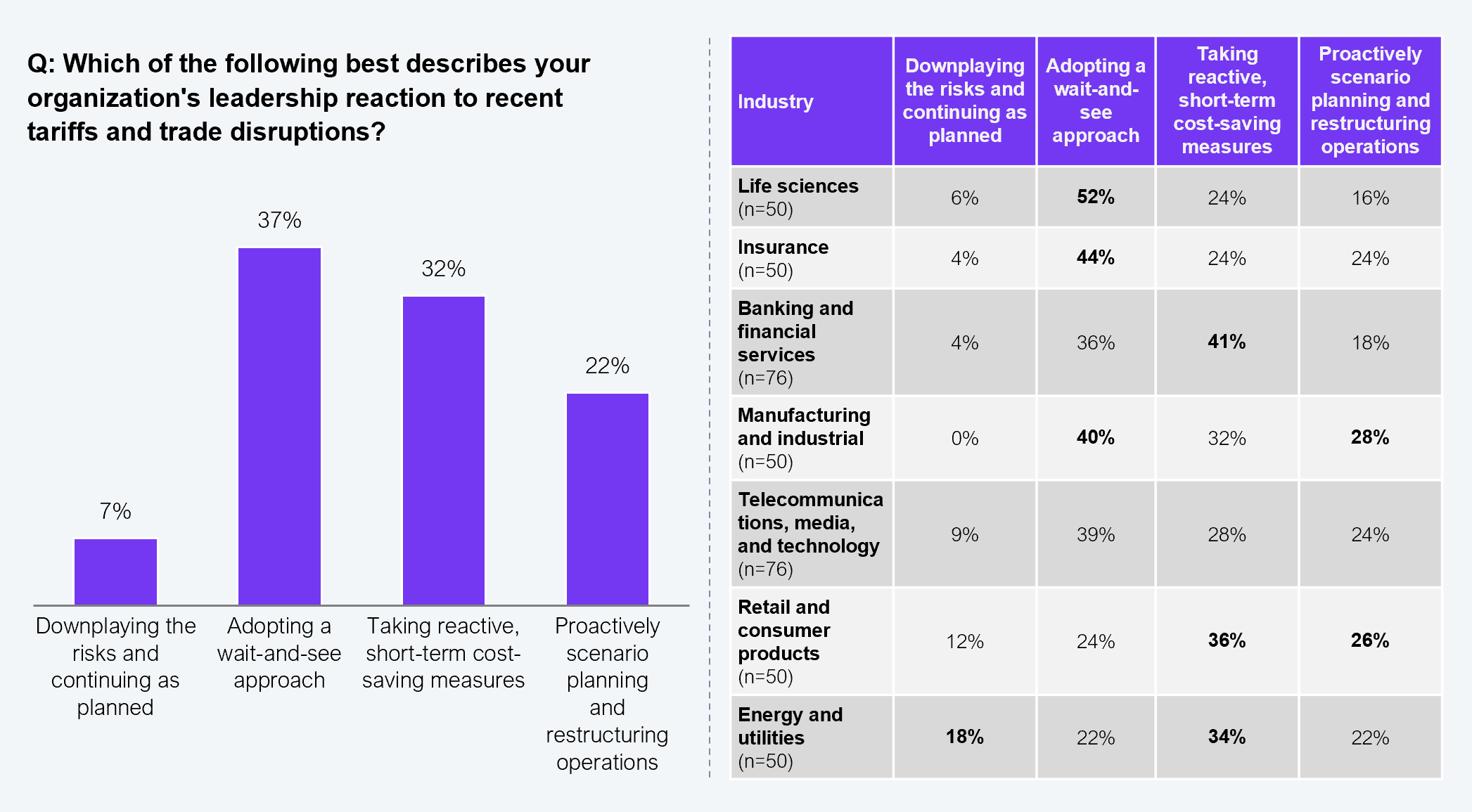
Sample: 402 US-based senior executives
Source: HFS Research in collaboration with KPMG, 2025
What’s most revealing is how this inertia plays out across industries, even those with significant trade exposure. In the life sciences and insurance sectors, over 40% have paused transformation plans—including tech upgrades, digital workflows, and sourcing redesigns—despite the regulatory and supply chain pressures from trade policies, while only 12–16% are moving faster. Even in energy and utilities, an industry positioned to benefit from domestic investment trends driven by trade policy, most firms are still hedging for stability rather than pushing for strategic change.
The threat is not receding but rather accelerating. While 52% of firms said that current trade policy is already disrupting delivery, that number jumped to 74% when asked about the next two years (see Exhibit 3).
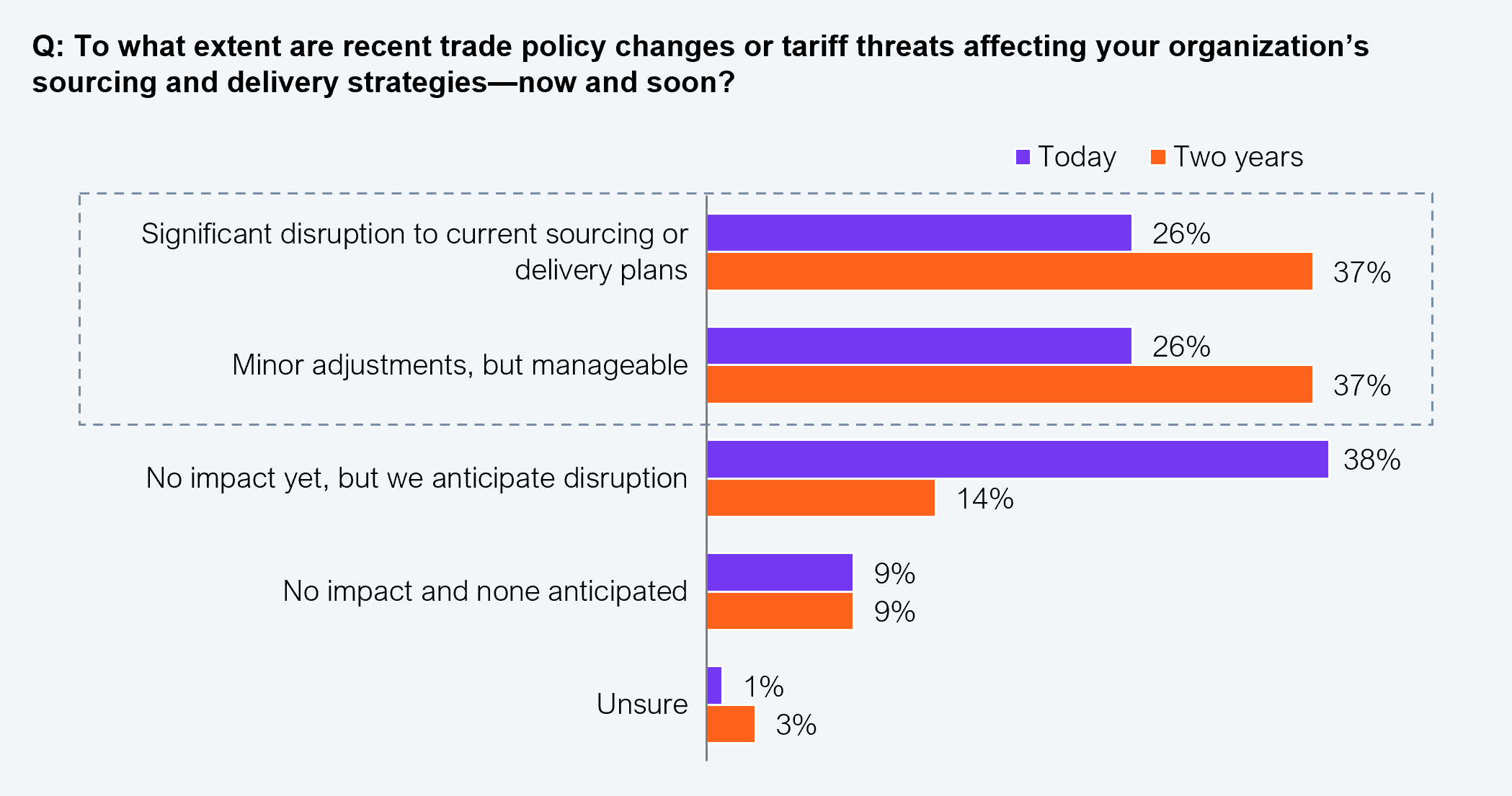
Sample: 402 US-based senior executives
Source: HFS Research in collaboration with KPMG, 2025
Yet, most enterprises aren’t preparing. Just 15% said they accelerated transformation in response, while 38% have paused or delayed initiatives (see Exhibit 4). There’s an odd logic at work: the greater the uncertainty, the more organizations retreat.
As Ron Walker, Global Head of Managed Services at KPMG LLP, put it: “The real shift isn’t just about trade policy. It’s about recognizing that old delivery models were built for cost, not resilience. Now companies need both.”
Waiting around might’ve been acceptable in the old, slower world, but today’s environment allows trade policy shifts to be broadcast in real time even before contracts catch up. A Global Business Services (GBS) leader of a Fortune 500 CPG firm remarked, “You can’t build a five-year roadmap around a policy that can change with a social media post.”
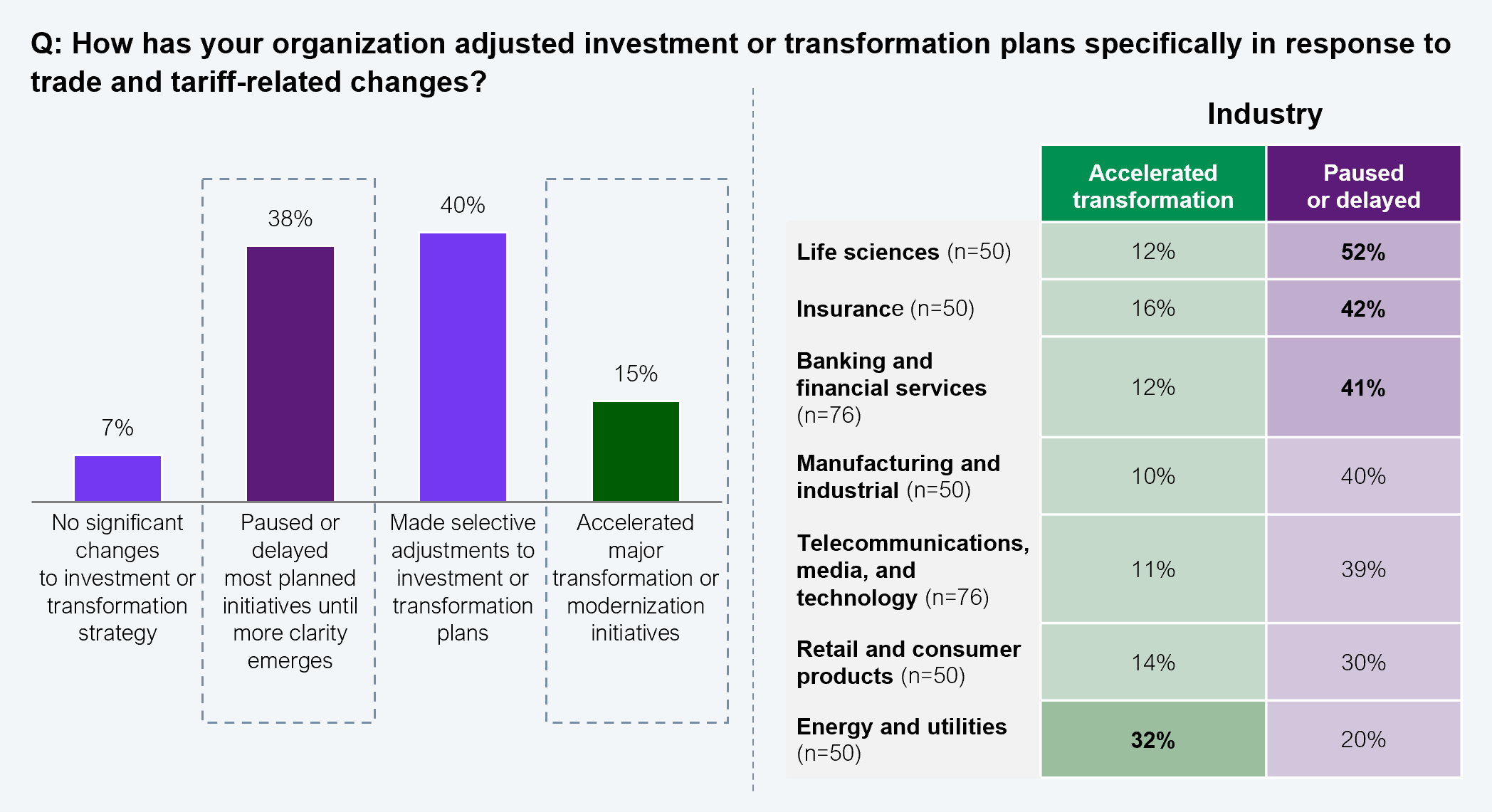
Sample: 402 US-based senior executives
Source: HFS Research in collaboration with KPMG, 2025
But not everyone is retreating. A small but significant subset of organizations is using chaos as the impetus for reinvention. A GBS executive described how a tariff threat-induced hiring freeze helped stabilize technical talent. When attrition dropped and external movement slowed, that window became the perfect moment to test automation at scale.
Their team ran more than 20 pilots across key workflows, reallocating more than 300 roles through AI augmentation. It was a deliberate repositioning effort: de-risking delivery today while building muscle for tomorrow. These examples are still the exception, but they point to a different mindset: one that sees turbulence not as a reason to pause but as the best moment
to move.
Enterprises aren’t fleeing geography; they’re automating around it.
When disruption strikes, enterprises don’t start with relocation or renegotiation. They turn to automation. It’s faster, quieter, and avoids the red tape of structural change.
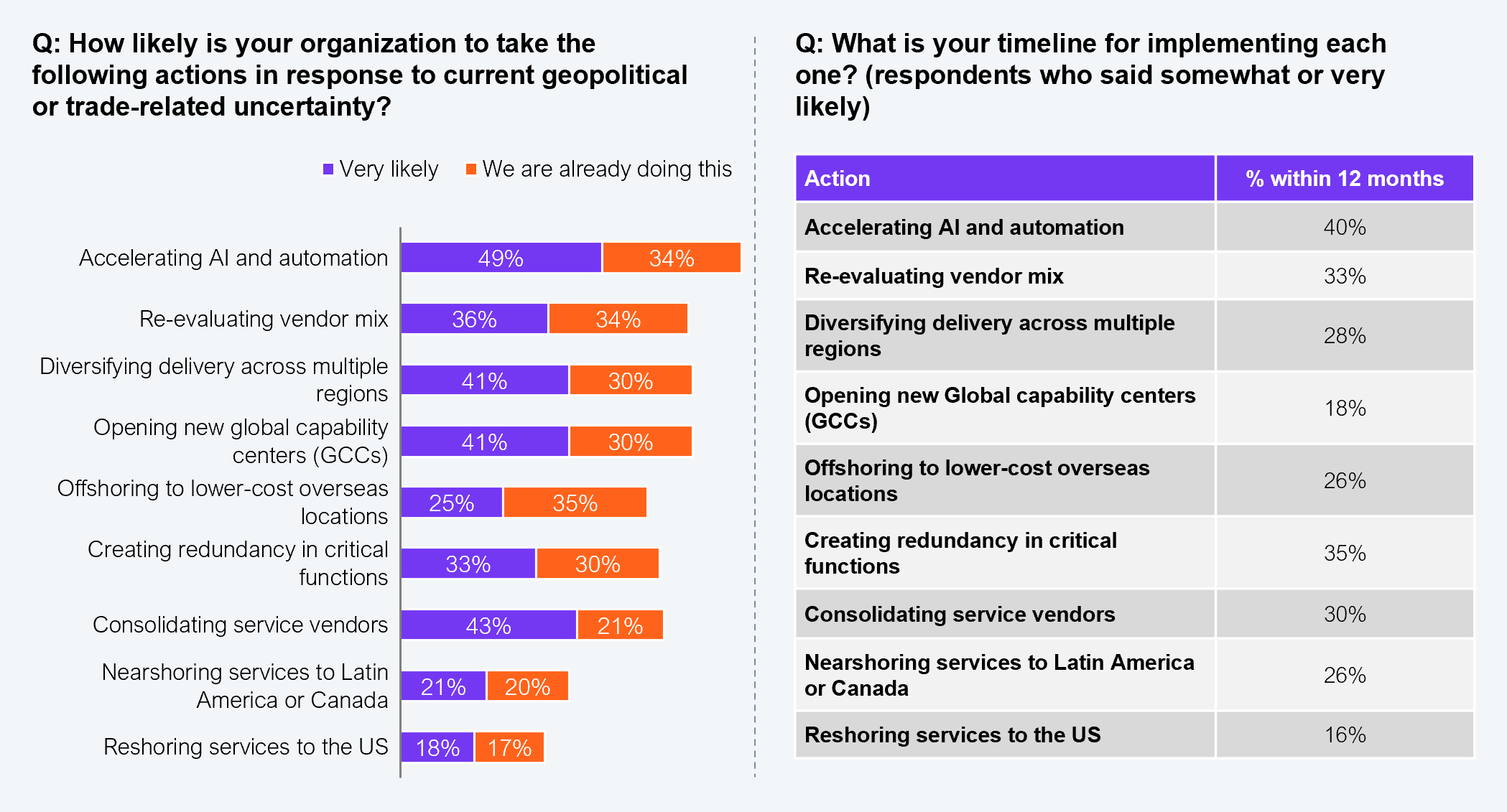
A significant 83% of enterprise leaders said they’re either already accelerating or are very likely to accelerate AI and automation initiatives in response to the geopolitical and trade uncertainty. This spans everything from automating supplier onboarding and invoice processing to reprogramming how support, compliance, and planning workflows are executed. Why automation? Because it delivers impact without inviting complexity. It doesn’t require site moves, new vendor contracts, or regulatory reviews. It’s the one lever companies can pull fast—quietly reengineering the work itself before taking bigger swings. And it’s not just talk—40% said they will act within the next 12 months, more than any other tactic by a significant margin (see Exhibit 5).
Sample: 402 US-based senior executives
Source: HFS Research in collaboration with KPMG, 2025
The reason is not because automation is the most transformative option—it’s the most deployable. It doesn’t provoke regulators or public scrutiny. It’s fast, discreet, and under enterprise control, making it the default response even when it’s not the long-term answer.
The head of operations at a multinational consumer goods company noted that while automation initiatives had long been on the roadmap, they rarely cleared the investment hurdle until the external pressure shifted. “We had the automation plans ready. But the numbers never justified the spend. Now that even a 10% tariff can swing the balance sheet, it’s a different equation.“
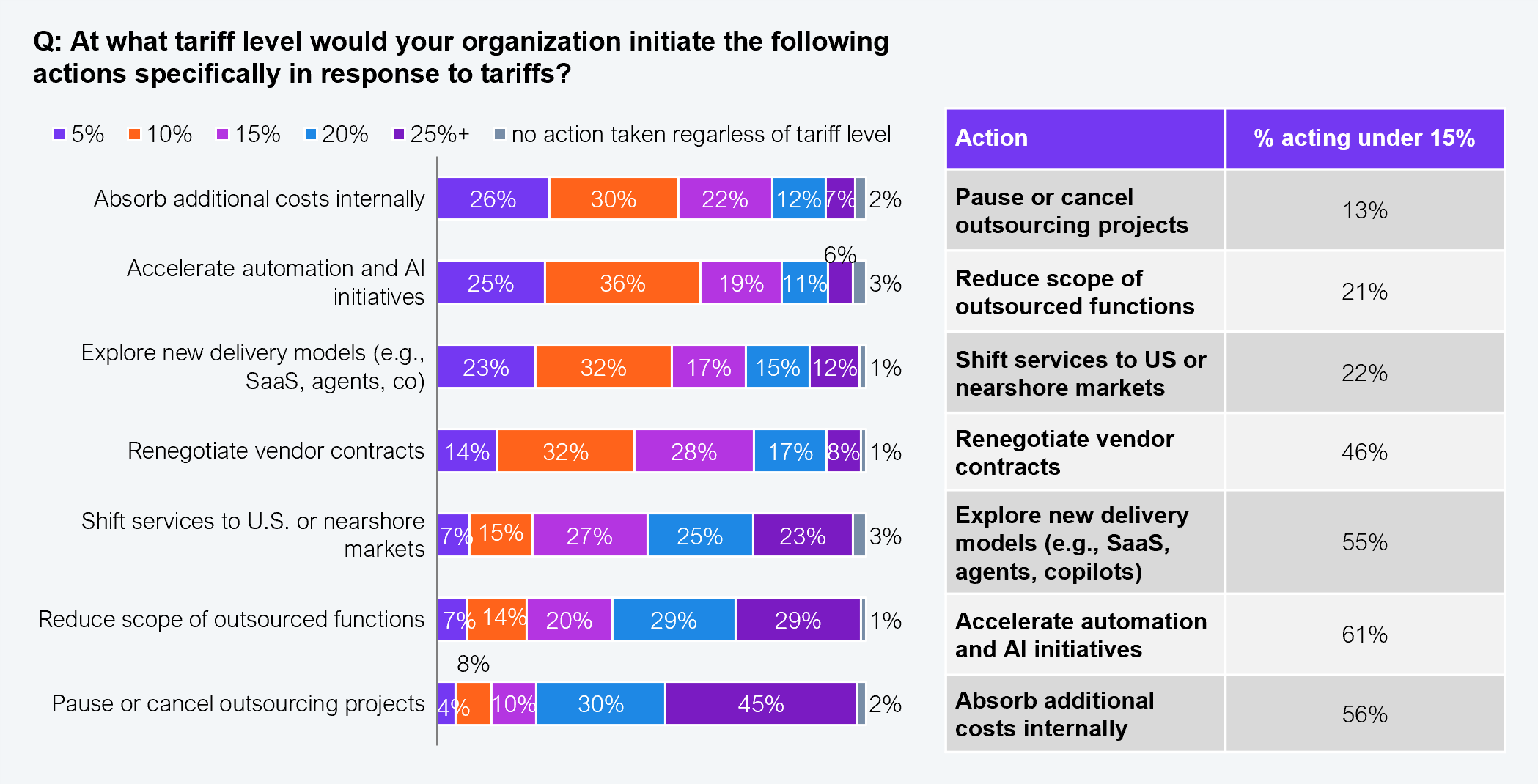
When asked about the tariff levels that would initiate specific actions, enterprise leaders outlined a clear sequence of escalation. AI and automation came first, triggered at just 5–10% tariff levels by 61% of respondents—the highest early activation rate across all options. The second most common early-stage move is to absorb the costs internally, with 56% of enterprises opting to bear the brunt of tariff hikes before considering structural changes (see Exhibit 6).
This shows how enterprises are prioritizing risk response. AI is the hedge—the first lever pulled, not because it’s radical but for its promise of productivity without upheaval. The only other actions triggered early with any scale are renegotiating vendor contracts (46%) and exploring new delivery models (55%), both of which serve as transitional maneuvers to buy time, not transform the model.
Sample: 402 US-based senior executives
Source: HFS Research in collaboration with KPMG, 2025
Most enterprises aren’t leaping into new markets or overhauling sourcing strategies. They’re stabilizing spend and preserving existing structures. Geographic moves such as reshoring or even nearshoring remain marginal; only 22% said they would shift services to the US or nearby markets at sub-15% tariff levels, and even fewer (13%) would consider pausing or cancelling outsourcing entirely. Companies aren’t choosing between automation and relocation—they’re using automation to avoid relocation entirely, achieving speed, discretion, and minimal disruption.
Rahsaan Shears, Principal at KPMG and aiQ Program Lead, framed the shift as deeper than just automation: “AI is reshaping how work gets done and it’s exposing the limits of traditional, in-house operating models. That’s where managed services comes in. It gives organizations the ability to scale faster, with built-in access to automation, analytics, specialized talent, and global delivery.
This isn’t just outsourcing. It’s a new way to run the business, one that can keep up with AI’s pace and extend transformation across every function. To make it work, companies need more than tech. They need clear roles, stronger data foundations, and a culture ready to embrace continuous change.”
This shift is more than just where work gets done—it’s about how. Enterprises are turning to AI and managed services not as a stopgap but as a way to rewire their delivery models for volatility and scale.
Enterprises are no longer buying services—they’re investing in agility.
In the past, geopolitical disruption has been associated with broken supply chains—ports clogged with containers, semiconductor droughts, and factories forced to relocate. Meanwhile, services seemed immune, a safe haven from global shocks. But that assumption is unraveling fast. Digital services, previously considered bulletproof, are now undeniably within the geopolitical blast zone.
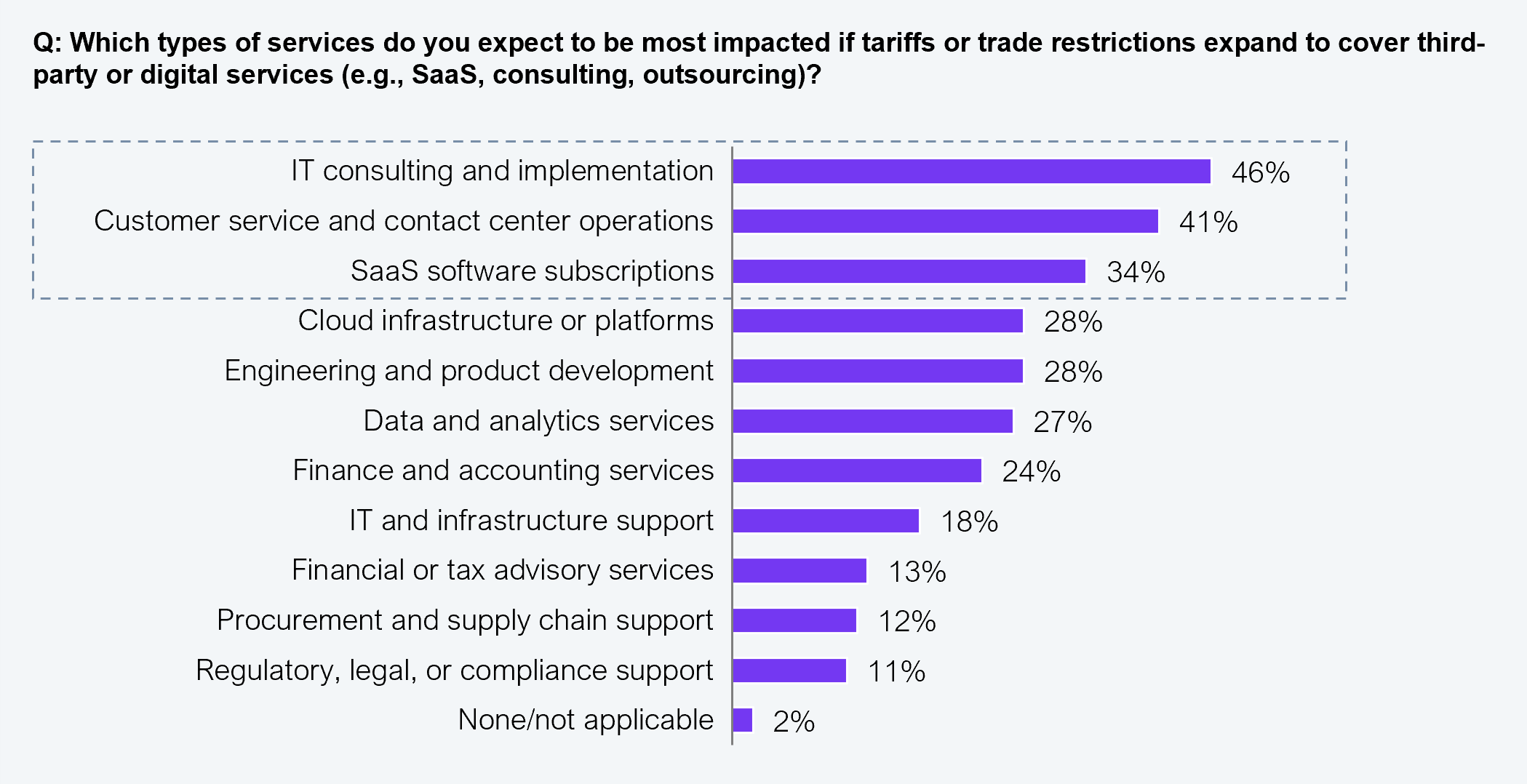
Tax is just part of the concern. Enterprises are worried whether services can withstand volatility in the first place. When asked which services would be most vulnerable if tariffs extended to digital or third-party delivery, respondents pointed to the operating system of modern business (see Exhibit 7): IT consulting (46%), contact centers (41%), and SaaS (34%). These aren’t fringe services—they’re foundational.
Sample: 402 US-based senior executives
Source: HFS Research in collaboration with KPMG, 2025
Even if service tariffs aren’t yet a reality, the perceived exposure is already shifting enterprise behavior. Services are being restructured, not because of what has changed, but rather what could.
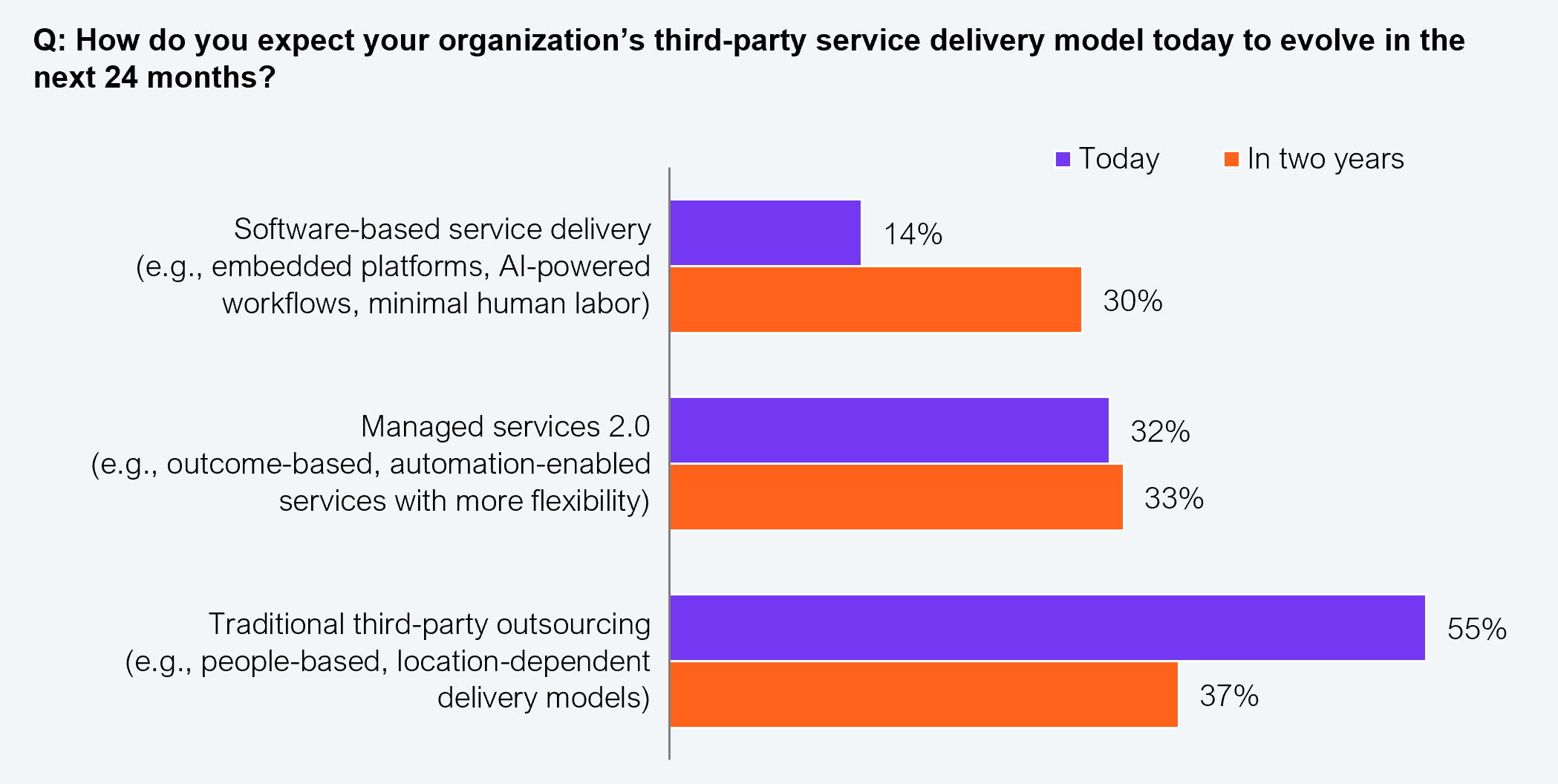
The real shift isn’t away from outsourcing—but from labor-based delivery. Over the next 24 months, traditional outsourcing models (defined by location dependency and manual effort) are expected to drop from 55% to 37%. In contrast, modular and software-based services—including embedded platforms, AI-powered workflows, and automation-first delivery—will more than double from 14% to 30%. Managed services, particularly those blending automation with outcomes, remain steady, highlighting the shift from staffing to scalable systems (see Exhibit 8).
Sample: 402 US-based senior executives
Source: HFS Research in collaboration with KPMG, 2025
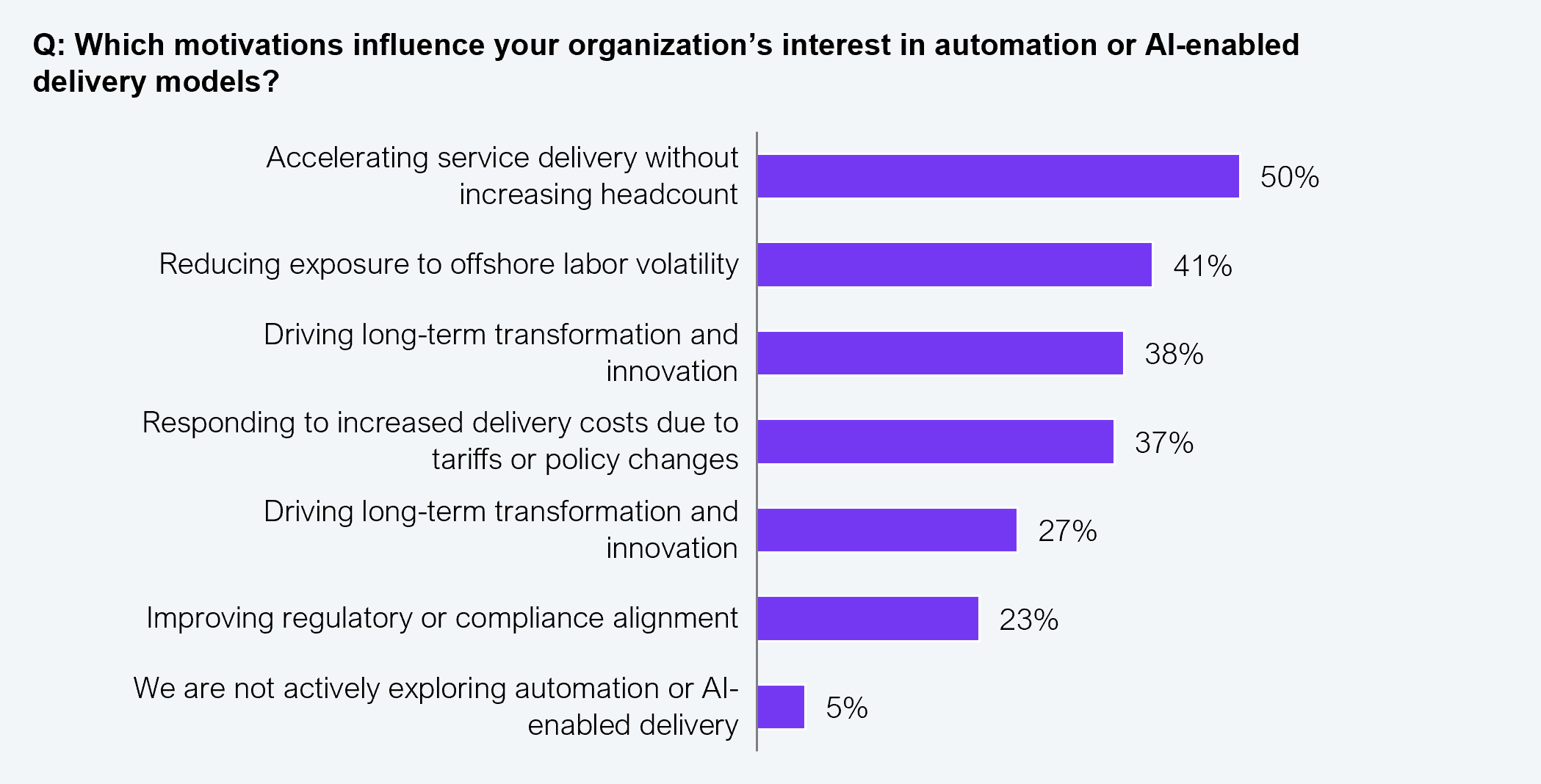
This isn’t just a geopolitical hedge—it’s a structural reset. Enterprises are prioritizing automation and AI-enabled delivery for speed, resilience, and control. Half of the respondents said they’re turning to automation to accelerate service delivery without increasing headcount. Others cited the need to reduce offshore labor volatility (41%), drive long-term transformation (38%), and address tariff-related cost increases (37%) (see Exhibit 9).
Sample: 402 US-based senior executives
Source: HFS Research in collaboration with KPMG, 2025
This is not about chasing cheaper labor markets anymore. Enterprises are doubling down on delivery models where geography and headcount no longer dictate outcomes. As a CTO of a Fortune 500 firm put it: “We are not chasing the next low-cost country. We are chasing a model that doesn’t care where the cost sits.”
This is the foundation of the services-as-software shift. Software is no longer a wrapper around work—it is the work. Instead of scoping headcount and signing service-level agreements, enterprises are embedding workflows and configuring capabilities. As services become software, the criteria for choosing who delivers them is being fundamentally rewritten.

Picking the right vendors matters; structuring the right relationships matters more.
Enterprises are no longer evaluating service providers based on traditional metrics. Size, reputation, and cost competitiveness—the holy trinity of vendor selection—are giving way to a new priority: maneuverability. In a world where trade winds shift overnight, the real test for vendors isn’t meeting today’s specs—it’s whether they’ve got the agility to pivot when tomorrow flips the script.
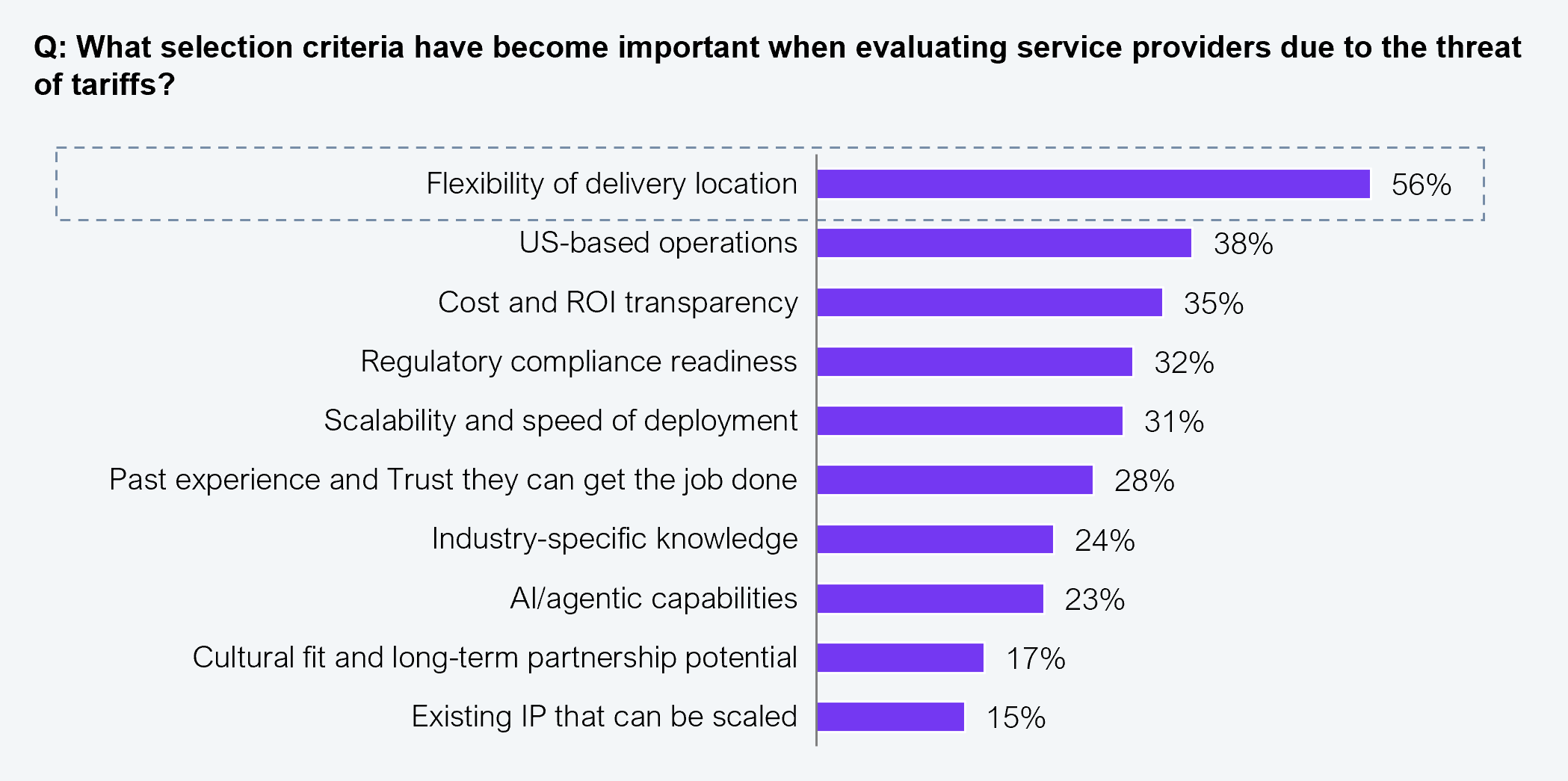
The data clearly reveals this shift. When asked about the most important vendor selection criteria, 56% of enterprises now prioritize flexibility of delivery location above all else. That beats out cost and ROI transparency (35%), regulatory compliance readiness (32%), and even past experience and trust (28%) (see Exhibit 10).
Sample: 402 US-based senior executives
Source: HFS Research in collaboration with KPMG, 2025
This is a fundamental reordering of what enterprises value in partnerships. Geographic agility has become the new table stakes, while traditional strengths such as industry expertise (24%) and cultural fit (17%) have slipped down the priority list.
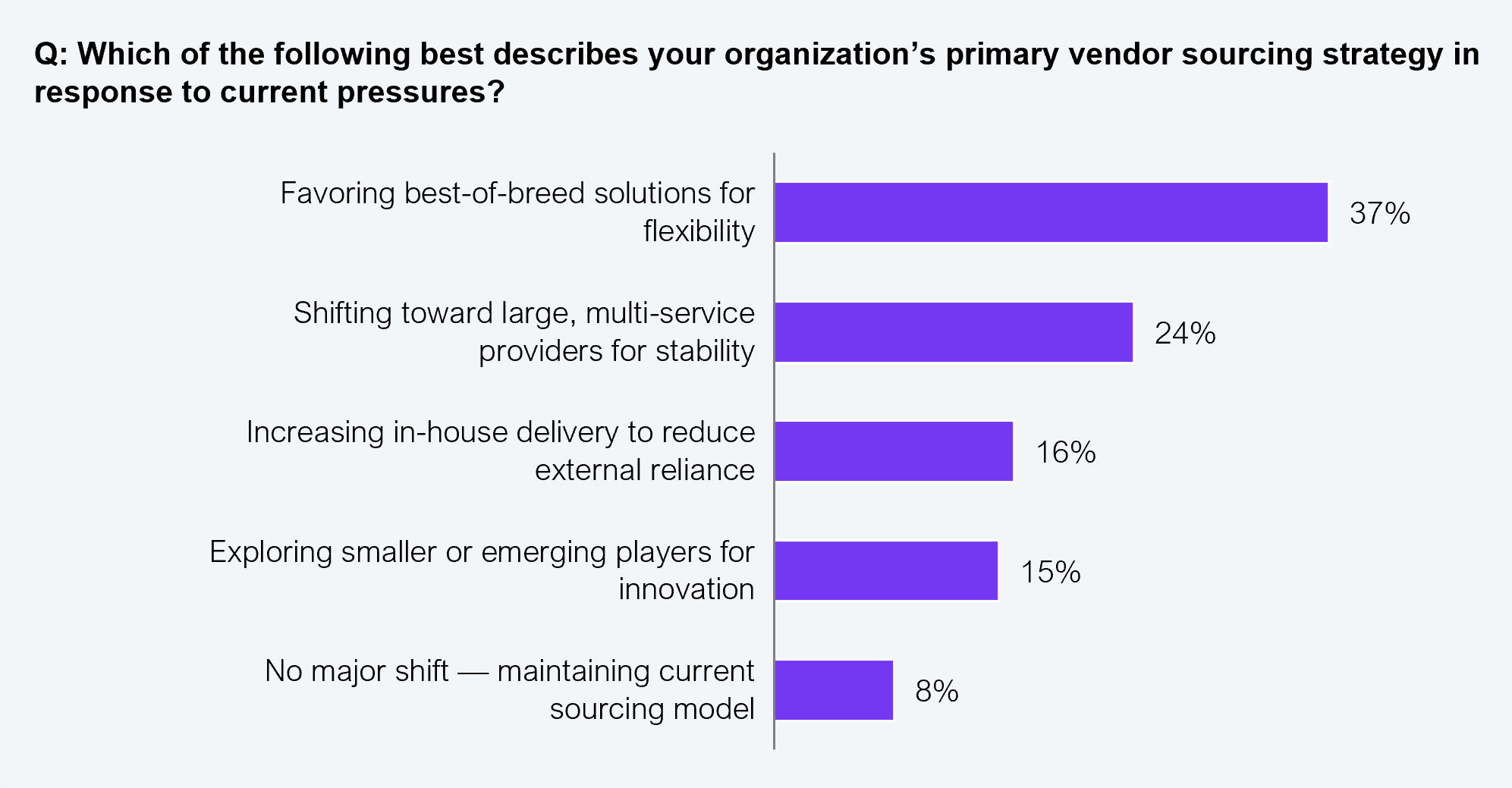
The vendor strategy follows the same logic. When asked about their primary sourcing approach in response to current pressures, 37% of enterprises favor best-of-breed solutions for flexibility. This significantly outpaces consolidation plays such as shifting to large multi-service providers (24%) or reducing external reliance through insourcing (16%) (see Exhibit 11).
Sample: 402 US-based senior executives
Source: HFS Research in collaboration with KPMG, 2025
This is a subtle but powerful shift. Enterprises are not picking partners based on scale or one-stop shopping convenience but on adaptability—how quickly a vendor can reconfigure delivery if geopolitical realities shift. The emphasis is on building a portfolio of specialized providers that can move fast rather than betting on integrated giants that might be too complex to pivot.
The scale of change is significant. Seventy percent of enterprises are either very likely to reevaluate their vendor mix or are already doing so, making this one of the most widespread responses to trade uncertainty. But enterprises aren’t just swapping providers—they’re fundamentally changing what they buy.
Over 90% plan to increase AI-specific spending over the next 12 months, while 18% are pulling back on traditional IT services. This shift toward AI-enabled providers reflects a broader strategy: partnering with vendors that can automate away geographic risk rather than simply relocate it.
Enterprises are no longer sourcing just for value; they’re sourcing for volatility.
Geopolitical storms, tariff uncertainty, and regulatory volatility aren’t just shaking things up—they’re rewriting vendor management rules entirely. Procurement teams, once considered mere gatekeepers or bargain-hunters, are now at the strategic forefront, architecting resilience into their operating DNA.
Sourcing agility isn’t just about who you choose. It’s about how you contract. Here, the strategy has fundamentally shifted: contracts are now tools for building in flexibility before
disruption hits.
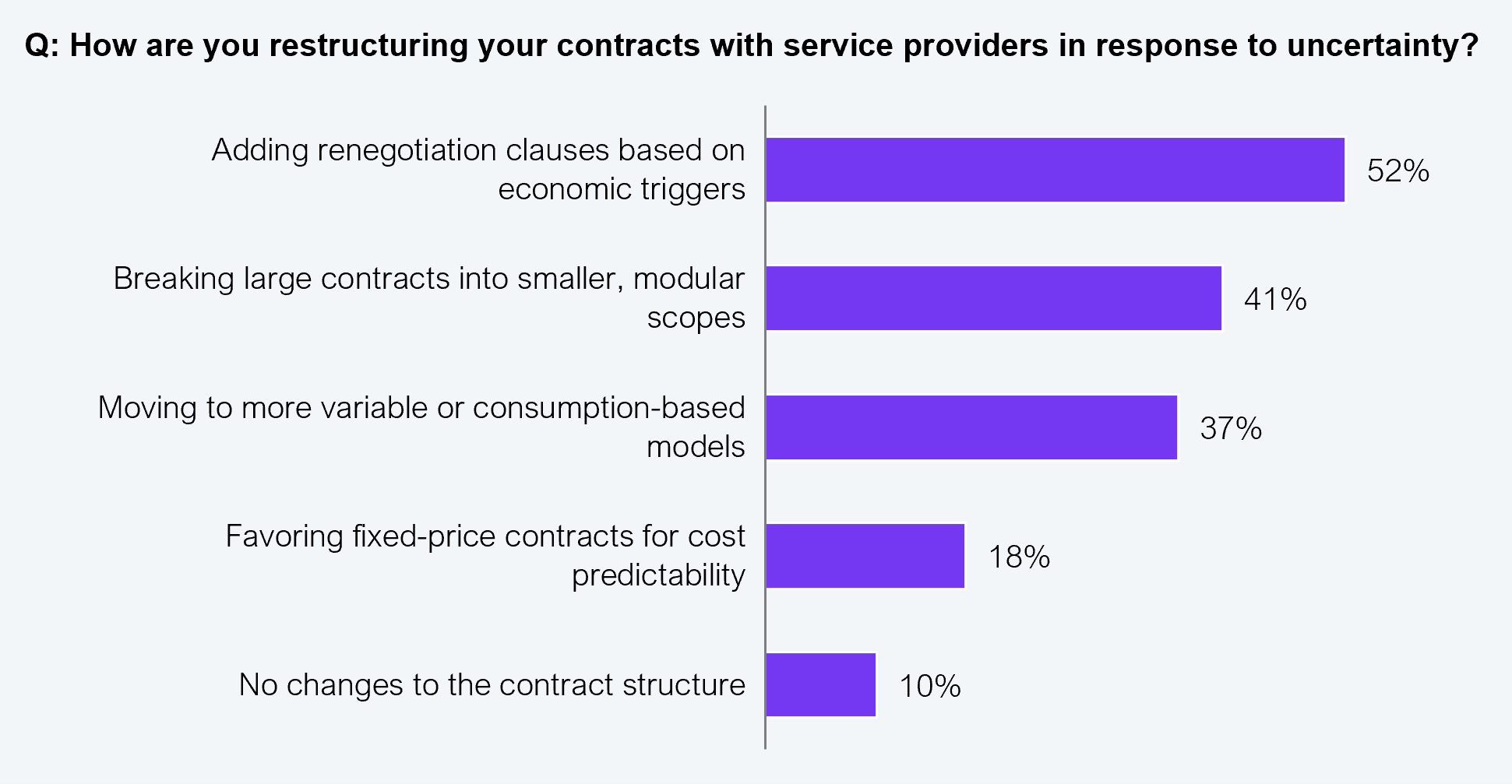
More than half of enterprises (52%) are inserting renegotiation clauses tied to economic or policy triggers. Another 41% are breaking large contracts into smaller, modular scopes, and 37% are shifting to more variable or consumption-based pricing models (see Exhibit 12).
Enterprises are moving from long-cycle partnerships to dynamic agreements that can adapt in real time. The traditional approach—lock in favorable terms and cruising comfortably for three to five years—no longer works when a single policy announcement can shred every assumption overnight.
Sample: 402 US-based senior executives
Source: HFS Research in collaboration with KPMG, 2025
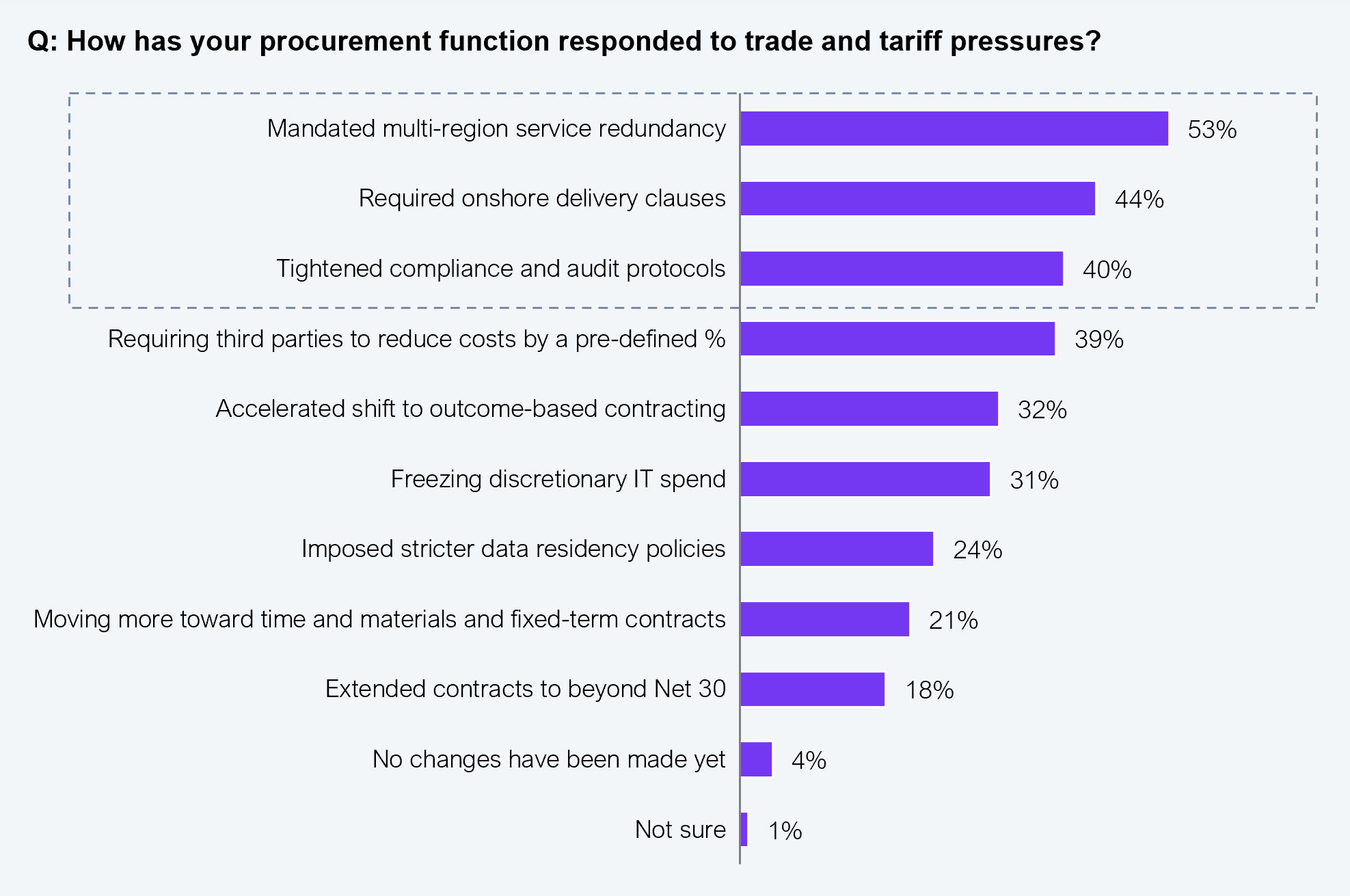
These aren’t incremental moves. They’re structural responses to persistent instability. Procurement teams are translating this mindset into action. Over half (53%) now mandate multi-region service redundancy, 44% require onshore delivery clauses, and 40% have tightened compliance and audit protocols (see Exhibit 13).
These actions show that sourcing is no longer just about cost optimization. It’s a resilience strategy. Procurement has become a strategic shock absorber—anticipating disruption, not just reacting to it.
Sample: 402 US-based senior executives
Source: HFS Research in collaboration with KPMG, 2025
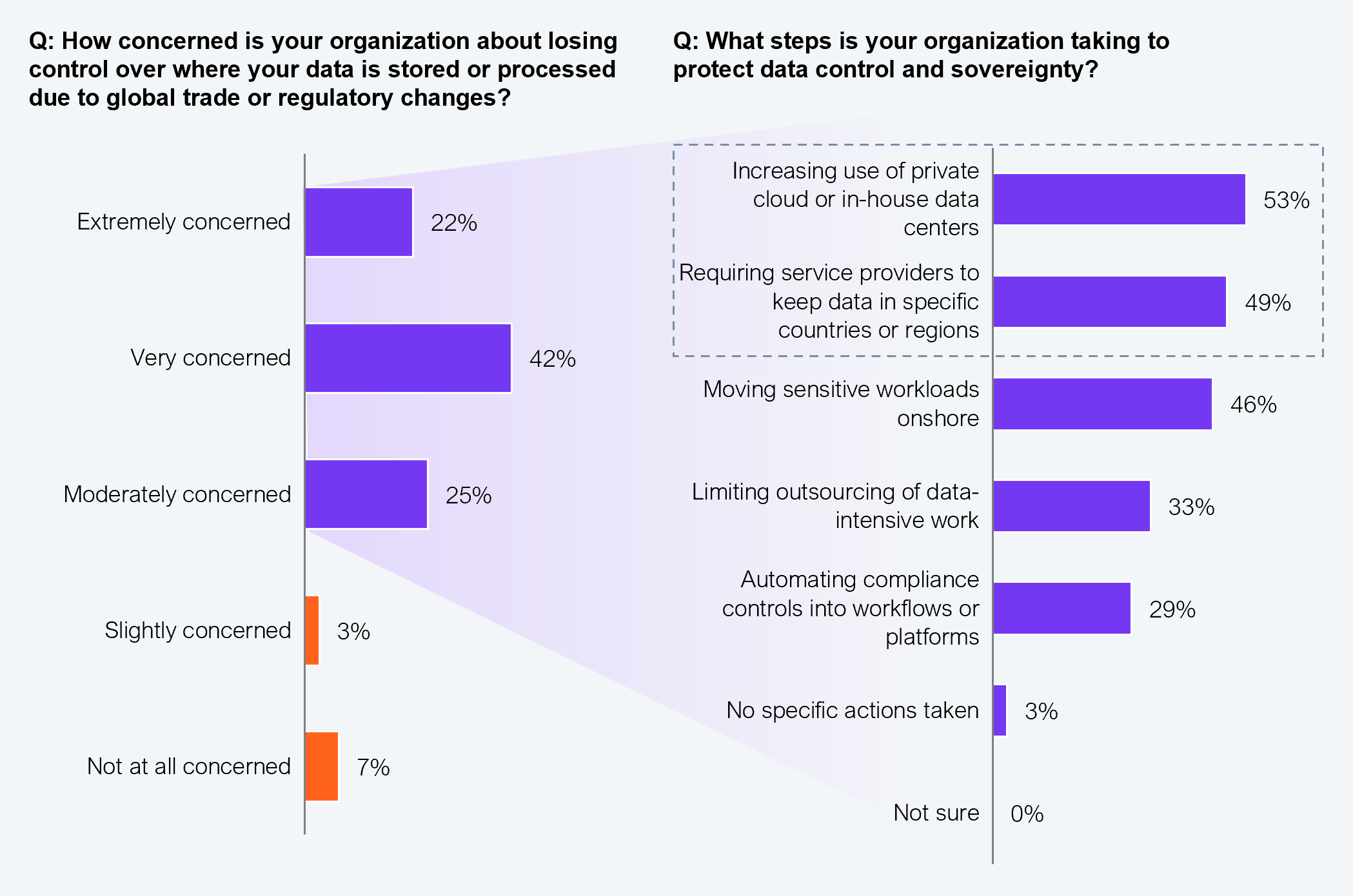
The urgency extends beyond commercial terms to data control. Sixty percent of enterprises are ‘extremely’ and ‘very concerned’ about losing control over where their data is stored or processed due to global trade changes (see Exhibit 14). This isn’t theoretical anxiety; it’s driving concrete contractual changes.
“In today’s disruptive landscape, external pressures such as shifting regulations and rapid tech change are often compounded by inefficient data management and legacy deployments,” said Chris Yeaton, Tax Managed Services Leader, KPMG LLP. “Once you build the infrastructure to treat data as a strategic asset and automate capacity, you can finally shift focus to business enablement and risk management.”
Sample: 402 US-based senior executives
Source: HFS Research in collaboration with KPMG, 2025
As a recap, 53% are increasingly using private cloud or in-house data centers, 49% are turning to service providers to keep data in specific countries or regions, and 46% are moving sensitive workloads onshore entirely. The data sovereignty requirements are becoming non-negotiable, forcing vendors to redesign delivery architectures or risk losing business. The stakes are even higher when paired with cybersecurity concerns, given the growing pressure to secure regulated data across borders while maintaining resilience against rising threats.
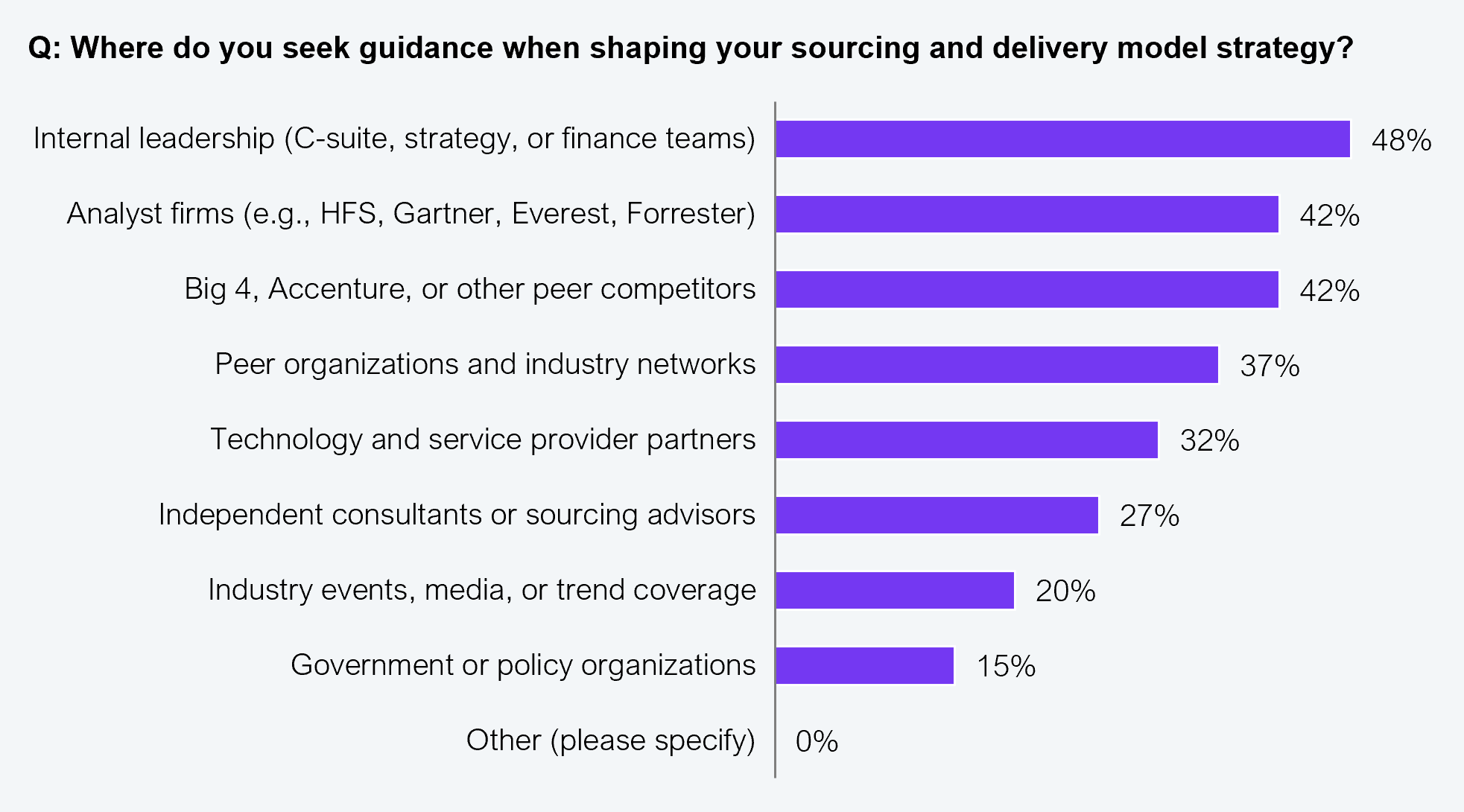
The shift extends to who is driving sourcing decisions. Internal strategy and finance teams are now the top source of guidance (48%), followed by analyst firms (42%) and peer networks. Independent sourcing advisors and traditional consultants are further down the list, while government guidance trails far behind (see Exhibit 15).
Sample: 402 US-based senior executives
Source: HFS Research in collaboration with KPMG, 2025
The procurement function has moved from tactical execution to strategic design. Vendor diversification, geographic hedging, and embedded flexibility are now central to competitive advantage. The question is no longer “can we get this cheaper?” It’s “can we keep this running when everything else breaks?”

The real question isn’t about how we survive this wave. It’s what we would build if we knew disruption wasn’t going away.
Enterprises that will lead the next decade aren’t waiting for stability to return. They’re the 22% using trade chaos to build automation capabilities, platform-based services, and adaptive sourcing strategies, while others hesitate.
What separates them isn’t just speed—it’s mindset and, to some extent, executive commitment and foresight. They’ve moved beyond treating volatility as an aberration and started designing systems that assume constant change. This strategic shift requires five fundamental changes:
What emerges from this is a very different enterprise mindset: agility not for its own sake but as a structural condition. The endgame isn’t stability—it’s fluidity.
Today’s disruption isn’t seasonal—it’s structural. Enterprises poised to succeed aren’t chasing elusive stability; they’re engineering operating models that can flex, absorb, and evolve continuously. The objective isn’t achieving certainty—it’s mastering adaptability. Designing for turbulence, not control, is the only way forward.
Register now for immediate access of HFS' research, data and forward looking trends.
Get Started



If you don't have an account, Register here |
With the exception of our Horizons reports, most of our research is available for free on our website. Sign up for a free account and start realizing the power of insights now.
Our premium subscription gives enterprise clients access to our complete library of proprietary research, direct access to our industry analysts, and other benefits.
Contact us at [email protected] for more information on premium access.

