
For several decades, computer scientists and artificial intelligence (AI) specialists have been studying the behavior of social animals and insects to try and export the benefits of such systems beyond the natural world. Since the 1980s, AI specialists have been developing algorithms modeled on natural swarm behaviors to build AI systems to mimic natural swarm systems’ efficiency and accuracy. The application of such “swarm intelligence” to AI has become known as “swarm AI.” More recently, advances in AI and the rise of digital and online interactions have moved swarm AI algorithms out of the field of academia and into real-world scenarios, where they are already delivering tangible benefits for enterprise users across functions and industries.
In particular, swarm AI is proving itself adept at helping organizations—and individuals—make complex decisions that require tapping into the collective opinion of large groups of people, whose opinion reflects public sentiment or the amalgamated knowledge of specialists. Just one example includes amazon founder Jeff Bezos turning to his Twitter followers to ask how to best invest his money in a worthwhile cause. The overwhelming number of responses was subsequently processed by up and coming player Unanimous AI to cull the group’s collective wisdom. Swarm AI is rapidly being adopted by the healthcare, financial, and market research firms in particular. Organizations within these industries especially should start evaluating swarm AI now or risk falling behind their competitors in a cut-throat marketplace.
Real-world applications of swarm AI technology within enterprises
The use of swarm AI to solve internal or consumer-facing business intelligence issues by making more efficient use of enterprises’ existing resources is growing rapidly. The growing connectivity enabled by social media and other online platforms is further accelerating adoption and use cases. Across multiple industries, swarm AI is proving adept at optimization tasks, routing conundrums, and staff scheduling challenges, to name but a few. Industries pioneering the use of swarm AI include:
Swarm AI leverages the best of the natural world to enable enterprises to make informed decisions efficiently
“Swarm intelligence” (SI), the concept underpinning both natural and artificial swarms, refers to the “collective behavior of decentralized, self-organized systems, natural or artificial,” and it was first used in a computer science context in 1989. Populations that display such behavior are known as SI systems. They consist of multiple independent agents whose local and largely random interactions generate broader “intelligent” behavior patterns that the population as a whole engages in to solve complex problems. Artificial SI systems, in turn, are sets of algorithms programmed to follow SI patterns observed in nature. More commonly, these algorithm sets are known as “swarm AI.”
Despite being small, birds, fish, ants, bees, and bacteria engage in group behaviors that allow them to solve complex challenges such as defending themselves effectively against predators, finding the shortest route between two points, and scouting for and communicating the location of a food source. Individually, these organisms would be unable to solve such complex challenges and achieve optimal outcomes. But, by pooling their resources, they can accomplish what organisms their size otherwise couldn’t. For instance, when bees are scouting for locations to establish a new nest, the hive has to converge on an option together. Hundreds of worker bees are dispatched to scout the territory, and upon return, they perform a dance that communicates their findings to the group. Individual worker bees have to try to influence the rest of the group to follow them to their preferred direction and keep vying against each other until one scout persuades the rest to follow.
Swarm AI is finding the most traction in the form of “middleman” software, for example, a digital platform that organizes scattered networks of individuals into “swarms” through real-time, closed-loop systems. These systems allow individuals to act as a “hive mind” to form predictions and answer queries and polls. In testing, human swarms have repeatedly proven capable of amplifying human knowledge and generating predictions far more accurately than individuals could in sports match outcomes, elections, and entertainment award programs. Enterprises are looking closely at swarm AI because it allows them to mine maximum value from readily available resources—the knowledge, skills, and opinions of employees, customers, and members of the public—quickly and cheaply. There are no leaders or permissions in swarms, meaning decisions don’t have to go through a central authority and that information is easily and rapidly shared. This makes swarm AI decision-making very rapid and transparent. As we shall see, swarm AI offers numerous advantages over other forms of AI and analytics for enterprises interested in more informed decision making at a lower cost.
In particular, swarm AI boasts several characteristics that ought to make it interesting to enterprises wanting to reduce expenditure and improve their quality of service:
The diversity of swarm AI offerings keeps growing—start scouting the market to find one for your company
Thanks at least in part to the years that swarm AI has spent in an academic context and the value it displayed there, the technology has found a comfortable home with enterprise buyers, and demand has kept growing. The market is a large one for specialist companies that can find a niche in it, and several candidates are developing swarm AI solutions tailored specifically to the needs of large enterprises:
Exhibit 1: The Unanimous AI platform in action: processing input data to generate reliable answers
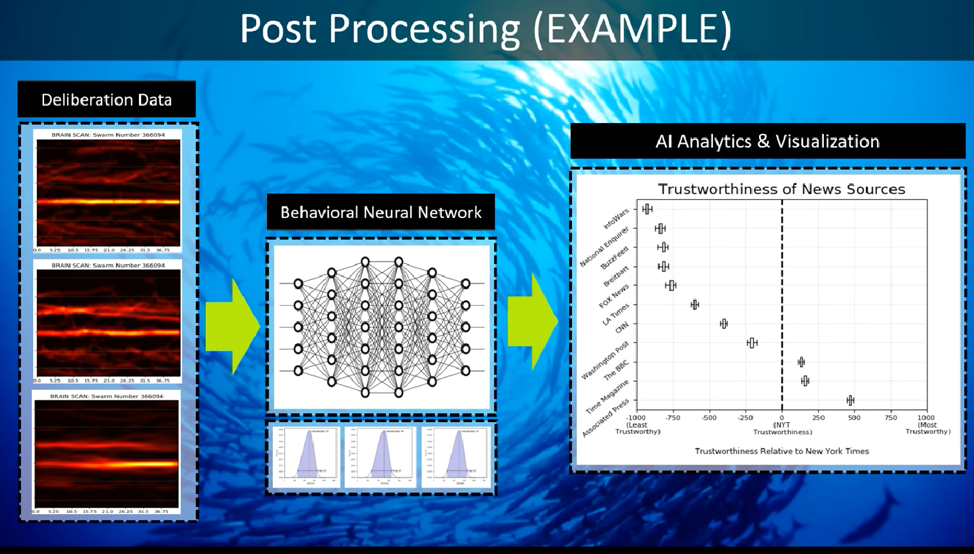
Source: Unanimous AI (screenshot)
Exhibit 2: Convergent AI PatentID swarm AI solution
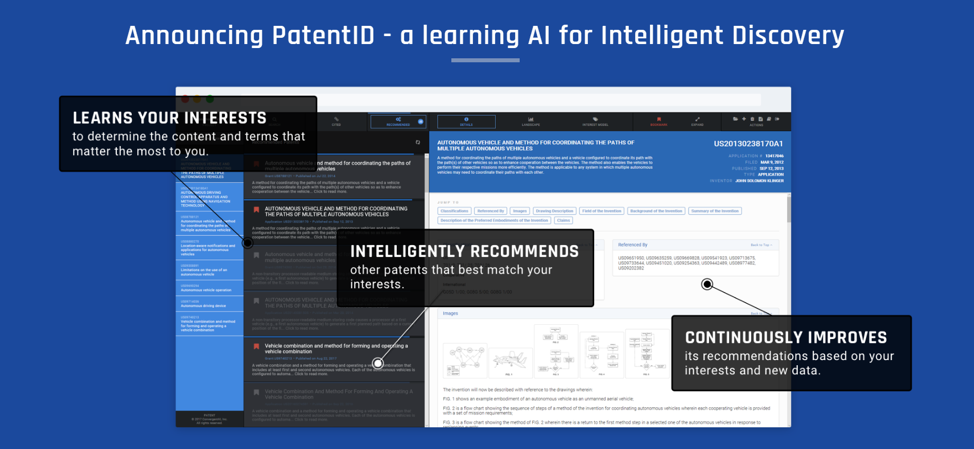
Source: Convergent AI (screenshot)
Exhibit 3: Lexalytics technology features
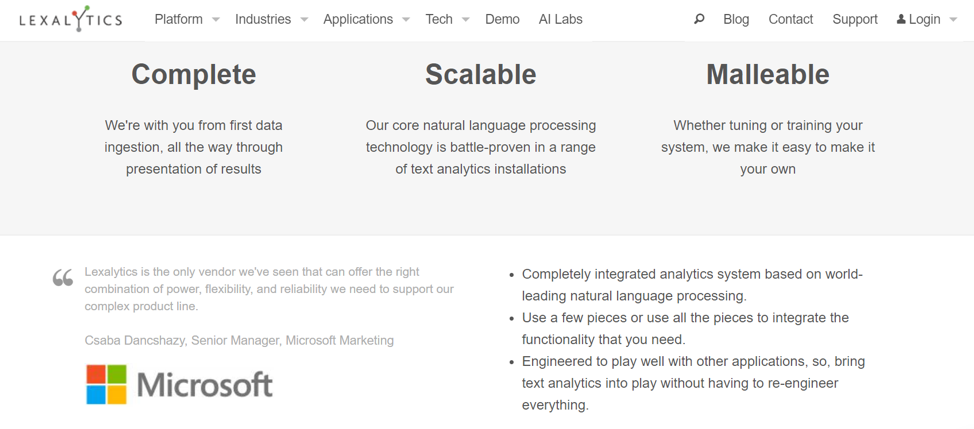
Source: Lexalytics (screenshot)
Risks of and best practices for implementing swarm AI in your enterprise
Despite the benefits such enterprises are already reaping from swarm AI, awareness of the technology’s potential shortcomings and effective techniques for avoiding or at least mitigating them are essential for successful swarm AI projects. Below, we look at some of the major risks and emerging best practices for enterprises interested in or already using swarm AI should have on their radar.
Inevitably, due to the complexity of any form of AI technology, and the even more complex nature of the human beings acting as the input data in swarm AI systems, swarm AI comes with risks and challenges enterprises should be aware of. These include:
However, the good news is that since the risk factors posed by swarm AI are largely to do with human nature, there are some easy steps enterprises can take to mitigate them. Best practices for implementing swarm AI safely include:
Bottom line: Human insight can be turned into an invaluable resource. Start looking at swarm AI to do the job, because your competitors will be.
Human intuition and opinions are becoming an increasingly invaluable data source as the Digital OneOffice model, which prioritizes consumer satisfaction, becomes the standard for all industries. Swarm AI holds immense potential because it can do the heavy lifting in filtering this data. Swarm AI is a perfect example of humans and machines working together and doing what they do best to deliver superior outcomes for enterprise users.
Swarm AI makes quantifying people’s intuition, opinions, beliefs, and convictions a reality, organizing an otherwise subjective and ephemeral form of information into a usable format, enabling enterprises to gauge what consumers, the public, and their employees are really thinking. Make no mistake—your competitors will be looking closely at swarm AI. Don’t get stung—be a busy bee and start doing your swarm AI research.
Register now for immediate access of HFS' research, data and forward looking trends.
Get StartedIf you don't have an account, Register here |
With the exception of our Horizons reports, most of our research is available for free on our website. Sign up for a free account and start realizing the power of insights now.
Our premium subscription gives enterprise clients access to our complete library of proprietary research, direct access to our industry analysts, and other benefits.
Contact us at [email protected] for more information on premium access.

